Blog

  • Navigating OPWDD Services: A Guide to Home Care in Brooklyn & the Bronx

    Navigating OPWDD Services: A Guide to Home Care in Brooklyn & the Bronx

    πŸ‘€

    Medically Reviewed By: David Zhorzholiani. MSN

    Chief Operating Officer | Advantage Home Care


    Navigating OPWDD Services: A Guide to Home Care in Brooklyn & the Bronx

    Securing home care for a family member with a developmental disability can feel like navigating a maze. In New York State, the Office for People With Developmental Disabilities (OPWDD) provides vital support, but the application processβ€”known as the “Front Door”β€”requires patience and preparation.

    OPWDD services are a crucial lifeline in our communities. Currently, over 130,000 New Yorkers receive support through OPWDD. Nationwide data shows that developmental disability support systems serve a diverse population, with service recipients identifying as approximately 60% White, 19% Black or African American, 14% Hispanic or Latino, and 3% Asian. At Advantage Home Care, our goal is to ensure families across all demographics in the Bronx, Brooklyn, and greater NYC have equitable, fast access to the personal care aides they deserve.

    1. Understanding the OPWDD “Front Door” Process

    Before Advantage Home Care can step in to provide a compassionate Personal Care Aide (PCA), the individual must be deemed eligible by the state. The “Front Door” is the official entry point for all OPWDD services.

    • Determine Eligibility: The applicant must have a qualifying developmental disability (such as autism, cerebral palsy, or Down syndrome) diagnosed before age 22.
    • Attend a Front Door Information Session: These are mandatory sessions hosted by the state that explain the scope of available services.
    • Assessment and Authorization: A Care Delivery Organization (CCO) will help you create a Life Plan, which dictates the specific level of home and community-based support approved.
    1 Attend Front Door Session
    βž”
    2 Submit Medical Docs
    βž”
    3 CCO Creates Life Plan
    βž”
    4 Match with PCA Agency

    Get Approved for Medicaid Home Care Fast & Easy

    We help NYC families navigate the Medicaid and OPWDD home care processes with confidence. Our team assists with eligibility, paperwork, and connecting you with compassionate caregivers so your loved ones can thrive at home.

    • βœ“ Medicaid Accepted
    • βœ“ Fast Approval Assistance
    • βœ“ Experienced, Compassionate Caregivers
    • βœ“ Serving All 5 Boroughs of NYC

    Check Your Eligibility

    It only takes 30 seconds.

      2. Gathering Your Eligibility Documents

      Delays in OPWDD approval are almost always due to missing paperwork. To ensure your application moves quickly, gather the following documents before your first meeting with a Care Coordination Organization (CCO):

      The OPWDD Document Checklist

      • Psychological Evaluation: Must include an IQ test and an assessment of adaptive behavior, typically conducted within the last three years.
      • Medical Specialty Reports: Recent reports from neurologists, psychiatrists, or developmental pediatricians detailing the diagnosis.
      • Social/Developmental History: A comprehensive psychosocial report outlining the individual’s history and current needs.
      • IEP (If applicable): For applicants currently in the school system, an Individualized Education Program provides proof of long-term support needs.

      Transitioning to Advantage Home Care

      Once OPWDD eligibility is confirmed and Medicaid is in place, you have the right to choose your home care provider. Whether you reside in the Bronx, Brooklyn, or anywhere in NYC, Advantage Home Care specializes in pairing individuals with highly trained Personal Care Aides who understand the nuances of developmental disabilities.

      Published: June 18, 2026 | Category: OPWDD & Specialized Care

      Disclaimer: This guide is intended for informational purposes to aid families in navigating community and state resources. It does not replace official OPWDD guidance or professional clinical assessments.

    • Centerlight PACE vs. Traditional MLTC: Selecting Your NYC Home Care Infrastructure

      Centerlight PACE vs. Traditional MLTC: Selecting Your NYC Home Care Infrastructure

      Centerlight PACE vs. Traditional MLTC: Selecting Your NYC Home Care Infrastructure

      πŸ‘€

      Medically Reviewed By: David Zhorzholiani. MSN

      Chief Operating Officer | Advantage Home Care


      Structuring long-term care for a relative in New York requires careful planning. First, you must evaluate distinct insurance management models. Specifically, you will likely encounter two primary frameworks. You can choose a Program of All-Inclusive Care for the Elderly (PACE), like Centerlight. Alternatively, you can select a traditional Managed Long-Term Care (MLTC) plan.

      Both programs help dual-eligible individuals stay safely inside their homes. You can learn more about Medicaid and Medicare eligibility online. However, their operational structures and doctor restrictions differ significantly. Caregiver networks also vary between the two. Understanding these distinct insurance management models is essential. Ultimately, it helps you pick a framework that fits your family’s routines.

      1. Distinct Insurance Management Models: The PACE Framework

      A PACE program acts as an all-in-one insurer and provider network. When a senior enrolls, the program takes complete control. Specifically, it manages their Medicare and Medicaid benefits entirely.

      • The Hub Concept: PACE programs frequently utilize physical adult day centers. Transport services bring enrollees to these centers directly. Here, they receive medical checkups, physical therapy, and communal meals.
      • The Provider Network: A PACE plan requires the senior to switch providers. Therefore, they must use doctors and specialists contracted within that specific network.

      2. Distinct Insurance Management Models: The MLTC Approach

      A traditional Managed Long-Term Care (MLTC) plan works differently. It manages only the long-term community care portion of insurance. For example, it allocates daily Home Health Aide hours.

      • Keep Your Regular Doctors: Your Medicare remains entirely separate. Therefore, your loved one can keep their longtime primary care physician. They also keep their existing cardiologists and specialists.
      • Agency Choice: The MLTC plan authorizes specific weekly care hours. The family then selects a trusted Licensed Home Care Services Agency. Finally, the agency recruits, vets, and sends the caregiver to you.

      Traditional MLTC Model

      • Medicare remains completely independent
      • Keep your existing local doctors and specialists
      • Choose your preferred LHCSA personal aide

      Integrated PACE Model

      • Medicare and Medicaid merge into one plan
      • Must utilize network clinic physicians and staff
      • Care and socialization center around Day Centers

      Get Approved for Medicaid Home Care Fast & Easy

      We help NYC families navigate the Medicaid home care process with confidence. Our team assists with eligibility, paperwork, and connecting you with compassionate caregivers. Consequently, you receive high-quality care at home.

      • βœ“ Medicaid Accepted
      • βœ“ Fast Approval Assistance
      • βœ“ Experienced, Compassionate Caregivers
      • βœ“ Serving All 5 Boroughs of NYC

      Check Your Eligibility

      It only takes 30 seconds.

        How to Choose the Optimal Path for Your Family

        The choice often comes down to independence versus centralization. Your relative might value their relationship with existing doctors. Furthermore, they might want a dedicated caregiver in their home. Therefore, a traditional MLTC paired with a local agency is often ideal.

        You might be evaluating your plan choices right now. Alternatively, you might want to coordinate a case transfer. Understanding these distinct insurance management models saves weeks of delays. Ultimately, it simplifies administrative pathways completely.

        Published: May 31, 2026 | Category: Managed Care Comparisons

        Disclaimer: Plan structures, network statuses, and state health insurance rules evolve constantly. This guide provides an objective educational comparison of New York care options. Always check directly with your chosen insurance company before initiating enrollment changes.

      • How to Qualify for Medicaid Home Care in NYC (2026 Guide)

        How to Qualify for Medicaid Home Care in NYC (2026 Guide)

        How to Qualify for Medicaid Home Care in NYC (2026 Guide)

        πŸ‘€

        Medically Reviewed By: David Zhorzholiani. MSN

        Chief Operating Officer | Advantage Home Care


        Medicaid home care helps thousands of NYC seniors and individuals receive quality care in the comfort of their homes. However, many families are confused about the qualification process, income requirements, and application steps.

        In this 2026 guide, we’ll explain who qualifies for Medicaid home care in New York City, what documents are needed, and how families can start the process faster and avoid common mistakes.

        What Is Medicaid Home Care?

        Medicaid home care is a New York State program that allows eligible seniors and individuals with health conditions to receive care services in their own homes instead of moving into a nursing facility.

        Services may include personal care assistance, home health aides, meal preparation, mobility support, medication reminders, and companionship. The goal is to help individuals remain safe, independent, and comfortable while receiving the care they need.

        Who Qualifies for Medicaid Home Care in NYC?

        To qualify for Medicaid home care in NYC, individuals generally must meet both medical and financial eligibility requirements. Typical qualifications include:

        • Being a New York resident
        • Having Medicaid coverage or qualifying for Medicaid
        • Requiring assistance with Activities of Daily Living (ADLs)
        • Having a medical condition that limits independence or mobility

        Daily living activities may include bathing, dressing, walking, meal preparation, medication reminders, and personal hygiene assistance. Eligibility requirements can vary depending on the type of Medicaid program and the level of care needed.

        Income Requirements for Medicaid Home Care

        Medicaid income limits in New York change each year, and qualification depends on several financial factors including income, assets, marital status, and household size. For 2026, New York continues to enforce specific baseline resource metrics for community-based long-term care.

        Some individuals who believe they earn too much may still qualify through Medicaid planning programs or spend-down options, such as utilizing a Pooled Income Trust to shield excess monthly income.

        Because Medicaid eligibility rules are complex, many NYC families choose to speak with a home care agency or Medicaid specialist to better understand their options before applying.

        Get Approved for Medicaid Home Care Fast & Easy

        We help NYC families navigate the Medicaid home care process with confidence. Our team assists with eligibility, paperwork, and connecting you with compassionate caregivers so you can receive quality care at home.

        • βœ“ Medicaid Accepted
        • βœ“ Fast Approval Assistance
        • βœ“ Experienced, Compassionate Caregivers
        • βœ“ Serving All 5 Boroughs of NYC

        Check Your Eligibility

        It only takes 30 seconds.

          Documents Needed to Apply

          Families applying for Medicaid home care in NYC are often asked to provide a variety of verifying paperwork. Having these documents prepared in advance can significantly speed up the approval process and reduce delays:

          • Proof of identity: Driver’s license, passport, or state ID.
          • Insurance cards: Active Medicaid card, Medicare card, or private insurance details.
          • Financial records: Bank statements, asset balances, and verification of any existing property.
          • Proof of income: Social Security award letters, pension statements, or pay stubs.
          • Medical records: Documentation from a primary care physician outlining medical diagnoses and functional limitations.
          • Social Security information: Copy of the applicant’s Social Security card.
          • Proof of New York residency: Utility bills, lease agreements, or official mail.

          How Long Does Approval Take?

          Approval times for Medicaid home care in NYC can vary depending on the application pipeline, complete documentation submission, and the immediate urgency of care needs. Some families may receive services within a few weeks, while more complex financial or clinical cases can take longer.

          Working with an experienced home care agency can often help simplify the process, cut through bureaucratic paperwork, and drastically reduce administrative onboarding wait times.

          How Advantage Home Care Can Help

          Advantage Home Care helps NYC families understand the Medicaid home care process and guides them through each step of qualification and enrollment. Our support model covers:

          • Comprehensive Medicaid guidance and assessment prep
          • Hands-on application and administrative assistance
          • Personalized caregiver matching based on language, culture, and care needs
          • Faster onboarding support through local health channels
          • Ongoing communication and dedicated family care portals

          Get Help Qualifying for Medicaid Home Care

          If you or a loved one may qualify for Medicaid home care in NYC, our team can help you understand your options and begin the process with confidence. Compassionate home care services are designed to help NYC families feel supported, safe, and cared for right where they belong.

          Contact Advantage Home Care today to speak with our enrollment team and learn exactly how to get started on your terms.

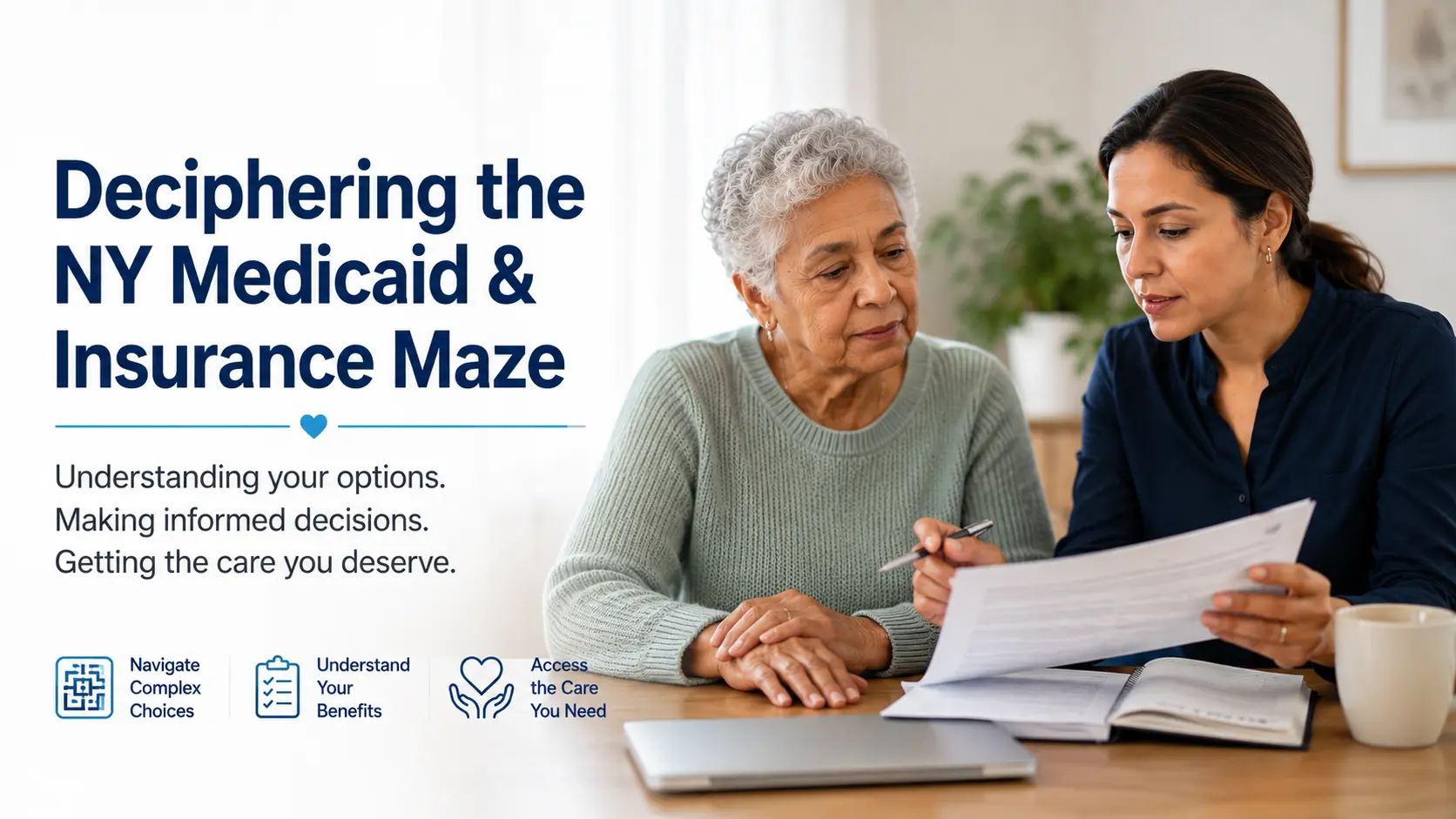
        • Deciphering the NY Medicaid & Insurance Maze

          Deciphering the NY Medicaid & Insurance Maze

          Deciphering the NY Medicaid & Insurance Maze

          πŸ‘€

          Medically Reviewed By: David Zhorzholiani. MSN

          Chief Operating Officer | Advantage Home Care


          When an elderly or disabled loved one requires full-time or part-time care at home, funding that care becomes a primary concern. Private-pay options can quickly exhaust family savings. Fortunately, New York State offers some of the most comprehensive Medicaid-funded long-term home care programs in the country.

          However, navigating the maze of acronymsβ€”such as MLTC, NHTD, and OPWDDβ€”can feel like learning a completely different language. This guide simplifies NY Medicaid home care eligibility and details the waiver programs available to keep your relative safe in their own community.

          1. Understanding NY Medicaid Home Care Eligibility

          To qualify for government-funded personal care services through a Licensed Home Care Services Agency (LHCSA) in New York, an applicant must meet both medical and financial criteria.

          Financial Eligibility Thresholds

          New York Medicaid evaluates an individual’s monthly income and total liquid assets. For individuals whose income exceeds the strict Medicaid limits, New York allows a specialized financial strategy known as a Pooled Income Trust. This legal framework allows applicants to deposit their “excess” income into a trust to pay for non-medical living expenses (like rent or utilities) while still qualifying for full Medicaid home care benefits.

          Medical Eligibility & The Independent Assessment

          An applicant must demonstrate a functional need for assistance with Activities of Daily Living (ADLs), such as transferring, toileting, eating, or dressing. New York utilizes the New York Independent Assessor (NYIA) system to conduct an independent clinical evaluation to verify how many hours of care are medically necessary.

          Acronym Full Program Name Target Demographic Key Benefit
          MLTC Managed Long-Term Care Adults 21+ with Medicaid who need long-term care Coordinates daily home health aide (HHA) or personal care aide (PCA) hours through insurance networks
          NHTD Nursing Home Transition & Diversion Individuals age 18-64 with physical disabilities, or seniors 65+ Provides specialized waivers to keep individuals out of nursing homes
          OPWDD Office for People With Developmental Disabilities Individuals of all ages with verified developmental disabilities Offers specialized residential, habilitation, and personal care support

          Get Approved for Medicaid Home Care Fast & Easy

          We help NYC families navigate the Medicaid home care process with confidence. Our team assists with eligibility, paperwork, and connecting you with compassionate caregivers so you can receive quality care at home.

          • βœ“ Medicaid Accepted
          • βœ“ Fast Approval Assistance
          • βœ“ Experienced, Compassionate Caregivers
          • βœ“ Serving All 5 Boroughs of NYC

          Check Your Eligibility

          It only takes 30 seconds.

          πŸ‘€
          πŸ“ž
          βœ‰οΈ
          πŸ“‹

          2. The Power of the NHTD Waiver Program in Brooklyn

          The Nursing Home Transition and Diversion (NHTD) waiver program is a highly specialized New York State initiative. It is specifically designed for individuals who technically qualify for a nursing home level of care but prefer to live independently at home with advanced community support.

          Following the NHTD waiver program guidelines in Brooklyn, qualifying individuals receive comprehensive case management backed by dedicated care coordination and family support, structured day programs, environmental modifications (like wheelchair ramps), and extended hours from a certified home health aide or personal care aide. This program serves as a vital tool for families fighting to preserve the dignity, independence, and safety of an aging parent within their local neighborhood.

          How to Begin the Enrollment Process Without the Stress

          The road to securing Medicaid home care benefits is complex, but you do not have to walk it alone. Securing approvals requires precise coordination between financial documentation, medical assessments, and insurance enrollment. Our enrollment experts manage the heavy lifting so your family can focus on what matters mostβ€”wellness and peace of mind.

          Published: May 31, 2026 | Category: Medicaid & Waiver Enrollment

          Disclaimer: Medicaid rules and financial asset limits are subject to change. This guide provides an educational overview of New York State programs and does not constitute formal legal or financial advice.

        • Hospital Discharge Home Care Checklist NYC: The Step-by-Step Guide for Families

          Hospital Discharge Home Care Checklist NYC: The Step-by-Step Guide for Families

          Hospital Discharge Home Care Checklist NYC: The Step-by-Step Guide for Families

          πŸ‘€

          Medically Reviewed By: David Zhorzholiani. MSN

          Chief Operating Officer | Advantage Home Care

          Discovering that a New York City hospital is discharging a parent or elderly relative can be incredibly overwhelming. Often, hospital social workers or discharge planners provide only a 24-to-48-hour notice before they release a patient. Consequently, if your loved one still requires assistance with daily activities, navigating this sudden transition becomes a race against time.

          Therefore, to prevent an unsafe discharge or an unnecessary re-hospitalization, families must act quickly. You must coordinate professional home care immediately. Fortunately, we designed this step-by-step checklist specifically for NYC families navigating a sudden discharge. Ultimately, it ensures you meet all clinical and safety needs before arrival.

          1. Questions to Ask the Hospital Discharge Planner Immediately

          First, before your relative leaves the facility (whether it is Maimonides, Mount Sinai, NYU Langone, or NewYork-Presbyterian), you need to speak directly with their assigned case manager or social worker. Specifically, ask the following questions immediately:

          • What level of care do the doctors recommend? For example, do they require a Certified Home Health Aide (CHHA) for clinical nursing needs? Alternatively, do they need a Personal Care Aide (PCA) for help with bathing, dressing, and meal preparation?
          • Has the staff completed a Patient Review Instrument (PRI)? Importantly, New York State requires this mandatory medical assessment. It determines the level of clinical care a patient needs before they transition to home care or a community setting.
          • Does their current insurance or New York Medicaid cover the home care services?
          1 Request PRI Form from Social Worker
          βž”
          2 Identify LHCSA Agency (Advantage)
          βž”
          3 Coordinate Medicaid / MLTC Intake
          βž”
          4 Transition Safely Home with Aide

          Get Approved for Medicaid Home Care Fast & Easy

          We help NYC families navigate the Medicaid home care process with confidence. Our team assists with eligibility, paperwork, and connecting you with compassionate caregivers so you can receive quality care at home.

          • βœ“ Medicaid Accepted
          • βœ“ Fast Approval Assistance
          • βœ“ Experienced, Compassionate Caregivers
          • βœ“ Serving All 5 Boroughs of NYC

          Check Your Eligibility

          It only takes 30 seconds.


            2. Secure Your Home Care Intake Verification

            Next, in New York State, a Certified Home Health Agency (CHHA) typically manages short-term clinical care directly following a surgery. However, long-term, ongoing personal care requires a Licensed Home Care Services Agency (LHCSA).

            Furthermore, establishing authorization through a Managed Long-Term Care (MLTC) plan or Medicaid can take time. Consequently, you should select an agency that understands how to fast-track the intake process.

            The Essential Post-Hospital Safety Checklist

            Therefore, ensure you verify the following elements at least 24 hours prior to discharge:

            • DME Delivery: Has the supplier delivered the medical equipment (wheelchair, walker, hospital bed, oxygen) directly to the home?
            • Medication Reconciliation: Do you have a clear, updated list of new prescriptions? Has a local pharmacy verified they have these medications in stock?
            • Aide Schedule Set: Did you schedule the PCA or HHA to be at the home the exact hour the non-emergency medical transport vehicle arrives?

            How to Fast-Track Home Care Placement in Brooklyn and NYC

            At Advantage Home Care, our specialized clinical intake coordinators work directly with NYC hospital social workers. We actively review PRI assessments, clear insurance hurdles, and place qualified, compassionate caregivers in the home immediately upon discharge. We can also assist with transitioning individuals needing specialized support through OPWDD services or the NHTD/TBI waiver program.

            Published: May 31, 2026 | Category: Hospital Discharge Guides

            Disclaimer: We provide this checklist for informational and educational purposes to aid families in navigating community resources. It does not replace professional clinical assessments or official hospital discharge instructions.