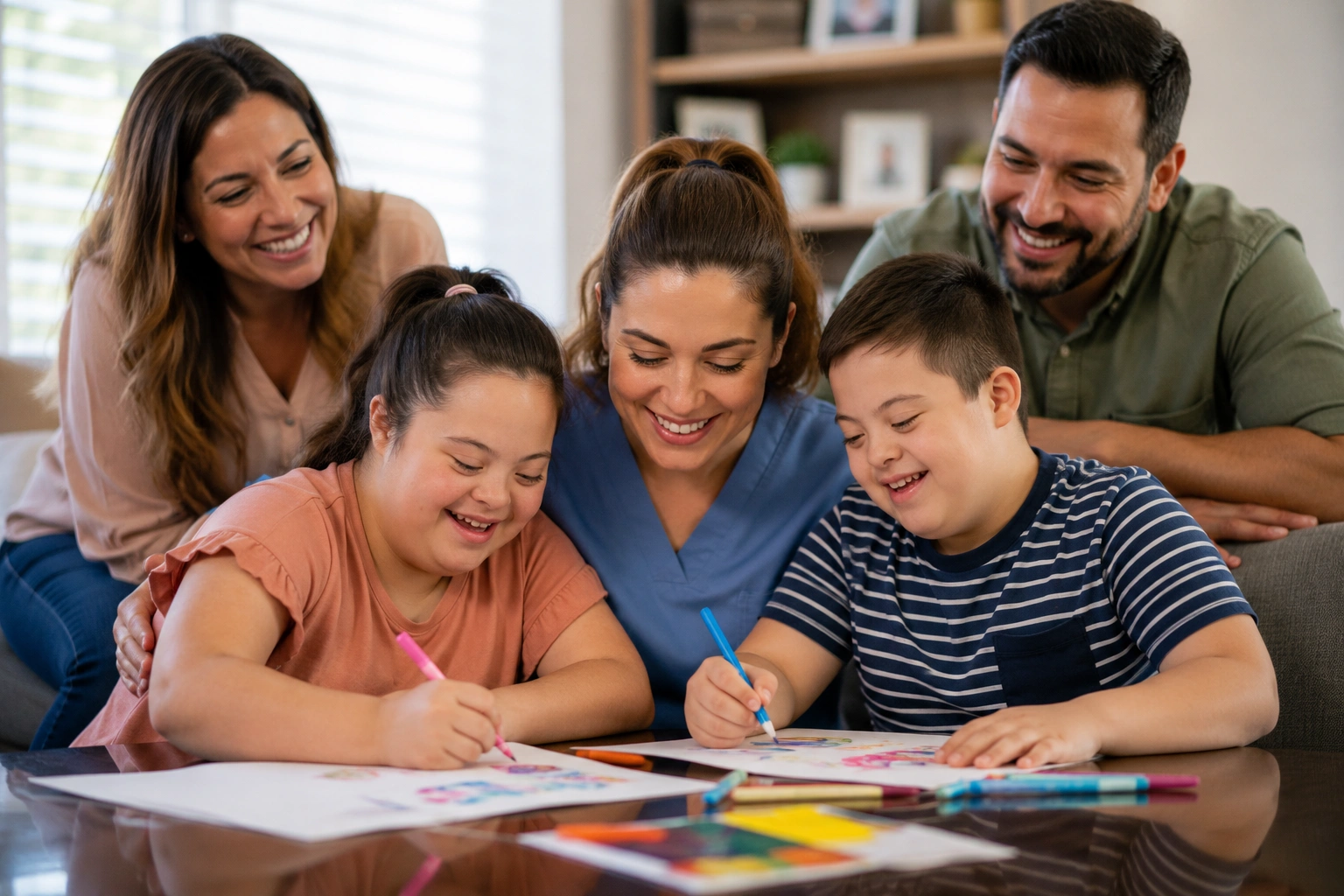
Children Who May Qualify for OPWDD Home Care
Children diagnosed with one or more of the following conditions may qualify for specialized network coverage options:
Advantage Home Care is licensed by the New York State Department of Health to offer home health care services in the Bronx, Brooklyn, Manhattan, Queens, Staten Island, plus Westchester.
What OPWDD Stands For
OPWDD is the New York State Office for People With Developmental Disabilities. It is the state agency that funds and oversees supports for New Yorkers with developmental disabilities — autism, cerebral palsy, intellectual disability, epilepsy, Down syndrome and a long list of genetic conditions. It is not an insurer and not a care provider: OPWDD determines eligibility and funds the services, and agencies like Advantage Home Care deliver them in your home and community.
To be eligible in New York, a developmental disability generally has to have originated before age 22, be expected to continue indefinitely, and cause a substantial limitation in everyday functioning. That is why an adult can be found eligible today for a condition that has been present since childhood.
The OPWDD Services We Provide
Four of the services OPWDD funds are ones we deliver directly. Each has its own guide:
- In-home support. A trained aide in the home with help for daily living, personal care, safety and routine — the service most families start with.
- Community habilitation. Skill-building out in the community rather than at home: travel training, shopping, social skills, using public transport and building independence step by step.
- Day habilitation. A structured daytime programme built around goals in the Life Plan, with activities, community outings and support workers.
- Respite. Short-term cover so the family caregiver gets a genuine break. Funded directly by OPWDD, unlike most respite in New York.
Who Qualifies: Children and Adults
OPWDD supports people across the whole lifespan, not only children. We work with families whose child has just received a diagnosis, with adults living at home with ageing parents, and with people moving toward more independence in their twenties and thirties.
We have written a plain-language guide for each qualifying diagnosis we support — autism, cerebral palsy, Down syndrome, intellectual disability, epilepsy, Prader-Willi, Fragile X, Angelman, spina bifida, Rett, Williams and a dozen rarer genetic syndromes. They are all indexed on our OPWDD conditions and services hub.
How to Get OPWDD Services: The Front Door
Every OPWDD service in New York starts at the same place, and families routinely lose months not knowing this.
- Contact your regional Front Door office. The Front Door is OPWDD’s intake process. You attend an information session, then begin the eligibility packet.
- Gather documentation. Psychological and adaptive-functioning evaluations, medical records and school records. This is the step that stalls most applications — the evaluations have to show onset before age 22 and current substantial limitation. See where to get an OPWDD evaluation.
- Eligibility determination. OPWDD reviews the packet and issues a decision. Our full walkthrough is in OPWDD eligibility in New York.
- Choose a Care Coordination Organization. Once eligible, a CCO care manager builds the Life Plan — the document that authorises which services you actually receive and how much.
- Pick your providers. This is where you choose an agency. Call us and we will tell you what we can staff and how soon.
Self-Direction and the Life Plan
Two pieces of OPWDD vocabulary decide what your family actually receives. The Life Plan is written with your CCO care manager and reviewed at least annually; if a service is not in the Life Plan, it is not funded, so the annual review is the moment to ask for more. Self-Direction is the alternative route: instead of an agency arranging everything, the family manages an individualised budget and can hire staff directly, often including a relative. It gives more control and more administration — plenty of families run a mix, with self-directed hours alongside agency-delivered community habilitation.
Where We Provide OPWDD Services
All five boroughs, coordinated from our Brooklyn headquarters in Sheepshead Bay and our Bronx office on East 149th Street. Families in Brooklyn, the Bronx, Queens, Manhattan and Staten Island all work with the same coordinators. We match caregivers by language wherever we can.
OPWDD Services: Common Questions
What does OPWDD stand for?
The New York State Office for People With Developmental Disabilities. It funds and oversees supports for New Yorkers with developmental disabilities; provider agencies deliver the actual services.
What are OPWDD services?
The main ones families use at home are in-home support, community habilitation, day habilitation and respite. OPWDD also funds supported employment, residential options and family support services. Which ones you receive is set in your Life Plan.
Who is eligible for OPWDD in New York?
Broadly, someone with a developmental disability that began before age 22, is expected to continue indefinitely, and substantially limits everyday functioning. Qualifying conditions include autism, cerebral palsy, intellectual disability, epilepsy, Down syndrome and many genetic syndromes.
How do I apply for OPWDD services?
Through the Front Door, OPWDD’s intake process: an information session, then an eligibility packet with psychological, adaptive-functioning and medical documentation. After a determination you choose a Care Coordination Organization, which writes your Life Plan.
Does OPWDD cover adults, or only children?
Both. Eligibility depends on the disability having originated before age 22, not on current age. Many of the adults we support were found eligible well into adulthood.
What is OPWDD Self-Direction?
An option where the family manages an individualised budget and hires and schedules staff directly, rather than an agency arranging everything. It offers more control in exchange for more administrative work, and can often be combined with agency-delivered services.
Can a family member be paid to provide OPWDD services?
Often yes. Under OPWDD, a relative who is not a legally responsible parent or spouse can frequently be hired and paid, particularly for respite and under Self-Direction. The rules depend on the service, so ask about your specific situation.
How long does the OPWDD process take?
Longer than families expect, and almost always because of the documentation step rather than the review. Getting the evaluations organised early is the single biggest thing you can do to shorten it. Private-pay home care can bridge the gap while an application is in progress.
Talk to Us About OPWDD Support
Whether you are at the very start of the Front Door process or already hold a Life Plan and need a provider, one call tells you what we can staff and how soon.
OPWDD Support Services: Quick Answers
What is the difference between this page and your OPWDD services page?
This page describes the in-home support and respite we staff for people already receiving OPWDD services. For eligibility, the full list of conditions we support and how OPWDD funds home care for developmental disabilities, see OPWDD services in NYC: home care for developmental disabilities and the OPWDD conditions guide.
Can OPWDD in-home support and Medicaid aide hours run at the same time?
Yes. Community habilitation or respite (OPWDD) and personal care hours (Medicaid) are authorized separately and often overlap in the same household; we staff both so the family deals with one agency. Call 718-375-2707.