
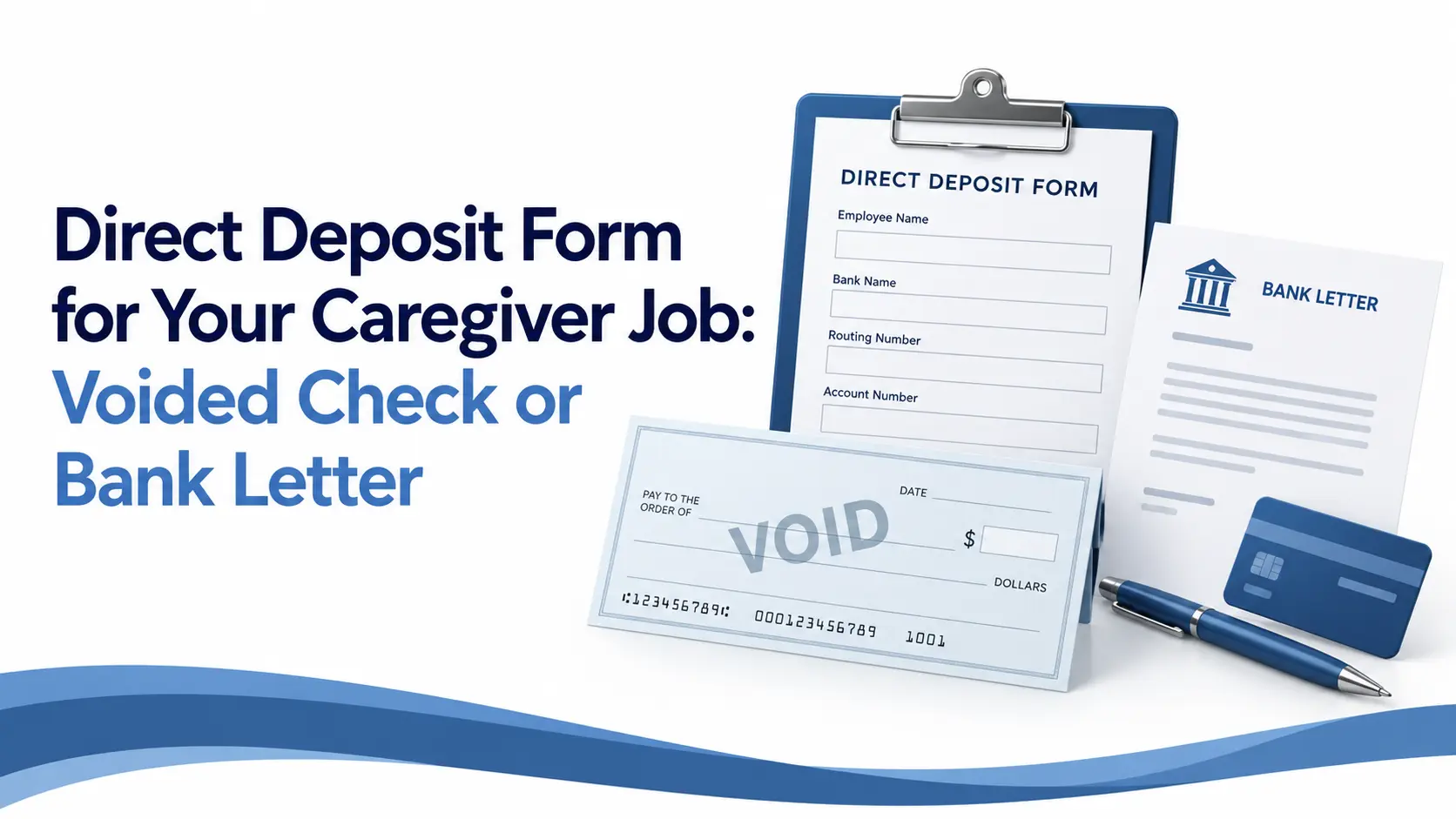
Direct Deposit Form for Your Caregiver Job: Voided Check or Bank Letter
The easiest document on the list, and the one that most often delays a first paycheck. Here is exactly what payroll needs and how to get it from any bank, including online banks and pay cards.
Payroll needs three things to pay you by direct deposit: your bank’s routing number, your account number, and proof they belong to you. A voided check does all three. So does a bank letter or a direct-deposit form printed from your bank’s app or website with your name on it. Upload it in the Caregiver Portal with the rest of your documents. No bank account? See the options below; do not let this be the reason your first pay is late.
Why It Matters More Than It Looks
Home care aides are paid on a regular payroll cycle, and in New York, wages for home care workers are set and tracked under state rules, so payroll runs on a fixed schedule with fixed cutoffs. If your deposit information is missing or has a typo when the first cycle closes, you wait for the next one. Sending a clear document once, before your first shift, is the whole task.
What Payroll Accepts
Write VOID across a blank check from your checkbook; photograph it flat with the routing and account numbers readable at the bottom.
Most banks provide a “direct deposit authorization” or “account verification letter” in the app or online banking, with your name, routing and account number.
Chime, Cash App, PayPal and similar accounts have routing and account numbers in the app; download the direct-deposit form they provide.
A debit card photo (card numbers are not account numbers), a deposit slip without your name, or a screenshot with the numbers cut off.
No Bank Account Yet?
- Open one before your first shift. Many banks and credit unions in Brooklyn, the Bronx and Queens offer basic checking with no minimum balance; New York’s low-cost “basic banking” accounts exist at most banks by law. Bring your ID and Social Security card.
- Online accounts can be opened in minutes from your phone and provide direct-deposit details immediately.
- Ask HR about a pay card if the agency offers one; some do, for caregivers without an account.
Checking Your Numbers
The routing number is nine digits and identifies the bank; the account number identifies you and is usually 8 to 12 digits. On a check, the routing number is first, then the account number, then the check number. Double-check the account number against your app before uploading; a single wrong digit sends money back to the bank and delays pay by a cycle.
Upload It Once, and You Are Done
Use the secure upload page from your Caregiver Portal. Previous: drug screen. That completes the packet; HR reviews it and reaches out when there is a case that fits. Full list: the 9 documents. Looking for where the cases are: HHA jobs in Brooklyn, HHA jobs in the Bronx.
Frequently Asked Questions
Can I get paid by paper check instead?
Ask HR; direct deposit is standard and fastest, and some agencies offer a pay card as the alternative.
Is a screenshot from my banking app enough?
Yes if it shows your name, the routing number and the full account number; the bank’s direct-deposit form is safer.
Can I use a Chime or Cash App account?
Yes. Download the direct-deposit form from the app; it has the routing and account numbers payroll needs.
Can I split my pay between two accounts?
Some payroll systems allow it; ask HR.
How do I change my bank later?
Upload a new voided check or bank letter and tell HR the effective date; keep the old account open until the first deposit lands in the new one.
Is my banking information safe?
The file goes to HR by secure email and is never displayed on the website; the portal only shows that it was received.
Finish Your Packet
Upload your direct deposit document and your checklist is complete. Our HR team reviews every packet and reaches out when there is a good fit.
Open the Caregiver PortalCall 718-375-2707