
Category: Careers

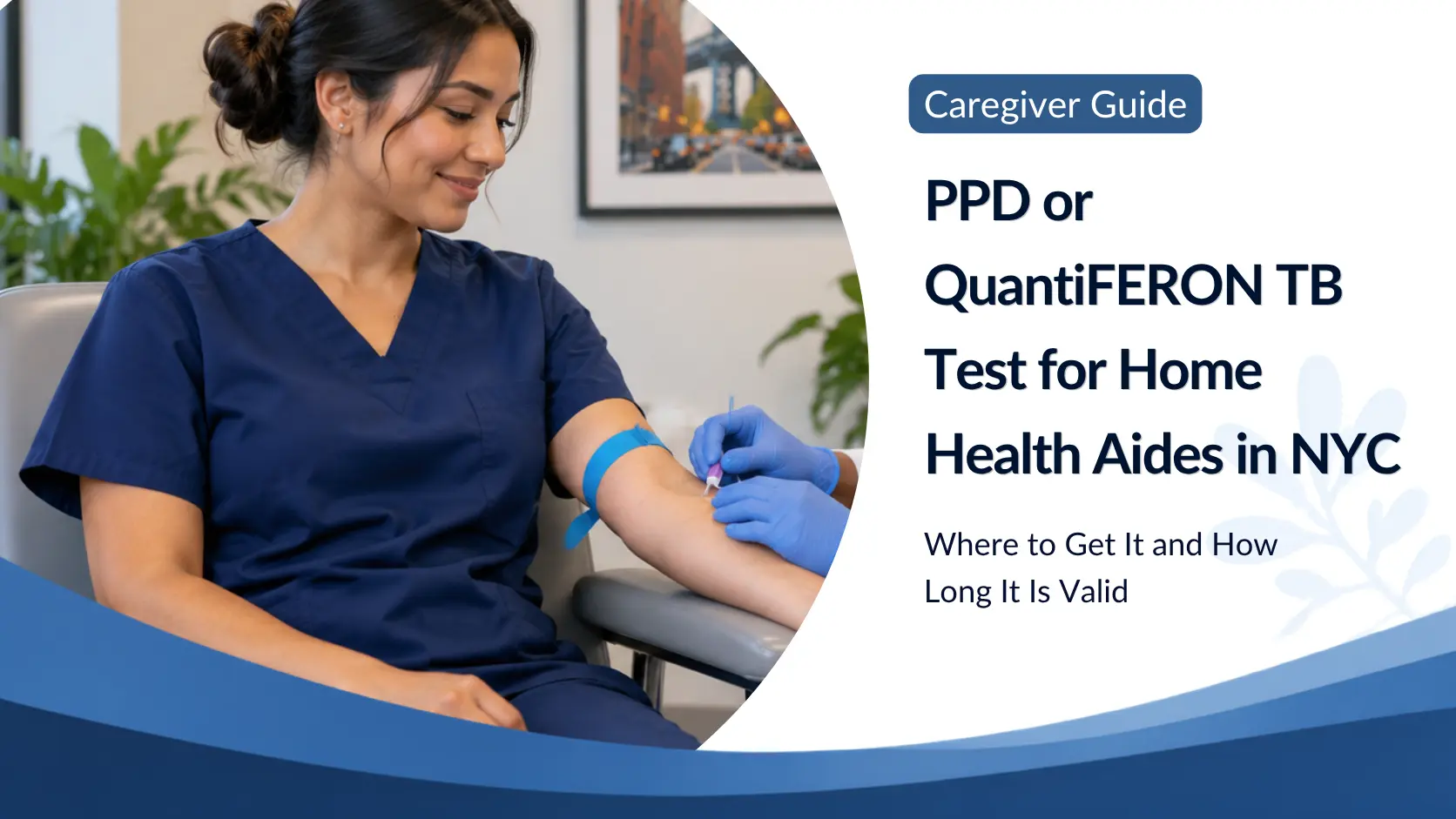
  • PPD or QuantiFERON TB Test for Home Health Aides in NYC: Where to Get It and How Long It Is Valid

    PPD or QuantiFERON TB Test for Home Health Aides in NYC: Where to Get It and How Long It Is Valid

    Caregiver Documents Β· 6 of 9

    PPD or QuantiFERON TB Test for Home Health Aides in NYC: Where to Get It and How Long It Is Valid

    The TB test is the document with the most rules: two visits for a skin test, a blood test that avoids them, a “positive” that does not mean what people fear, and a yearly clock. Here is how to get it right the first time.

    Quick answer

    New York home care agencies require tuberculosis screening before you start and generally a yearly assessment after that. You can do a PPD (tuberculin skin test), which needs a second visit 48 to 72 hours later to be read, or a QuantiFERON (or T-SPOT) blood test, which needs one visit and is required if you have had the BCG vaccine or a positive skin test in the past. Many clinics do it with your employment physical. A positive result means a chest X-ray and a doctor’s note, not the end of the job. Upload the result in the Caregiver Portal.

    Why It Is Required

    New York State health rules for home care agencies require tuberculosis screening for workers with patient contact, because TB spreads through the air and home care clients are often elderly or immunocompromised. The agency does not choose whether to ask; the state does. The screening has two parts: the test itself at hire, and an annual assessment afterward (a symptom review, and repeat testing when the clinician decides it is needed).

    PPD vs QuantiFERON

    PPD (skin test)

    A small injection under the skin of the forearm, read by the clinic 48 to 72 hours later. Two visits. For a first hire, many agencies ask for a “two-step” PPD: a second test one to three weeks after the first, to catch old exposure.

    QuantiFERON or T-SPOT (blood test)

    One visit, results in a few days, not affected by the BCG vaccine. The right choice if you were vaccinated with BCG abroad, if you have had a positive skin test before, or if two visits are hard to schedule.

    Positive result

    Usually means past exposure, not active disease. The clinic orders a chest X-ray and provides a clearance note; with that note you can work. Keep it, because future years use a symptom review instead of another test.

    Timing

    The test at hire is generally expected within the last 12 months; agencies then require a yearly TB assessment, so mark the date.

    Where to Get Tested in NYC

    • The clinic doing your physical. Ask for “PPD or QuantiFERON for home health aide employment”; if you choose the PPD, book the reading visit before you leave.
    • Urgent care and walk-in clinics in Brooklyn, the Bronx and Queens do both tests routinely; ask the price and whether a two-step is included.
    • NYC Health + Hospitals and community health centers offer TB testing, often on a sliding scale; some NYC Health Department chest centers provide TB evaluation at no cost.
    • Your own doctor, if you have insurance.

    Common Mistakes

    Missing the 48-to-72-hour reading window (the test must be repeated); getting a skin test after BCG vaccination and then needing a blood test anyway; uploading only the injection date without the reading result; letting the yearly assessment lapse, which can pause your cases until it is done. Photograph the result page with the reading, the clinician’s signature and the date.

    Upload It Once

    Use the secure upload page from your Caregiver Portal. Previous: rubella and rubeola immunity. Next: reference letters. Full list: the 9 documents.

    Frequently Asked Questions

    How long is a PPD test good for a home care job?

    The hire test is generally expected within the last 12 months, and agencies require a yearly TB assessment afterward under current New York rules.

    Which is better, PPD or QuantiFERON?

    Both are accepted. QuantiFERON needs one visit and is not affected by BCG; PPD is often cheaper but needs a reading visit and sometimes a second step.

    I had BCG as a child. Will my PPD be positive?

    It can be. Ask for the blood test instead to avoid a false positive and a chest X-ray.

    My test was positive. Can I still work as an HHA?

    Usually yes. A chest X-ray and a clinician’s clearance note showing no active TB are what the agency needs.

    Can I do the TB test and the physical on the same day?

    Yes, and the titers too; most clinics bundle them for employment physicals.

    What if I miss the reading appointment?

    The skin test has to be repeated; consider the blood test instead.

    Upload Your TB Result

    The reading, the signature and the date, in the Caregiver Portal. We keep track of the yearly renewal so your cases are never paused.

    Open the Caregiver PortalCall 718-375-2707
  • PCA vs HHA Jobs in NYC: Which Certification Should You Get, and What Each Job Is Really Like

    PCA vs HHA Jobs in NYC: Which Certification Should You Get, and What Each Job Is Really Like

    Caregiver Careers

    PCA vs HHA Jobs in NYC: Which Certification Should You Get, and What Each Job Is Really Like

    For people considering home care work in New York City: the two entry-level certificates, what the day is actually like, and how to choose.

    Quick answer

    Both are certified caregiver jobs with steady demand in NYC. A Personal Care Aide (PCA) completes a 40-hour New York State-approved program and helps clients with bathing, dressing, meals, housekeeping and escorts; a Home Health Aide (HHA) completes a longer program (about 75 hours plus a competency exam) and can also perform health-related tasks under a nurse’s supervision, which opens more cases and often slightly higher pay. If you have no experience, the fastest route is free PCA training with an agency that hires its graduates, then upgrade to HHA later. Advantage Home Care runs a free PCA training school in Brooklyn and hires PCAs and HHAs across the five boroughs: 718-375-2707 or apply online.

    The Two Certificates

    PCA (Personal Care Aide)

    40-hour NYS-approved course; certificate valid statewide; work includes personal care, meals, light housekeeping, escorts, companionship; Medicaid personal care cases and most private-pay cases.

    HHA (Home Health Aide)

    Approximately 75 hours including supervised practical training and a competency evaluation; adds health-related tasks under nurse supervision (assisting with self-administered medications, vital signs, simple exercises); eligible for cases that require an HHA, including many Medicare home health visits.

    Upgrading PCA to HHA

    A shorter β€œbridge” program (roughly 35 hours) takes a working PCA to HHA certification; many agencies help arrange it.

    Both

    Require a physical, immunizations, a background check and annual in-service training; both are placed on the New York State Home Care Registry.

    What the Job Is Really Like

    Most shifts are in a client’s home, one client at a time, from four hours to live-in. The work is physical (transfers, bathing), relational (the same person, often for months or years) and independent (you are usually the only worker in the home, with a coordinator and nurse a phone call away). The best caregivers are punctual, observant and calm; the hardest parts are commuting between boroughs and the emotional weight of illness. Language skills are a real advantage in NYC: Spanish, Russian, Chinese, Haitian Creole, Bengali and Yiddish speakers are matched to clients who need them.

    Which Should You Choose?

    No experience, need income soon

    Free PCA training (about two weeks) and a case right after; see our free PCA training school in Brooklyn.

    Already a PCA

    Bridge to HHA for more cases and Medicare home health work; ask your agency about the schedule.

    Interested in nursing later

    HHA experience is a common first step toward CNA, LPN or RN training.

    Prefer companionship-type work

    PCA cases and private-pay companion care suit people who prefer less medical involvement.

    What Agencies Look For

    • Valid certificate on the Home Care Registry, or enrollment in training.
    • Legal authorization to work in the US.
    • Physical exam, immunizations, background check, references.
    • Reliability: showing up on time, every time, is the single trait agencies value most.
    • Language and neighborhood: living near clients and speaking their language gets you steadier hours.

    Pay and Hours

    Home care aide pay in New York City is set by state minimum wage rules for home care workers, which are higher than the general minimum, with agencies competing on schedule stability, benefits and training rather than large pay differences. HHAs generally earn somewhat more than PCAs and have access to more cases. Ask about weekly pay, direct deposit, overtime rules, and whether live-in shifts are available. See what working with Advantage Home Care includes.

    How to Start This Month

    • Certified already: apply online and bring your certificate, ID and health forms to onboarding at our Brooklyn or Bronx office.
    • Not certified: enrol in free PCA training; classes run regularly at 1515 Sheepshead Bay Road, with cohorts arranged for Bronx applicants.
    • Questions: call 718-375-2707 and ask for recruiting.

    Frequently Asked Questions

    Which pays more, PCA or HHA?

    HHAs generally earn somewhat more per hour and have access to more cases, because some cases require an HHA. The gap is modest; schedule stability matters more to most caregivers’ income.

    How long does it take to become a PCA in NYC?

    About two weeks for the 40-hour course, then onboarding; many trainees start their first case within a month of enrolling.

    Is PCA training really free?

    At Advantage Home Care, yes, for students who work with our clients after certification. Ask any school what conditions apply.

    Can I work as an HHA without a PCA certificate first?

    Yes. You can enrol directly in an HHA program; PCA first is simply the faster route to earning.

    Do I need a car?

    No. Most NYC caregivers travel by subway and bus; we match you to clients near home whenever possible.

    Can I choose live-in shifts?

    Yes, if you want them; live-in cases suit caregivers who prefer fewer, longer assignments.

    Ready to Start a Caregiver Career?

    Apply online or call recruiting; free PCA training is available for new caregivers in Brooklyn and the Bronx.

    Call 718-375-2707Apply Now