Category: Careers

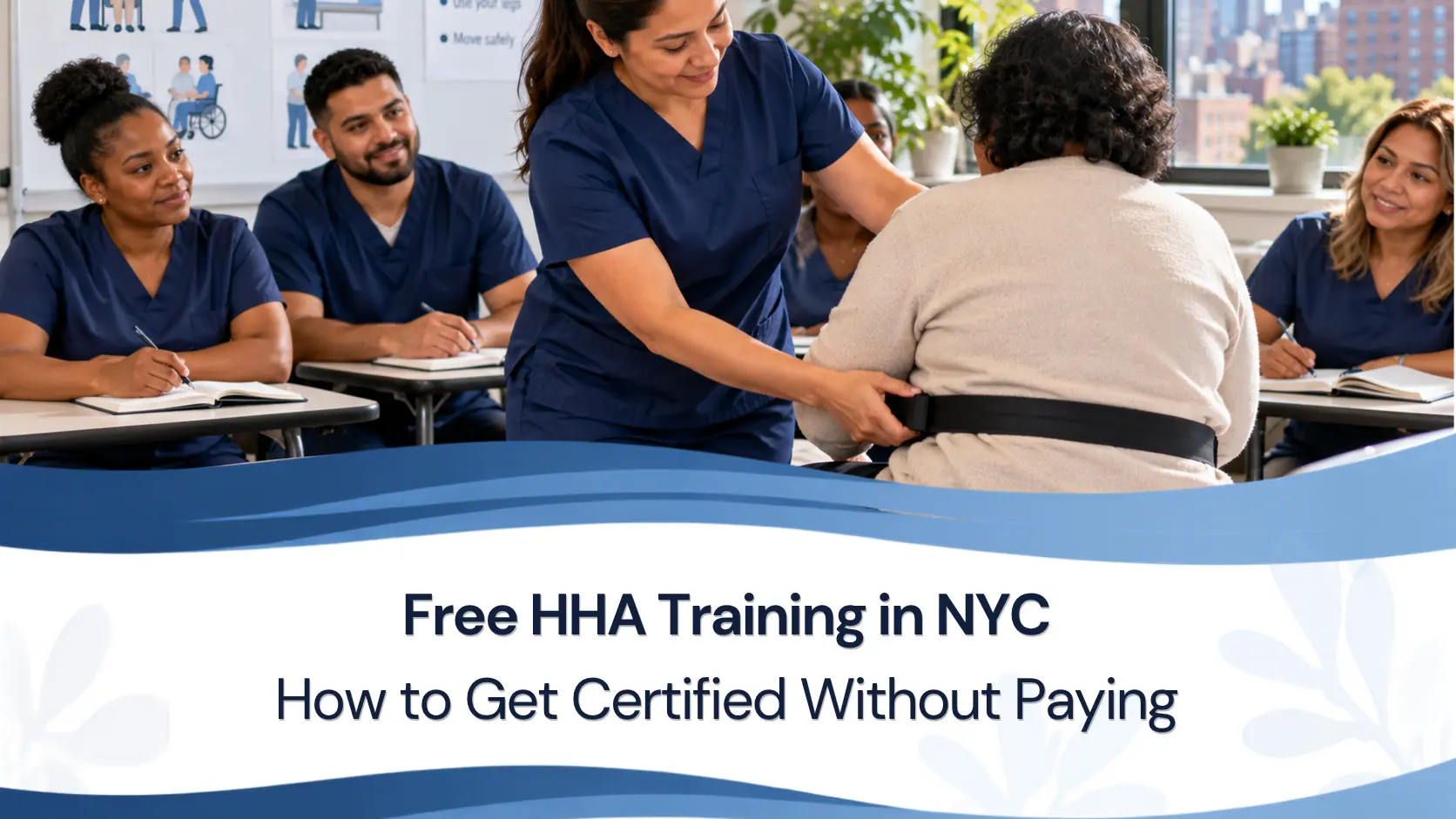
  • Free HHA Training in NYC: What’s Real, What’s a Catch, and How to Get Certified Without Paying

    Free HHA Training in NYC: What’s Real, What’s a Catch, and How to Get Certified Without Paying

    Caregiver Careers

    Free HHA Training in NYC: What’s Real, What’s a Catch, and How to Get Certified Without Paying

    Free home health aide training exists in New York City, and so do programs that are free in name only. Here is how to tell them apart and come out with a certificate the state recognizes.

    Quick answer

    Real free HHA training in NYC comes from three places: home care agencies that run or sponsor a New York State-approved training program and hire graduates, workforce and union-affiliated training funds, and PCA-to-HHA upgrade courses for aides already certified. A legitimate program is on the state’s approved list, issues a certificate recorded in the Home Care Registry, and does not charge you for the certificate itself. Advantage Home Care operates a PCA training school and hires certified HHAs and PCAs; see our PCA training school page or call 718-375-2707.

    Why Training Can Be Free

    Home care agencies in New York need aides constantly, and state rules allow approved agencies and schools to train them. An agency that trains you and then places you recovers its cost through the work you do, which is why free programs almost always come with the expectation that you will work for the sponsor for some period, or at least apply. That is not a scam; it is the business model. The catch to watch for is a program that is not state-approved, charges “registration” or “materials” fees that add up to tuition, or promises a certificate without the required classroom and supervised practical hours.

    The Three Real Paths

    Agency-sponsored training

    A licensed agency runs or partners with an approved HHA or PCA program and hires graduates. Ask whether the training is state-approved and whether a job offer follows.

    Workforce and union programs

    City workforce programs and union-affiliated training funds run free HHA courses for eligible New Yorkers, often with job placement.

    PCA-to-HHA upgrade

    Already a PCA? The additional HHA training is shorter and is often provided free by an employer that needs HHAs.

    What is never free

    Your own physical, immunizations and ID documents; budget a little time and money for those regardless of program.

    Questions to Ask Before You Enroll

    • Is the program on the New York State Department of Health’s approved list, and will my certificate appear in the Home Care Registry?
    • How many classroom and supervised practical hours does it include, and where is the practical done?
    • Are there any fees at all: registration, uniforms, books, exam, certificate?
    • Is there a work commitment afterward, and what happens if I leave early?
    • Does the sponsor actually have cases in my borough and language?

    PCA or HHA?

    PCA training is shorter and qualifies you for personal care cases; HHA training is longer and opens more cases, including those requiring an HHA. Many aides start as PCAs, begin working, and upgrade. See PCA vs HHA jobs in NYC, how to become a PCA and what a certified home health aide is. Once certified, see HHA jobs in Brooklyn and HHA jobs in the Bronx.

    Frequently Asked Questions

    Is free HHA training in NYC legitimate?

    Often yes, when the program is state-approved and sponsored by an agency, a workforce program or a union training fund. Check the approved list and ask about fees and work commitments.

    How long does HHA training take?

    Under current New York requirements, HHA training involves a set number of classroom and supervised practical hours, typically completed over a few weeks; PCA training is shorter.

    Do I have to work for the agency that trains me?

    Usually there is an expectation or a commitment; ask for it in writing before you start.

    Does Advantage Home Care offer free training?

    We operate a PCA training school and hire certified aides; see the PCA training school page for current details and dates.

    Can I get certified without speaking fluent English?

    Some programs offer instruction in Spanish, Russian or Chinese; ask. Agencies value bilingual aides.

    What do I need to enroll?

    Typically ID, work authorization, a physical and immunization records, and in some programs a basic reading assessment.

    Start Your Home Care Career

    Ask us about training and hiring. We will tell you plainly what is free, what is required, and where the cases are in your neighborhood.

    Call 718-375-2707Apply Online
  • HHA Jobs in the Bronx: Cases Near Home, Bilingual Demand and How to Get Started

    HHA Jobs in the Bronx: Cases Near Home, Bilingual Demand and How to Get Started

    Caregiver Careers

    HHA Jobs in the Bronx: Cases Near Home, Bilingual Demand and How to Get Started

    The Bronx has some of the highest home care demand in New York State, and most of it is Medicaid cases in the neighborhoods where aides already live. Here is how to get placed close to home.

    Quick answer

    Advantage Home Care hires home health aides and personal care aides throughout the Bronx from our office at 391 East 149th Street (3rd floor, Room 319). You need a current New York State HHA or PCA certificate, a recent physical and required health records, ID and work authorization, and references. Bilingual Spanish/English aides are placed fastest because most families ask for them. Apply online or call 718-375-2707.

    Where the Bronx Cases Are

    Medicaid home care demand runs through every part of the borough: Mott Haven, Hunts Point and Melrose near our office; Tremont, Highbridge and the Grand Concourse; Soundview, Castle Hill and Parkchester in the east; Fordham, Kingsbridge and Norwood in the northwest; Co-op City, Wakefield and Baychester in the north. Cases are assigned by where the aide can reach reliably, so an aide who lives on the 2, 5 or 6 line is usually placed within a few stops of home. Families ask for Spanish first, then Bangla, French and West African languages, Albanian and Italian in Morris Park and Belmont, and English everywhere.

    What a Licensed Agency Checks

    Certificate

    An HHA or PCA certificate from a New York State-approved program, current in the state’s Home Care Registry.

    Health requirements

    A recent physical, required immunizations and screenings as set by state rules; we tell you exactly which at the interview.

    Identity and eligibility

    Government ID, Social Security number, work authorization, and the state-required criminal history record check.

    References and availability

    Two references and a clear picture of the days, nights or weekends you can work; reliability is what earns steady cases.

    From Application to First Shift

    • Apply online or walk into our Bronx office with your certificate and ID; call first so the right coordinator is there.
    • Onboarding: paperwork, health documents, the background check and orientation; complete documents make this days, not weeks.
    • Matching: tell us your neighborhoods, languages and schedule preferences.
    • First case: an introduction with the coordinator and a steady schedule with the same client where possible.

    Not certified yet? See how to become a PCA in NYC, PCA vs HHA jobs and our PCA training school page. For a family-side view of Bronx HHA services, see HHA services in the Bronx.

    What Aides Ask Us

    Can I work in my own neighborhood? That is how we match. Do you have live-in cases? Yes. What about pay? Home care wages in New York are set by state rules and rise on a schedule; we go over current pay and schedules at the interview. Can I visit the office? Yes, 391 East 149th Street, 3rd floor, Room 319. See careers at Advantage Home Care and start your career as a PCA or HHA.

    Frequently Asked Questions

    Is Advantage Home Care hiring HHAs in the Bronx?

    Yes, throughout the borough, from our office at 391 East 149th Street. Apply online or call 718-375-2707.

    Hay trabajo para cuidadoras que hablan espaΓ±ol?

    SΓ­. La mayorΓ­a de las familias del Bronx piden cuidadores bilingΓΌes, y los colocamos rΓ‘pidamente.

    What documents do I need?

    Your HHA or PCA certificate, government ID, Social Security card, work authorization, a recent physical and immunization records, and two references.

    How fast can I start?

    With complete documents, onboarding usually takes days; the background check and health paperwork are the typical delays.

    Do you have cases in Co-op City and Riverdale?

    Yes, and we match them to aides who can reach those areas reliably.

    Can I switch from another agency?

    Yes. Bring your certificate and records; if you have a client who wants to move with you, we discuss it case by case.

    Apply to Work in the Bronx

    Bring your certificate and ID to our East 149th Street office or apply online. We will finish your paperwork and match you to cases near home.

    Call 718-375-2707Apply Online
  • HHA Jobs in Brooklyn: What Agencies Look For and How to Get Hired Fast

    HHA Jobs in Brooklyn: What Agencies Look For and How to Get Hired Fast

    Caregiver Careers

    HHA Jobs in Brooklyn: What Agencies Look For and How to Get Hired Fast

    Brooklyn has more home care cases than any other borough, and agencies are hiring all year. Here is what actually gets you a case quickly, from the paperwork to the neighborhoods.

    Quick answer

    To get an HHA job in Brooklyn, you need a valid New York State home health aide certificate (or PCA certificate for PCA cases), a current physical and required health screenings, identification and work authorization, and references. Agencies then match you to cases by neighborhood, language and availability. Advantage Home Care hires HHAs and PCAs across Brooklyn from our Sheepshead Bay office; apply online or call 718-375-2707.

    Why Brooklyn Cases Are Different

    Brooklyn’s home care demand is spread across very different communities: Russian-speaking clients in Brighton Beach and Sheepshead Bay, Chinese-speaking clients in Sunset Park and Bensonhurst, Orthodox households in Borough Park and Williamsburg, Caribbean and Haitian families in Flatbush and Canarsie, and long-time residents everywhere in between. An aide who lives in one of these neighborhoods and speaks the language is the easiest person for a coordinator to place, because families ask for exactly that. If you are choosing between agencies, choose one with an office in your part of the borough; the cases will be closer to home.

    What a Licensed Agency Checks

    Certificate

    An HHA or PCA certificate from a New York State-approved training program, listed in the state’s Home Care Registry; it must be current.

    Health requirements

    A recent physical, required immunization records and screenings as set by state rules; the agency will tell you exactly which.

    Identity and eligibility

    Government ID, Social Security number and proof of work authorization; a criminal history record check is required by the state for home care workers.

    References and reliability

    Two references and an honest conversation about your availability; agencies place aides who show up.

    From Application to First Shift

    • Apply online or in person with your certificate and ID.
    • Onboarding: paperwork, health documents, the state background check, and agency orientation; bringing complete documents is what makes this take days instead of weeks.
    • Matching: tell the coordinator your neighborhoods, languages, and whether you want days, nights, weekends or live-in.
    • First case: an introduction with the coordinator, then a regular schedule with the same client wherever possible.

    Not certified yet? See how to become a PCA in NYC, PCA vs HHA jobs and our PCA training school page.

    What Aides Ask Us

    Where are the cases? Throughout Brooklyn, with many near our Sheepshead Bay office and in Flatbush, Canarsie, Sunset Park, Bay Ridge and Williamsburg. Can I work near home? That is how we match. Is live-in available? Yes, for aides who want it. What about pay? Home care wages in New York are set by state rules and rise on a schedule; we explain current pay and schedules in the interview. See careers at Advantage Home Care and start your career as a PCA or HHA.

    Frequently Asked Questions

    Is Advantage Home Care hiring HHAs in Brooklyn?

    Yes, throughout the borough. Apply online or call 718-375-2707.

    What documents do I need to bring?

    Your HHA or PCA certificate, government ID, Social Security card, work authorization, a recent physical and immunization records, and two references.

    How long does onboarding take?

    With complete documents, usually days; the state background check and health paperwork are the usual delays.

    Can I choose my neighborhood?

    Tell the coordinator where you live and which areas you can reach; we match cases to aides who can get there reliably.

    Do you have Russian- or Chinese-speaking clients?

    Yes, many; bilingual aides are matched quickly.

    Can a PCA take HHA cases?

    No; HHA cases require an HHA certificate. PCAs can take personal care cases and can upgrade to HHA with additional training.

    Apply to Work in Brooklyn

    Bring your certificate and ID. We will get your paperwork done, match you to cases near home, and put you on a steady schedule.

    Call 718-375-2707Apply Online
  • Drug Screen for Home Care Jobs in NYC: What to Expect

    Drug Screen for Home Care Jobs in NYC: What to Expect

    Caregiver Documents Β· 8 of 9

    Drug Screen for Home Care Jobs in NYC: What to Expect

    A routine step that worries people more than it should. Here is what the screen involves, how prescriptions are handled, what New York law says about cannabis, and how quickly it is done.

    Quick answer

    Many licensed home care agencies in New York, including Advantage Home Care, ask new caregivers for a recent pre-employment drug screen, usually a urine test at a lab or clinic, with results in a few days. It is an agency policy rather than a state requirement, and it exists because aides work alone with vulnerable clients and handle their medications. Prescribed medications are not a problem when you tell the lab. Upload the result in the Caregiver Portal; many clinics do it in the same visit as your physical.

    Why Agencies Ask

    A home health aide is trusted alone in a client’s home, often with a locked medication box and a client who cannot advocate for themselves. Families and Medicaid plans expect agencies to screen for that responsibility, and most agency policies include a drug test at hire, sometimes with random or for-cause testing afterward. Ask HR for the agency’s written policy so there are no surprises.

    What the Screen Involves

    The test

    Most often a urine screen at a lab or clinic; some agencies accept a saliva test. The agency tells you which panel and where.

    Timing

    Results typically take two to five days. Results are generally expected to be recent at hire; ask HR how recent.

    Prescriptions

    Bring a list of prescribed medications; a medical review officer confirms legitimate prescriptions before a result is reported to the employer.

    Cost

    Varies by clinic; some agencies cover it or use a partner lab. Ask before you go.

    Cannabis and New York Law

    New York’s adult-use cannabis law generally protects employees from being penalized for legal off-duty cannabis use, and most employers may not test for cannabis unless a specific exception applies (for example, roles governed by federal rules, or impairment on the job). Agency policies have been updated to reflect this, and panels for home care hires often exclude THC; confirm the current panel with HR rather than assuming. Being impaired at work remains a reason for dismissal under any policy.

    Where to Get It Done

    • The agency’s partner lab or clinic, if there is one; this avoids a rejected result.
    • Urgent care and occupational health clinics in Brooklyn, the Bronx and Queens, often bundled with the employment physical and TB test.
    • National lab chains with locations across the city, by appointment.

    Upload It Once

    Use the secure upload page from your Caregiver Portal. Previous: reference letters. Next: direct deposit. Full list: the 9 documents.

    Frequently Asked Questions

    Do home health aides get drug tested in New York?

    Many agencies require a pre-employment screen as a matter of policy; it is not a state licensing requirement for aides.

    Will my prescription show up as a failed test?

    No, when you disclose it; a medical review officer verifies prescriptions before reporting to the employer.

    Is cannabis tested?

    Under New York law most employers may not test for cannabis outside specific exceptions; confirm the current panel with HR.

    How long do results take?

    Usually two to five business days.

    Can I use a drug screen from another employer?

    Sometimes, if it is recent and from a recognized lab; ask HR.

    Is there random testing after I am hired?

    Depends on the agency’s written policy; ask HR for it.

    Upload Your Drug Screen Result

    In the Caregiver Portal, with the other documents. One document left after this one.

    Open the Caregiver PortalCall 718-375-2707
  • Reference Letters for a Home Health Aide Job: Who to Ask and What to Write

    Reference Letters for a Home Health Aide Job: Who to Ask and What to Write

    Caregiver Documents Β· 7 of 9

    Reference Letters for a Home Health Aide Job: Who to Ask and What to Write

    References are the document caregivers put off the longest, usually because they are not sure who counts. Almost everyone has two people who can vouch for them. Here is how to ask, and a letter that takes five minutes.

    Quick answer

    Most New York home care agencies ask for two references: short, signed letters (or contact details for a phone reference) from people who have seen you work, such as a previous employer, a family you cared for, a supervisor, a training instructor or a volunteer coordinator. A good letter is half a page: who they are, how they know you, how long, what you did, and their phone number. Family members do not count. Upload the letters in the Caregiver Portal; if you are new to caregiving, see below for what to use instead.

    Why Agencies Ask

    Unlike the health documents, references are not a state requirement; they are the agency’s own hiring standard, and a sensible one. An aide works alone in a client’s home, often with a vulnerable person, and the agency is responsible for who it sends. Two people saying “I have seen this person be reliable and kind” is the simplest check there is, and HR will usually call at least one of them.

    Who Counts as a Reference

    Past employers and supervisors

    A previous agency coordinator, a nursing home charge nurse, a retail or restaurant manager: anyone who supervised your work, in caregiving or not.

    Families you cared for

    Private clients or families whose relative you looked after, including informally; they are often the strongest references for home care.

    Instructors and coordinators

    Your HHA or PCA training instructor, a church or community volunteer coordinator, a teacher from a recent program.

    Who does not count

    Relatives, close friends who never saw you work, and anyone who cannot be reached by phone.

    What a Good Letter Says

    Keep it short and specific. Dates, letterhead and formal language are not required; a signed note with a phone number is. A five-line template you can give your reference:

    • Who I am: name, job or relationship to you, phone number and email.
    • How I know you: “I supervised [name] at [place] from [month year] to [month year]” or “[Name] cared for my mother in our home in Flatbush for eight months.”
    • What you did: two or three concrete tasks: bathing and transfers, meals, medication reminders, night shifts, working with a client with dementia.
    • What they think: reliability, punctuality, patience, honesty; one sentence each is enough.
    • Signature and date.

    Typed and signed, or handwritten and photographed, both work. A short email from the reference’s own address, with their phone number, is also accepted by most agencies.

    New to Caregiving?

    Use references from any job, from your training program, or from volunteer work; tell HR the situation and they will say what works. Many caregivers who trained at our free PCA school use an instructor as one reference. It is better to upload one good letter now and add the second later than to wait for both; the portal keeps track.

    Upload Them Once

    Use the secure upload page. Previous: TB test. Next: drug screen. Full list: the 9 documents.

    Frequently Asked Questions

    Can a family member write my reference?

    No. References must be people who saw you work and are not relatives.

    Does the reference have to be from a home care job?

    No. Any employer, supervisor, instructor or family you cared for can write one; caregiving references are strongest but not required.

    Is a phone number enough instead of a letter?

    Many agencies accept a phone reference; a short signed letter with the number is the safest way to satisfy the checklist.

    Does the letter need to be in English?

    Ask HR; a letter in Spanish, Russian or Chinese is often fine when HR can read it or reach the reference by phone.

    Will the agency really call them?

    Usually at least one; tell your references to expect a call from Advantage Home Care.

    What if my last employer will not give references?

    Use a supervisor or coworker who will, or a family you cared for; note the situation for HR.

    Upload Your Reference Letters

    One now, one later is fine. Create your account in the Caregiver Portal and keep the checklist moving.

    Open the Caregiver PortalCall 718-375-2707
  • Rubella and Rubeola Immunity for Home Care Workers in New York: Titers, Vaccines and Records

    Rubella and Rubeola Immunity for Home Care Workers in New York: Titers, Vaccines and Records

    Caregiver Documents Β· 5 of 9

    Rubella and Rubeola Immunity for Home Care Workers in New York: Titers, Vaccines and Records

    Two words most caregivers have never seen until an agency asks for them. Here is what they mean, what proof counts, and how to get it done in the same clinic visit as your physical.

    Quick answer

    Rubella is German measles and rubeola is measles. New York requires home care workers to show immunity to both, by either a documented vaccination record (usually two MMR doses) or a blood test called a titer that shows antibodies. Ask for “rubella and rubeola titers” at the same visit as your employment physical; results take a few days. If a titer shows you are not immune, the clinic gives the vaccine and documents it. Upload the lab report or vaccination record in the Caregiver Portal. Once documented, this does not expire.

    Why It Is Required

    New York State health regulations for home care agencies require workers with patient contact to show immunity to measles and rubella (with certain age-based exceptions for people born before 1957, which the clinic will apply). The reason is simple: home care clients are often elderly, immunocompromised or caring for infants, and a caregiver who carries measles into a home can cause serious harm. Because it is a state rule, every licensed agency asks for it.

    What Counts as Proof

    Titer (blood test)

    A lab report showing rubella IgG and rubeola (measles) IgG as “immune” or “positive.” The most common route for adults who do not have childhood records.

    Vaccination record

    Documentation of two doses of MMR (measles, mumps, rubella) vaccine, from a school, clinic or immunization registry.

    Records from abroad

    Often accepted if they clearly show the vaccine and dates; if in doubt, a titer settles it.

    Born before 1957

    Clinicians may document presumed immunity for measles under current guidance; ask the clinic and confirm with HR what the agency accepts.

    Where to Get a Titer in NYC

    • The clinic doing your physical. Ask for “rubella and rubeola titers for home health aide employment” so the order is right; blood is drawn the same day.
    • Urgent care and walk-in clinics across Brooklyn, the Bronx and Queens do this routinely; ask the price.
    • Your own doctor, if you have insurance.
    • Results usually take two to five days; you can upload the other documents while you wait.

    If the Result Is “Non-Immune”

    It happens, especially for people vaccinated decades ago or with incomplete records. The clinic gives an MMR dose (a second dose may follow) and documents it; that documentation is what you upload. It does not stop you from being hired; it just adds a step. Some caregivers cannot receive live vaccines for medical reasons; talk to the clinician and tell HR so the file is handled correctly.

    Upload It Once

    Use the secure upload page from your Caregiver Portal. Previous: physical exam form. Next: PPD or QuantiFERON. Full list: the 9 documents.

    Frequently Asked Questions

    What is the difference between rubella and rubeola?

    Rubella is German measles; rubeola is measles. New York requires proof of immunity to both for home care workers.

    Is the titer the same as the MMR vaccine?

    No. The titer is a blood test that checks whether you already have antibodies; the vaccine is what creates them.

    How long does immunity proof last?

    Once documented, it does not need to be repeated for employment purposes.

    Can I use my childhood vaccination card from another country?

    Often yes if it is legible and shows the vaccine and dates; otherwise a titer is the simplest proof.

    What if I am pregnant?

    The MMR vaccine is not given during pregnancy; the titer can still be drawn. Tell the clinician and HR.

    Does the agency need mumps too?

    New York’s home care rule is about measles and rubella; the MMR vaccine covers all three, so a two-dose MMR record satisfies it.

    Upload Your Immunity Records

    The titer report or the vaccination record, in the Caregiver Portal. Then the TB test is next, and often done at the same visit.

    Open the Caregiver PortalCall 718-375-2707
  • Physical Exam Form for Home Health Aide Jobs in NYC: What It Must Include and Where to Get One

    Physical Exam Form for Home Health Aide Jobs in NYC: What It Must Include and Where to Get One

    Caregiver Documents Β· 4 of 9

    Physical Exam Form for Home Health Aide Jobs in NYC: What It Must Include and Where to Get One

    The physical is the document most likely to be sent back: the wrong form, an unsigned page, or a date that is too old. Here is what New York agencies actually need and how to get it done in one visit.

    Quick answer

    New York home care agencies need a health assessment (a “physical”) signed by a physician, nurse practitioner or physician assistant, generally dated within the last 12 months, stating that you are free of a health impairment that would prevent you from doing the job and have no communicable disease. It is renewed yearly. Most clinics can do the physical, the TB test and the immunity blood work in the same visit; ask for an “employment physical for home health aide.” Upload it in the Caregiver Portal.

    Why Every Agency Asks for It

    New York State Department of Health regulations for licensed home care agencies require a pre-employment health assessment for anyone who has direct contact with patients, and an annual reassessment after that. The point is protecting the people you care for, who are often frail, and confirming you can physically do the work (lifting, transfers, long days on your feet). Because the rule is the state’s, every agency needs the same thing, and a physical done for one agency is usually accepted by another if it is recent.

    What the Form Must Include

    Who signs

    A licensed physician, nurse practitioner or physician assistant; the signature, printed name, license and date must be on the form.

    What it says

    A statement that you are free of health impairment that would interfere with the job and free of communicable disease; the clinician’s stamp or letterhead.

    How recent

    Generally within 12 months at hire; agencies then require a yearly reassessment.

    Often on the same form

    TB screening result, rubella and rubeola immunity and, at many clinics, the drug screen; one visit can cover several documents.

    Where to Get It in NYC

    • Your own primary care doctor. Usually the cheapest option if you have insurance; bring the agency’s form so nothing is missed.
    • Urgent care and walk-in clinics. Many across Brooklyn, the Bronx and Queens offer employment physicals, TB tests and titers as a package, often same day; ask the price for a “pre-employment physical for home health aide” before the visit.
    • NYC Health + Hospitals and community health centers. Sliding-scale fees for people without insurance; call ahead about employment physicals.
    • Ask HR first. Some agencies have a clinic they work with and a specific form; using it avoids a second visit.

    Common Reasons a Physical Is Sent Back

    Missing signature or license number; a date older than a year; a school physical or a sports form instead of an employment health assessment; TB result not recorded; a copy so blurry the date cannot be read. Photograph every page, including the clinician’s stamp, before you leave the clinic.

    Upload It Once

    Use the secure upload page from your Caregiver Portal. Previous: certificate. Next: rubella and rubeola immunity. Full list: the 9 documents.

    Frequently Asked Questions

    How recent does the physical need to be for a home care job?

    Generally within the last 12 months at hire, then renewed yearly under current New York rules.

    Can a nurse practitioner sign it?

    Yes. Physicians, nurse practitioners and physician assistants can all sign the health assessment.

    How much does an employment physical cost in NYC?

    It varies by clinic and insurance; walk-in clinics often quote a flat price for the physical plus TB test. Ask before the visit.

    Does the agency pay for it?

    Policies vary; ask HR at your interview whether a partner clinic or reimbursement is available.

    Can I use a physical done for another agency?

    Usually yes if it is within 12 months and includes the required statements; upload it and HR will confirm.

    What if I have a health condition?

    The assessment asks whether a condition would prevent you from doing the job safely, not whether you have one; talk to the clinician.

    Upload Your Physical in the Caregiver Portal

    Every page, clinician’s signature visible. If you have not had it yet, ask us which clinic and which form to use so it is right the first time.

    Open the Caregiver PortalCall 718-375-2707
  • HHA or PCA Certificate in New York: How to Prove It, Check the Home Care Registry, and What to Do Without One

    HHA or PCA Certificate in New York: How to Prove It, Check the Home Care Registry, and What to Do Without One

    Caregiver Documents Β· 3 of 9

    HHA or PCA Certificate in New York: How to Prove It, Check the Home Care Registry, and What to Do Without One

    The certificate is the one document that decides which cases you can take. Here is how New York agencies verify it, what to do if yours is lost, out of state or lapsed, and how to get one for free if you are starting out.

    Quick answer

    A valid certificate comes from a New York State-approved home health aide or personal care aide training program and is recorded in the state’s Home Care Registry, which agencies check by name and date of birth. Upload a photo of the certificate to the Caregiver Portal; if the paper is lost, the registry entry is what matters and the school can reissue the document. No certificate? Advantage Home Care’s PCA training school is free.

    HHA vs PCA: What the Certificate Decides

    In New York, a personal care aide (PCA) completes a shorter state-approved course and can provide personal care and household help; a home health aide (HHA) completes a longer course, including additional health-related tasks, and can take any case a PCA can plus cases that require an HHA. Many Medicaid cases through MLTC plans are staffed with HHAs, which is why agencies place HHAs faster and why PCAs are often encouraged to upgrade. See PCA vs HHA jobs in NYC and what a certified home health aide is.

    How Agencies Verify It

    The Home Care Registry

    New York’s Department of Health keeps a registry of certified HHAs and PCAs. Agencies look you up by name and date of birth; if you are not there, the paper certificate is not enough.

    The certificate itself

    Upload a clear photo showing your name, the program name, the type (HHA or PCA) and the completion date.

    Lapse rule

    Under current New York rules, an aide who has not worked in home care for a period of about two years generally needs retraining or a competency evaluation before being placed again.

    Out-of-state certificates

    Generally not accepted directly; ask the agency about competency evaluation options or take a New York-approved course.

    Lost Certificate, Wrong Name, Old Date

    • Lost the paper. Contact the school that trained you for a reissue; meanwhile, the agency can confirm your registry entry.
    • Name changed since training. Provide the marriage certificate or court order so the registry entry and your ID match.
    • Trained years ago, worked steadily. Fine; the registry shows continuous employment.
    • Trained years ago, did not work. Expect to need a refresher or evaluation; ask HR what applies to you.

    No Certificate Yet?

    Create your portal account anyway and choose “I’m starting from zero.” Our PCA training school is free, and PCAs who work with us can move to HHA later. For how free training works across the city and what to watch out for, see free HHA training in NYC and how to become a PCA.

    Upload It Once

    Use the secure upload page from your Caregiver Portal. Previous: Social Security card. Next: the physical exam form. Full list: the 9 documents.

    Frequently Asked Questions

    How do I check my own Home Care Registry entry?

    The New York State Department of Health’s Home Care Registry can be searched online by name; the agency also checks it at hire.

    Is a CNA certificate accepted for home care?

    Not on its own in New York; a CNA generally needs a shorter bridge course to be certified as an HHA. Ask HR.

    I trained in New Jersey. Can I work in New York?

    Out-of-state certificates are generally not accepted directly; there are evaluation and training routes, and we can explain them.

    Can I work as a PCA while I train to be an HHA?

    Yes, on PCA cases; many of our caregivers do exactly that.

    How long is the certificate valid?

    As long as you keep working in home care; a lapse of about two years generally requires retraining or evaluation.

    Is the PCA training really free?

    Yes, through our training school; see the training page for current dates and requirements.

    Upload Your Certificate, or Start Training Free

    Certified? Upload it in the Caregiver Portal. Not yet? Create your account and choose “starting from zero,” and we will tell you about the next free class.

    Open the Caregiver PortalFree PCA Training
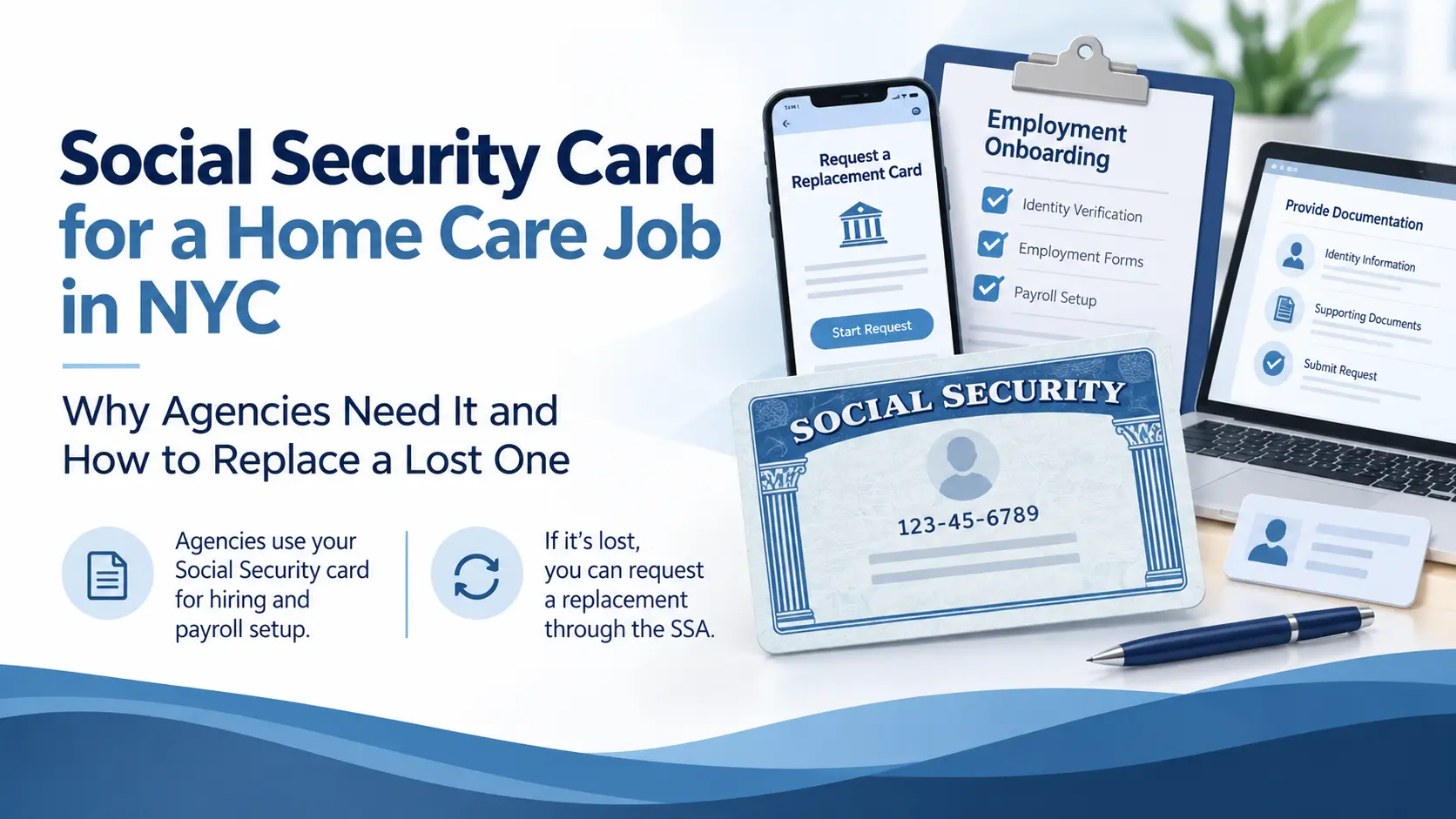
  • Social Security Card for a Home Care Job in NYC: Why Agencies Need It and How to Replace a Lost One

    Social Security Card for a Home Care Job in NYC: Why Agencies Need It and How to Replace a Lost One

    Caregiver Documents Β· 2 of 9

    Social Security Card for a Home Care Job in NYC: Why Agencies Need It and How to Replace a Lost One

    Small card, big holdup. Many caregivers stall here because the card is lost, unsigned or photographed on one side only. Here is what HR needs and the fastest way to get it.

    Quick answer

    Upload a clear photo of the front and back of your Social Security card, signed on the front signature line. The agency needs it for payroll and tax reporting and, together with a photo ID, for the federal I-9. If it is lost, a replacement is free: most people can request one online with a my Social Security account, or by visiting a Social Security office; the new card arrives by mail, usually within a couple of weeks. Upload it in the Caregiver Portal.

    Why the Agency Needs It

    Your wages are reported to the IRS and to New York State under your Social Security number, so payroll cannot be set up without it. The card is also one of the documents that proves work authorization on the federal I-9 when paired with a photo ID such as a New York driver’s license or state ID. Agencies ask for the physical card, not just the number, because employment rules require seeing the document itself.

    What Works and What Does Not

    Signed, front and back

    Sign the front in ink if you have not already; photograph both sides so the full card is visible.

    Restricted cards

    A card marked “valid for work only with DHS authorization” is fine together with your current work permit or green card; “not valid for employment” cards need a different work-authorization document.

    Name changes

    The name on the card should match your ID and certificate. Update it with the Social Security Administration first if you married or changed your name.

    Laminated or damaged

    Heavily laminated or torn cards can be rejected; request a replacement.

    Replacing a Lost Card

    • Online. With a my Social Security account, most U.S. citizens and many permanent residents can request a replacement at ssa.gov without visiting an office; you need a valid driver’s license or state ID.
    • In person. Social Security has field offices in every borough, including several in Brooklyn, the Bronx and Queens; check ssa.gov for the nearest one and current appointment rules. Bring an original ID and, if applicable, your immigration document.
    • Cost and timing. Replacement cards are free. Delivery is by mail and generally takes a few weeks, so start this early; you can create your portal account and upload the other documents while you wait.

    Upload It Once

    Use the secure upload page from your Caregiver Portal account. The portal only records that the card was received; the file goes to HR. Previous document: government ID. Next: your HHA or PCA certificate. Full list: the 9 documents.

    Frequently Asked Questions

    Can I start working while my replacement card is in the mail?

    Ask HR; federal rules allow a receipt for a replacement in some cases, and other documents can cover the I-9 in the meantime.

    Is it enough to know my number?

    No. The agency must see the card itself for employment paperwork.

    Why sign the card?

    The signature line is part of the document; an unsigned card is a common reason HR asks for a re-upload.

    How much does a replacement cost?

    Nothing. The Social Security Administration issues replacements free of charge.

    My card says “valid for work only with DHS authorization.” Is that a problem?

    Not with a current work permit or green card alongside it.

    Where does the upload go?

    Straight to our HR team by secure email; it is never displayed on the website.

    Upload Your Social Security Card

    Signed, front and back, in the Caregiver Portal. Then keep going: the certificate is next.

    Open the Caregiver PortalCall 718-375-2707
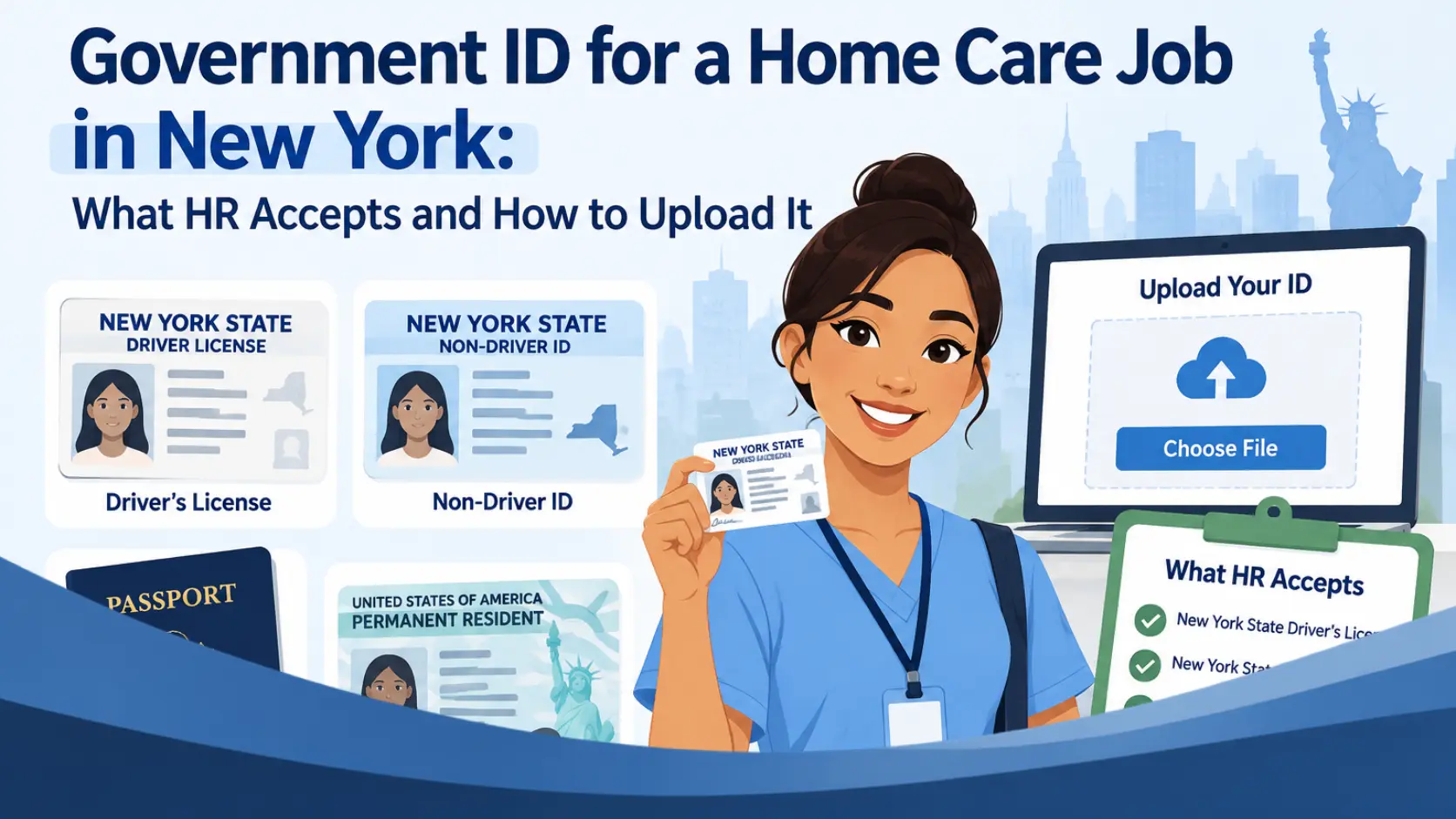
  • Government ID for a Home Care Job in New York: What HR Accepts and How to Upload It

    Government ID for a Home Care Job in New York: What HR Accepts and How to Upload It

    Caregiver Documents Β· 1 of 9

    Government ID for a Home Care Job in New York: What HR Accepts and How to Upload It

    The first document every agency asks for, and the one that causes the most back-and-forth when a photo is blurry, cut off or missing the back. Here is exactly what works.

    Quick answer

    Upload a clear photo or scan of the front and back of one government-issued photo ID that also shows you are authorized to work in the United States: a U.S. passport, a permanent resident card (green card) or an employment authorization card (work permit) covers both on its own; a New York driver’s license or state ID card needs to be paired with a Social Security card or another work-authorization document. Upload it in the Caregiver Portal. Questions: 718-375-2707.

    Why the Agency Needs It

    Two reasons. First, identity: a licensed home care agency in New York must verify who it is sending into patients’ homes, and the state background check is run against your legal name and date of birth. Second, federal law: every employer must complete a Form I-9 within three days of hire, which requires documents proving both identity and authorization to work. The agency does not decide which documents count; the federal list does. That is why HR asks for the back of the card as well as the front: the I-9 rules require the full document.

    What Works

    One document that covers both

    U.S. passport or passport card, permanent resident card (green card), employment authorization document (work permit, EAD).

    Identity plus a second document

    New York driver’s license, non-driver ID card or IDNYC, paired with an unrestricted Social Security card, a birth certificate or another work-authorization document.

    Photo quality

    All four corners visible, no glare, name and expiration readable; front and back as two images, not one folded shot.

    Name matters

    The name on the ID must match the Social Security card and the certificate; if you changed your name, include the marriage certificate or court order.

    Common Problems and Fixes

    • Expired ID. Generally not acceptable for the I-9; renew at the DMV (online renewal is available for most New York licenses and ID cards) or use a valid passport.
    • Work permit renewal pending. Bring the receipt notice and the expired card; HR will tell you what the current federal rules allow.
    • IDNYC only. It proves identity for many purposes but must be paired with a work-authorization document.
    • Different name on the certificate. Contact the training school to reissue, or provide the name-change document.

    Upload It Once

    Create a free account in the Caregiver Portal and use the secure upload page. Your account shows that the ID has been received; the file itself goes to HR and is not displayed on the website. Next document: the Social Security card. Full list: the 9 documents every HHA and PCA needs.

    Frequently Asked Questions

    Is a New York driver’s license enough for a home care job?

    It proves identity; pair it with a Social Security card or another document that proves you can work in the U.S.

    Can I use IDNYC?

    Yes for identity, together with a work-authorization document.

    Do I really need the back of my ID?

    Yes. The employment form requires the complete document, and HR will ask again if the back is missing.

    My green card is expired but my status is valid. What now?

    Tell HR; the federal rules allow certain receipts and extensions, and HR will explain what is acceptable at the time.

    Can I upload a photo from my phone?

    Yes, as long as it is sharp, straight and shows the whole card.

    Where do my documents go?

    Straight to our HR team by secure email; the portal only records that they were received.

    Upload Your ID in the Caregiver Portal

    Front and back, clear photo, then move on to the next document. We will guide you to the rest.

    Open the Caregiver PortalCall 718-375-2707
  • HHA and PCA Job Requirements in New York: The 9 Documents and Where to Get Each One

    HHA and PCA Job Requirements in New York: The 9 Documents and Where to Get Each One

    Caregiver Careers

    HHA and PCA Job Requirements in New York: The 9 Documents and Where to Get Each One

    Every licensed home care agency in New York asks for the same core paperwork before an aide can be placed. Here is the full list, what each document is for, where NYC caregivers actually get them, and how to hand them in once instead of emailing them over and over.

    Quick answer

    To work as a home health aide (HHA) or personal care aide (PCA) with a licensed agency in New York City you need: a government ID and work authorization, a Social Security card, your HHA or PCA certificate, a recent physical, proof of rubella and rubeola immunity, a tuberculosis test (PPD or QuantiFERON), two reference letters, a drug screen, and direct deposit information. You do not need all nine to start: create a free account in the Caregiver Portal, upload what you have, and add the rest as you get them. Questions: 718-375-2707.

    Why Agencies Ask for the Same Nine Things

    Most of this list is not the agency’s preference; it comes from New York State Department of Health rules for home care agencies, which require a health assessment, immunity records and tuberculosis screening for anyone who works in a patient’s home, plus proof of the aide’s certification in the state’s Home Care Registry, and from federal employment law, which requires identity and work-authorization documents for every hire. References, a drug screen and direct deposit are the agency’s own hiring standards. Because every licensed agency needs the same packet, collecting it once and keeping copies means you can start with any agency quickly.

    The Nine Documents

    1. Government ID and work authorization

    A driver’s license, state ID, passport, green card or work permit; front and back. Used for identity verification and the federal I-9. What HR accepts

    2. Social Security card

    Front and back, signed. Needed for payroll and the I-9. Lost yours? Replacement is free through the Social Security Administration. How to replace it

    3. HHA or PCA certificate

    From a New York State-approved training program, recorded in the Home Care Registry. No certificate yet? Our PCA training is free. Proving your certificate

    4. Physical exam form

    A health assessment signed by a doctor, nurse practitioner or physician assistant, generally within the last 12 months and repeated yearly. What it must include

    5. Rubella and rubeola immunity

    Vaccination records or blood titers showing immunity to rubella (German measles) and rubeola (measles). Titers, vaccines and records

    6. PPD or QuantiFERON

    A tuberculosis screening: a PPD skin test (often two-step for a first hire) or a QuantiFERON blood test, then a yearly assessment. Where to get it

    7. Two reference letters

    From past employers or families you cared for; a short signed letter with a phone number is enough. Who to ask and what to write

    8. Drug screen

    A recent screening result; the agency tells you which lab and which panel. What to expect

    9. Direct deposit information

    A voided check or a bank letter with routing and account numbers, so you are paid on time. Voided check or bank letter

    How Long Each One Stays Valid

    Under current New York rules, the physical and the tuberculosis assessment are generally renewed every year, so keep the dates in mind; immunity records, once documented, do not expire; the certificate stays valid as long as you keep working in home care (the registry tracks a two-year lapse); ID and Social Security documents are checked at hire and when they expire. The Caregiver Portal shows which documents we have on file so you can see what is still missing.

    Upload Once, Not Nine Times

    Instead of emailing files one at a time, create a free account in the Caregiver Portal, then use the secure upload page. Your files go straight to our HR team; your account only shows which documents have been received. No password: we email you a sign-in link. If you are not certified yet, see free HHA training in NYC and our free PCA training school. For the job side, see HHA jobs in Brooklyn and HHA jobs in the Bronx.

    Frequently Asked Questions

    What documents do I need for a home health aide job in New York?

    Government ID and work authorization, Social Security card, HHA or PCA certificate, a recent physical, rubella and rubeola immunity records, a TB test (PPD or QuantiFERON), two reference letters, a drug screen and direct deposit information.

    Do I need all nine before I apply?

    No. Apply and create your portal account with your name and email; upload what you have and add the rest as you collect them.

    Are the PCA requirements different from the HHA requirements?

    The health and identity documents are the same; the difference is the certificate. PCA training is shorter; HHA training opens more cases.

    How long does it take to get everything?

    With a certificate in hand, most caregivers complete the packet in one to two weeks; the physical and TB test are usually the slowest items.

    Does the agency pay for the physical or TB test?

    Policies differ by agency and clinic; ask at your interview. Many NYC clinics offer low-cost employment physicals and TB tests.

    Are my documents safe when I upload them?

    Files go directly to our HR team by secure email and are never displayed on the website; the portal only records which documents were received.

    Upload Your Documents in the Caregiver Portal

    Create your free account, upload what you have today, and we will guide you to the rest. Our HR team matches caregivers to cases in all five boroughs.

    Open the Caregiver PortalCall 718-375-2707
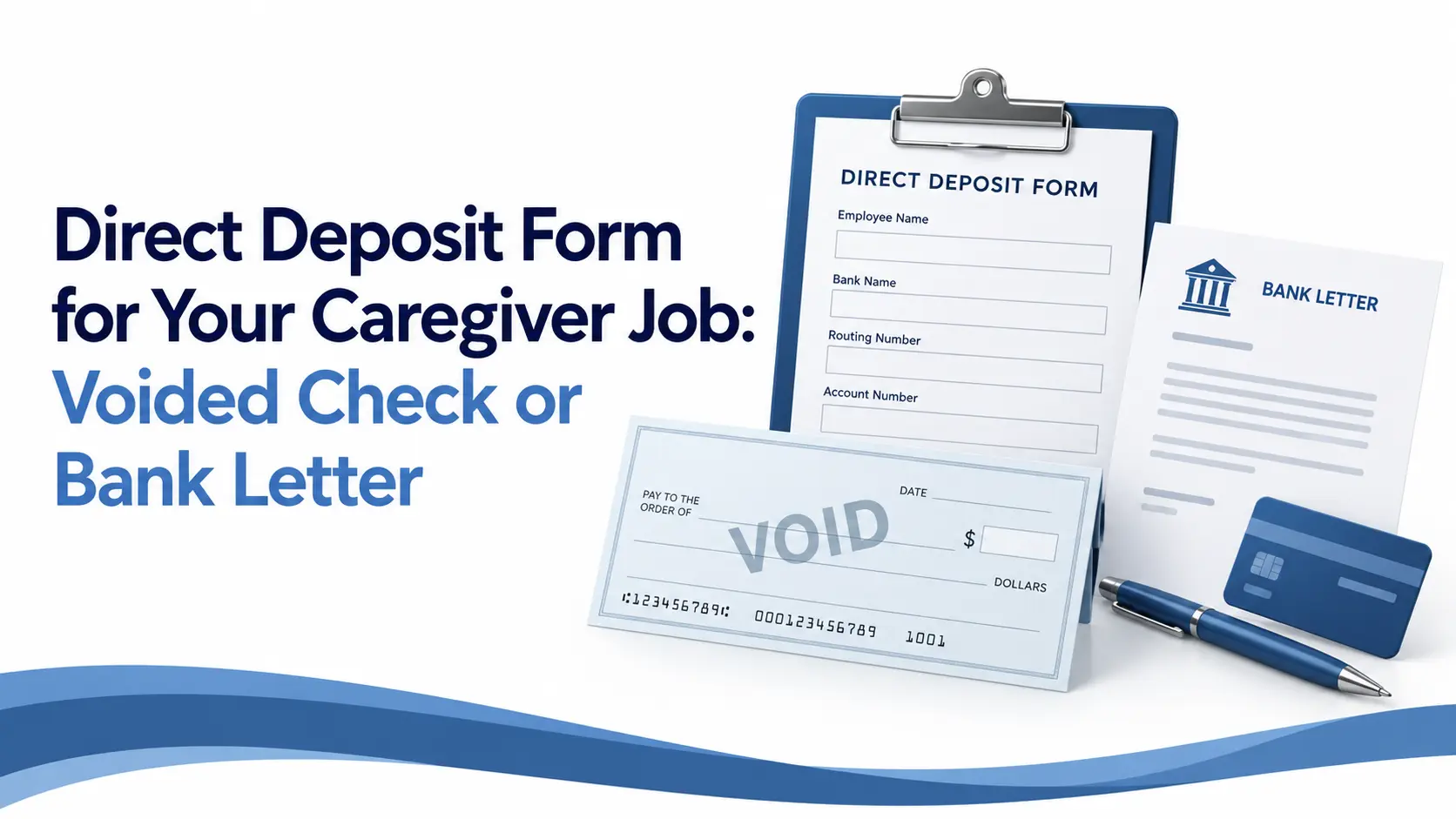
  • Direct Deposit Form for Your Caregiver Job: Voided Check or Bank Letter

    Direct Deposit Form for Your Caregiver Job: Voided Check or Bank Letter

    Caregiver Documents Β· 9 of 9

    Direct Deposit Form for Your Caregiver Job: Voided Check or Bank Letter

    The easiest document on the list, and the one that most often delays a first paycheck. Here is exactly what payroll needs and how to get it from any bank, including online banks and pay cards.

    Quick answer

    Payroll needs three things to pay you by direct deposit: your bank’s routing number, your account number, and proof they belong to you. A voided check does all three. So does a bank letter or a direct-deposit form printed from your bank’s app or website with your name on it. Upload it in the Caregiver Portal with the rest of your documents. No bank account? See the options below; do not let this be the reason your first pay is late.

    Why It Matters More Than It Looks

    Home care aides are paid on a regular payroll cycle, and in New York, wages for home care workers are set and tracked under state rules, so payroll runs on a fixed schedule with fixed cutoffs. If your deposit information is missing or has a typo when the first cycle closes, you wait for the next one. Sending a clear document once, before your first shift, is the whole task.

    What Payroll Accepts

    Voided check

    Write VOID across a blank check from your checkbook; photograph it flat with the routing and account numbers readable at the bottom.

    Bank letter or direct-deposit form

    Most banks provide a “direct deposit authorization” or “account verification letter” in the app or online banking, with your name, routing and account number.

    Online banks and pay cards

    Chime, Cash App, PayPal and similar accounts have routing and account numbers in the app; download the direct-deposit form they provide.

    What does not work

    A debit card photo (card numbers are not account numbers), a deposit slip without your name, or a screenshot with the numbers cut off.

    No Bank Account Yet?

    • Open one before your first shift. Many banks and credit unions in Brooklyn, the Bronx and Queens offer basic checking with no minimum balance; New York’s low-cost “basic banking” accounts exist at most banks by law. Bring your ID and Social Security card.
    • Online accounts can be opened in minutes from your phone and provide direct-deposit details immediately.
    • Ask HR about a pay card if the agency offers one; some do, for caregivers without an account.

    Checking Your Numbers

    The routing number is nine digits and identifies the bank; the account number identifies you and is usually 8 to 12 digits. On a check, the routing number is first, then the account number, then the check number. Double-check the account number against your app before uploading; a single wrong digit sends money back to the bank and delays pay by a cycle.

    Upload It Once, and You Are Done

    Use the secure upload page from your Caregiver Portal. Previous: drug screen. That completes the packet; HR reviews it and reaches out when there is a case that fits. Full list: the 9 documents. Looking for where the cases are: HHA jobs in Brooklyn, HHA jobs in the Bronx.

    Frequently Asked Questions

    Can I get paid by paper check instead?

    Ask HR; direct deposit is standard and fastest, and some agencies offer a pay card as the alternative.

    Is a screenshot from my banking app enough?

    Yes if it shows your name, the routing number and the full account number; the bank’s direct-deposit form is safer.

    Can I use a Chime or Cash App account?

    Yes. Download the direct-deposit form from the app; it has the routing and account numbers payroll needs.

    Can I split my pay between two accounts?

    Some payroll systems allow it; ask HR.

    How do I change my bank later?

    Upload a new voided check or bank letter and tell HR the effective date; keep the old account open until the first deposit lands in the new one.

    Is my banking information safe?

    The file goes to HR by secure email and is never displayed on the website; the portal only shows that it was received.

    Finish Your Packet

    Upload your direct deposit document and your checklist is complete. Our HR team reviews every packet and reaches out when there is a good fit.

    Open the Caregiver PortalCall 718-375-2707