Category: Private Pay Home Care

  • Private Pay Home Care in NYC: The Complete Family Guide

    Private Pay Home Care in NYC: The Complete Family Guide

    Out-of-Pocket Senior Support

    Private Pay Care in NYC: The Complete Family Guide

    Immediate access to professional in-home support is possible without Medicaid eligibility requirements or waiting periods. Here is everything you need to know about how this funding model works in New York City.

    💡 Key Takeaways
    • Professional in-home support can begin within 24–48 hours — meaning no eligibility process, no waiting period, and no paperwork delays.
    • It is the best option for families who need help quickly, do not qualify for state assistance, or simply want more flexibility in scheduling.
    • Furthermore, out-of-pocket funding and Medicaid can be used together. For instance, families often use personal funds to bridge the gap while an application is pending.

    First, not every family’s path to in-home support runs through state assistance. Specifically, certain households earn too much to qualify. Additionally, many relatives need help to start in days, not weeks. Furthermore, a growing number of individuals want more flexibility in scheduling or caregiver selection than standard state programs allow. Ultimately, many simply prefer the directness of a personal arrangement. They want to choose their caregiver, set their own hours, and bypass an approval process that takes time and heavy documentation to navigate. For all of these families, Private Pay Care represents the clearest, fastest path to professional support.

    Caregiver assisting an elderly woman outside, demonstrating compassionate Private Pay Care

    What Private Pay Care Is — and Isn’t

    Essentially, utilizing Private Pay Care means funding professional services directly, without Medicaid, Medicare, or other government insurance covering the cost. That is it. Importantly, the support itself is identical. You receive the exact same trained and vetted home health aides, the same daily assistance, and the same professional standards. What differs is simply the funding source and, consequently, the speed of access.

    Therefore, this funding model is not a lesser form of support. In fact, for many families, it is actually the preferred option precisely because of what it removes. It bypasses the strict eligibility requirements, the complex assessment process, the rigid plan restrictions, and the authorization delays that come with publicly funded programs.

    Who This Funding Model Is Right For

    Urgent Needs

    Specifically, returning home from a hospital or rehab often requires help starting tomorrow. Fortunately, direct funding can begin in 24–48 hours, whereas state approval takes weeks to months.

    📊
    Above Income Limits

    Furthermore, families whose income or assets exceed state thresholds essentially have one option for professional help. While some may qualify via spend-down, many will not.

    🗓️
    Flexible Scheduling Needs

    Conversely, state programs authorize specific hours based on a strict assessment. However, funding care directly lets families choose any schedule — including an extra evening each week, weekend coverage, or live-in support.

    🤝
    Specific Caregiver Preferences

    Moreover, language, personality, experience, and cultural background matter. This approach gives families far more direct input into caregiver selection than most funded programs allow.

    Bridging to State Assistance

    Additionally, families with an application in progress often use personal funds to cover support while waiting for approval. Consequently, this prevents dangerous gaps during the processing period.

    Supplementing Authorized Hours

    Finally, when state-approved hours are not enough to meet the family’s needs, direct funding covers the additional time. Ultimately, the two funding methods can work seamlessly side by side.

    What Private Pay Care Covers

    Importantly, Private Pay Care through Advantage Home Care covers the exact same services available through Medicaid programs. Ultimately, the only difference is how the service is funded:

    • Personal assistance — bathing, dressing, grooming, toileting, and transfers.
    • Health aide services — personal assistance plus vital monitoring and medication reminders.
    • Meal preparation — planning and cooking nutritious meals suited to specific dietary requirements.
    • Light housekeeping — actively maintaining a clean, safe, and organized home environment.
    • Companionship — providing engaging conversation, planning activities, and facilitating social outings.
    • Transportation — safely accompanying your loved one to medical appointments and daily errands.
    • Overnight and live-in options — delivering continuous support for individuals who need around-the-clock presence.

    How It Is Priced in NYC

    Typically, out-of-pocket support in New York City is priced by the hour, with minimum daily or weekly commitments depending on the agency. Conversely, live-in support is usually priced as a flat daily or weekly rate rather than hourly. Therefore, costs vary heavily based on the type of assistance, the hours needed, and the specific experience required of the professional.

    Consequently, we do not publish flat rates here because they depend entirely on your specific situation. However, our care coordinators will give you a clear, straightforward quote once we understand what you need. Rest assured, there are no surprises and no hidden fees.

    Out-of-Pocket vs. Medicaid: Which Should You Use?

    First, if your loved one is eligible for state assistance, it is absolutely worth pursuing, as it can cover the exact same services at no cost to the family. However, state assistance is not the right starting point for every situation, and direct funding is not just a fallback. Instead, think of them as different tools for different circumstances:

    Situation
    Best Option
    Need help in the next 48 hours
    Personal Funds
    Income above limit, no spend-down path
    Personal Funds
    Application pending — need help now
    Personal Funds (as a bridge)
    State approved, but need additional hours
    Both together
    Eligible for state help, no urgency
    Medicaid

    Getting Started With Private Pay Care

    Fortunately, starting Private Pay Care with Advantage Home Care is incredibly straightforward. First, you call or reach out and tell us about your specific situation. Next, we will have a care coordinator follow up with you, usually on the exact same day. Then, we will discuss what your loved one needs, walk through professional options, and confirm scheduling. Ultimately, in most cases, we have a professional in place within a day or two.

    Importantly, there is absolutely no commitment required to have that first conversation. Furthermore, if you are not sure whether this path or a state program is right for your family, our team will actively help you figure that out. Reach out to get started, or explore our full range of in-home solutions to learn more about what we offer today.

  • Home Care for ALS: Supporting a Loved One With ALS at Home in NYC

    Home Care for ALS: Supporting a Loved One With ALS at Home in NYC

    Family Caregiver Guide

    Home Care for ALS: Supporting a Loved One With ALS at Home in NYC

    ALS progresses differently for each person — but the need for thoughtful, consistent home support grows over time for everyone. Here’s what home care for ALS looks like and how NYC families build a plan that works.

    💡 Key Takeaways
    • ALS care at home requires a team approach — professional caregivers, family, and medical specialists all play important roles.
    • Home care needs escalate over time; most families start with a personal care aide and move toward ALS home health care as swallowing and breathing symptoms progress.
    • Private pay is the most common path to ALS home care in NYC, though Medicaid and CDPAP — which can pay a family member to provide care — may also apply.

    An ALS diagnosis is one of the most difficult things a family can face. The disease progresses relentlessly, taking away physical abilities while the person inside remains fully present and aware. Home care for ALS is unlike any other kind of care — it demands tremendous physical and emotional skill from caregivers, and tremendous courage from families. Done well, it allows people with ALS to remain at home, surrounded by people they love, for as long as possible. This guide covers what that care actually looks like in practice.

    How ALS Affects Daily Life Over Time

    ALS affects motor neurons, causing progressive muscle weakness throughout the body. Early symptoms are often subtle — a weak grip, a foot that drags, slurred speech. According to the ALS Association, the condition advances to affect mobility, swallowing, breathing, and eventually all voluntary movement, though the pace of progression varies significantly from person to person — some people live with ALS for a decade or more, while for others the course is more rapid.

    Planning home care around this progression — building support that can grow with changing needs — is one of the most important things a family can do early.

    What Home Care for ALS Involves

    🚶
    Mobility & Transfer Assistance

    As leg strength declines, safe transfers — bed to chair, chair to toilet, in and out of vehicles — require skilled assistance. Proper technique protects both the person with ALS and the caregiver.

    🍽️
    Eating & Swallowing Support

    Dysphagia (swallowing difficulty) is common in ALS and requires diet modifications and careful meal assistance to prevent aspiration. Caregivers work alongside speech therapists’ dietary guidance.

    🛁
    Personal Care & Hygiene

    Bathing, dressing, oral care, and skin care all become progressively more dependent. Maintaining dignity during personal care is as important as the physical assistance itself.

    💬
    Communication Support

    As speech is affected, caregivers adapt to augmentative communication devices, eye-gaze technology, and other tools. Patience and attentiveness are essential skills for ALS caregivers.

    🫁
    Respiratory Monitoring

    As breathing muscles weaken, caregivers assist with respiratory equipment (BiPAP, cough-assist devices) and monitor for breathing difficulties that need medical attention.

    🫂
    Emotional Presence

    ALS care is emotionally demanding for everyone. A consistent caregiver who builds a genuine relationship with the person they care for provides something family members sometimes struggle to — calm, non-grieving presence.

    Building an ALS Care Team at Home

    No single caregiver can meet all of an ALS patient’s needs — effective home care involves a coordinated team:

    🏠
    Home Health Aide or Personal Care Aide

    Provides daily personal care, mobility assistance, and companionship. Often the most hours of support and the most consistent presence in the home.

    🏥
    Neurologist & ALS Clinic Team

    NYC has world-class ALS specialty centers (NYU Langone, Columbia, Weill Cornell). Regular clinic visits coordinate the medical team’s recommendations with the home care plan.

    🗣️
    Speech & Occupational Therapists

    Speech therapists guide swallowing management and communication devices. OTs help adapt the home environment and recommend equipment as needs change.

    💙
    Palliative Care Team

    Palliative care is not end-of-life care — it’s expert symptom management and quality-of-life support that can start at any stage of ALS alongside other treatments.

    ALS Home Health Care vs. Personal Care Aide: What’s the Difference

    One of the first decisions NYC families face is what type of caregiver an ALS diagnosis calls for. The two most common options — a Personal Care Aide (PCA) and a Home Health Aide (HHA) — sound similar but serve different purposes as the disease progresses.

    🧑‍🦽
    Personal Care Aide (PCA)

    A personal care aide supports activities of daily living — bathing, dressing, transfers, meal prep, and companionship. Many families start ALS home care with a PCA while the person is still relatively mobile and their needs are primarily hands-on rather than clinical.

    🩺
    ALS Home Health Care (HHA)

    A home health aide is trained to also monitor vital signs, assist with prescribed exercises, and support more involved needs such as feeding tube care or working alongside respiratory equipment under a nursing care plan. Most families transition from PCA-level to HHA-level ALS home health care as swallowing and breathing symptoms progress.

    There is no single right starting point — the appropriate level of ALS home health care depends on where your loved one is in the disease’s progression today, and a good agency should reassess and adjust as needs change rather than locking a family into one aide type for the duration of care.

    Planning Ahead: What Families Should Address Early

    ALS care planning that happens early — before a crisis — leads to significantly better outcomes and less family stress:

    • Legal documents: Healthcare proxy, power of attorney, and advance directives should be completed while communication is easiest.
    • Home modifications: Ramps, widened doorways, hospital bed, and bathroom modifications are easier to arrange before they’re urgently needed.
    • Equipment needs: Wheelchairs, hoyer lifts, communication devices, and respiratory equipment take time to obtain and be fitted properly.
    • Caregiver scheduling: As needs escalate from part-time to full-time care, having a trusted agency relationship already established makes transitions smoother.
    • Family caregiver support: Respite care, counseling, and caregiver support groups help family members sustain their own wellbeing over what is often a long journey.

    Paying for ALS Home Care in NYC: Private Pay, Medicaid, and CDPAP

    Private pay remains the most common path to ALS home care in NYC, since it starts immediately without a financial or functional assessment — often important when symptoms are progressing quickly. That said, ALS is a qualifying condition for Medicaid home care for New Yorkers who meet the eligibility criteria, typically coordinated through an MLTC plan.

    Many ALS families also look into CDPAP, New York’s Consumer Directed Personal Assistance Program. Because a spouse, adult child, or other family member is often already providing the bulk of hands-on care, CDPAP allows that same family member to become the paid, Medicaid-funded caregiver — an option worth exploring early, since enrollment takes time to set up.

    Finding the Right Caregiver for ALS

    ALS care requires caregivers with specific experience and temperament — patience, physical strength for transfers, comfort with medical equipment, and the emotional resilience to provide consistent, present-focused care. At Advantage Home Care, we work with families navigating serious neurological conditions and can match you with caregivers who have relevant experience, from PCA-level to HHA-level support. We also coordinate with your broader care team through our care coordination program to ensure our caregivers understand and follow the protocols your medical team has established.

    Frequently Asked Questions

    What does home care for ALS include?
    ALS home care typically includes mobility and transfer assistance, help with eating and swallowing, personal care and hygiene, communication support as speech changes, and monitoring of respiratory equipment — delivered by a PCA, an HHA, or both as needs evolve.

    What’s the difference between ALS home health care and a personal care aide?
    A personal care aide focuses on hands-on daily living tasks, while ALS home health care (an HHA) is trained to also monitor vital signs and support more clinical needs, such as feeding tube care or working alongside respiratory equipment, under a nursing care plan.

    Does Medicaid cover ALS home care in NYC?
    Yes, ALS is a qualifying condition for Medicaid home care in New York for families who meet the financial and functional eligibility requirements, typically coordinated through an MLTC plan. Families who need care to start immediately, or who don’t yet qualify, often begin with private pay.

    Can a family member get paid to provide ALS home care through CDPAP?
    Yes. CDPAP lets a Medicaid-eligible individual with ALS choose a family member or friend as their paid caregiver, which is a common option for families already providing significant hands-on support.

    Every ALS journey moves at its own pace, and the right home care plan should move with it. Reach out to get started, or contact our care coordination team to talk through what ALS home care could look like for your family.

  • Bypassing the Wait: Why Families Choose Private Pay Home Care

    Bypassing the Wait: Why Families Choose Private Pay Home Care

    Private Pay Home Care: Why Families Choose Out-of-Pocket Support

    Bypassing the Wait: Why Families Choose Private Pay Home Care

    By The Advantage Home Care Team • 4 min read

    Your aging relative might suddenly need physical support at home. Consequently, you must decide how to fund this assistance. Evaluating private pay home care is a critical decision for your family.

    State-funded structures like Medicaid offer wonderful long-term security. However, strict application criteria often cause long evaluation backlogs. These delays create unnecessary waiting periods during active family transitions.

    Therefore, many households pursue private pay home care. Families choose to fund support out-of-pocket or use long-term care insurance. This proactive choice guarantees absolute control over your loved one’s schedule. Furthermore, you control their personal environment and choose their caregiver.

    The Core Benefit: Out-of-pocket care skips institutional waiting lines completely. Services begin exactly when your household requires them. Ultimately, you can build an adaptive schedule that fits your family’s actual routine perfectly.

    Real Situations Where Private Pay Home Care is Ideal

    Unique scenarios drive every household care journey. However, families often face common life moments. During these times, opting for private pay home care offers a clear roadmap for family peace of mind.

    1. When Out-of-Pocket Home Care Must Start Immediately

    Significant health shifts often arrive without warning. For example, you might receive a sudden hospital discharge notification. Alternatively, your parent’s daily balance might change. Waiting for state assessments is dangerous if your loved one risks falling. Fortunately, self-pay options allow for immediate setup. You can place a certified caregiver in the home right away to anchor their safety.

    2. When You Demand Autonomy Over Private Care Hours

    State assistance plans frequently limit your approved hours. They also introduce rigid rules regarding caregiver tasks. Therefore, families choose self-pay options to achieve complete customization. You might need a companion for weekly errands. Alternatively, you may require overnight monitoring or 24/7 care. Ultimately, a private plan scales and pivots to fit your life dynamically.

    3. Short-Term Transitions and Respite Home Care

    Home care arrangements do not always require permanent lifestyle shifts. We frequently coordinate short-term care for households. Sometimes, the primary caregiver simply needs a two-week vacation. Other times, a relative navigates a brief recovery window after surgery. Private funding allows you to establish expert support without long-term contracts. Consequently, you gain the freedom to wind down care as recovery concludes.

    Uncompromised Reassurance with Private Pay Home Care

    Arranging personal assistance is a profound family milestone. Fortunately, taking the self-pay track provides an unmatched level of choice. It empowers you to pick the perfect caregiver personality match. Furthermore, you can structure shift blocks around your career timelines. This approach bypasses stressful validation backlogs completely. Ultimately, you create a safe, comfortable setting for your loved one on your own terms.

  • Total Choice and Speed: Why Families Opt for Private Pay Home Care

    Total Choice and Speed: Why Families Opt for Private Pay Home Care

    Total Choice and Speed: Why Families Opt for Private Pay Home Care

    By The Advantage Home Care Team • 4 min read

    When looking at the best way to support an aging parent or relative, understanding your private pay home care options is one of the most important decisions your family will make. State-sponsored programs like Medicaid are incredible, but qualifying based on strict financial assets or waiting on administration approval backlogs can sometimes create unnecessary friction during an already stressful time.

    Because of this, many households choose to manage their care independently. Paying out-of-pocket or utilizing a long-term care insurance plan is much more than a financial preference—it is a proactive choice to secure total control over your loved one’s schedule, their environment, and who handles their care.

    The main advantage: Private care cuts through the institutional red tape completely. Services begin exactly when your family needs them, allowing you to build an uncompromised care plan that completely adapts to your household’s personal life.

    Real Situations Where Private Pay Home Care Options Are the Perfect Fit

    While every family dynamic varies, there are a few very clear situations where managing care through a self-pay plan is the ideal option for long-term comfort:

    1. When Out-of-Pocket Home Care Needs to Start Immediately

    Significant safety changes can happen overnight—such as a sudden discharge plan from a hospital stay or an unexpected shift in a parent’s daily stability. Waiting weeks or months for state agencies to run assessments isn’t an option when a loved one is at immediate risk for a household fall. Paying privately allows you to establish care instantly, putting a professional caregiver in the home to secure their safety from day one.

    2. When You Need Complete Control Over Private Senior Care Hours

    Government programs often cap your support at a certain number of hours or place strict limits on what tasks a caregiver can actually perform. Families look to customized options when they want total freedom. Whether you need a companion aide for just a few hours a week to run grocery errands, evening safety monitoring, or comprehensive 24/7 care, a private pay plan shifts and scales to your needs on a dime.

    3. For Short-Term or Transitional Recovery

    Not every care plan needs to be a permanent, lifelong arrangement. We frequently partner with families where a primary family member needs to take a well-deserved two-week vacation, or an elderly relative is recovering from a temporary procedure like hip surgery. Funding care independently lets you introduce professional personal care with zero long-term contract commitments, letting you scale support back down as recovery progresses.

    Securing Peace of Mind with Customized Private Pay Home Care Options

    Deciding how to navigate home care is a big milestone, but going the private route offers an unmatched level of personal choice. It means you get to pick the ideal personality match for your parent, arrange the hours around your busy work schedule, and enjoy the reassurance that comes with zero waiting lists. It’s about setting up a safe environment for the person you love, completely on your own terms.

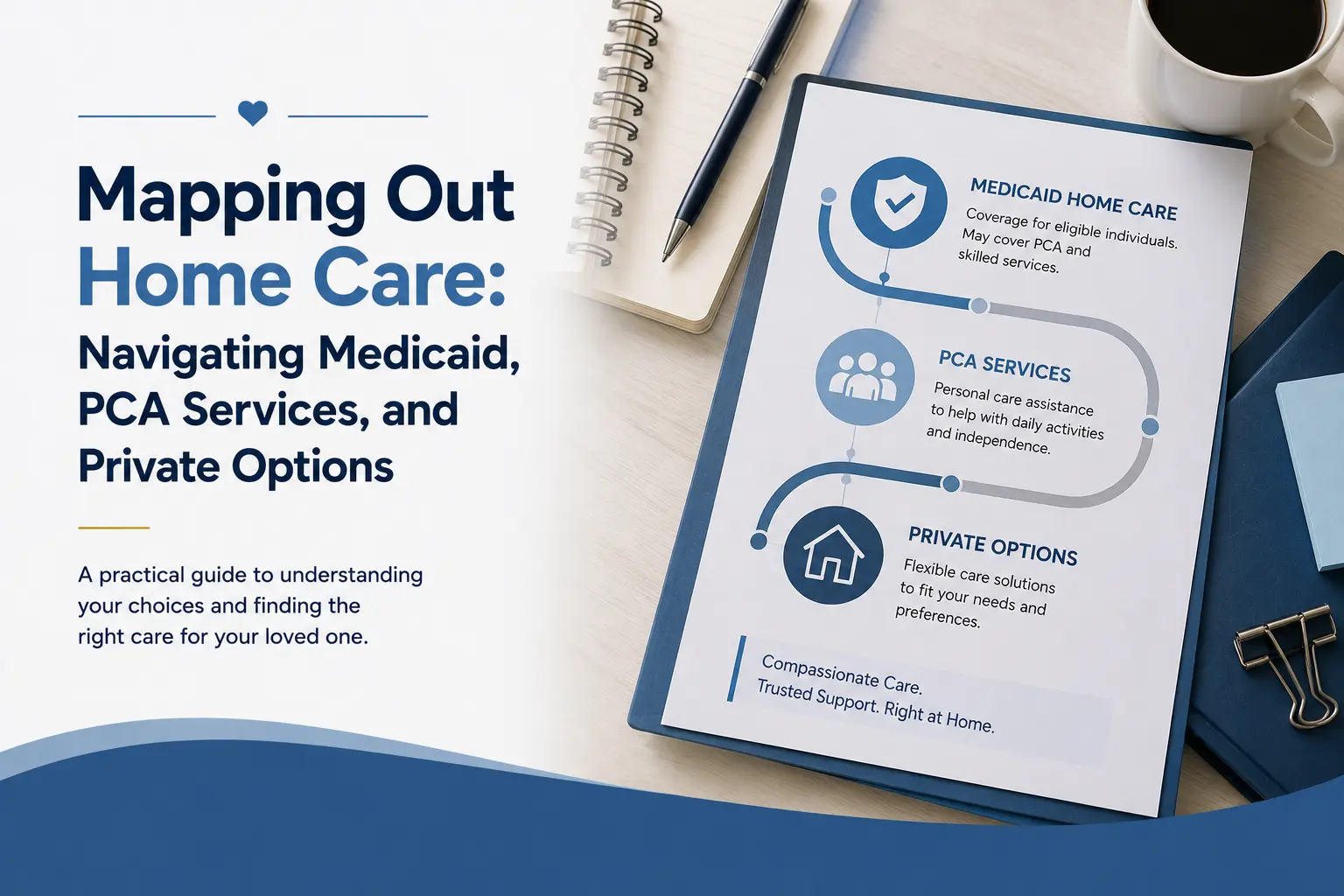
  • Mapping Out Home Care: Navigating Medicaid, PCA Services, and Private Options

    Mapping Out Home Care: Navigating Medicaid, PCA Services, and Private Options

    Mapping Out Home Care: Navigating Medicaid, PCA Services, and Private Options

    By The Advantage Home Care Team • 5 min read

    When exploring home care for a loved one, you quickly realize how many paths exist. First, you must decode financial qualifications. Then, you need to determine the right level of daily assistance. Consequently, building the perfect safety net can feel overwhelming.

    Every family’s starting line is completely unique. Some households have time to plan long-term benefits. However, others face sudden medical changes. These situations require an immediate, safe care solution at home. Ultimately, understanding how funding paths and clinical services intersect helps you find a calm, sustainable routine.

    The Core Strategy: Home care is never one-size-fits-all. Therefore, the best care map blends financial practicality with immediate safety. As a result, your family member gets total personal support without unnecessary delays.

    Step 1: Assessing the Funding Path

    First, families must decide how to fund long-term home support. In New York, this generally divides into two distinct pathways:

    The Medicaid Route

    For families who meet state financial guidelines, qualifying for state-funded support is the ideal long-term choice. Furthermore, it unlocks comprehensive care plans that cover vital personal routines entirely. However, navigating validation paperwork and clinical screenings takes time. Therefore, getting professional support early is crucial. This step prevents administrative approval delays.

    The Private Pay Route

    Sometimes, families do not meet state asset thresholds. Other times, they need care to start immediately after a hospital discharge. Consequently, paying out-of-pocket or via insurance becomes the preferred path. Ultimately, private care skips the red tape entirely. It gives you total control over hours and caregivers. Furthermore, you can instantly set up short-term or 24/7 care.

    Step 2: Defining Daily Personal Support

    Next, you must decide exactly what tasks your caregiver will manage. This ensures comfort and safety at home. Specifically, this is where a certified Personal Care Aide steps in.

    First, a PCA handles the daily physical challenges. This keeps a home running smoothly and safely. For instance, they provide steady physical support during transfers. Additionally, they assist with hygiene, manage light housekeeping, and prepare meals. Most importantly, a PCA preserves your loved one’s pride. It lifts the physical weight of constant caregiving off your shoulders. As a result, you can return to simply being a family member.

    Building Your Family’s Care Plan

    You might choose immediate private flexibility. Alternatively, you could pursue state-funded care. Regardless, the goal remains the same. You want to keep your loved one safe, happy, and autonomous. Fortunately, you don’t have to map out this journey alone. Instead, the right support team simplifies the system every step of the way.

    Quick Links to Our Core Support Programs

    Finally, select a pathway below to explore our dedicated home care frameworks. You will easily find the best match for your situation: