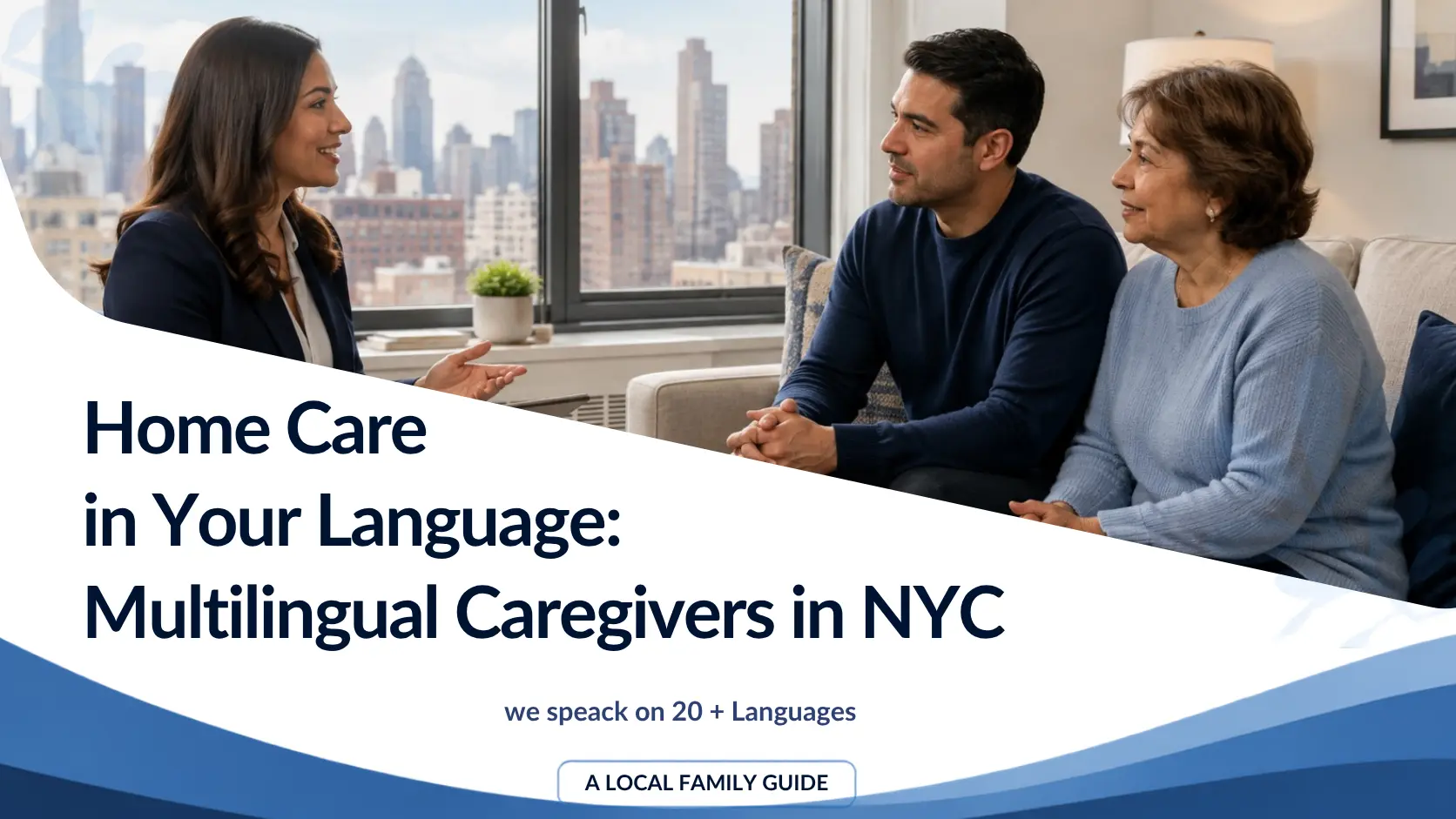
Home Care in Your Language: Russian, Spanish and Multilingual Caregivers in NYC
When a caregiver and a client do not share a language, care quietly stops working. Here is how language matching works in New York, your right to a free interpreter, and exactly what to ask for.
- Language matching is a safety issue, not a preference — it affects medication, pain and mood.
- Ask for it explicitly at intake; agencies match on language, culture and gender when asked.
- Medicaid plans must provide free interpretation — you should never be asked to bring your own.
- People with dementia often lose their second language first and revert to their first.
- This site can be read in other languages using the selector in the menu.
New York City is the most multilingual place on earth, and home care is one of the few services where that fact has consequences every single day. A caregiver spends four, eight, sometimes twenty-four hours in someone’s home. If they cannot understand each other, almost everything that matters degrades — and it does so silently.
Why It Matters More Than People Expect
- Safety. “I feel dizzy,” “my chest hurts,” “I did not take the blue pill.” These have to be understood immediately, not eventually.
- Dignity. Being washed and dressed by someone you cannot speak to is a daily indignity people rarely complain about and always feel.
- Dementia. This is the one families do not see coming. As dementia progresses, people frequently lose a language learned in adulthood and return to their first. A parent who spoke fluent English for fifty years can end up needing a Russian- or Spanish-speaking caregiver for the first time in their life.
- Food, routine and faith. A caregiver who knows what to cook, which holidays matter and what “normal” looks like in that household is doing better care, not softer care.
- Retention. Well-matched placements last. Badly matched ones churn, and every change is disruptive for someone frail.
Language Needs Across the Boroughs
Brighton Beach, Sheepshead Bay and Bensonhurst — Russian and Ukrainian above all, alongside Chinese and Uzbek. Our Sheepshead Bay guide covers the neighbourhood in detail.
Spanish across the South Bronx and Fordham, with growing Bengali and West African communities. See our Bronx guide.
Spanish, Mandarin, Cantonese, Korean, Bengali, Urdu and more — often several within one building. See our Queens guide.
Spanish in Washington Heights and Inwood, Chinese downtown, Haitian Creole across Flatbush and Canarsie. See our Manhattan guide.
How to Ask for a Language Match
The single most useful thing you can do is say it in the first sentence of the first phone call. Not “it would be nice if” — state it as a requirement, the same way you would state a medical need.
- Name the language and the dialect. “Cantonese, not Mandarin.” “Haitian Creole, not French.” It saves a failed placement.
- Say who needs it. Sometimes it is the client; sometimes it is the daughter who manages everything by phone. Both count.
- Add the cultural specifics that matter to you — kosher or halal food handling, shoes off in the home, gender preference for personal care, religious observance.
- Ask what happens for coverage. The real test of an agency is not the first caregiver, it is who covers when that caregiver is sick. Ask whether backup will also be language-matched.
- Ask about the coordinator, too. Being able to reach someone in the office who speaks your language matters as much as the caregiver does.
Our coordinators handle intake in English, Russian and Spanish, and we match caregivers across a much wider range of languages depending on the borough and the schedule. If we cannot match a language for a particular shift, we will tell you plainly rather than send someone and hope.
You have a right to an interpreter. Medicaid managed care plans and health providers in New York are required to provide language assistance at no cost to you. If a plan or an assessor asks you to bring your own interpreter, or leans on a grandchild to translate a clinical conversation, you can request a professional interpreter instead. This matters most during the assessment that decides your hours — a mistranslated answer there costs real care.
Reading This Site in Your Language
Our guides are available in other languages — use the language selector in the site menu to switch. If you would rather simply talk to someone, call 718-375-2707 and say which language you need; we will route you to a coordinator who speaks it or arrange one to call you back.
Where to Start
If you are at the beginning, these are the guides most families read first: how to get started with home care, how to qualify for Medicaid home care, and which type of caregiver you need. If dementia is part of the picture, our dementia guide is worth reading alongside this one.
Frequently Asked Questions
Can I request a Russian-speaking caregiver in Brooklyn?
Yes. Russian-speaking caregivers are among the most requested in South Brooklyn, and we staff Brighton Beach, Sheepshead Bay, Bensonhurst and the surrounding neighbourhoods from our office on Sheepshead Bay Road.
Can I get a Spanish-speaking home attendant?
Yes. Spanish is the most widely requested language across the Bronx, Queens and Upper Manhattan, and we match Spanish-speaking aides and coordinators throughout the five boroughs.
Does asking for a specific language slow down starting care?
Occasionally, by a little, depending on the language, the borough and the shift. It is almost always worth the short wait — a mismatched placement usually has to be replaced anyway.
Do I have to pay for an interpreter for Medicaid appointments?
No. Language assistance must be provided free of charge by Medicaid plans and providers. Ask for a professional interpreter rather than relying on a family member, especially for assessments and clinical appointments.
My parent has dementia and has stopped speaking English. Is that normal?
It is common. People with dementia often lose a language acquired later in life and revert to their first language. It is a good reason to revisit language matching even if it was not needed when care began.
Can the office staff speak my language too?
Our coordinators handle intake in English, Russian and Spanish, and we arrange callbacks in other languages. Tell us at the first call which language you would like to be contacted in.
Tell Us Which Language You Need
Say it on the first call and we will build it into the match — caregiver, backup coverage and the coordinator you deal with.
Call 718-375-2707 Request Care Online