
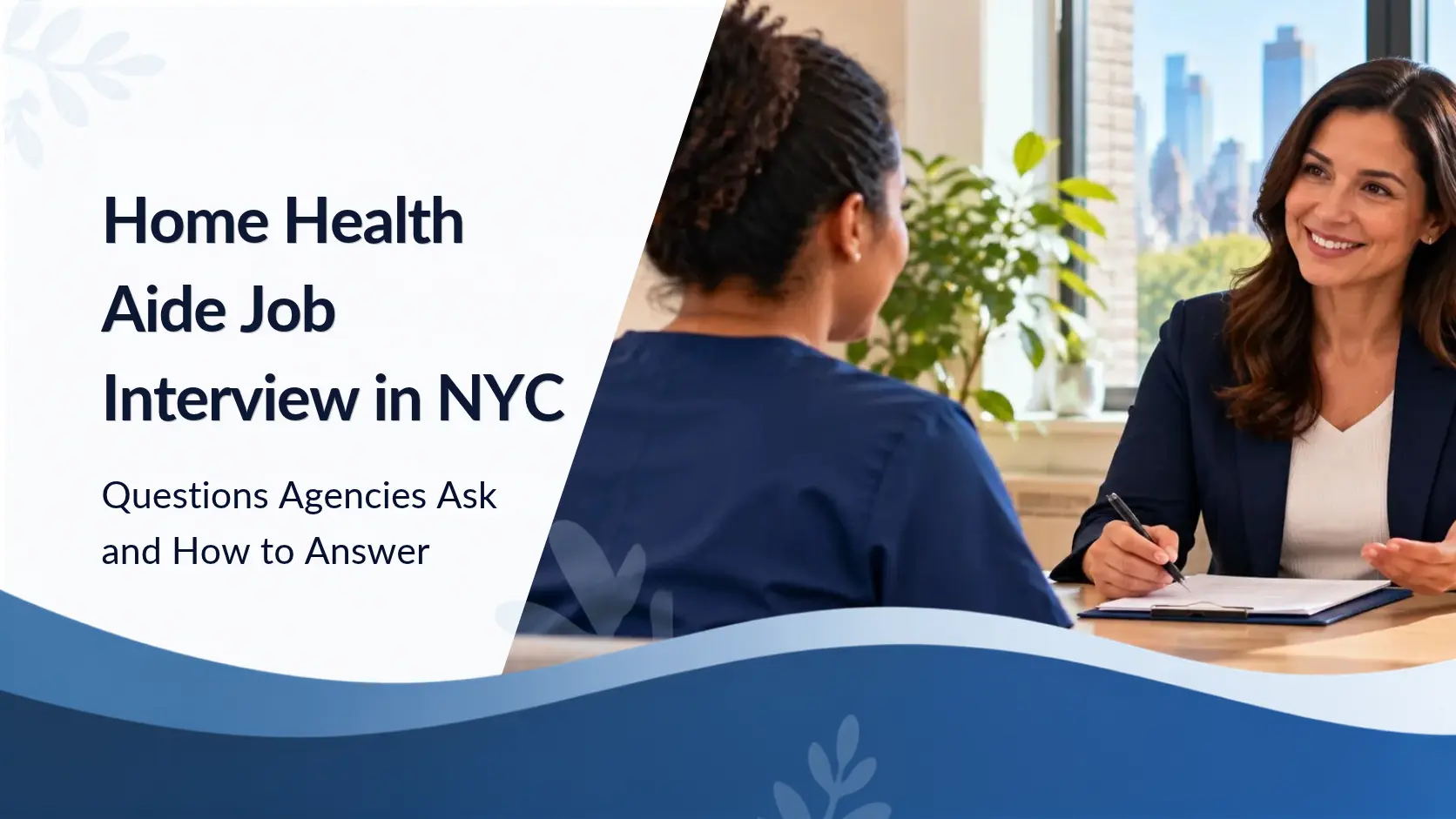
Home Health Aide Job Interview in NYC: Questions Agencies Ask and How to Answer
Agency interviews for aides are usually short and friendly, but a little preparation helps you stand out and get placed on a case faster.
Common home health aide interview questions in NYC cover why you want the job, your experience, your availability, which boroughs you can travel to, languages you speak, and how you would handle situations like a fall or a client refusing care. Answer honestly, give short real examples, and bring all your documents so the agency can move quickly.
What to Expect at a Home Health Aide Interview
If you are preparing for home health aide interview questions, it helps to know what an agency interview in New York City is really like. It is usually not a panel or a test. Most of the time you meet with a recruiter or coordinator, sometimes a nurse, for 15 to 45 minutes. They want to know three things: Can you do the work safely? Will you show up reliably? Will clients and families trust you?
The interview is often part of a longer hiring visit that includes reviewing documents, health requirements, and orientation. That is why having your paperwork ready matters as much as your answers. Our guide to HHA and PCA job requirements in New York lists what to bring.
Common Interview Questions and How to Answer
1. Why do you want to work as a home health aide?
Be sincere and specific. “I took care of my grandmother for two years and I liked helping her stay at home” is stronger than “I like helping people.” If you are new, talk about what drew you to the work and what you learned in training.
2. Tell me about your experience.
Mention paid cases, family caregiving, or work in nursing homes or hospitals. Say what kind of clients you helped: dementia, stroke, wheelchair users, people living alone. If you are newly certified, describe your training and any clinical practice.
3. What days, hours, and boroughs can you work?
This is one of the most important questions. Be honest and clear. Agencies match aides to cases near where they live and by schedule. If you can do weekends, overnights, or live-in cases, say so, since these are often harder to fill.
4. What languages do you speak?
In NYC, languages like Spanish, Russian, Chinese, Haitian Creole, Bengali, Yiddish, and Polish are valuable. Say every language you can speak comfortably with a client, even if you do not read it.
5. What would you do if your client fell?
Agencies want to hear that you stay calm and follow training. A good answer: “I would not try to lift them alone. I would check if they are hurt, keep them comfortable, call 911 if they are injured or I am not sure, and call my coordinator right away. Then I would document what happened.”
6. What would you do if a client refused a bath or medication reminder?
Show patience and respect. “I would not force them. I would try again later, offer choices, explain gently, and if they keep refusing, I would tell my coordinator and the nurse.” For clients with dementia, mention redirecting and keeping a calm routine.
7. A family member asks you to do something not in the plan of care. What do you do?
The right answer is to follow the plan of care. “I would politely explain that I need to follow the plan, and I would call my coordinator so they can discuss it with the family.” Aides do not give injections, change sterile dressings, or make medical decisions.
8. How do you handle stress or a difficult client?
Give a short real example. Talk about staying professional, not taking things personally, and asking for support from your coordinator when needed.
9. Are you comfortable with personal care tasks?
Bathing, toileting, and incontinence care are a big part of the job. Say yes only if it is true, and mention how you protect the client’s dignity and privacy.
10. Do you have any questions for us?
Always ask something. See the list below.
Arriving early shows the reliability agencies need for real cases.
Certificate, ID, work authorization, and health papers in one folder.
Clean, simple clothes or scrubs and closed-toe shoes.
Clear answers about schedule and skills lead to better case matches.
Questions You Should Ask the Agency
- How are cases assigned, and how soon could I start?
- How is pay handled? Is it weekly with direct deposit?
- Do you have hourly, daily, and live-in cases in my borough?
- What benefits are available, such as health insurance or paid time off, and who is eligible?
- Is there union membership?
- Who do I call if there is a problem on a case, and is someone available at night and on weekends?
- What in-service training do you offer?
Pay depends on the case. New York has a home care worker minimum wage that is higher than the general minimum wage, so ask the agency for the current rate for the cases you would work.
Mistakes to Avoid
- Saying you are available “anytime” if you are not. Turning down cases later hurts your reputation with coordinators.
- Talking badly about past employers or clients. Keep it neutral and professional.
- Forgetting documents. Missing papers is the most common reason hiring is delayed.
- Overstating skills. If you have not used a mechanical lift, say so. Agencies can train you.
- Using your phone during the interview. Put it away.
After the Interview
If the agency is interested, the next steps often include completing health requirements, background checks, orientation, and learning the agency’s time and attendance system. Respond quickly to calls and messages. Coordinators often have cases that need to be filled the same week, and the aide who answers first often gets the case.
If you are not certified yet, start there. Our guides to becoming a PCA in NYC and free HHA training in NYC explain the options. To understand which certificate fits your goals, read PCA vs HHA jobs.
Tip: practice your answers out loud with a friend. Short, honest answers with one real example are better than long speeches.
Interviewing With Advantage Home Care
Advantage Home Care hires PCAs and HHAs across the five boroughs for hourly, daily, and live-in cases. We offer weekly pay with direct deposit, health insurance and paid time off for eligible staff, union options, in-service training, and 24/7 coordinator support. Our PCA training school holds classes in English and Spanish. Read more about starting your career with Advantage Home Care, or see what agencies look for in our guide to HHA jobs in Brooklyn.
Related Guides
HHA jobs in Brooklyn · Advantage Home Care jobs · HHA jobs in the Bronx · Documents you need
Frequently Asked Questions
What questions are asked in a home health aide interview?
Expect questions about your experience, availability, boroughs you can travel to, languages, and how you would handle situations like a fall, a refusal, or a request outside the plan of care.
What should I wear to a home health aide interview?
Clean, neat, simple clothes or scrubs with closed-toe shoes. Keep jewelry and perfume minimal, as you would on a case.
What documents should I bring to an HHA interview in NYC?
Bring your HHA or PCA certificate, photo ID, work authorization, Social Security card, and any health records the agency requested. Ask the agency for its list ahead of time.
How long does a home care agency interview take?
The interview itself is often 15 to 45 minutes, but the full hiring visit with paperwork can take longer. Plan for a few hours.
Can I get hired as a home health aide with no experience?
Yes, many agencies hire newly certified aides. Talk about your training, family caregiving, and willingness to learn.
How do I answer “what would you do if the client falls?”
Say you would not lift them alone, check for injury, call 911 if needed, call your coordinator, and document the incident. That shows safety and good judgment.
Ready for Your Interview?
Apply online and our recruiting team will contact you to schedule a visit.
Apply NowSee Careers