
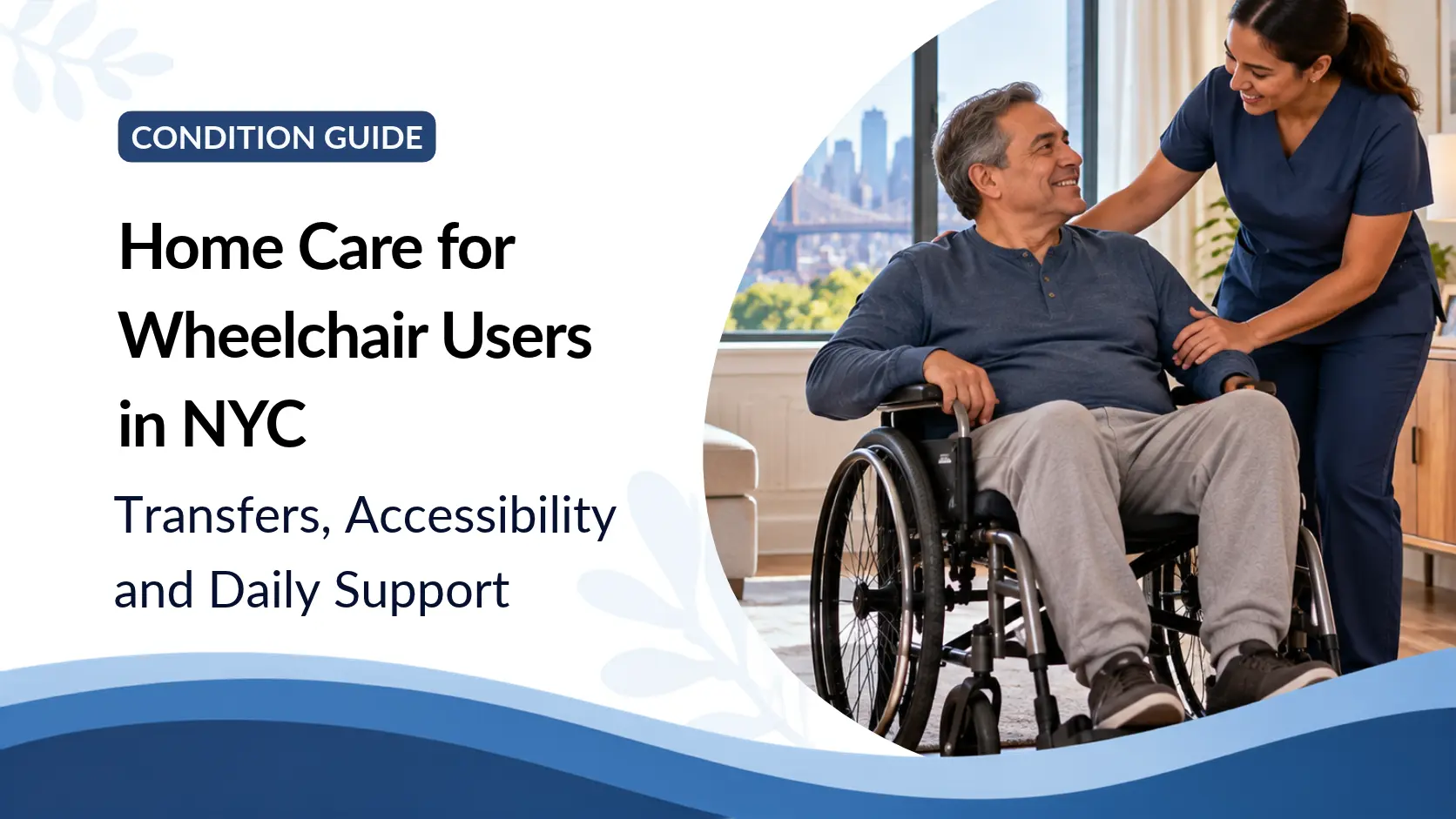
Home Care for Wheelchair Users in NYC: Transfers, Accessibility and Daily Support
When a parent uses a wheelchair, every part of the day, from getting out of bed to getting out the door, takes planning. Here is how home care helps in a New York City home.
Home care for wheelchair users focuses on safe transfers (bed, chair, toilet, shower), personal care, skin protection, and getting around the home and neighborhood. In NYC, a PCA or HHA can provide this help, often paid by Medicaid based on how much hands-on assistance is needed. Some people need two aides or a mechanical lift for safe transfers.
What Home Care for Wheelchair Users Involves
Home care for wheelchair users is less about the wheelchair itself and more about everything around it. People use wheelchairs after a stroke, with multiple sclerosis, ALS, Parkinson’s, spinal cord injury, amputation, severe arthritis, or general weakness after illness. Some can stand briefly and pivot. Others cannot bear weight at all. The amount and type of help depends on that difference.
A trained aide can help with:
- Transfers: bed to wheelchair, wheelchair to toilet or commode, wheelchair to shower chair, and back.
- Personal care: bathing, dressing, grooming, toileting, and incontinence care.
- Positioning: helping your parent shift weight and change position to protect the skin, as instructed by the nurse or therapist.
- Meals and household tasks: cooking, setting things within reach, laundry, and light cleaning.
- Getting out: escorting to appointments, the pharmacy, or a walk outside.
- Equipment care: keeping the chair clean, checking that brakes are on before transfers, and noticing worn parts to report.
Safe Transfers: The Most Important Part of the Day
Most injuries for wheelchair users and their caregivers happen during transfers. That is why the plan of care should spell out exactly how each transfer is done.
For people who can bear some weight. The aide guards and guides while your parent stands and turns.
A smooth board bridges the gap between surfaces so your parent can slide across with help.
For people who cannot bear weight. Often requires two people for safety, depending on the plan.
A sturdy belt around the waist gives the aide a safe handhold during standing transfers.
A physical or occupational therapist should teach the right method for your parent, and the agency nurse should confirm the aide can do it safely. Never let anyone lift your parent under the arms, which can injure shoulders. If your parent is larger or fully dependent, two aides may be needed. Our guide to bariatric home care and two-aide transfers explains when Medicaid may authorize a second aide.
General information only, not medical advice. Ask your parent’s doctor or therapist which transfer method is safe for them.
Protecting the Skin
Sitting for long periods puts pressure on the tailbone, hips, and heels. Pressure sores can develop faster than most families expect. The doctor, nurse, or therapist will advise on a pressure-relieving cushion and how often your parent should shift weight or reposition. The aide can help with those changes, keep skin clean and dry, and report any red or darkened areas that do not fade. For people who spend most of the day in bed as well as a chair, see our guide to preventing pressure sores.
Making a NYC Home Wheelchair Accessible
New York apartments were rarely built with wheelchairs in mind. Common problems include narrow doorways, small bathrooms, raised thresholds, and buildings with steps at the entrance. Practical fixes:
- Clear paths: remove throw rugs, extra furniture, and cords so the chair can turn.
- Bathroom: a tub transfer bench, handheld shower, raised toilet seat or commode, and grab bars installed into studs.
- Bedroom: a hospital bed with adjustable height makes transfers safer for everyone.
- Doorways: offset hinges can add a little width without major construction.
- Entrance: ask the landlord or building management about a ramp or other accommodation.
Many of these items may be covered with a prescription. Our guide on whether Medicaid covers a hospital bed, wheelchair, or grab bars explains the process. The home safety checklist is also helpful before care starts.
Walk-ups and elevator buildings
For a wheelchair user living in a walk-up, getting outside may require help from more than one person or specialized equipment, and it can be unsafe without the right setup. Families in this situation sometimes look into a ground-floor or elevator apartment. In elevator buildings, ask management to tell you about planned elevator outages in advance.
Getting Around the City
An aide can accompany your parent to appointments and errands. Options include Access-A-Ride, accessible taxis, Medicaid non-emergency transportation for medical visits (arranged in advance), and accessible subway stations with elevators. Buses in NYC have ramps or lifts. Plan extra time, and check elevator status before relying on a subway station.
Supporting Independence, Not Replacing It
Good home care does not mean doing everything for your parent. Many wheelchair users can still wash their face, brush their teeth, feed themselves, or propel the chair short distances. The aide should encourage what your parent can do safely and step in only where help is needed. This protects strength, dignity, and mood. Ask the therapist which tasks your parent should keep practicing, and share that list with the aide and the agency nurse so it becomes part of the daily routine. Small daily wins, like dressing the upper body independently, matter a great deal over months of care.
Paying for Home Care for Wheelchair Users
Medicaid home care hours are based on how much help your parent needs with activities of daily living such as bathing, dressing, toileting, transferring, and eating. Using a wheelchair does not automatically mean a set number of hours. What matters is how much hands-on help is needed and how often, including at night. Someone who needs help for every toilet transfer may need much more care than someone who transfers independently.
Most adults who need long-term care get it through a Managed Long Term Care plan, after an assessment by the New York Independent Assessor. Our guides to how many hours of Medicaid home care you can get and how to prepare for the assessment explain how to describe transfer needs clearly. Medicare covers short-term skilled home health and some equipment, but not long-term personal care.
Condition-Specific Guides
Wheelchair needs often come with a specific diagnosis. These guides go deeper: home care after a stroke and home care for multiple sclerosis.
Related Guides
Medicaid equipment coverage · Two-aide transfers · Preventing pressure sores · Stroke recovery at home
Frequently Asked Questions
Can a home health aide transfer someone from a wheelchair?
Yes. PCAs and HHAs are trained in transfers, and the plan of care should specify the method. Some people need a mechanical lift or two aides for safety.
Does Medicaid pay for home care for wheelchair users in NYC?
Medicaid can cover home care when your parent qualifies financially and needs help with daily activities. Hours depend on the level of hands-on help needed, not the wheelchair itself.
Will Medicaid cover a Hoyer lift?
Medicaid may cover a mechanical lift and other equipment with a prescription and documentation of need. Your doctor and plan care manager can help start the request.
How often should a wheelchair user change position?
It varies by person and skin condition. Ask the doctor, nurse, or therapist for a specific schedule, and share it with the aide.
Can a wheelchair user live in a walk-up apartment in NYC?
It is possible but often difficult, since getting outside safely may require extra help or equipment. Some families seek an elevator or ground-floor apartment.
Can the aide take my parent to appointments in a wheelchair?
Yes. Aides commonly escort wheelchair users using Access-A-Ride, accessible taxis, buses, or Medicaid medical transportation.
Support for Safe Days at Home
Call us to talk about aides trained in safe transfers and daily support for wheelchair users.
Call 718-375-2707Start Home Care