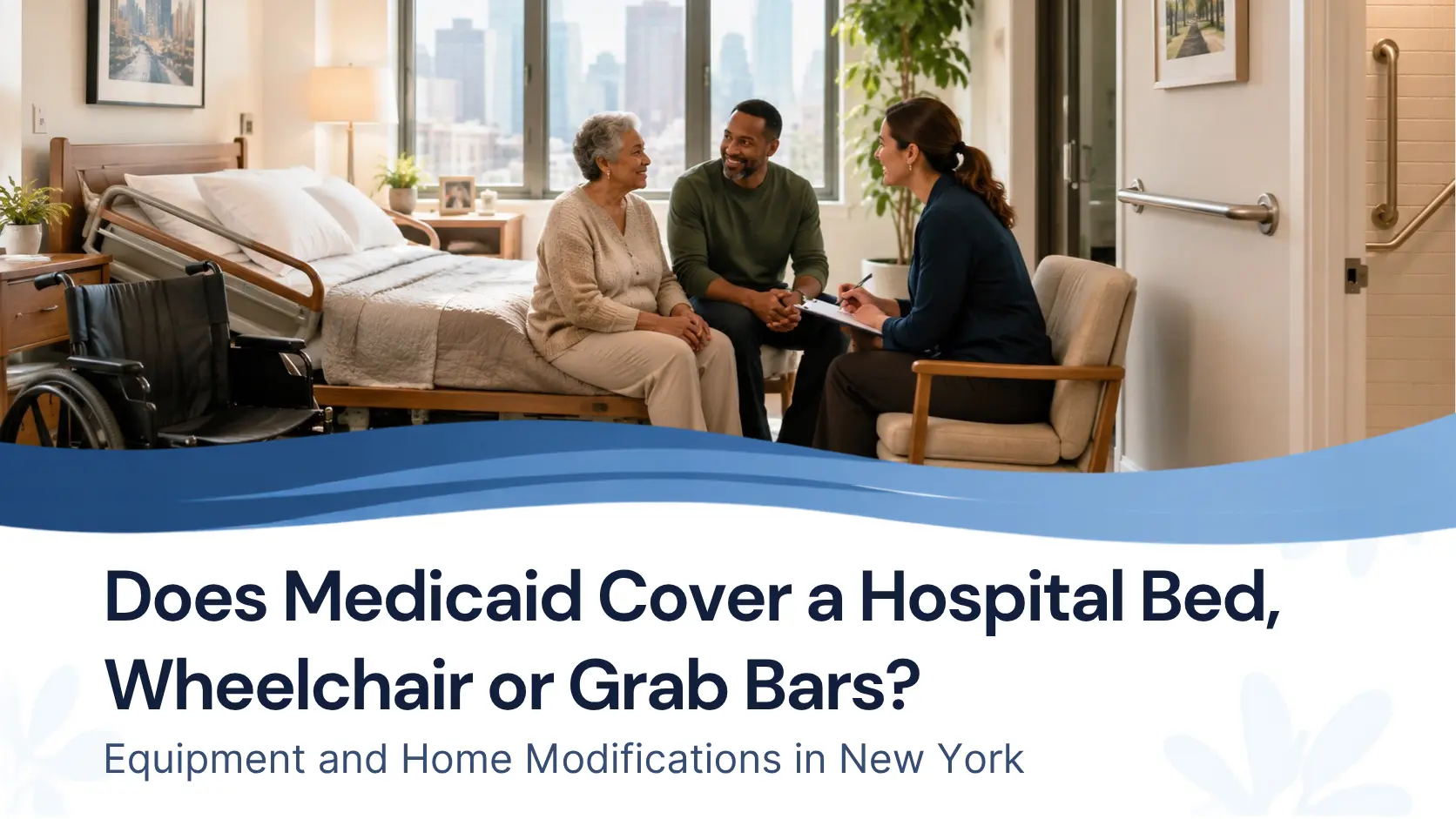
Does Medicaid Cover a Hospital Bed, Wheelchair or Grab Bars? Equipment and Home Modifications in New York
An aide is only half of staying home safely. The other half is the bed, the chair, the bars on the bathroom wall — and New York Medicaid covers more of it than most families realise.
- Equipment and home modifications are two different benefits with two different processes.
- Durable medical equipment — beds, wheelchairs, walkers, commodes — needs a doctor’s order and often prior approval.
- Construction-grade changes like ramps, grab bars and roll-in showers are covered as environmental modifications.
- Those need clinical justification from a therapist plus a physician’s order, submitted by your care manager.
- General home improvements are excluded — the change has to address an assessed care need.
Families often assume the aide is the whole answer. Then the first transfer happens and it becomes obvious that the problem is partly the apartment: a bath nobody can step into, a bed too low to get out of, three steps at the front door that may as well be a wall.
New York Medicaid covers both categories of fix. They work differently, so it helps to know which one you are asking for.
Category One: Durable Medical Equipment
Durable medical equipment (DME) is the movable, reusable, medically necessary kit: hospital beds, manual and power wheelchairs, walkers and rollators, commodes, shower chairs, patient lifts, oxygen equipment, nebulisers, hospital-grade mattresses.
- A doctor’s order is required establishing medical necessity.
- Prior approval is common — especially for higher-cost items like beds, lifts and custom wheelchairs.
- It comes through an enrolled supplier, not from the home care agency.
- Repairs and replacement are generally covered too when the item is still needed and no longer serviceable.
Realistically the timeline runs to weeks, not days, so start the order as soon as the need is clear — ideally while the person is still in hospital or rehab and a doctor is right there to write it.
Category Two: Environmental Modifications
Environmental modifications — E-Mods — are the construction-grade changes to the home itself. In New York these are covered under the Community First Choice Option as a Medicaid State Plan service, and also through the NHTD, TBI and OPWDD waiver programs.
Ramps, lifts that require structural work, widened doorways, automatic door openers.
Roll-in showers, accessible tubs, grab bars and hand rails, related plumbing work.
Electrical and plumbing accommodations needed to make an approved modification function.
General improvements with no clinical purpose — central air conditioning, new carpet, roof repair — and anything that adds square footage or goes beyond the assessed need.
How an E-Mod gets approved
- A clinician justifies it. An occupational therapist, physical therapist or other licensed clinician documents how the modification addresses an assessed need with daily activities or health.
- A physician’s order documenting the need is required before work proceeds.
- Your care manager submits it to the local Department of Social Services or your managed care plan.
- Contractors bid. Projects above a modest threshold go out to bid, and larger annual amounts need Department of Health approval.
Two practical implications. First, this takes real time — assume months rather than weeks for anything structural. Second, if you rent, you will need the landlord’s cooperation, so raise it early.
Renting in New York? Most of our clients do. Landlord permission is usually the long pole for anything structural. Reversible options — a tub transfer bench instead of a roll-in shower, a portable threshold ramp instead of a permanent one, a grab bar that mounts without major work — often solve the immediate safety problem while a bigger modification is being considered.
Waivers Cover More
If the person is enrolled in a waiver program, the menu widens: assistive technology, more extensive environmental modifications, and in some cases vehicle modifications. This applies to the NHTD and TBI waivers for people with physical disabilities and brain injuries, and to OPWDD services for people with developmental disabilities.
See NHTD and TBI support services, home care for adults with disabilities, and OPWDD services in NYC.
What Medicare Does and Does Not Do Here
Medicare covers durable medical equipment — wheelchairs, walkers, hospital beds — when a doctor certifies it is medically necessary for use at home. It does not pay for home modifications. Grab bars, ramps and bathroom remodelling are not Medicare benefits, which is a frequent and expensive surprise.
What You Can Do This Week Without Waiting for Anyone
Approval processes are slow and falls are not. While the paperwork moves, the cheap fixes matter more than people expect: clear the walking routes, remove loose rugs, add night lights on the path to the bathroom, move daily items to waist height, put a chair in the shower. Our home safety checklist and fall prevention guide are written for exactly this, and both are free to act on today.
If the goal is staying put long term, read aging in place in NYC alongside this.
Frequently Asked Questions
Does Medicaid cover a hospital bed at home in New York?
Yes, as durable medical equipment, when a doctor documents medical necessity. Higher-cost items like hospital beds typically require prior approval and are supplied through an enrolled DME provider.
Will Medicaid pay for grab bars or a ramp?
These fall under environmental modifications rather than equipment. New York covers them under the Community First Choice Option and through waiver programs, with clinical justification from a therapist and a physician’s order, submitted through your care manager.
How long does approval take?
Equipment generally runs to weeks. Construction-type modifications involve assessment, documentation, bidding and authorisation, so plan for months. Start as early as the need is identified.
Does Medicare cover home modifications?
No. Medicare covers durable medical equipment prescribed for use at home, but not structural changes such as grab bars, ramps or bathroom remodelling.
What if we rent our apartment?
Structural modifications need the landlord’s permission, which is often the slowest part. Reversible alternatives such as transfer benches, portable ramps and non-structural grab bars can address the immediate risk in the meantime.
Who starts the process?
Usually your care manager or care coordinator, working with the doctor and a therapist. If you are not sure who that is for your case, your home care agency’s care coordination team can point you in the right direction.
More Equipment Questions
Does Medicaid cover stair lifts in NY?
Standard New York Medicaid does not cover a stair lift as durable medical equipment. Environmental modifications, including stair lifts and ramps, can be funded through waiver programs such as NHTD, TBI and OPWDD when they are in the service plan and the person would otherwise not be able to stay at home. Ask your service coordinator or call 718-375-2707 to check which program fits.
Not Sure What You Can Get Covered?
Tell us what is difficult at home and we will tell you which route applies — equipment, modification or simply more hours of help.
Call 718-375-2707 Request Care Online