
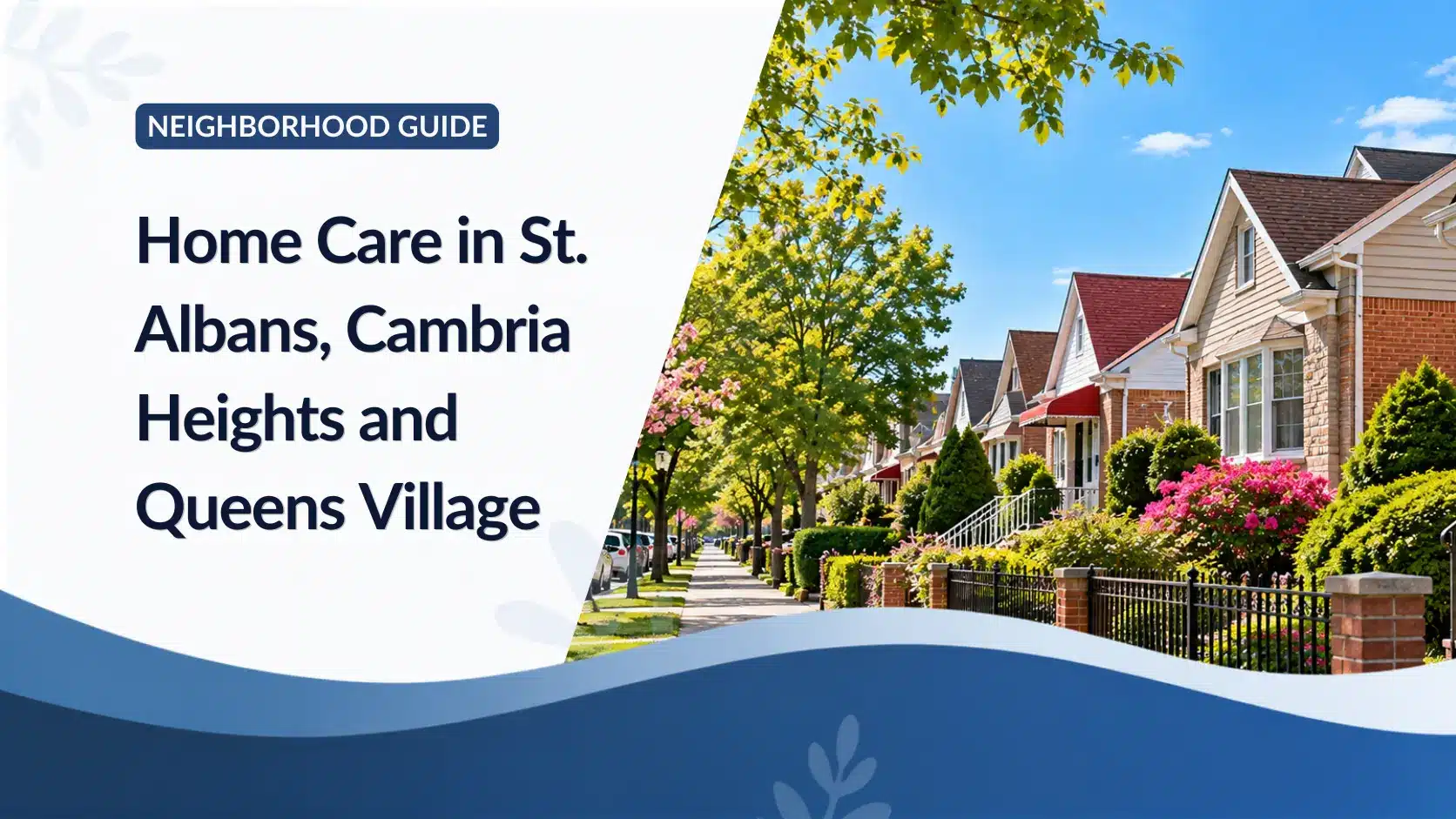
Home Care in St. Albans, Cambria Heights and Queens Village: A Southeast Queens Family Guide
Southeast Queens is a neighborhood of family homes and long-time owners. Here is how home care works when your parent wants to stay in the house they have lived in for decades.
Home care in St. Albans, Queens, Cambria Heights, and Queens Village is available through Medicaid (usually a Managed Long Term Care plan) or private pay. A licensed agency sends trained PCAs or HHAs to help with bathing, dressing, meals, and getting around the house. Families can start by calling an agency or applying for Medicaid home care.
Home Care in St. Albans, Queens and Its Neighbors
If you are looking for home care in St. Albans, Queens, or the neighborhoods next door, you are part of a community where many older adults have owned their homes for 30, 40, or 50 years. St. Albans, Cambria Heights, and Queens Village sit in southeast Queens near the Nassau County line. They are known for tree-lined blocks of detached and semi-attached houses, many with driveways, small yards, and basements.
The area has long been home to Black families, including many Caribbean households with roots in Jamaica, Haiti, Guyana, and Trinidad and Tobago. In parts of Queens Village you will also find South Asian and Latino families. Older adults here often speak English, Haitian Creole, or Spanish at home, and many families care deeply about keeping a parent in the house they worked hard to buy.
Common Care Needs in Southeast Queens
The housing stock shapes the care. Unlike apartment neighborhoods, the main challenges here are inside the house:
- Stairs inside the home. Bedrooms and the only full bathroom are often upstairs. Many families move a parent’s bedroom to the first floor.
- Front steps. Brick stoops and steps without good railings make getting out to appointments hard.
- Older bathrooms. Tubs with high sides and no grab bars are a common fall risk.
- Living alone in a large house. When children have moved to Long Island or out of state, a parent may be on their own in a multi-bedroom home.
- Chronic conditions. Diabetes, high blood pressure, heart failure, and stroke recovery are common reasons families reach out.
A home care aide can help with bathing, dressing, toileting, meals, light housekeeping, laundry, and walking safely between floors. Our home safety checklist for seniors is a good place to start before care begins.
Help with bathing, dressing, grooming, toileting, and transfers.
Meal preparation, laundry, light cleaning, and shopping errands.
Escort to doctor visits, the pharmacy, church, or a senior center.
Conversation, routine, and someone noticing when things change.
Paying for Home Care: Medicaid and MLTC
Most long-term home care in this part of Queens is paid for by Medicaid. Owning a home does not automatically disqualify your parent, especially when they live in it, though the rules on assets and income are detailed. For adults who need care for more than 120 days and are eligible for both Medicare and Medicaid, care usually comes through a Managed Long Term Care (MLTC) plan.
The typical path looks like this:
- Apply for Medicaid, or confirm your parent already has it.
- Schedule an assessment with the New York Independent Assessor (NYIA). A nurse completes a Community Health Assessment, and a separate clinician issues the Practitioner Order.
- Choose an MLTC plan, which then decides the hours and works with an agency to send an aide.
This often takes several weeks. If your parent needs help sooner, read about immediate need home care in NYC. To check whether your parent might qualify, try our 2-minute self-check.
Many families in southeast Queens are over the income limit. If that applies to your parent, our guide to excess income and pooled income trusts explains a common solution. Income and asset limits change each year, so check current figures with HRA or New York Medicaid.
Private Pay Home Care
Some families choose private pay, either while Medicaid is pending or because they want flexible hours. Private pay lets you start quickly and set the schedule yourself, from a few hours a few days a week to live-in care. Our guide to private pay home care costs in NYC explains how rates are structured.
Veterans in Southeast Queens
St. Albans has a long connection to veterans care through the VA’s St. Albans campus on Linden Boulevard. If your parent served in the military, VA benefits may help with home care costs or services. Our guide to home care for veterans in NYC explains how to start.
How Scheduling and Travel Work for Aides
Southeast Queens is less served by the subway than other parts of the city, so travel matters when an agency matches an aide. Many aides who work in this area live nearby in Jamaica, Hollis, Laurelton, Springfield Gardens, or eastern Queens, and get around by bus along major roads like Linden Boulevard, Francis Lewis Boulevard, Springfield Boulevard, and Jamaica Avenue. The LIRR also has stations in St. Albans and Queens Village.
Agencies try to match aides who live close by so they arrive on time, especially for early morning shifts and in bad weather. Ask the agency where the assigned aide is traveling from, and let them know if your street has parking or a nearby bus stop. For families who want a consistent aide, a short commute is one of the best predictors of reliability.
Getting Started: A Simple Plan for Families
If you are not sure where to begin, start small. Write down what your parent can and cannot do safely on their own, such as climbing the stairs, getting in and out of the tub, cooking, and remembering medications. Note any recent falls or hospital visits. Then call an agency to talk through options. If Medicaid is the likely payer, gather your parent’s ID, Medicare and insurance cards, proof of income, and recent bank statements. If you live outside the city, ask a nearby relative or neighbor to be available for the first home visit. Our step-by-step guide to getting started with home care lays out the full process.
Local Resources
- Older adult centers. NYC Aging (formerly DFTA) funds older adult centers in southeast Queens that offer meals, activities, and case assistance. Call 311 to find the closest one.
- Hospitals. Many residents use Queens Hospital Center or Jamaica Hospital Medical Center, and some use Long Island Jewish Medical Center near the Nassau border.
- Places of worship. Churches in the area often run visiting ministries and can be a good support network alongside paid care.
- 311. For home-delivered meals, case management, and information on senior services.
Related Guides
Home care in Queens · Jamaica and Richmond Hill · Fresh Meadows, Jamaica Estates and Hollis · Getting started with home care
Frequently Asked Questions
Is home care available in St. Albans, Queens?
Yes. Licensed agencies, including Advantage Home Care, send aides to St. Albans, Cambria Heights, Queens Village, and the rest of southeast Queens through Medicaid plans and private pay.
Can my parent get Medicaid home care if they own their house in Queens?
Often yes. A home the person lives in is treated differently from other assets, but rules are detailed. Check with HRA or a Medicaid application service for your parent’s situation.
Can I get an aide who speaks Haitian Creole in Cambria Heights?
Ask the agency at intake. Language matching depends on aide availability, but Creole, Spanish, and Caribbean English speakers are common among NYC aides.
How long does it take to start home care in southeast Queens?
Private pay can often start within days. Medicaid home care through an MLTC plan often takes several weeks because of the assessment and enrollment steps.
Can an aide help my parent with stairs at home?
Yes, aides help with walking and stairs as the plan of care allows. For safety, many families also move the bedroom downstairs and add railings.
Does Medicare pay for long-term home care in Queens?
No. Medicare covers only short-term, part-time skilled home health. Long-term personal care is usually paid by Medicaid or privately.
Care for Your Parent in Southeast Queens
Call us to talk through Medicaid or private pay options for St. Albans, Cambria Heights, and Queens Village.
Call 718-375-2707Start Home Care