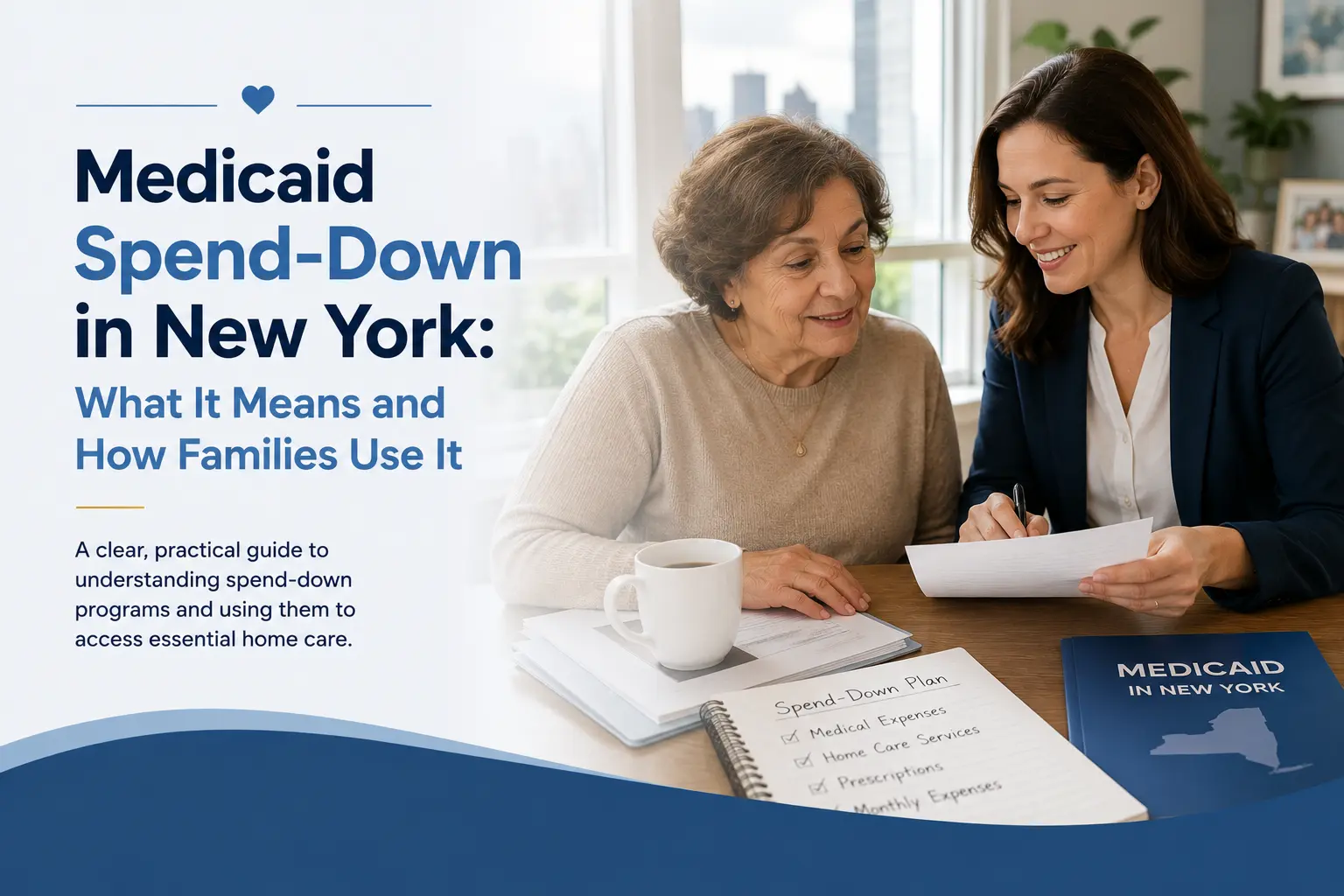
Medicaid Spend-Down in New York: What It Means and How Families Use It
Many families assume they earn too much for Medicaid. New York’s spend-down program changes that calculation — and understanding it could be the key to accessing home care coverage for your loved one.
- Medicaid spend-down allows people with income above the standard limit to still qualify for Medicaid coverage.
- It works like a deductible — you “spend down” excess income on medical costs, then Medicaid covers the rest.
- Pooled income trusts are the most practical way most NYC families meet their spend-down obligation.
One of the most common things families tell us when they first call is some version of: “We don’t think we qualify for Medicaid — my father’s Social Security is too high.” In many cases, they’re wrong. New York’s Medicaid spend-down program exists specifically for situations like this, and it opens the door to home care coverage for families who would otherwise be locked out.
What Is Medicaid Spend-Down?
Medicaid in New York has income limits. If someone earns more than the limit, they ordinarily wouldn’t qualify. But the spend-down program says: if your excess income goes toward medical expenses, Medicaid will cover everything else once that threshold is met.
Think of it like a health insurance deductible. You pay a set amount first — your “excess income” — and Medicaid kicks in for the remainder of your medical and care costs. For people who need regular, ongoing home care, this can be an enormously valuable path to coverage.
How the Spend-Down Calculation Works
Add up all sources: Social Security, pension, retirement distributions, investment income, and any other regular income.
New York sets a monthly income limit for Medicaid eligibility. The difference between your income and this limit is your “excess income.”
Each month, you must show that your excess income has been applied to allowable medical expenses before Medicaid coverage activates.
Once the spend-down threshold is met, Medicaid covers all remaining eligible expenses — including home care — for the rest of that period.
The Pooled Income Trust: How Most Families Handle Spend-Down
In practice, very few people can afford to simply pay their excess income out of pocket toward medical bills each month. That’s where a pooled income trust comes in — and it’s the most common and practical way families in NYC meet their Medicaid spend-down obligation.
A pooled income trust is a legal account managed by a nonprofit organization. Each month, the person deposits their excess income into the trust. The trust then pays their bills — rent, utilities, groceries, personal expenses — while the deposit itself satisfies the spend-down requirement. Medicaid coverage activates, covering home care costs for the month.
This structure lets your loved one keep their income available for living expenses, while still qualifying for Medicaid. It requires proper legal setup and ongoing administration, which is why working with an experienced team matters.
Common Questions Families Ask
Medicaid also has asset limits separate from income. If someone has excess assets (savings, investments), there are separate strategies — some legal, some not — for addressing this. A spend-down program specifically addresses monthly income, not assets.
Medical bills, prescription costs, health insurance premiums, home care costs, and certain other health-related expenses typically count toward the spend-down. The exact list varies — a care coordinator can walk through what applies in your situation.
Yes. Many Managed Long-Term Care plans in New York work with spend-down enrollees. The process of coordinating between a pooled income trust and an MLTC plan can be complex, but it’s a common arrangement in NYC.
Getting the Right Help
Medicaid spend-down planning isn’t something to navigate alone. An error in the setup — wrong income calculation, improper trust documentation, missing paperwork — can delay coverage by months. Advantage Home Care’s team works with families throughout the process: confirming income and eligibility, connecting families with the right legal and trust resources, and making sure the path to home care coverage is as smooth as possible. If you’re not sure whether spend-down applies to your situation, the right first step is a conversation.