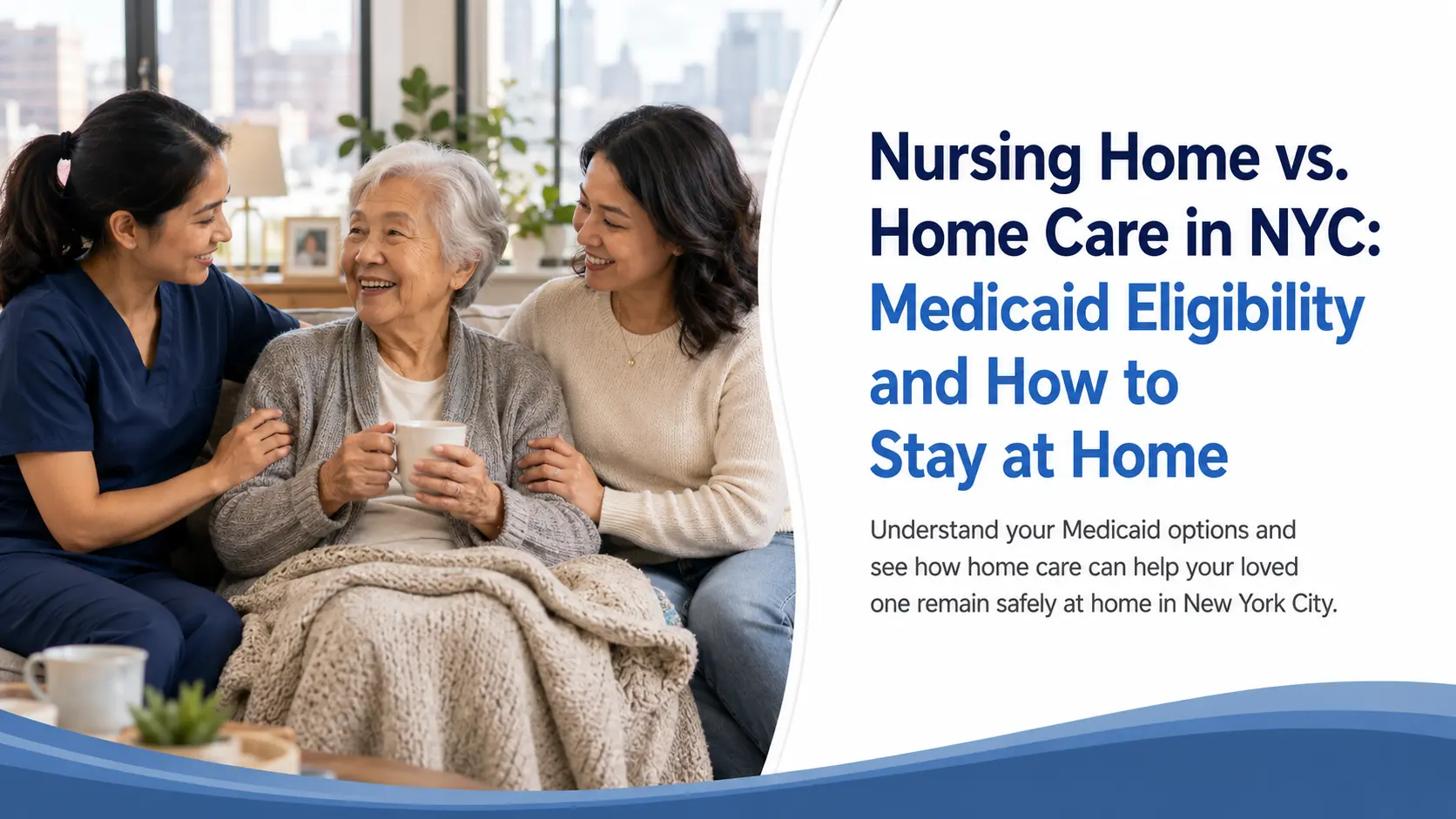
Nursing Home vs. Home Care in NYC: Medicaid Eligibility and How to Stay at Home
When a loved one needs more care than the family can provide, a nursing home can feel like the only option. For most New Yorkers, it isn’t. Here’s how nursing home and home care Medicaid differ — and how to keep your loved one safely at home.
- Medicaid for a nursing home and Medicaid for home care are two different programs with different eligibility rules.
- Home care (community) Medicaid is often more accessible than families expect — and being over the income limit doesn’t automatically disqualify you.
- With enough authorized aide hours, most people who would “qualify for a nursing home” can be supported safely at home instead.
After a hospitalization, a fall, or a dementia diagnosis, families are often told their loved one “needs a nursing home.” It’s one of the most stressful moments a family faces — and one where the available options are widely misunderstood. In New York, the same person who qualifies for nursing-home-level care can very often receive that care at home instead, funded by a different branch of Medicaid. Understanding the difference is the first step to making a real choice rather than a forced one.
Two Different Medicaid Programs
People use “Medicaid” as if it were one thing, but for long-term care it splits into two very different pathways, each with its own rules:
This distinction matters enormously. Families who are told “you have too many assets” or “you won’t qualify” are often being measured against nursing home rules — when the home care pathway may have been open to them all along. If you’ve been discouraged based on institutional rules, it is always worth asking specifically about community-based Medicaid home care.
Who “Qualifies for a Nursing Home”? (And Why That Person Can Usually Stay Home)
To receive Medicaid in a nursing home, a person must be assessed as needing a “nursing-facility level of care” — meaning substantial help with daily activities and health oversight. Here’s the part many families don’t realize: that same level of need is exactly what qualifies someone for substantial home care hours. New York’s home care and waiver programs are specifically designed to let people who could be institutionalized remain in the community instead.
In practice, that means a person who needs help with bathing, dressing, mobility, meals, and medication supervision can often receive many hours of aide support at home — up to and including around-the-clock coverage — rather than moving into a facility.
Why Families Choose Home Over a Facility
What If You’re “Over the Income Limit”?
Being over the Medicaid income limit is one of the most common reasons families assume they don’t qualify — and one of the most common misunderstandings. New York offers established tools that let people with income above the standard threshold still receive home care:
- A Medicaid spend-down, where excess monthly income goes toward care costs.
- A pooled income trust, which shelters excess income so it can be used for the person’s own household expenses while they still receive Medicaid home care.
These are legitimate, widely used strategies — not loopholes. The paperwork can be intricate, which is exactly where working with an experienced team makes the difference between a denial and an approval.
How to Keep a Loved One Home Instead
Frequently Asked Questions
Is Medicaid home care eligibility the same as nursing home Medicaid?
No. They are separate pathways. Nursing home (institutional) Medicaid applies a five-year look-back on asset transfers and stricter financial rules, while community-based Medicaid home care generally has a more flexible eligibility path. Being told you don’t qualify for one doesn’t mean you don’t qualify for the other.
Can someone who needs a nursing home level of care really stay home?
Very often, yes. The same assessment that qualifies a person for a nursing home also qualifies them for substantial home care hours — sometimes including around-the-clock coverage — so they can remain in the community with the right support in place.
What if our income is too high for Medicaid?
Income above the standard limit doesn’t automatically disqualify you. A spend-down or a pooled income trust can allow someone over the income threshold to still receive Medicaid home care. These are common, legitimate tools in New York.
How many home care hours can Medicaid authorize?
Hours are based on assessed need. Someone with significant needs can qualify for many hours per day, and in some cases 24-hour or live-in care, keeping them safely at home instead of in a facility.
Explore Staying Home Before You Decide
Before accepting a nursing home as the only option, let us help you understand what home care could look like — coverage, hours, and eligibility. Call 718-375-2707 or reach out online, and our care coordination team will walk you through it.