
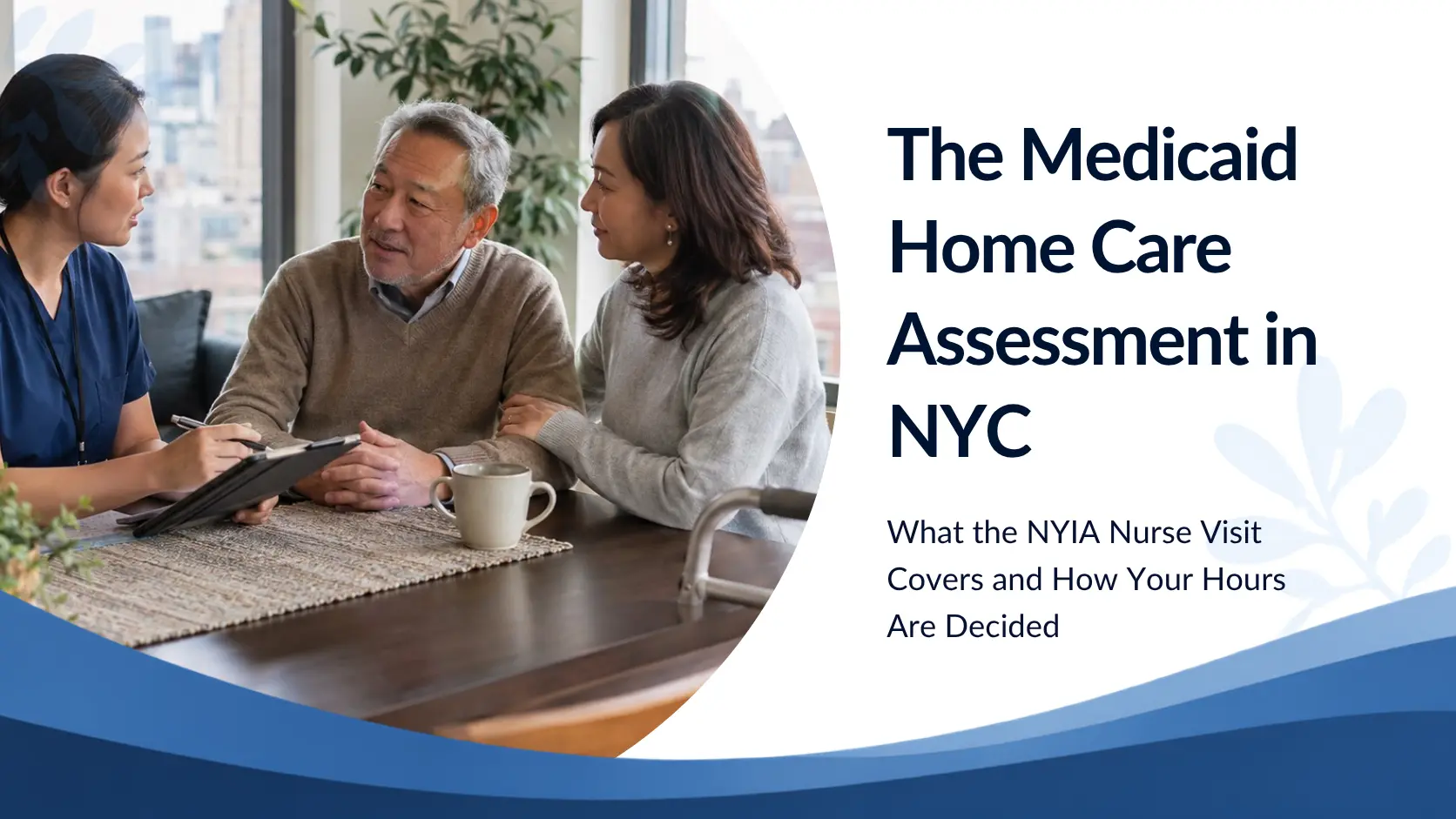
The Medicaid Home Care Assessment in NYC: What the NYIA Nurse Visit Covers and How Your Hours Are Decided
One nurse visit and one clinical appointment decide how much help your family gets. Here is exactly what happens, how to prepare, and the mistakes that quietly cost families hours.
- The New York Independent Assessor (NYIA) handles assessments for Medicaid personal care services.
- There are two appointments: a nurse’s Community Health Assessment and a clinical exam.
- The nurse visit uses the UAS-NY tool and can take up to three hours, at home or by video.
- Cases needing more than 12 hours of care a day get an extra independent review.
- Describe the hardest day, not the best day — this is where most families lose hours.
Every New York family that applies for Medicaid home care runs into the same moment: a nurse is coming to the apartment to decide how much help your mother, father or spouse is entitled to. It is short, it feels informal, and it carries more weight than any other step in the process.
Understanding what the assessor is actually measuring — and what they are not — changes the outcome. This guide walks through both appointments, what to have ready, and the specific mistakes we watch families make.
Who Runs the Assessment?
Since 2022, assessments for Medicaid personal care services in New York are handled by the New York Independent Assessor Program (NYIA), a state program operated under contract rather than by the home care agency or the health plan. That independence is deliberate: the people deciding your hours are not the people providing or paying for the care.
It also means your agency cannot influence the outcome, and neither can your plan. What decides the result is the evidence in front of the assessor on the day.
The Two Appointments
A registered nurse assesses health status, medications, mobility, bathing, dressing, equipment and what help is already available from family. Uses the state’s UAS-NY tool. Up to three hours, in person or by video, at home.
An independent clinician — a doctor, nurse practitioner or physician assistant — reviews medical history and current care, and may contact your own doctor. About one hour, in person or by video.
If the proposed care plan calls for more than 12 hours of care a day, an additional independent panel reviews whether the plan is appropriate and safe.
Results arrive by mail. Your managed long-term care plan then authorises a specific number of weekly hours based on the assessment.
What the Assessor Is Actually Measuring
The UAS-NY tool is built around activities of daily living and how much assistance each one requires. In plain terms, the assessor is scoring questions like:
- Can this person bathe, dress and use the toilet without hands-on help — and how much help?
- Can they move safely around the apartment, get in and out of bed, manage stairs?
- Can they prepare a meal, take medication correctly, manage money, use a phone?
- What happens at night? Do they get up, wander, need help to the bathroom?
- Is there cognitive impairment, and does it affect safety or judgment?
- Who is already helping, and how much? Informal support from family reduces the assessed need.
That last point surprises people. If a daughter says “I come every day and do everything,” the assessment can record that the need is already met. Be honest — but be equally honest about what that arrangement costs you, and what happens when you cannot be there.
How to Prepare
- Have the documents out. ID, the current medication list including doses, contact details for the primary doctor, and recent hospital or specialist paperwork.
- Complete the information-sharing consent form in advance so the clinician can obtain records from your own doctors rather than relying on the visit alone.
- Keep a two-week log before the visit. What help was needed, when, and how long it took. “She needs help bathing” is weak. “Bathing takes 40 minutes with two people because of the transfer” is evidence.
- Have the family caregiver present. The person being assessed often minimises; someone who sees the daily reality should be in the room.
- Get a doctor’s letter if there is a specific risk — falls, wandering, aspiration, wound care, dialysis schedules.
The single most common mistake: presenting the best day. Many older adults instinctively perform — they get dressed up, sit upright, insist they manage fine. It is pride, not dishonesty, and it is completely understandable. But the assessment is a snapshot, and a good snapshot means fewer hours. Ask the assessor directly to consider bad days, night-time needs and what happens when nobody is there.
After the Assessment: How Hours Get Authorised
The assessment results go to your managed long-term care plan, which authorises a weekly number of hours and the caregiver type — usually a personal care aide or a home health aide. Your agency then staffs those hours.
If you have not yet chosen a plan, that decision shapes everything afterwards — see how to choose an MLTC plan and how MLTC plans work.
If Medicaid itself is not in place yet, start there: how to qualify for Medicaid home care, how to get approved, and if income is over the limit, spend-down and pooled trusts.
If the Hours Are Not Enough
Two routes, and they are not mutually exclusive. You can challenge the decision — there are formal appeal rights with strict deadlines, and asking is far more effective than families expect. Or you can top up the authorised hours with private pay, which many families do for evenings, weekends or the specific shift that is hardest.
Either way, keep the log going. Documentation is what moves a reassessment.
What is the UAS-NY assessment?
UAS-NY is the Uniform Assessment System New York — the standardised tool a registered nurse uses to record health status and how much help someone needs with daily activities. Its scores drive the number of home care hours a plan authorises.
How long does the NYIA assessment take?
The nurse’s Community Health Assessment can take up to three hours. The separate clinical appointment takes about an hour. Both can be done in person at home or by video.
How many hours of home care will Medicaid approve?
There is no fixed number. Hours follow the assessed need for help with daily activities, safety risk, and how much informal support is already available — from a few hours a week up to live-in or 24-hour care. Cases above 12 hours a day get an extra independent review.
Can family be present during the assessment?
Yes, and they should be. A family member who sees the day-to-day reality gives the assessor context the person being assessed often leaves out.
Can I ask for a reassessment if things get worse?
Yes. If the person’s condition changes — a fall, a hospital stay, faster cognitive decline — contact your plan and request a reassessment, with documentation of what changed.
The NYIA Visit: Quick Answers
How long does the NYIA assessment take and is it in person?
The nurse assessment usually runs 60–90 minutes and can be by telehealth or in person; the clinical exam is a separate appointment. Expect a few weeks between requesting the assessment and receiving both outcomes. For what to gather beforehand see how to prepare for the Medicaid home care assessment.
What happens after the assessment?
The outcome goes to you and to the MLTC plan you choose; the plan’s nurse then sets the weekly hours. If the number is too low, ask for a reassessment or appeal; see what to do when hours are cut or denied.
Assessment Coming Up? Talk to Us First.
Our coordinators walk families through what to expect and what to have ready — before the nurse arrives, not after the notice comes.
Call 718-375-2707 Request Care Online