Category: NYC Resources

  • OPWDD Services for Tuberous Sclerosis in NYC: In-Home and Community Support

    OPWDD Services for Tuberous Sclerosis in NYC: In-Home and Community Support

    OPWDD for Tuberous Sclerosis

    OPWDD Services for Tuberous Sclerosis in NYC: In-Home and Community Support

    When tuberous sclerosis involves developmental disability, OPWDD services can provide the skilled, safety-focused support families need. Here’s how it works, and how Advantage Home Care helps.

    πŸ’‘ Key Takeaways
    • Tuberous sclerosis complex (TSC) can qualify for OPWDD services when it results in a developmental disability with substantial functional limitations that began before age 22.
    • OPWDD funds in-home support, community and day habilitation, and respite β€” with attention to the epilepsy and autism that often accompany TSC.
    • Advantage Home Care provides these OPWDD services and guides families through eligibility and the Front Door.

    Tuberous sclerosis complex (TSC) is a genetic condition that can affect many parts of the body, and it frequently brings developmental challenges β€” including epilepsy, autism, and intellectual disability. When those effects rise to the level of a developmental disability, OPWDD services can provide meaningful, safety-focused support. Advantage Home Care helps NYC families understand and access it.

    A real-world example

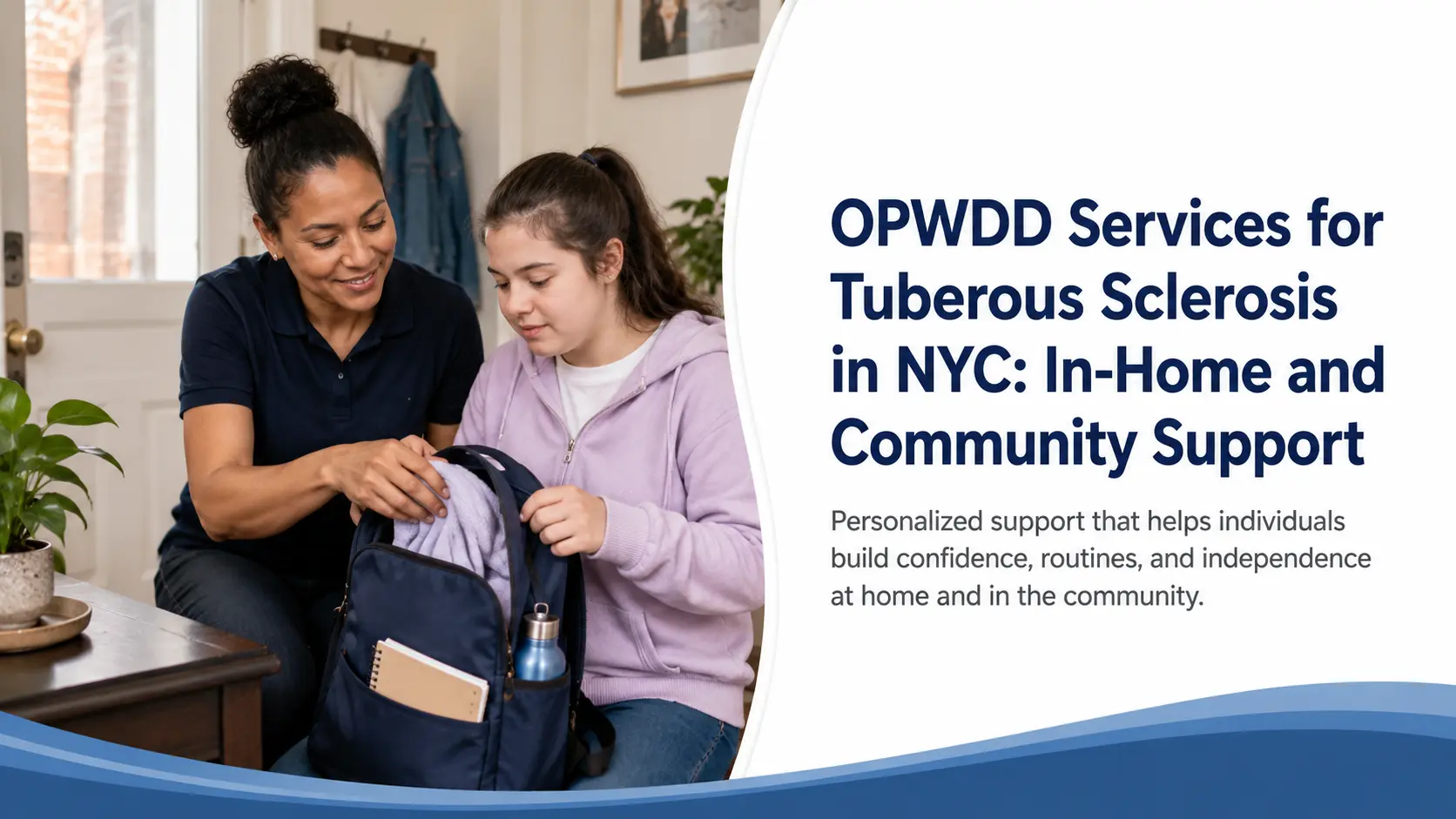
    Consider a 13-year-old in Manhattan with tuberous sclerosis, whose condition includes epilepsy and an intellectual disability. His seizures mean he needs supervision, and his family struggles to balance his safety with his desire for more independence. Through OPWDD, he receives in-home support from staff trained in seizure safety, and community habilitation that helps him build skills with someone by his side. He gains independence within a safe structure, and his family gains reliable help. That’s what these OPWDD services are designed to do.

    How OPWDD Services Help People With Tuberous Sclerosis

    Support is tailored to the individual, with safety woven through. The most relevant services usually include:

    Explore our full range of OPWDD services and OPWDD support services.

    Does Tuberous Sclerosis Qualify for OPWDD?

    It can. Tuberous sclerosis complex qualifies for OPWDD when it results in a developmental disability β€” a condition that began before age 22, is lifelong, and causes substantial functional limitations, often through the intellectual disability, autism, or epilepsy that can accompany TSC. Eligibility is established through OPWDD’s “Front Door” process, which requires medical and diagnostic documentation. Because eligibility here depends on the specifics, our team helps families assess and document it β€” see our guide to OPWDD eligibility in New York.

    How Advantage Home Care Helps

    Staff trained for safety. We match individuals with support staff who understand seizure recognition and response and the range of needs TSC can bring.

    We navigate the system with you. From the Front Door to building a plan with your Care Coordination Organization, we turn a complex process into clear steps.

    A partner as needs change. Our care coordination and family support team keeps the plan current as your loved one grows.

    Frequently Asked Questions

    Does tuberous sclerosis qualify for OPWDD services?

    It can, when it results in a developmental disability with substantial functional limitations that began before age 22. Eligibility is determined through the Front Door process.

    What OPWDD services help most with tuberous sclerosis?

    In-home support, community habilitation, day habilitation, and respite β€” often with an emphasis on seizure safety β€” all available through Advantage Home Care’s OPWDD services.

    Are your staff trained for seizures?

    We match families with support staff experienced in seizure safety and response as part of a plan built around the individual’s needs.

    How do we get started?

    It begins with the OPWDD Front Door process to establish eligibility. We help families gather documentation and move from approval to services at home.

    Related OPWDD condition guides: Epilepsy, Autism, and Intellectual Disability.

    Part of our complete guide to OPWDD Services in NYC

    Get OPWDD Support for Tuberous Sclerosis

    Whether you’re starting the Front Door process or looking for a provider who understands tuberous sclerosis, we’re here to help. Call 718-375-2707 or reach out online.

    Get Started β†’

  • OPWDD Services for Williams Syndrome in NYC: Support for Every Stage

    OPWDD Services for Williams Syndrome in NYC: Support for Every Stage

    OPWDD for Williams Syndrome

    OPWDD Services for Williams Syndrome in NYC: Support for Every Stage

    Williams syndrome brings a warm, social personality alongside real developmental challenges. Here’s how OPWDD services help β€” and how Advantage Home Care supports families across NYC.

    πŸ’‘ Key Takeaways
    • Williams syndrome is a qualifying developmental disability for OPWDD services in New York.
    • OPWDD funds community and day habilitation, in-home support, and respite β€” helpful for the learning, safety, and independence needs Williams syndrome brings.
    • Advantage Home Care provides these OPWDD services and guides families through eligibility and the Front Door.

    Williams syndrome is a genetic condition known for a strikingly social, verbal, and empathetic personality β€” alongside intellectual disability, anxiety, and health considerations that call for real support. That very sociability can also mean a need for safety awareness with strangers. New York’s OPWDD system funds services that build on each person’s strengths while supporting their challenges, and Advantage Home Care helps NYC families access them.

    A real-world example

    Consider a 16-year-old in Queens with Williams syndrome. He’s outgoing, loves music, and never meets a stranger β€” but he struggles with academics, anxiety, and knowing whom to trust. Through OPWDD, he works with a community habilitation aide on social safety, money, and daily-living skills, and attends day habilitation where his warmth and love of music are a gift to everyone around him. He grows more capable and confident, and his family has a partner in planning his future. That’s what these OPWDD services are designed to do.

    How OPWDD Services Help People With Williams Syndrome

    Support builds on strengths while addressing real needs. The most relevant services usually include:

    Explore our full range of OPWDD services and OPWDD support services.

    Does Williams Syndrome Qualify for OPWDD?

    Yes. Williams syndrome is a recognized developmental disability under OPWDD β€” it is genetic, present from birth, lifelong, and results in substantial functional limitations. Eligibility is established through OPWDD’s “Front Door” process, which requires medical and diagnostic documentation. We help families gather what’s needed and navigate intake β€” see our guide to OPWDD eligibility in New York.

    How Advantage Home Care Helps

    Support that builds on strengths. We match individuals with staff who nurture each person’s sociability and interests while supporting safety and independence.

    We guide the whole process. From the Front Door and eligibility to building a plan with your Care Coordination Organization, we help families move forward with clarity.

    A partner through every transition. Our care coordination and family support team is there from childhood into adult life.

    Frequently Asked Questions

    Does Williams syndrome qualify for OPWDD services?

    Yes. It is a qualifying developmental disability under OPWDD β€” genetic, lifelong, and causing substantial functional limitations.

    What OPWDD services help most with Williams syndrome?

    Community habilitation, day habilitation, in-home support, and respite β€” all available through Advantage Home Care’s OPWDD services.

    Can support help with social safety?

    Yes. Community habilitation often focuses on social-safety skills, which are especially important for the outgoing nature many people with Williams syndrome share.

    How do we get started?

    It begins with the OPWDD Front Door process to establish eligibility. We help families gather documentation and move from approval to services at home.

    Related OPWDD condition guides: Down Syndrome, Intellectual Disability, and Fragile X Syndrome.

    Part of our complete guide to OPWDD Services in NYC

    Get OPWDD Support for Williams Syndrome

    Whether you’re starting the Front Door process or looking for a provider who understands Williams syndrome, we’re here to help. Call 718-375-2707 or reach out online.

    Get Started β†’

  • OPWDD Services for Rett Syndrome in NYC: Skilled, Compassionate Home Support

    OPWDD Services for Rett Syndrome in NYC: Skilled, Compassionate Home Support

    OPWDD for Rett Syndrome

    OPWDD Services for Rett Syndrome in NYC: Skilled, Compassionate Home Support

    Rett syndrome calls for skilled, patient, communication-focused care. Here’s how OPWDD services help β€” and how Advantage Home Care supports families across New York City.

    πŸ’‘ Key Takeaways
    • Rett syndrome is a qualifying developmental disability for OPWDD services in New York.
    • OPWDD funds in-home support, communication help, community habilitation, and respite β€” matched to significant physical and communication needs.
    • Advantage Home Care provides these OPWDD services and guides families through eligibility and the Front Door.

    Rett syndrome is a rare genetic condition that mainly affects girls, bringing significant challenges with movement, hand use, and communication, often alongside seizures β€” while leaving a bright, connected person inside who deserves to be seen and supported. Care has to be skilled, patient, and deeply attuned to communication. New York’s OPWDD system funds that kind of care, and Advantage Home Care helps NYC families access it.

    A real-world example

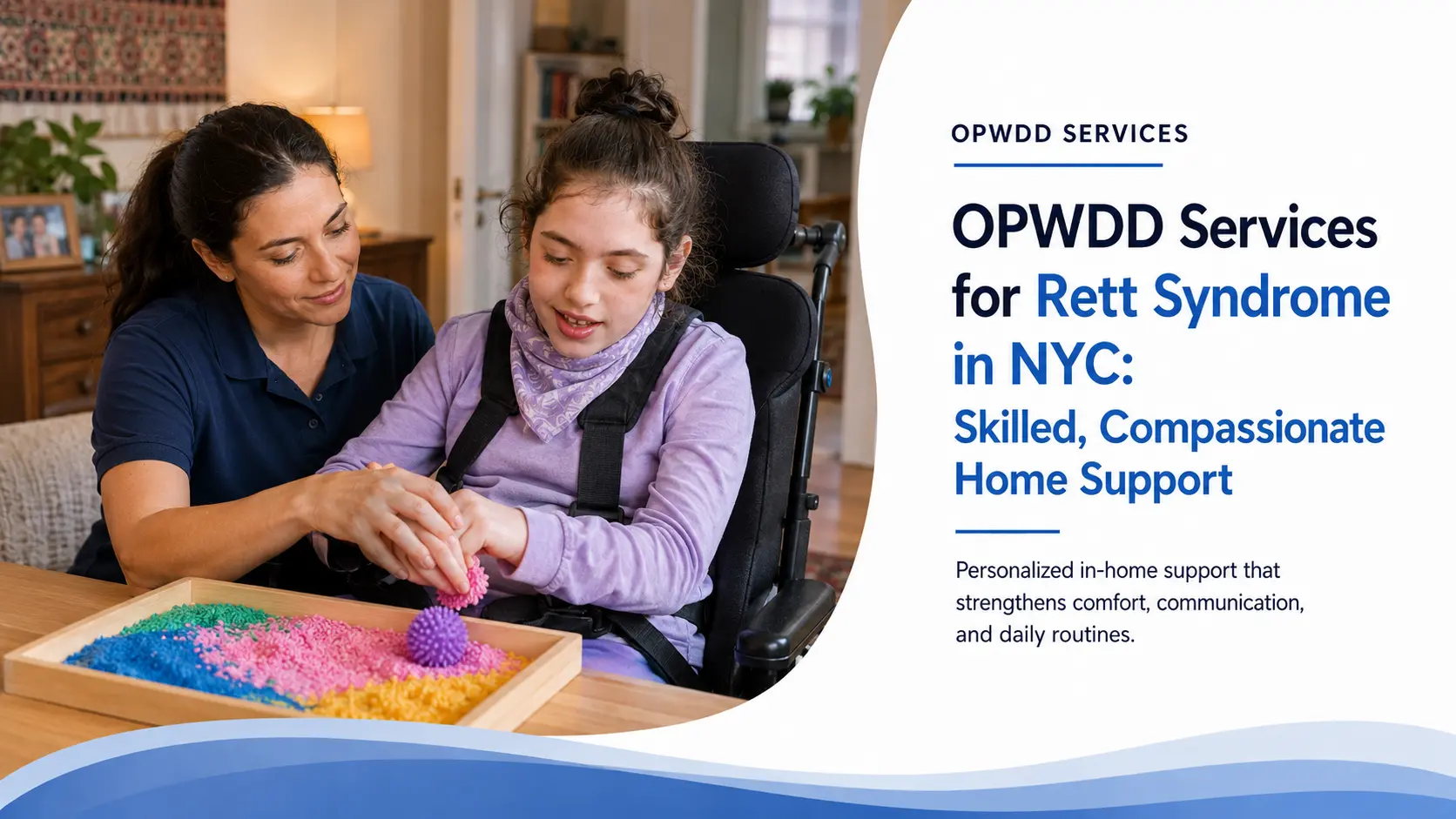
    Consider an 11-year-old girl in Brooklyn with Rett syndrome. She’s nonverbal, uses a wheelchair, and needs help with nearly every daily task β€” but she communicates through her eyes and an eye-gaze device, and she lights up around the people who understand her. Through OPWDD, she receives in-home support from staff trained in her mobility, feeding, and communication needs, and her family gets respite that lets them rest and recharge. She’s safe, engaged, and understood; her parents are supported. That’s what these OPWDD services make possible.

    How OPWDD Services Help People With Rett Syndrome

    Support is built around communication, physical needs, and safety. The most relevant services usually include:

    Explore our full range of OPWDD services and OPWDD support services.

    Does Rett Syndrome Qualify for OPWDD?

    Yes. Rett syndrome is a recognized developmental disability under OPWDD β€” it is genetic, appears in early childhood, is lifelong, and results in substantial functional limitations. Eligibility is established through OPWDD’s “Front Door” process, which requires medical and diagnostic documentation. We help families gather what’s needed and navigate intake β€” see our guide to OPWDD eligibility in New York.

    How Advantage Home Care Helps

    Skilled, patient staff. We match individuals with support staff experienced in communication support, mobility and feeding assistance, and the close supervision Rett care requires.

    We guide the whole process. From the Front Door and eligibility to building a plan with your Care Coordination Organization, we make a complex process manageable.

    A partner as needs change. Our care coordination and family support team keeps the plan aligned with your loved one’s needs over time.

    Frequently Asked Questions

    Does Rett syndrome qualify for OPWDD services?

    Yes. It is a qualifying developmental disability under OPWDD β€” genetic, lifelong, and causing substantial functional limitations.

    What OPWDD services help most with Rett syndrome?

    In-home support, communication support, community habilitation, and respite β€” all available through Advantage Home Care’s OPWDD services.

    Can staff help with communication devices?

    Yes. We match families with staff experienced in eye-gaze and alternative communication as part of a plan built around the individual.

    How do we get started?

    It begins with the OPWDD Front Door process to establish eligibility. We help families gather documentation and move from approval to services at home.

    Related OPWDD condition guides: Angelman Syndrome, Epilepsy, and Cerebral Palsy.

    Part of our complete guide to OPWDD Services in NYC

    Get OPWDD Support for Rett Syndrome

    Whether you’re starting the Front Door process or looking for a provider who understands Rett syndrome, we’re here to help. Call 718-375-2707 or reach out online.

    Get Started β†’

  • OPWDD Day Habilitation Services in NYC with Advantage Home Care

    OPWDD Day Habilitation Services in NYC with Advantage Home Care

    OPWDD Service

    OPWDD Day Habilitation Services in NYC with Advantage Home Care

    Day habilitation gives individuals with developmental disabilities structure, connection, and growth during the day. Here’s what it offers and how Advantage Home Care supports families across NYC.

    πŸ’‘ Key Takeaways
    • Day habilitation (“Day Hab”) is OPWDD-funded structured daytime programming built around skill-building, socialization, and community participation.
    • It provides routine and purpose during the day β€” especially important after school ends.
    • Advantage Home Care supports families accessing day habilitation as part of our OPWDD services in NYC.

    For many individuals with developmental disabilities, the day needs structure, purpose, and people β€” and day habilitation provides all three. It’s the service families often turn to when school ends and the question becomes “what now?” Advantage Home Care helps NYC families understand and access it.

    What Day Habilitation Offers

    Day hab is designed around meaningful daytime engagement:

    πŸ“…
    Routine & StructureA predictable, purposeful daily rhythm that supports wellbeing and stability.
    πŸ‘₯
    SocializationFriendships, peer connection, and a sense of belonging and community.
    🧠
    Skill-BuildingDaily-living, communication, and pre-vocational skills that build independence.
    πŸŒ†
    Community ParticipationOutings and activities that connect individuals with the world around them.

    For a deeper explainer of the service itself, see our guide to OPWDD day habilitation in NYC.

    Who Day Habilitation Helps

    Day hab supports teens and adults with a developmental disability who are eligible for OPWDD services β€” including people with autism, intellectual disability, Down syndrome, cerebral palsy, and related conditions. It’s especially valuable during the transition out of school, when the structure of the school day disappears and a new source of routine and connection is needed. See the full range of OPWDD services we provide.

    How to Access Day Habilitation

    Day habilitation is accessed through OPWDD. Eligibility is established via the “Front Door” process, and the service is built into the individual’s plan with their Care Coordination Organization. We help families every step of the way β€” see our guide to OPWDD eligibility in New York.

    Why Advantage Home Care

    We help families navigate the choice. Day hab, community habilitation, or both? We help families understand the options and build the right mix for their loved one.

    Support around the program. We coordinate day hab alongside the in-home and community support that rounds out a person’s week.

    A partner through transitions. Our care coordination and family support team is there for the school-to-adult-life transition and beyond.

    Frequently Asked Questions

    What is the difference between day habilitation and community habilitation?

    Day habilitation is a structured group program at a day site; community habilitation is one-on-one support in the home and community. Many individuals benefit from a combination.

    Is day habilitation only for adults?

    It primarily serves teens and adults, and is especially valuable after a person ages out of school-based services.

    Who is eligible for day habilitation?

    Individuals found eligible for OPWDD services through the Front Door process. We help families establish eligibility and add day hab to the plan.

    Related OPWDD services: Community Habilitation and Respite.

    Part of our complete guide to OPWDD Services in NYC

    Explore Day Habilitation in NYC

    Wondering whether day habilitation is right for your loved one? We’re here to help you figure it out. Call 718-375-2707 or reach out online.

    Get Started β†’

  • OPWDD Community Habilitation in NYC: Building Skills and Independence

    OPWDD Community Habilitation in NYC: Building Skills and Independence

    OPWDD Service

    OPWDD Community Habilitation in NYC: Building Skills and Independence

    Community habilitation is one of OPWDD’s most powerful services β€” one-on-one support that helps a person grow more independent at home and in their community. Here’s how it works, and how Advantage Home Care delivers it.

    πŸ’‘ Key Takeaways
    • Community habilitation (“Com Hab”) is OPWDD-funded one-on-one support focused on daily-living, social, and independence skills.
    • It happens where life happens β€” at home and out in the community β€” and is built around the individual’s personal goals.
    • Advantage Home Care provides community habilitation as part of our OPWDD services across NYC.

    Community habilitation is where OPWDD support gets personal. Instead of a classroom or a center, a trained staff member works one-on-one with an individual β€” in their home and their neighborhood β€” on the specific skills that lead to a more independent, connected life. For many families, it’s the service that makes the biggest day-to-day difference.

    What Community Habilitation Includes

    Com Hab is tailored to each person’s goals, but it commonly focuses on:

    🧠
    Daily-Living SkillsCooking, cleaning, personal care, and the routines of running a household.
    πŸ’¬
    Social & Communication SkillsBuilding relationships, self-advocacy, and confidence in everyday interactions.
    πŸš‰
    Community AccessTraveling safely, using public transit, shopping, and taking part in local life.
    πŸ’΅
    Money & IndependenceBudgeting, handling money, and the practical skills of adult life.

    Because the support is one-on-one, it moves at exactly the pace the person needs β€” and it grows with them over time.

    Who Community Habilitation Helps

    Com Hab is for individuals with a developmental disability who are eligible for OPWDD services β€” including people with autism, intellectual disability, cerebral palsy, Down syndrome, and related conditions. It’s especially valuable for teens and adults working toward greater independence, and for anyone whose goals are best pursued in real-world settings rather than a program room. Explore the full range of OPWDD services we provide.

    How to Access Community Habilitation

    Community habilitation is accessed through OPWDD. Eligibility is established via OPWDD’s “Front Door” process, and the service is then built into the individual’s plan with their Care Coordination Organization. We help families through every step β€” see our guide to OPWDD eligibility in New York.

    Why Advantage Home Care

    Staff matched to the individual. We pair each person with a Com Hab provider suited to their goals, communication style, and personality β€” and prioritize consistency.

    Goal-driven support. We focus on real, meaningful progress toward the outcomes that matter to the individual and family.

    A partner through the system. Our care coordination and family support team keeps everything aligned as goals evolve.

    Frequently Asked Questions

    What is the difference between community habilitation and day habilitation?

    Community habilitation is one-on-one support in the home and community; day habilitation is a structured group program at a day site. Many people use one or both depending on their goals.

    Where does community habilitation take place?

    Wherever the person’s goals are best pursued β€” their home, their neighborhood, stores, transit, and community spaces.

    Who is eligible for community habilitation?

    Individuals found eligible for OPWDD services through the Front Door process. We help families establish eligibility and add Com Hab to the plan.

    Related OPWDD services: Day Habilitation and Respite.

    Part of our complete guide to OPWDD Services in NYC

    Community Habilitation: Meaning and Quick Answers

    What does community habilitation mean?

    Community habilitation (“com hab”) is an OPWDD service in which a trained staff member works one-to-one with a person with a developmental disability, at home and in the community, on goals from their Life Plan: cooking, money and travel skills, social skills, health routines and community participation. It is skill-building support, distinct from a personal care aide who does tasks for the person.

    Who provides OPWDD community habilitation in NYC?

    OPWDD-approved agencies such as Advantage Home Care. Hours are authorized in the Life Plan by the Care Manager, and families can often choose or request a specific staff member. Call 718-375-2707 to check availability in your borough.

    Start Community Habilitation in NYC

    Want to add community habilitation to your loved one’s OPWDD plan, or just starting out? We’re here to help. Call 718-375-2707 or reach out online.

    Get Started β†’

  • OPWDD Services for Angelman Syndrome in NYC: Compassionate, Skilled Care

    OPWDD Services for Angelman Syndrome in NYC: Compassionate, Skilled Care

    OPWDD for Angelman Syndrome

    OPWDD Services for Angelman Syndrome in NYC: Compassionate, Skilled Care

    Angelman syndrome calls for skilled, patient, communication-focused support. Here’s how OPWDD services help β€” and how Advantage Home Care supports families across New York City.

    πŸ’‘ Key Takeaways
    • Angelman syndrome is a qualifying developmental disability for OPWDD services in New York.
    • OPWDD funds in-home support, community and day habilitation, and respite β€” supporting communication, mobility, and safety needs.
    • Advantage Home Care provides these OPWDD services and guides families through eligibility and the Front Door.

    Angelman syndrome brings significant developmental delays, limited speech, movement and balance challenges, and often seizures β€” alongside a famously joyful, social nature. Support has to be skilled and patient, with a real focus on communication and safety. New York’s OPWDD system funds that kind of care, and Advantage Home Care helps NYC families access it.

    A real-world example

    Consider an 8-year-old in Queens with Angelman syndrome. She’s affectionate and full of smiles, but she’s nonverbal, needs help with nearly every daily task, and requires close supervision for safety. Her parents are devoted but exhausted. Through OPWDD, she receives in-home support from staff trained to help with communication devices, mobility, and daily care, and her family gets respite that gives them real, regular rest. She’s safe and engaged; her parents are supported. That’s what these OPWDD services make possible.

    How OPWDD Services Help People With Angelman Syndrome

    Support is built around communication, safety, and daily needs. The most relevant services usually include:

    Explore our full range of OPWDD services and OPWDD support services.

    Does Angelman Syndrome Qualify for OPWDD?

    Yes. Angelman syndrome is a recognized developmental disability under OPWDD β€” it is genetic, present from early in life, lifelong, and results in substantial functional limitations. Eligibility is established through OPWDD’s “Front Door” process, which requires medical and diagnostic documentation. We help families gather what’s needed and navigate intake β€” see our guide to OPWDD eligibility in New York.

    How Advantage Home Care Helps

    Skilled, patient staff. We match individuals with support staff experienced in communication support, mobility assistance, and the close supervision Angelman care requires.

    We guide the whole process. From the Front Door and eligibility to building a plan with your Care Coordination Organization, we make a complex process manageable.

    A partner as needs change. Our care coordination and family support team keeps the plan aligned with your loved one’s needs over time.

    Frequently Asked Questions

    Does Angelman syndrome qualify for OPWDD services?

    Yes. It is a qualifying developmental disability under OPWDD β€” genetic, lifelong, and causing substantial functional limitations.

    What OPWDD services help most with Angelman syndrome?

    In-home support, community habilitation, day habilitation, and respite β€” all available through Advantage Home Care’s OPWDD services.

    Can staff help with communication devices?

    Yes. We match families with staff experienced in supporting communication devices and nonverbal communication as part of a plan built around the individual.

    How do we get started?

    It begins with the OPWDD Front Door process to establish eligibility. We help families gather documentation and move from approval to services at home.

    Related OPWDD condition guides: Rett Syndrome, Epilepsy, and Prader-Willi Syndrome.

    Part of our complete guide to OPWDD Services in NYC

    Get OPWDD Support for Angelman Syndrome

    Whether you’re starting the Front Door process or looking for a provider who understands Angelman syndrome, we’re here to help. Call 718-375-2707 or reach out online.

    Get Started β†’

  • OPWDD Services for Fragile X Syndrome in NYC: Support That Grows With Your Child

    OPWDD Services for Fragile X Syndrome in NYC: Support That Grows With Your Child

    OPWDD for Fragile X Syndrome

    OPWDD Services for Fragile X Syndrome in NYC: Support That Grows With Your Child

    Fragile X syndrome is the most common inherited cause of intellectual disability β€” and a qualifying condition for OPWDD. Here’s how that support works, and how Advantage Home Care helps families access it.

    πŸ’‘ Key Takeaways
    • Fragile X syndrome is a qualifying developmental disability for OPWDD services in New York.
    • OPWDD funds community and day habilitation, in-home support, and respite β€” helpful for the learning, social, and sensory needs Fragile X often brings.
    • Advantage Home Care provides these OPWDD services and guides families through eligibility and the Front Door.

    Fragile X syndrome is the most common inherited cause of intellectual disability, and it often brings anxiety, sensory sensitivities, and autism-like features alongside learning differences. Every child is different, and support has to grow and adapt with them. New York’s OPWDD system funds services designed to do exactly that β€” and Advantage Home Care helps NYC families access them.

    A real-world example

    Consider a 12-year-old in the Bronx with Fragile X syndrome. He’s warm and eager to connect, but anxiety and sensory overload make new situations hard, and his parents struggle to find support that truly gets it. Through OPWDD, he works with a community habilitation aide on social and daily-living skills at a pace that respects his sensory needs, and his family receives respite that gives them room to breathe. Over time he grows more confident, and his family feels supported rather than alone. That’s what these OPWDD services are designed to do.

    How OPWDD Services Help People With Fragile X Syndrome

    Support is tailored to the individual’s learning, social, and sensory needs. The most relevant services usually include:

    Explore our full range of OPWDD services and OPWDD support services.

    Does Fragile X Syndrome Qualify for OPWDD?

    Yes. Fragile X syndrome is a recognized developmental disability under OPWDD β€” it is genetic, present from early in life, lifelong, and results in substantial functional limitations. Eligibility is established through OPWDD’s “Front Door” process, which requires medical and diagnostic documentation. We help families gather what’s needed and navigate intake β€” see our guide to OPWDD eligibility in New York.

    How Advantage Home Care Helps

    Staff who understand sensory needs. We match individuals with support staff experienced in anxiety, sensory sensitivities, and the pace that works for children and adults with Fragile X.

    We guide the whole process. From the Front Door and eligibility to building a plan with your Care Coordination Organization, we help families move forward with clarity.

    A partner as your child grows. Needs change from childhood into adulthood; our care coordination and family support team adapts the plan at every stage.

    Frequently Asked Questions

    Does Fragile X syndrome qualify for OPWDD services?

    Yes. It is a qualifying developmental disability under OPWDD β€” genetic, lifelong, and causing substantial functional limitations.

    What OPWDD services help most with Fragile X?

    Community habilitation, day habilitation, in-home support, and respite β€” all available through Advantage Home Care’s OPWDD services.

    Can support accommodate my child’s sensory needs?

    Yes. We match families with staff experienced in sensory sensitivities and anxiety, and support is delivered at a pace built around the individual.

    How do we get started?

    It begins with the OPWDD Front Door process to establish eligibility. We help families gather documentation and move from approval to services at home.

    Related OPWDD condition guides: Autism, Intellectual Disability, and Down Syndrome.

    Part of our complete guide to OPWDD Services in NYC

    Fragile X syndrome Support in NYC: Quick Answers

    Does Fragile X syndrome qualify for OPWDD services in New York?

    Yes. Fragile X qualifies through the intellectual disability and/or autism it causes, confirmed by genetic testing plus developmental evaluation. Eligibility is decided through the OPWDD Front Door with medical and psychological documentation showing the condition began before age 22 and substantially limits daily functioning. See OPWDD eligibility in New York.

    What in-home support is available for Fragile X syndrome in NYC?

    OPWDD community habilitation and respite for skill-building and caregiver relief, plus Medicaid personal care or home health aide hours when hands-on help with bathing, mobility or supervision is needed. Advantage Home Care staffs both across the five boroughs and coordinates with the Care Manager. Call 718-375-2707.

    How does Fragile X support differ from autism services?

    Much of it overlaps: community habilitation, behavioural supports and respite. Fragile X families often also need medical coordination for seizures, anxiety and sensory issues, which the Care Manager and aide team build into the plan.

    Get OPWDD Support for Fragile X Syndrome

    Whether you’re starting the Front Door process or looking for a provider who understands Fragile X, we’re here to help. Call 718-375-2707 or reach out online.

    Get Started β†’

  • OPWDD Services for Prader-Willi Syndrome in NYC: Structured, Compassionate Support

    OPWDD Services for Prader-Willi Syndrome in NYC: Structured, Compassionate Support

    OPWDD for Prader-Willi Syndrome

    OPWDD Services for Prader-Willi Syndrome in NYC: Structured, Compassionate Support

    Prader-Willi syndrome calls for a very particular kind of support β€” structure, consistency, and understanding. Here’s how OPWDD services help, and how Advantage Home Care supports families.

    πŸ’‘ Key Takeaways
    • Prader-Willi syndrome is a qualifying developmental disability for OPWDD services in New York.
    • OPWDD funds in-home support, community and day habilitation, and respite β€” with the structure and consistency Prader-Willi care requires.
    • Advantage Home Care provides these OPWDD services and guides families through eligibility and the Front Door.

    Prader-Willi syndrome brings a unique set of needs β€” including a persistent, hard-to-manage hunger that requires careful structure around food, alongside intellectual and behavioral challenges. Support has to be consistent, compassionate, and well-informed. New York’s OPWDD system funds exactly this kind of care, and Advantage Home Care helps NYC families put it in place.

    A real-world example

    Consider a 15-year-old in Brooklyn with Prader-Willi syndrome. His constant hunger makes unstructured time risky, and managing it has consumed his family’s daily life. Through OPWDD, he receives in-home support from staff who understand the routines and food supervision his condition requires, and community habilitation that builds independence within a safe, predictable structure. His days become calmer and more consistent, and his parents finally get support that understands what they’re managing. That’s what these OPWDD services are for.

    How OPWDD Services Help People With Prader-Willi Syndrome

    Support is built around structure, safety, and the individual’s goals. The most relevant services usually include:

    Explore our full range of OPWDD services and OPWDD support services.

    Does Prader-Willi Syndrome Qualify for OPWDD?

    Yes. Prader-Willi syndrome is a recognized developmental disability under OPWDD β€” it is genetic, present from birth, lifelong, and results in substantial functional limitations. Eligibility is established through OPWDD’s “Front Door” process, which requires medical and diagnostic documentation. We help families gather what’s needed and navigate intake β€” see our guide to OPWDD eligibility in New York.

    How Advantage Home Care Helps

    Staff who understand the condition. We match individuals with support staff experienced in the structure and consistency Prader-Willi care requires.

    We guide the whole process. From the Front Door and eligibility to building a plan with your Care Coordination Organization, we help families move forward with confidence.

    A partner as needs change. Our care coordination and family support team keeps the plan current as your loved one grows.

    Frequently Asked Questions

    Does Prader-Willi syndrome qualify for OPWDD services?

    Yes. It is a qualifying developmental disability under OPWDD β€” genetic, lifelong, and causing substantial functional limitations.

    What OPWDD services help most with Prader-Willi syndrome?

    In-home support, community habilitation, day habilitation, and respite β€” all available through Advantage Home Care’s OPWDD services.

    Do your staff understand the food-related needs of Prader-Willi?

    We match families with support staff experienced in the routines and structure Prader-Willi care requires, as part of a plan built around the individual.

    How do we get started?

    It begins with the OPWDD Front Door process to establish eligibility. We help families gather documentation and move from approval to services at home.

    Related OPWDD condition guides: Angelman Syndrome, Fragile X Syndrome, and Intellectual Disability.

    Part of our complete guide to OPWDD Services in NYC

    Get OPWDD Support for Prader-Willi Syndrome

    Whether you’re starting the Front Door process or looking for a provider who understands Prader-Willi, we’re here to help. Call 718-375-2707 or reach out online.

    Get Started β†’

  • OPWDD Services for Spina Bifida in NYC: In-Home and Community Support

    OPWDD Services for Spina Bifida in NYC: In-Home and Community Support

    OPWDD for Spina Bifida

    OPWDD Services for Spina Bifida in NYC: In-Home and Community Support

    When spina bifida involves substantial functional limitations, OPWDD services can provide the physical support and independence-building that make daily life work. Here’s what that looks like β€” and how Advantage Home Care helps.

    πŸ’‘ Key Takeaways
    • Spina bifida can qualify for OPWDD services when it results in substantial functional limitations closely related to a developmental disability, with onset before age 22.
    • OPWDD funds in-home support, community and day habilitation, and respite β€” supporting both physical needs and independence.
    • Advantage Home Care provides these OPWDD services and guides families through eligibility and the Front Door.

    Spina bifida affects each person differently β€” some need significant help with mobility and personal care, while others are highly independent with the right support. New York’s OPWDD system funds services that meet people where they are, supporting both physical needs and the drive for independence. Advantage Home Care helps NYC families access that support.

    A real-world example

    Consider a 22-year-old in Queens with spina bifida who uses a wheelchair and needs help with some daily tasks, but is determined to live independently. Through OPWDD, she receives in-home support with personal care and daily routines, and works with a community habilitation aide on accessible transportation, managing appointments, and building the skills for her own apartment one day. She gains independence; her family gains reliable help and reassurance. That’s what these OPWDD services are designed to do.

    How OPWDD Services Help People With Spina Bifida

    Support is tailored to the individual’s physical needs and personal goals. The most relevant services usually include:

    Explore our full range of OPWDD services and OPWDD support services.

    Does Spina Bifida Qualify for OPWDD?

    It can. Spina bifida may qualify for OPWDD when it is a neurological impairment closely related to a developmental disability β€” one that began before age 22, is lifelong, and results in substantial functional limitations similar to an intellectual disability. Eligibility is established through OPWDD’s “Front Door” process, which requires medical and diagnostic documentation. Because eligibility here depends on the specifics, our team helps families assess and document it β€” see our guide to OPWDD eligibility in New York.

    How Advantage Home Care Helps

    Support matched to physical and personal needs. We pair individuals with staff who provide safe, respectful physical support while encouraging every bit of independence.

    We navigate the system with you. From the Front Door to building a plan with your Care Coordination Organization, we make a complex process manageable.

    A partner as goals evolve. Our care coordination and family support team keeps the plan aligned with your loved one’s changing goals.

    Frequently Asked Questions

    Does spina bifida qualify for OPWDD services in New York?

    It can, when it results in substantial functional limitations closely related to a developmental disability and began before age 22. Eligibility is determined through the Front Door process.

    What OPWDD services help most with spina bifida?

    In-home support, community habilitation, day habilitation, and respite are the most commonly used β€” all available through Advantage Home Care’s OPWDD services.

    Can OPWDD help with personal care and mobility?

    Yes. In-home support staff can help with personal care, transfers, and mobility as part of an OPWDD plan tailored to the individual.

    How do we get started?

    It begins with the OPWDD Front Door process to establish eligibility. We help families gather documentation and move from approval to services at home.

    Related OPWDD condition guides: Cerebral Palsy, Intellectual Disability, and Epilepsy.

    Part of our complete guide to OPWDD Services in NYC

    Get OPWDD Support for Spina Bifida

    Whether you’re starting the Front Door process or looking for a provider who understands both physical needs and independence, we’re here to help. Call 718-375-2707 or reach out online.

    Get Started β†’

  • OPWDD Services for Autism in NYC: How Advantage Home Care Supports Families

    OPWDD Services for Autism in NYC: How Advantage Home Care Supports Families

    OPWDD for Autism

    OPWDD Services for Autism in NYC: How Advantage Home Care Supports Families

    Autism is one of the most common qualifying conditions for OPWDD services in New York. Here’s what that support looks like in real life β€” and how Advantage Home Care helps families access it.

    πŸ’‘ Key Takeaways
    • Autism spectrum disorder is a qualifying developmental disability for OPWDD services in New York.
    • OPWDD funds community habilitation, day habilitation, respite, and in-home support that help autistic individuals build skills and independence.
    • Advantage Home Care provides these OPWDD services and guides families through eligibility and the Front Door.

    For families raising a child or supporting an adult with autism, the right services can be the difference between simply coping and genuinely thriving. New York’s OPWDD system funds exactly this kind of support β€” but knowing what’s available and how to access it is half the battle. Advantage Home Care helps NYC families do both.

    A real-world example

    Consider a family in Queens with a 9-year-old son on the autism spectrum. He’s bright and affectionate, but transitions are hard, communication is limited, and his parents are stretched thin β€” one has cut back at work, and there’s rarely a moment to breathe. Through OPWDD, they access community habilitation, where a trained staff member works with him one-on-one on communication and daily-living skills, and respite, which finally gives his parents regular, reliable breaks. Within months, he’s more settled, his parents are less exhausted, and the whole household is steadier. That’s what these OPWDD services are designed to do.

    How OPWDD Services Help People With Autism

    OPWDD-funded services are flexible and built around the individual. For someone with autism, the most relevant usually include:

    See our full range of OPWDD services and OPWDD support services, or read our broader guide to home care for children and adults with autism.

    Does Autism Qualify for OPWDD?

    Yes. Autism spectrum disorder is a recognized developmental disability under OPWDD, provided it originated before age 22, is expected to be lifelong, and results in substantial functional limitations β€” which it commonly does. Eligibility is established through OPWDD’s “Front Door” process, which requires documentation such as psychological and diagnostic evaluations. It’s a step that overwhelms many families, and it’s one we help with directly. For the full walkthrough, see our guide to OPWDD eligibility in New York.

    How Advantage Home Care Helps

    Staff who understand autism. We match individuals with support staff experienced in autism β€” people who understand sensory needs, communication differences, and the power of routine.

    We guide the whole process. From the Front Door and eligibility to building a plan with your Care Coordination Organization, we help families move from “where do we even start?” to services in the home.

    A partner for the long haul. Needs change as a child grows into a teen and an adult. Our care coordination and family support team adjusts the plan every step of the way.

    Frequently Asked Questions

    Does autism qualify for OPWDD services in New York?

    Yes. Autism is a qualifying developmental disability under OPWDD when it began before age 22, is lifelong, and causes substantial functional limitations.

    What OPWDD services help most with autism?

    Community habilitation, day habilitation, respite, and in-home support are the most commonly used β€” all available through Advantage Home Care’s OPWDD services.

    At what age can my child start OPWDD services?

    Children can be found eligible and receive services from a young age; the qualifying disability must have begun before age 22. Starting the Front Door process early is a good idea.

    Can we get respite as an autism family?

    Yes. Respite is an OPWDD-funded service specifically meant to give family caregivers a break while their loved one is well cared for.

    Related OPWDD condition guides: Intellectual Disability, Fragile X Syndrome, and Down Syndrome.

    Part of our complete guide to OPWDD Services in NYC

    Autism Home Support in NYC: Quick Answers

    Can I get a home health aide for my autistic child in NYC?

    Yes, through two routes that can run together: OPWDD community habilitation or respite staff for skill-building and supervision, and, when the child also has personal-care needs, a Medicaid personal care or home health aide authorized through the child’s Medicaid plan. Advantage Home Care staffs both and matches aides with autism experience and the family’s language. Call 718-375-2707.

    What OPWDD services are available for autism?

    Community habilitation, day habilitation (after school age), respite, family support services, supported employment for adults, and environmental modifications. Eligibility runs through the OPWDD Front Door with a psychological evaluation confirming autism spectrum disorder and adaptive-functioning limits.

    Get OPWDD Support for Autism

    Whether you’re beginning the Front Door process or looking for a provider who understands autism, we’re here to help. Call 718-375-2707 or reach out online.

    Get Started β†’

  • Advantage Home Care OPWDD Services & Family Support in NYC

    Advantage Home Care OPWDD Services & Family Support in NYC

    OPWDD Services & Family Support

    Advantage Home Care OPWDD Services & Family Support in NYC

    For families caring for a loved one with a developmental disability, the right support changes everything. Advantage Home Care provides OPWDD services across New York City β€” and helps families navigate a system that can feel overwhelming.

    πŸ’‘ Key Takeaways
    • OPWDD is New York’s Office for People With Developmental Disabilities, which funds services for individuals with conditions like autism, intellectual disability, cerebral palsy, and epilepsy.
    • Advantage Home Care provides OPWDD services including community habilitation, day habilitation, respite, and in-home support.
    • We help families through the entire process β€” from the OPWDD “Front Door” and eligibility to building a plan and starting services.

    Raising or caring for someone with a developmental disability is a lifelong commitment full of love β€” and full of paperwork, waitlists, and systems that don’t explain themselves. Advantage Home Care exists to lighten that load. We provide OPWDD services throughout New York City and, just as importantly, we help families understand and access the support their loved one is entitled to.

    What Is OPWDD?

    OPWDD stands for the New York State Office for People With Developmental Disabilities. It funds and oversees a wide range of services for individuals with developmental disabilities β€” conditions such as intellectual disability, autism spectrum disorder, cerebral palsy, epilepsy, Prader-Willi syndrome, and others that began before age 22 and are expected to continue indefinitely. Through OPWDD, eligible individuals can receive support at home and in the community rather than in an institutional setting.

    OPWDD Services We Provide

    We tailor support to each individual and family, drawing on the full range of OPWDD-funded services:

    Explore our OPWDD services and OPWDD support services in more detail.

    Who Qualifies for OPWDD?

    To be eligible for OPWDD services, a person generally must have a documented developmental disability that originated before age 22, is expected to continue indefinitely, and results in substantial functional limitations. Qualifying conditions include intellectual disability, autism, cerebral palsy, epilepsy, and certain related neurological conditions. Eligibility is established through OPWDD’s “Front Door” process, which involves documentation and an intake β€” a step that trips up many families. Our team helps you gather what’s needed and move through it. For a deeper walkthrough, see our guide to OPWDD eligibility in New York.

    How the Process Works

    1

    Front Door & eligibility. We help you request services and establish OPWDD eligibility with the right documentation.
    2

    Care planning. Working with a Care Coordination Organization, a plan is built around your loved one’s goals and needs.
    3

    Services begin. We match your loved one with the right staff and start community habilitation, day hab, respite, or in-home support.
    4

    Ongoing partnership. We adjust the plan as your loved one grows and their needs evolve.

    OPWDD Condition Guides

    OPWDD supports many developmental disabilities. We’ve written a dedicated guide for each of the 21 conditions we most often help families with β€” what support looks like, whether it qualifies, and how to access it:

    Autism  ·  Intellectual Disability  ·  Cerebral Palsy  ·  Down Syndrome  ·  Epilepsy  ·  Prader-Willi Syndrome  ·  Fragile X Syndrome  ·  Angelman Syndrome  ·  Spina Bifida  ·  Rett Syndrome  ·  Williams Syndrome  ·  Tuberous Sclerosis  ·  Familial Dysautonomia  ·  Smith-Magenis Syndrome  ·  Phelan-McDermid Syndrome  ·  Cornelia de Lange Syndrome  ·  Rubinstein-Taybi Syndrome  ·  Cri-du-chat Syndrome  ·  Lesch-Nyhan Syndrome  ·  Kabuki Syndrome  ·  Coffin-Lowry Syndrome

    Don’t see your loved one’s diagnosis here? Many other developmental disabilities qualify for OPWDD services β€” contact us and we’ll help you find out.

    Why Families Choose Advantage Home Care

    We understand the whole journey. From the first confusing steps of the Front Door to building a life full of routine and connection, we’ve walked it with many families.

    Staff matched to your loved one. We pair individuals with support staff suited to their needs, communication style, and personality β€” and we prioritize consistency.

    Real family support. Our care coordination and family support team stays involved, so you always have someone to turn to. New to OPWDD? Our guide to OPWDD day habilitation is a good place to start.

    Frequently Asked Questions

    What conditions qualify for OPWDD services?

    Developmental disabilities including intellectual disability, autism, cerebral palsy, epilepsy, Prader-Willi syndrome, and related conditions that began before age 22 and are expected to be lifelong.

    What is community habilitation?

    Community habilitation is one-on-one support that helps an individual build daily living, social, and independence skills at home and out in the community, based on their personal goals.

    Can our family get respite through OPWDD?

    Yes. Respite is an OPWDD-funded service designed to give family caregivers a break while their loved one is cared for by trained staff.

    How do we get started with OPWDD?

    It begins with OPWDD’s Front Door process to establish eligibility. We help families gather documentation, navigate intake, and move from approval to services in the home.

    Developmental Disabilities Home Care Services: Quick Answers

    What developmental disabilities home care services do you offer in NYC?

    In-home support (PCA/HHA), community habilitation, respite, help with OPWDD eligibility and Life Plan coordination, and condition-specific guidance for 21 diagnoses from autism and Down syndrome to rare genetic syndromes. See the full OPWDD services and conditions guide.

    Do you offer OPWDD services for autism?

    Yes. Autism is one of the most common OPWDD-qualifying diagnoses we support, including home health aides for autistic children and community habilitation for autistic adults. Read our autism OPWDD services guide.

    Get OPWDD Support for Your Family

    Whether you’re just starting the Front Door process or looking for a provider who truly partners with families, we’re here to help. Call 718-375-2707 or reach out online.

    Get Started β†’

  • OPWDD Respite Services in NYC: Support for Family Caregivers

    OPWDD Respite Services in NYC: Support for Family Caregivers

    OPWDD Service

    OPWDD Respite Services in NYC: Support for Family Caregivers

    Caring for a loved one with a developmental disability is a full-time commitment β€” and every caregiver needs a break. OPWDD respite provides trained relief, and Advantage Home Care helps families access it.

    πŸ’‘ Key Takeaways
    • OPWDD respite is short-term, substitute care that gives family caregivers a break while their loved one is well cared for.
    • It supports the whole family’s wellbeing β€” reducing burnout and helping caregiving arrangements last.
    • Advantage Home Care provides respite as part of our OPWDD services across NYC.

    Families caring for a loved one with a developmental disability give enormous amounts of themselves β€” and running on empty helps no one. OPWDD respite exists precisely to prevent that: trained, reliable relief so caregivers can rest, work, and simply be. Advantage Home Care helps NYC families make it part of their plan.

    What OPWDD Respite Provides

    Respite is flexible and built around the family’s needs:

    🏠In-Home RespiteA trained provider steps in at home, keeping routines and surroundings familiar.
    πŸ•Flexible SchedulingFrom a few hours to longer blocks, arranged around the family’s real needs.
    πŸ›‘οΈSafe, Skilled CareProviders experienced with developmental disabilities and each individual’s needs.
    ❀️Whole-Family WellbeingRelief that protects caregivers’ health and keeps care arrangements sustainable.

    OPWDD respite is distinct from general senior respite β€” it’s designed specifically for individuals with developmental disabilities and their families. Explore our full range of OPWDD services.

    Who Qualifies for OPWDD Respite?

    Respite is available to families of individuals who are eligible for OPWDD services β€” including people with autism, intellectual disability, cerebral palsy, Down syndrome, and related conditions. It’s accessed through OPWDD and built into the individual’s plan. We help families establish eligibility through the “Front Door” process β€” see our guide to OPWDD eligibility in New York.

    Why Advantage Home Care

    Providers who understand the individual. We match families with respite staff experienced in their loved one’s specific needs, so a break is a real break β€” not a worry.

    Consistency you can count on. We work to provide familiar, reliable respite providers rather than a rotating cast.

    Part of the bigger plan. Our care coordination and family support team weaves respite into the full support your family receives.

    Frequently Asked Questions

    What is OPWDD respite?

    Short-term, substitute care funded through OPWDD that gives family caregivers of individuals with developmental disabilities a break while their loved one is well cared for.

    How is OPWDD respite different from regular respite care?

    OPWDD respite is designed specifically for individuals with developmental disabilities and is accessed through OPWDD, with providers experienced in that support.

    How do we get OPWDD respite?

    It’s accessed through OPWDD and built into the individual’s plan. We help families establish eligibility via the Front Door process and add respite to the plan.

    Related OPWDD services: Community Habilitation and Day Habilitation.

    Part of our complete guide to OPWDD Services in NYC

    Get OPWDD Respite in NYC

    You can’t pour from an empty cup. Let us help you build reliable respite into your family’s plan. Call 718-375-2707 or reach out online.

    Get Started β†’