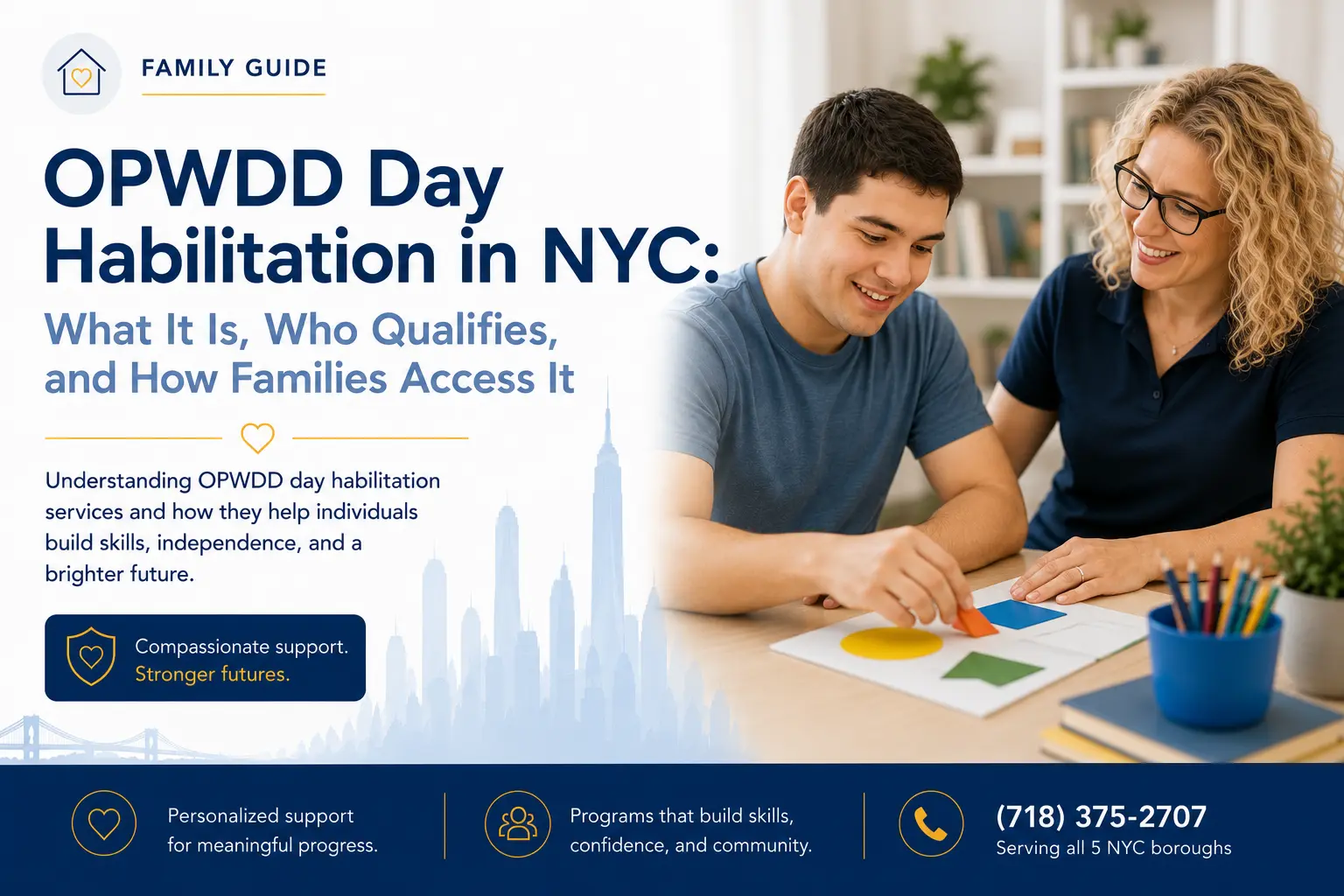
OPWDD Day Habilitation in NYC: What It Is, Who Qualifies, and How Families Access It
Day habilitation is one of the most important OPWDD services available to individuals with developmental disabilities in New York. Therefore, here is exactly what day HAB programs provide, who qualifies, and how NYC families get started.
- First, day habilitation provides structured daytime programming — skill building, socialization, community participation, and personal development — for individuals with developmental disabilities.
- Second, day hab is funded by OPWDD and costs families nothing out of pocket. Specifically, it is available to individuals who are OPWDD-eligible and enrolled in services.
- Ultimately, day hab serves both as a meaningful daily program for the individual and as essential daytime relief for families who provide care at home.
Indeed, families caring for a loved one with a developmental disability often face a difficult daily question: what happens during the day? Specifically, when school-age services end, when a family caregiver needs to work, or when an adult child with a disability needs structure and social connection beyond the home, the answer is often day habilitation. Consequently, day hab programs are one of the most widely used OPWDD services in New York City — and one of the most valuable. Therefore, this guide covers what day habilitation actually provides, who qualifies, and how families access it through Advantage Home Care’s OPWDD support services.
Looking for a provider rather than an explanation? This guide covers how OPWDD day habilitation works and who qualifies for it. If you already hold a Life Plan and need an agency to deliver it, see day habilitation with Advantage Home Care, or start from our OPWDD support services overview.
What Is Day Habilitation?
Essentially, day habilitation — commonly called “day hab” — is a structured daytime program designed to help individuals with developmental disabilities develop and maintain skills, participate in their community, and engage in meaningful daily activities. Specifically, programs operate during daytime hours (typically 9 AM to 3 PM, though schedules vary) and take place at licensed program sites or in community settings throughout NYC. Furthermore, day hab is not daycare. Instead, it is a goal-oriented service built around each individual’s specific needs, strengths, and Life Plan. Consequently, the programming is personalized — what one participant works on may be entirely different from the next.What Day Hab Programs Typically Include
Who Qualifies for Day Habilitation?
Importantly, day habilitation is available to individuals who meet OPWDD eligibility requirements. Specifically, this means individuals with a qualifying developmental disability — including but not limited to:Day Habilitation vs. Community Habilitation
Importantly, families sometimes confuse day habilitation with community habilitation — they sound similar but work differently:How to Access Day Habilitation in NYC
The Transition From School-Age Services to Day Hab
Critically, one of the most common entry points for day habilitation is the transition from school-age services. Specifically, when a student with a developmental disability ages out of the school system (typically at age 21), families suddenly face a gap — the structured, full-day programming that school provided disappears overnight. Consequently, day hab becomes the primary replacement for that daytime structure. Therefore, families should begin planning for this transition at least one to two years before the student exits school, working with their OPWDD Service Coordinator and school transition team.Day Habilitation Programs: Quick Answers
What is day hab?
“Day hab” is short for day habilitation, an OPWDD-funded program where adults with intellectual or developmental disabilities spend structured daytime hours building daily-living, social and community skills, either at a site or out in the community. It is not day care and it is not a job program, although it can lead toward one.
What OPWDD day habilitation programs are there in NYC?
Site-based programs (a set location with a daily schedule), community-based or “without walls” programs (small groups out in the neighborhood most of the day), and blended models. Every program must be run by an OPWDD-approved provider and is written into the person’s Life Plan by their Care Manager.
Who qualifies for day habilitation in New York?
Adults (generally 21 and over, or younger once school-age services end) who are OPWDD-eligible and enrolled in the HCBS waiver. Eligibility starts with OPWDD eligibility through the Front Door, then a Care Manager adds day hab to the Life Plan.
Is day habilitation free?
For OPWDD-eligible individuals with Medicaid, day habilitation is funded through the Medicaid HCBS waiver at no cost to the family, including program transportation in most cases. Advantage Home Care can staff the in-home support around the day hab schedule; call 718-375-2707.