Category: Home Care

  • What Is Companion Care? How Social Support Keeps Seniors Healthier at Home

    What Is Companion Care? How Social Support Keeps Seniors Healthier at Home

    Senior Care Guide

    What Is Companion Care? How Social Support Keeps Seniors Healthier at Home

    Physical assistance is only part of home care. For many seniors, loneliness and isolation are just as damaging as any health condition. Companion care addresses both — and the results are remarkable.

    💡 Key Takeaways
    • Loneliness in older adults is linked to cognitive decline, depression, and higher rates of hospitalization.
    • Companion care provides social engagement, routine, and emotional support alongside practical help.
    • Even a few hours of companionship per week can measurably improve a senior’s quality of life.

    When families think about home care, they often focus on the physical: bathing, medication reminders, mobility support. But for many seniors living alone in New York City, the hardest part of the day isn’t any of those things. It’s the silence. Companion care is the part of home care that addresses that — and it’s far more powerful than most people expect.

    What Companion Care Actually Involves

    Companion care is non-medical home support centered on social engagement and emotional connection. A companion caregiver spends meaningful time with a senior — having conversations, sharing meals, going on walks, playing cards, watching a favorite show together, or simply being present.

    But companions also help with the practical side of daily life: light housekeeping, grocery runs, appointment reminders, reading mail aloud, and helping maintain a consistent daily routine. It’s the kind of support that keeps a senior’s world feeling full instead of shrinking.

    What Companion Caregivers Do

    🗣️
    Conversation & Engagement

    Regular conversation, storytelling, reminiscing, and listening — a companion is genuinely present, not just physically there.

    🚶
    Walks & Outings

    Getting outside matters enormously for seniors. Companions make outings possible — to the park, the store, a community center, or a doctor’s visit.

    🍽️
    Shared Meals

    Eating alone is one of the strongest predictors of poor nutrition in seniors. A companion shares mealtimes and ensures your loved one is actually eating.

    📅
    Daily Routine Support

    Reminders for medications, appointments, and daily tasks. Light help around the home. Structure that keeps the day meaningful.

    🎮
    Activities & Hobbies

    Cards, puzzles, reading, music, crafts — activities matched to what the senior enjoys and finds stimulating.

    🧠
    Cognitive Engagement

    Conversation and activity are among the most evidence-backed ways to support cognitive health in aging adults.

    Why Loneliness Is a Health Issue, Not Just a Feeling

    The U.S. Surgeon General’s advisory on loneliness found that social isolation carries health risks comparable to smoking 15 cigarettes a day. For older adults, chronic loneliness is associated with higher rates of dementia, heart disease, depression, and emergency room visits.

    This isn’t a soft issue — it directly affects how long and how well seniors live. Companion care is one of the most evidence-supported interventions available, and it doesn’t require a prescription or a medical procedure.

    How Companion Care Fits Into a Broader Care Plan

    Companion care works alongside — not instead of — personal care and medical support. Many seniors receive companion care a few times a week to provide social connection and routine, while a home health aide or personal care aide covers the physical aspects of daily living on other days.

    For families managing a loved one’s care from a distance, companion care also provides peace of mind: a trusted, consistent presence checking in and keeping you updated on how your loved one is really doing day to day.

    Getting Started in NYC

    Companion care services are available through private pay or, in some cases, as part of a broader Medicaid home care plan depending on the program. Advantage Home Care carefully matches each senior with a companion based on personality, interests, language, and background — because the relationship is what makes it work. If you’re wondering whether companion care is right for your loved one, our team is happy to talk it through with you.

  • Navigating OPWDD: A Practical Guide for Families

    Navigating OPWDD: A Practical Guide for Families

    Family Resources

    Navigating OPWDD: A Practical Guide for Families

    By The Advantage Home Care Team • 5 min read

    If you have recently started researching support options for a family member with a developmental disability, you’ve likely come across the acronym OPWDD. For many families, this is the beginning of a journey that is deeply rooted in love, but also filled with confusing paperwork, new terminology, and endless questions.

    It is completely normal to feel overwhelmed. You want to ensure your loved one lives a fulfilled, safe, and supported life, and navigating state systems isn’t always intuitive. Today, we want to break down what OPWDD is from a family’s perspective, what it means for your loved one, and how to take the first steps without feeling lost.

    What Exactly is OPWDD?

    OPWDD stands for the New York State Office for People With Developmental Disabilities. In simple terms, this is the state agency responsible for coordinating services for New Yorkers with developmental disabilities. Their mission is to help individuals lead richer lives by providing necessary support—whether that means help at home, integration into the community, or job coaching.

    “Think of OPWDD as the gateway to a wide network of support. Once you are in the system, it opens up a variety of resources tailored to your family’s unique daily needs.”

    Common Questions Families Ask

    When families first reach out to our team at Advantage Home Care, they usually have similar, very practical questions. Here are the basics:

    1. Who is eligible for services?

    Eligibility is determined by the state, but generally, services are available to individuals who have a developmental disability that originated before the age of 22 and poses a significant challenge to their ability to function independently in society. This often includes conditions like intellectual disabilities, autism spectrum disorders, cerebral palsy, and neurological impairments.

    2. What kind of day-to-day help can we actually get?

    The services are incredibly diverse because they are meant to be tailored to the individual. Depending on your family’s approved plan, services can include:

    • Community Habilitation: Helping your loved one develop skills to participate actively in their community (like learning to use public transit or shopping for groceries).
    • Respite Care: Providing temporary relief for you and other primary family caregivers, so you can rest and recharge knowing your loved one is safe.
    • Day Habilitation: Programs that offer peer interaction, skill-building, and activities during the day.
    • Employment Training: Coaching to help individuals find and maintain meaningful employment.

    Why The Process Feels Complex (And How to Simplify It)

    The first step in accessing these services is an orientation process that New York State calls the “Front Door.” It is aptly named—it is the entry point where eligibility is confirmed and assessments are made.

    Because these are state-funded services, the process involves gathering documentation, attending informational sessions, and working with care managers. It can feel like taking on a part-time job just to get the paperwork done. The most important thing to remember is that you do not have to do this alone.

    Many families find peace of mind by partnering with an experienced home care agency early in the process. Professionals who navigate the OPWDD system every single day can help you understand what documentation is required, advocate for your loved one’s needs, and eventually match your family with a compassionate, trained caregiver who fits seamlessly into your daily life.

    Need help navigating the OPWDD process?

    Our care experts can answer your questions and guide you through the paperwork. Let us lighten the load for your family.

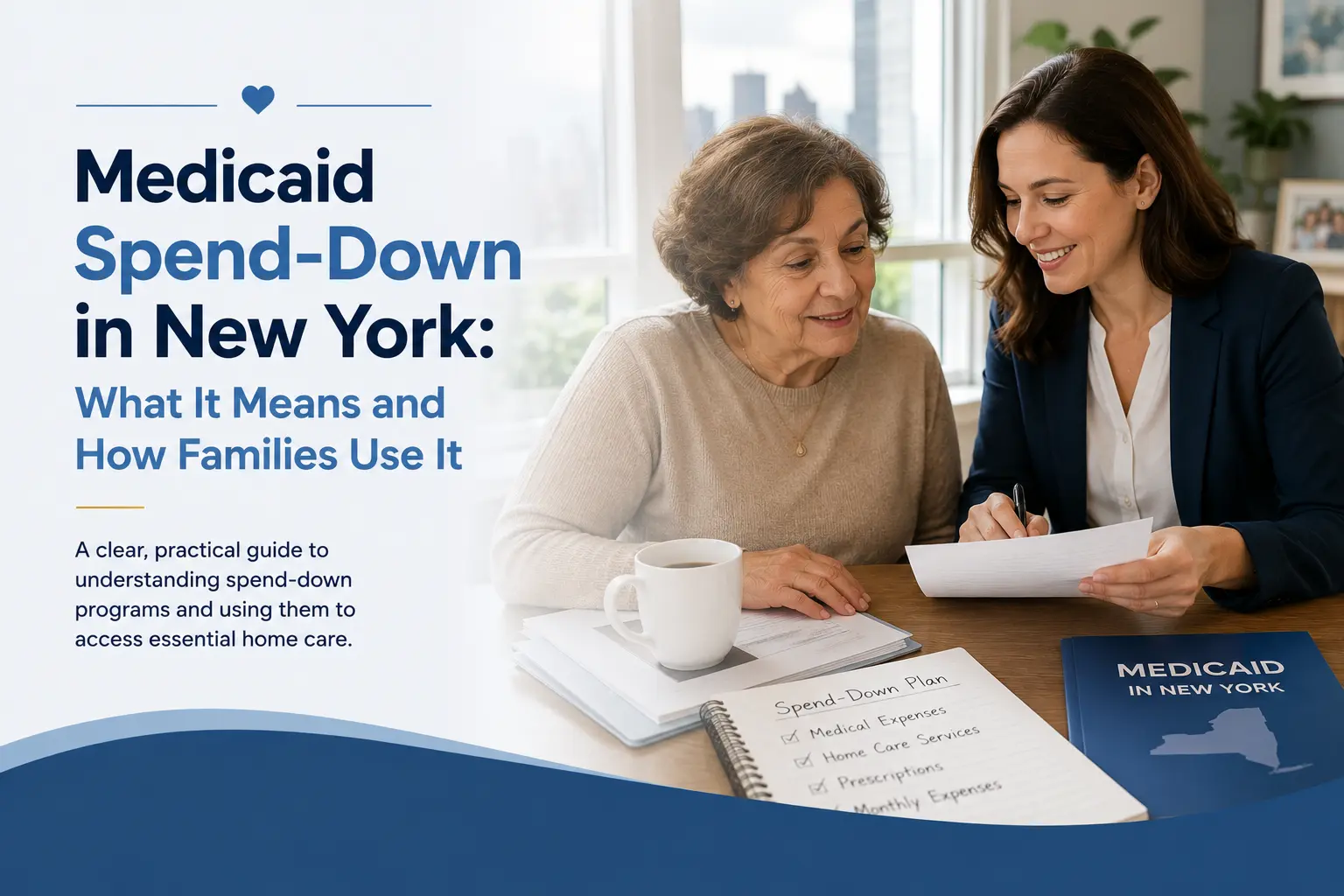
    • Medicaid Spend-Down in New York: What It Means and How Families Use It

      Medicaid Spend-Down in New York: What It Means and How Families Use It

      Medicaid Planning Guide

      Medicaid Spend-Down in New York: What It Means and How Families Use It

      Many families assume they earn too much for Medicaid. New York’s spend-down program changes that calculation — and understanding it could be the key to accessing home care coverage for your loved one.

      💡 Key Takeaways
      • Medicaid spend-down allows people with income above the standard limit to still qualify for Medicaid coverage.
      • It works like a deductible — you “spend down” excess income on medical costs, then Medicaid covers the rest.
      • Pooled income trusts are the most practical way most NYC families meet their spend-down obligation.

      One of the most common things families tell us when they first call is some version of: “We don’t think we qualify for Medicaid — my father’s Social Security is too high.” In many cases, they’re wrong. New York’s Medicaid spend-down program exists specifically for situations like this, and it opens the door to home care coverage for families who would otherwise be locked out.

      What Is Medicaid Spend-Down?

      Medicaid in New York has income limits. If someone earns more than the limit, they ordinarily wouldn’t qualify. But the spend-down program says: if your excess income goes toward medical expenses, Medicaid will cover everything else once that threshold is met.

      Think of it like a health insurance deductible. You pay a set amount first — your “excess income” — and Medicaid kicks in for the remainder of your medical and care costs. For people who need regular, ongoing home care, this can be an enormously valuable path to coverage.

      How the Spend-Down Calculation Works

      1
      Calculate Your Monthly Income

      Add up all sources: Social Security, pension, retirement distributions, investment income, and any other regular income.

      2
      Find the Medicaid Income Limit

      New York sets a monthly income limit for Medicaid eligibility. The difference between your income and this limit is your “excess income.”

      3
      Meet the Spend-Down Amount

      Each month, you must show that your excess income has been applied to allowable medical expenses before Medicaid coverage activates.

      4
      Medicaid Covers the Rest

      Once the spend-down threshold is met, Medicaid covers all remaining eligible expenses — including home care — for the rest of that period.

      The Pooled Income Trust: How Most Families Handle Spend-Down

      In practice, very few people can afford to simply pay their excess income out of pocket toward medical bills each month. That’s where a pooled income trust comes in — and it’s the most common and practical way families in NYC meet their Medicaid spend-down obligation.

      A pooled income trust is a legal account managed by a nonprofit organization. Each month, the person deposits their excess income into the trust. The trust then pays their bills — rent, utilities, groceries, personal expenses — while the deposit itself satisfies the spend-down requirement. Medicaid coverage activates, covering home care costs for the month.

      This structure lets your loved one keep their income available for living expenses, while still qualifying for Medicaid. It requires proper legal setup and ongoing administration, which is why working with an experienced team matters.

      Common Questions Families Ask

      Does spend-down apply to assets too?

      Medicaid also has asset limits separate from income. If someone has excess assets (savings, investments), there are separate strategies — some legal, some not — for addressing this. A spend-down program specifically addresses monthly income, not assets.

      What counts as an “allowable medical expense”?

      Medical bills, prescription costs, health insurance premiums, home care costs, and certain other health-related expenses typically count toward the spend-down. The exact list varies — a care coordinator can walk through what applies in your situation.

      Is spend-down available for MLTC plans?

      Yes. Many Managed Long-Term Care plans in New York work with spend-down enrollees. The process of coordinating between a pooled income trust and an MLTC plan can be complex, but it’s a common arrangement in NYC.

      Getting the Right Help

      Medicaid spend-down planning isn’t something to navigate alone. An error in the setup — wrong income calculation, improper trust documentation, missing paperwork — can delay coverage by months. Advantage Home Care’s team works with families throughout the process: confirming income and eligibility, connecting families with the right legal and trust resources, and making sure the path to home care coverage is as smooth as possible. If you’re not sure whether spend-down applies to your situation, the right first step is a conversation.

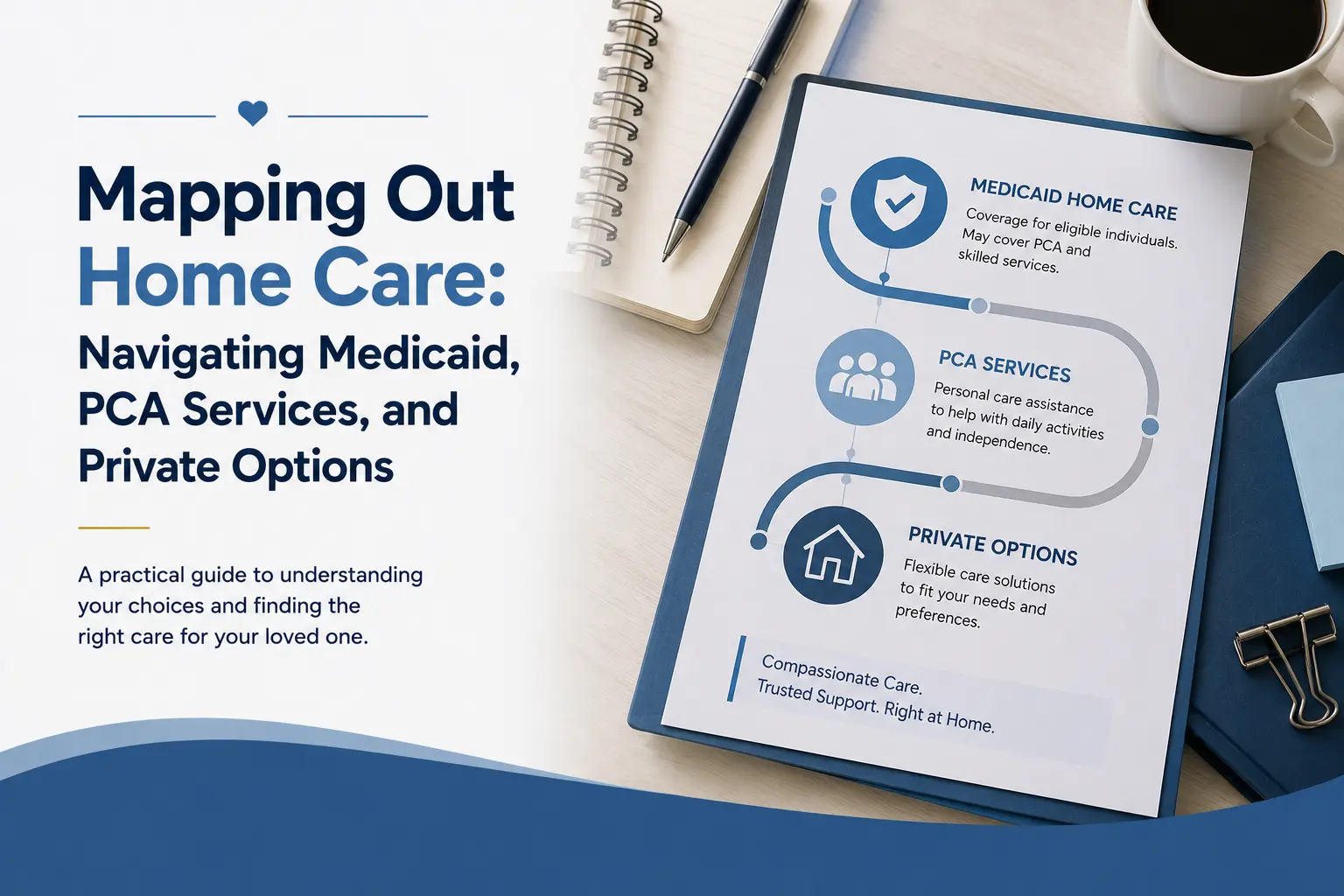
    • Mapping Out Home Care: Navigating Medicaid, PCA Services, and Private Options

      Mapping Out Home Care: Navigating Medicaid, PCA Services, and Private Options

      Mapping Out Home Care: Navigating Medicaid, PCA Services, and Private Options

      By The Advantage Home Care Team • 5 min read

      When exploring home care for a loved one, you quickly realize how many paths exist. First, you must decode financial qualifications. Then, you need to determine the right level of daily assistance. Consequently, building the perfect safety net can feel overwhelming.

      Every family’s starting line is completely unique. Some households have time to plan long-term benefits. However, others face sudden medical changes. These situations require an immediate, safe care solution at home. Ultimately, understanding how funding paths and clinical services intersect helps you find a calm, sustainable routine.

      The Core Strategy: Home care is never one-size-fits-all. Therefore, the best care map blends financial practicality with immediate safety. As a result, your family member gets total personal support without unnecessary delays.

      Step 1: Assessing the Funding Path

      First, families must decide how to fund long-term home support. In New York, this generally divides into two distinct pathways:

      The Medicaid Route

      For families who meet state financial guidelines, qualifying for state-funded support is the ideal long-term choice. Furthermore, it unlocks comprehensive care plans that cover vital personal routines entirely. However, navigating validation paperwork and clinical screenings takes time. Therefore, getting professional support early is crucial. This step prevents administrative approval delays.

      The Private Pay Route

      Sometimes, families do not meet state asset thresholds. Other times, they need care to start immediately after a hospital discharge. Consequently, paying out-of-pocket or via insurance becomes the preferred path. Ultimately, private care skips the red tape entirely. It gives you total control over hours and caregivers. Furthermore, you can instantly set up short-term or 24/7 care.

      Step 2: Defining Daily Personal Support

      Next, you must decide exactly what tasks your caregiver will manage. This ensures comfort and safety at home. Specifically, this is where a certified Personal Care Aide steps in.

      First, a PCA handles the daily physical challenges. This keeps a home running smoothly and safely. For instance, they provide steady physical support during transfers. Additionally, they assist with hygiene, manage light housekeeping, and prepare meals. Most importantly, a PCA preserves your loved one’s pride. It lifts the physical weight of constant caregiving off your shoulders. As a result, you can return to simply being a family member.

      Building Your Family’s Care Plan

      You might choose immediate private flexibility. Alternatively, you could pursue state-funded care. Regardless, the goal remains the same. You want to keep your loved one safe, happy, and autonomous. Fortunately, you don’t have to map out this journey alone. Instead, the right support team simplifies the system every step of the way.

      Quick Links to Our Core Support Programs

      Finally, select a pathway below to explore our dedicated home care frameworks. You will easily find the best match for your situation:

    • How to Get Approved for Medicaid Home Care in NYC: A Step-by-Step Family Guide

      How to Get Approved for Medicaid Home Care in NYC: A Step-by-Step Family Guide

      Medicaid Planning Guide

      How to Get Approved for Medicaid Home Care in NYC: A Step-by-Step Family Guide

      Medicaid can cover the full cost of home care in New York, but navigating eligibility and the application process can feel overwhelming. Here’s exactly what families need to know to get approved — and where to get help.

      💡 Quick Overview: Key Points
      • Medicaid covers home care for eligible New Yorkers based on financial and medical need.
      • The approval process involves an application, income/asset review, and a medical assessment.
      • Getting the right help with the paperwork and planning can cut months off the timeline.

      If you’ve started looking into home care for an aging parent or loved one in New York City, you’ve probably heard the same thing from friends and neighbors: “Medicaid can cover it.” And it’s true—for eligible New Yorkers, Medicaid home care can cover the full cost of a professional caregiver right at home, often at no cost to the family. The challenge is that the approval process can feel like a maze. Between income rules, medical assessments, and stacks of paperwork, many families put off applying simply because they don’t know where to begin.

      The Approval Process at a Glance

      Medicaid home care approval in New York typically follows four main steps, each with its own timeline and documentation. Here’s what happens in each stage:

      📋
      Step 1: Understand Eligibility Basics

      Medicaid home care eligibility is based on two main factors: financial eligibility (income and assets) and medical need (requiring help with daily activities like bathing, dressing, or medication management).

      📄
      Step 2: Gather the Right Documents Early

      Before you apply, start collecting: proof of identity and residency, Social Security and Medicare cards, bank statements, proof of income (Social Security/pension award letters), and existing insurance information.

      🏥
      Step 3: Complete the Medical Assessment

      A nurse assessor reviews your loved one’s health conditions and daily routines to establish the number of care hours they qualify for. Being thorough and honest here is critical.

      Step 4: Choose Your Home Care Agency

      After approval, you select a licensed home care agency that will match your loved one with a caregiver, manage scheduling, and handle ongoing coordination.

      Financial Eligibility: What Medicaid Looks At

      The biggest concern for most families is whether they’ll qualify financially. New York Medicaid has specific income and asset limits, but these are often lower than families expect. The key is understanding that there are legal strategies to help—like pooled income trusts and spend-down planning—that can make someone eligible without impoverishing their family.

      Basic limits in New York are modest and change each year, but don’t assume automatic ineligibility. Many families think they’re “too rich” for Medicaid, only to discover that planning options exist. This is where professional guidance makes the biggest difference: a single mistake with assets can cost months in reapplication.

      Medical Eligibility: The Assessment Process

      Once financial eligibility is confirmed, your loved one will be assessed to determine their level of care need. The assessment looks at Activities of Daily Living (ADLs)—bathing, dressing, toileting, feeding—and Instrumental Activities (IADLs)—cooking, cleaning, medication management. Most ongoing Medicaid home care in NYC is then coordinated through a Managed Long-Term Care (MLTC) plan.

      Families sometimes downplay struggles out of pride or habit. Being honest during this assessment is essential: it directly determines how many hours of home care your loved one will be approved for. If the assessment seems too low, you have the right to appeal.

      Getting Help With Your Medicaid Application in NYC

      Applying for Medicaid home care is one of the most valuable steps a family can take—but nobody should have to decode government paperwork during an already stressful time. This is exactly why many NYC families look for experienced Medicaid application help rather than going it alone. From checking eligibility to submitting documents, coordinating the assessment, and appealing denials, a professional Medicaid application service saves families time, money, and heartache—and can uncover planning strategies that make someone eligible who initially seemed ineligible.

      At Advantage Home Care, our care coordination team guides families through the entire Medicaid home care application from the first phone call to approved hours. Once you’re approved, our guide to choosing the right home care agency helps you take the final step, and families who need care to begin immediately can start with private pay while the application is pending.

      Frequently Asked Questions

      Is there a Medicaid application service in NYC that can handle it for me?
      Yes. Experienced teams — including Advantage Home Care’s care coordinators — help NYC families through the full Medicaid home care application: checking eligibility, gathering documents, preparing for the assessment, setting up any needed spend-down or pooled income trust, and appealing a denial if it happens. It removes the guesswork and often shortens the timeline.

      How do I apply for Medicaid home care in New York?
      Confirm financial and medical eligibility, gather your documents, submit the Medicaid application, complete an in-home nurse assessment, and then choose a licensed agency — usually enrolling in an MLTC plan for ongoing care. Each step has its own paperwork, which is why many families get help.

      How long does Medicaid home care approval take?
      It varies with the completeness of the application and current processing times, but it commonly takes several weeks to a few months from start to approved hours. Starting early — and avoiding paperwork errors that trigger reapplication — is the best way to keep it moving.

      What if we’re over the income or asset limit?
      Being over the limit doesn’t automatically disqualify you. A spend-down or a pooled income trust can allow someone above the income threshold to still receive Medicaid home care. These are common, legitimate planning tools in New York.

      Get Help With Your Medicaid Application

      Don’t let the paperwork stop you from getting covered care. Call 718-375-2707 or reach out online, and our care coordination team will guide your Medicaid home care application from start to approval.

      Start My Application →

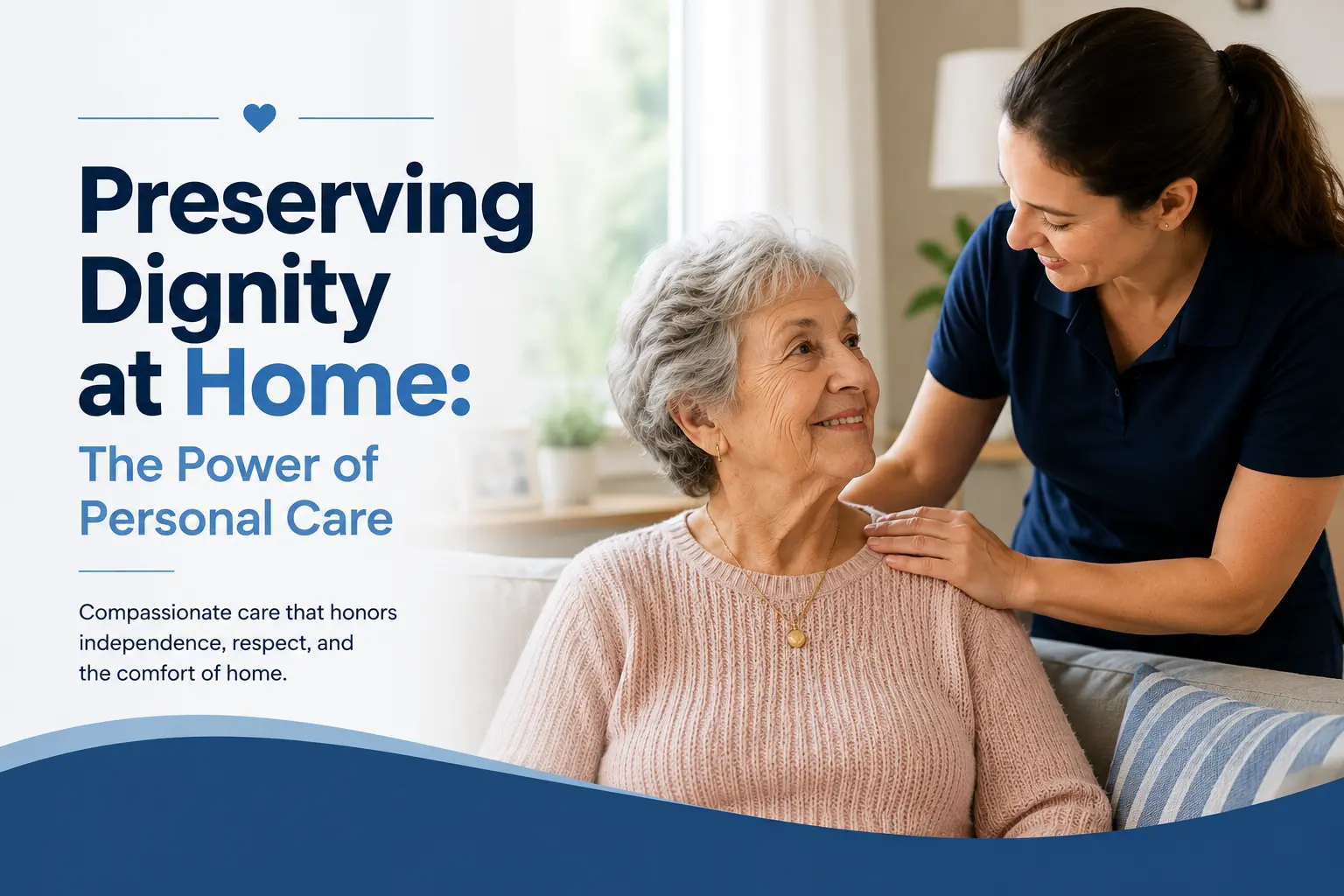
    • Preserving Dignity at Home: The Power of Personal Care

      Preserving Dignity at Home: The Power of Personal Care

      Preserving Dignity at Home: The Power of Personal Care

      By The Advantage Home Care Team • 4 min read

      As our parents or elderly family members get older, everyday routines that used to be second nature can become subtle challenges. Fastening buttons, stepping safely out of a slippery shower, or preparing a fresh meal can begin to require a level of energy and physical effort that makes them anxious or tired.

      When these changes happen, many families naturally step in to help. But over time, navigating deeply personal tasks like bathing or dressing can subtly alter the family dynamic, sometimes creating tension or embarrassment for a parent who values their independence above all else.

      A supportive perspective: Bringing in a Personal Care Aide (PCA) isn’t about taking away your loved one’s autonomy. It’s actually about preserving it. By entrusting sensitive daily routines to a trained professional, you help your loved one maintain their dignity and privacy while keeping them safe at home.

      Real Situations Where Families Welcome a PCA into the Home

      While every care plan is unique, there are a few common milestones when families decide that having professional personal care assistance is the best choice for everyone involved:

      1. When Fall Prevention and Safety Become Top Priorities

      The bathroom is statistically the highest-risk area for household slips and falls. Many families hire a PCA simply because they are worried about a parent navigating morning routines alone. Having a professional there to provide steady physical support during transfers, bathing, and dressing drastically minimizes injury risks and turns a high-anxiety routine into a safe, calm experience.

      2. When Daily Nutrition and Medication Reminders Need Structure

      Maintaining a healthy routine involves a lot of moving parts. A PCA doesn’t just assist with mobility; they ensure the structure of the day stays on track. Families often seek support when they notice a loved one is skipping fresh meals or forgetting their morning routines. A PCA handles light meal preparation, keeps the home environment tidy, and offers vital reminders to take daily medications on time.

      3. To Give Family Relationships Room to Breathe

      When you are constantly acting as a physical caregiver—managing laundry, cleaning, and assisting with personal hygiene—it leaves very little room to just enjoy being a daughter, son, or spouse. Families partner with us because they want their quality time back. Letting a PCA handle the daily physical tasks allows you to visit your loved one simply to talk, catch up, and share a meaningful day together.

      Support Tailored to Their Comfort

      Inviting someone new into a loved one’s private routine is a big transition, but the right Personal Care Aide approaches their work with deep empathy, patience, and absolute respect for the individual’s boundaries. It’s about finding that gentle balance where your loved one gets the care they need, completely on their own terms.

    • Flexibility and Control: Choosing Private Pay Home Care

      Flexibility and Control: Choosing Private Pay Home Care

      Flexibility and Control: Choosing Private Pay Home Care

      By The Advantage Home Care Team • 4 min read

      When a parent or senior loved one begins to need extra help around the house, families often find themselves at a crossroads looking at their care options. While government programs like Medicaid are incredible lifesavers, navigating their assessment timelines and strict income requirements can sometimes add pressure to an already stressful situation.

      That is why many families opt for private pay home care. Choosing to pay out-of-pocket or via long-term care insurance isn’t just about bypassing the red tape—it is fundamentally about securing complete control over your loved one’s care schedule, routine, and who steps through their front door.

      Why it matters: Private pay means care starts on your timeline, not a state agency’s. It allows you to customize a plan that molds perfectly to your family’s life, rather than trying to fit your life into rigid institutional guidelines.

      Real Situations Where Families Choose Private Pay Care

      Every household we coordinate with has a unique story, but there are a few distinct situations where choosing a private pay plan is the clear, preferred path for families:

      1. When Care Needs to Start Immediately

      Sometimes, care needs appear overnight—such as a sudden discharge from a hospital stay or a quick shift in safety at home. Because qualifying for state-funded programs can take weeks or months of administrative review, families use private pay to get a professional caregiver into the home immediately, ensuring their loved one is safe from day one.

      2. When You Want a Highly Customized Schedule

      Government programs often dictate a set maximum of hours or have strict limitations on what tasks a caregiver can perform. Families choose private pay when they want total freedom. Whether you need a caregiver for just a few hours a week to run grocery errands, temporary overnight safety monitoring, or full 24/7 care, private pay accommodates those adjustments instantly.

      3. For Temporary, Short-Term Support

      Not everyone needs permanent home care. We frequently work with families where a primary family caregiver is taking a two-week vacation, or an elderly relative is recovering from a minor procedure like a knee replacement. Private pay allows you to establish care with no long-term commitments, letting you scale services up or down as recovery progresses.

      Peace of Mind on Your Own Terms

      Deciding how to fund home care is a big financial and emotional choice, but opting for the private route provides an unmatched level of choice. It means you get to pick the ideal personality match for your parent, set the hours that work for your work schedule, and enjoy the peace of mind that comes with zero waiting periods.

    • When is the Right Time to Bring in an OPWDD Caregiver?

      When is the Right Time to Bring in an OPWDD Caregiver?

      When is the Right Time to Bring in an OPWDD Caregiver?

      By The Advantage Home Care Team • 4 min read

      If you are the primary caregiver for a child or sibling with a developmental disability, you are probably used to wearing a lot of hats. You are a coordinator, an advocate, a schedule-mapper, and a rock for your family. It’s a role filled with beautiful moments, but let’s be entirely honest—it is also exhausting.

      Many families we speak with hold onto a common myth: they think they only need to hire an agency if things reach a breaking point. But the truth is, professional OPWDD support isn’t about stepping aside; it’s about adding a trusted team member to your circle so everyone can thrive.

      A quick thought: Bringing in help isn’t a sign that you can’t handle things. It’s a proactive step to give your loved one new opportunities for independence while giving yourself a much-needed breath of fresh air.

      Real Situations Where Families Choose to Partner With Us

      Every family dynamic is unique, but we tend to notice a few common milestones when families decide it’s time to bring an Advantage caregiver into their routine:

      1. When “Growing Independence” Becomes the Goal

      As teenagers with developmental disabilities move into young adulthood, they often naturally want to expand their world outside of their parents. We frequently get hired by parents who say, “My son wants to learn how to use the subway and buy his own lunch, but he listens to a mentor differently than he listens to me.” A Community Habilitation specialist steps into that mentor role perfectly, building real-world skills directly out in the community.

      2. When Burnout Sneaks Up On You

      Caregiver burnout doesn’t happen overnight; it builds up quietly. You realize you haven’t been to your own doctor appointments, or you haven’t spent one-on-one time with your spouse or other children in months. Families use our Respite services simply to have peace of mind for a few hours, knowing their loved one is safe, engaged, and happy at home with a professional.

      3. When Routines Change (Like Heading Back to Work)

      Life transitions happen. Maybe a parent is returning to an office, a work schedule is shifting, or a school routine is ending. Families reach out to us when they need a reliable, consistent caregiver to bridge those gaps—whether that means help with morning routines or structured activities after school programs wrap up.

      Finding Your Perfect Rhythm

      Adjusting to having someone new in your home can feel like a big step, but it’s all about finding a rhythm that feels supportive, not intrusive. Whether it’s a few hours a week to focus on community skills or regular help at home, the right fit makes all the difference in the world.

    • Connecting the Dots: Why Families Need Care Coordination

      Connecting the Dots: Why Families Need Care Coordination

      Connecting the Dots: Why Families Need Care Coordination

      By The Advantage Home Care Team • 4 min read

      When a family member faces health challenges or aging, the care journey rarely involves just one person. Suddenly, a small army of professionals fills your life. You must manage primary doctors, specialists, therapists, and home care aides.

      Having access to resources is incredible. However, managing them quickly becomes a logistical puzzle. Many family caregivers share a common frustration. They spend less time actually caring for their loved one. Instead, they act as unpaid administrative assistants. They constantly make phone calls, chase records, and fix communication gaps.

      The missing link: Care Coordination isn’t about adding another appointment to your calendar. Instead, it introduces a single, dedicated navigator. This expert syncs your doctors, community resources, and home care plan. Consequently, your family can finally breathe easier.

      Real Moments When Care Coordination Changes Everything

      Most families manage on their own for a while. Eventually, specific situations arise that require professional help. Bringing in a dedicated Care Coordinator turns chaos into a structured, calm plan.

      1. When Navigating Complex State & Medical Benefits

      Applying for specialized waivers or Medicaid coverage requires precise terminology. You must match exact clinical language to strict state guidelines. Families often hire us when they feel stuck. They stare at an application stack thinking, “I don’t know what form comes first.” A coordinator bridges that gap. We ensure accurate documentation and meet all critical timelines.

      2. Managing Multiple Doctors and Changing Care Plans

      Your loved one might see multiple specialists across different boroughs. Keeping everyone on the same page is incredibly tough. We step in when communication breaks down. Often, Doctor A doesn’t know what Doctor B prescribed. To solve this, we create a single, centralized care record. This keeps the entire medical team unified.

      3. Transitioning Between Environments (Like Hospital to Home)

      Facilities and hospitals often discharge patients quickly. This creates a high-stress moment for any family. Staff members suddenly hand you new instructions, dietary changes, and follow-up tasks. Families use care coordination to map out this transition smoothly. We ensure the home care aide knows the new routine. We also guarantee prompt equipment delivery and schedule all follow-ups seamlessly.

      You Don’t Have to Be the Expert

      You shouldn’t need a healthcare administration degree to look after your family. Entrust the logistics to our professional team instead. This allows you to step back into your most important role. You can simply be a supportive, present family member.

    • Choosing the Comfort of Home: Understanding NHTD and TBI Support

      Choosing the Comfort of Home: Understanding NHTD and TBI Support

      Choosing the Comfort of Home: Understanding NHTD and TBI Support

      By The Advantage Home Care Team • 4 min read

      A loved one might experience a traumatic brain injury (TBI) or face complex physical challenges. Consequently, care conversations often feel limited. For instance, families frequently hear that nursing homes are the only realistic option. Supposedly, facilities guarantee constant safety and supervision.

      However, most individuals want to remain in a familiar setting. Specifically, they prefer their own home, community, and family. Fortunately, New York State offers specialized programs. For example, the NHTD and TBI waiver systems exist. Ultimately, they make this exact preference a safe reality.

      The core philosophy: Everyone deserves to live as independently as possible. Indeed, NHTD and TBI waiver services provide an alternative to facilities. Furthermore, they offer a structured path. As a result, individuals reclaim daily autonomy right where they belong.

      Start here: For the full picture of TBI home care in NYC — waivers, aide hours and how to arrange support — read the main guide. To see what we provide, visit NHTD and TBI support services.

      Real Milestones Where Families Reach Out for Waiver Support

      Navigating these specialized state programs requires a dedicated approach. Therefore, families usually notice the incredible impact during specific life chapters. Here is when they typically seek waiver support:

      1. Transitioning Safely Back Home From a Facility

      A family member might spend months recovering in a rehabilitation center. Consequently, bringing them home brings up mixed emotions. You certainly want them home. However, you also worry about managing logistics. Therefore, families hire us to coordinate a safe transition plan. We put trained specialists in place to prepare the environment. Ultimately, they guide the daily adjustment process smoothly.

      2. Rebuilding Practical, Everyday Community Skills

      Adapting after a traumatic brain injury means rediscovering daily rhythms. Therefore, it isn’t just about physical care. Instead, it focuses heavily on rebuilding confidence. Families choose specialized waiver services for specific reasons. For instance, their loved one is ready for cognitive exercises or daily life organization. Additionally, a dedicated trainer helps them navigate the neighborhood safely.

      3. Avoiding Institutional Placement Entirely

      Sometimes, progressive health changes occur. Consequently, a loved one’s care needs outgrow basic home assistance. Rather than looking toward institutional options, families use these waivers. Specifically, they utilize the “diversion” aspect. This allows them to scale up structured behavioral or physical support. As a result, they proactively keep their loved one safe, stable, and integrated.

      A Customized Team for Your Peace of Mind

      Every step of the waiver journey remains highly personal. First, it involves bringing together care managers and structured programs. Next, it introduces specialized home care aides. Importantly, they understand the nuances of severe physical conditions. You should rely on a team that values personal goals. Consequently, you gain absolute peace of mind. Ultimately, you know they are thriving on their own terms.

    • How to Verify a Legitimate Home Care Agency in NYC

      How to Verify a Legitimate Home Care Agency in NYC

      Trust & Safety Guide

      How to Verify a Legitimate Home Care Agency in NYC

      Protecting your loved ones means ensuring their caregivers are fully vetted, state-certified, and backed by a licensed agency. Learn the red flags of home care fraud and how Advantage Home Care guarantees your family’s safety.

      💡 Safety at a Glance: Key Takeaways
      • Always verify that an agency holds a valid license from the NYS Department of Health (LHCSA or CHHA).
      • Never pay a Medicaid-funded caregiver “under the table” or pay placement fees to a broker.
      • Advantage Home Care will only contact you through our official numbers and verified coordinators.

      Inviting a caregiver into your home is an act of immense trust, so it is worth verifying that you are working with a legitimate home care agency. Navigating the New York system sometimes exposes families to unauthorized brokers, unverified aides, or imitation agencies. At Advantage Home Care, we make protecting your family’s physical safety and financial security our highest priority.

      The Red Flags of Unauthorized Home Care

      When searching for OPWDD services, a Personal Care Aide, or a Certified Home Health Aide, you must know exactly who you are speaking with. Look out for these common warning signs of unauthorized operators:

      ⚠️
      Requests for Direct Payment

      Agencies bill legitimate Medicaid services directly to insurance. An agency should never ask you to pay an aide cash directly or charge a “placement fee” for Medicaid services.

      ⚠️
      No Physical Office Location

      Imitation agencies often operate exclusively online or use virtual P.O. boxes. A legitimate home care agency maintains verifiable, physical offices where you can meet coordinators in person.

      ⚠️
      Unverifiable Credentials

      An agency must immediately produce their NYS Department of Health license number and prove they conduct state-mandated background checks on their aides. If they fail to provide this, end the communication immediately.

      The Advantage Home Care Guarantee

      Advantage Home Care operates with total transparency to protect your family. When you work with us, you partner with a fully licensed, deeply rooted New York institution.

      • NYS Department of Health Licensed: We operate strictly under New York State guidelines, so all clinical and personal care meets the highest legal and medical standards.
      • Thorough Background Checks: We conduct comprehensive fingerprinting, medical clearance, and credential verification on every Personal Care Aide (PCA) and Certified Home Health Aide (CHHA). They must pass these checks before they ever step foot in your home.
      • Secure Data Protection: We use encrypted, HIPAA-compliant systems to manage your family’s medical records and Medicaid documentation, and we never sell or share your private information with third-party brokers.

      Verify You Are Speaking With the Real Advantage Team

      Make sure you communicate exclusively through our official channels to prevent spoofing or unauthorized representation. Advantage Home Care officially operates out of the following verified NYC locations:

      📍 Brooklyn Headquarters: 1515 Sheepshead Bay Road, Brooklyn, NY

      📍 The Bronx Office: 391 East 149th Street, Bronx, NY

      📞 Official Primary Intake Line: (718) 375-2707

      Secure Your Safe Home Care Plan

      Do not leave your family’s safety to chance. Connect directly with an official Advantage Care Coordinator today, and we will help you explore fully vetted, legitimate home care agency solutions.

      • What Do HHA Services Include? Your Guide to Everyday Home Support

        What Do HHA Services Include? Your Guide to Everyday Home Support

        Advantage Family Guide

        What Do HHA Services Include? Your Guide to Everyday Home Support

        Discover how dedicated Home Health Aides assist with everyday activities, helping clients maintain their daily routines, independence, and quality of life while remaining safely in their own homes.

        💡 Guide at a Glance: Key Takeaways
        • HHA services focus on the essential Activities of Daily Living (ADLs).
        • Caregivers provide both physical assistance and vital social companionship.
        • The primary goal is to ensure a safe, clean, and comfortable home environment.

        When an elderly parent or family member begins to need extra help around the house, the goal is always the same: to help them remain safely in the environment they know and love. HHA services are specifically designed to bridge the gap between complete independence and the need for a long-term care facility.

        Core HHA Services Included in Your Care Plan

        A Home Health Aide (HHA) does much more than simply watch over a patient. They are trained professionals who actively participate in maintaining a high quality of life. Whether you need support for a few hours a day or comprehensive live-in care, our aides provide the following essential services:

        🧹
        Light Housekeeping & Laundry

        Keeping the home environment clean, sanitary, and hazard-free, including washing clothes, changing bed linens, and tidying up living spaces.

        🍲
        Meal Prep & Eating Assistance

        Preparing nutritious meals aligned with specific dietary restrictions, and providing compassionate, dignified assistance with feeding if required.

        🗣️
        Companionship & Social Interaction

        Combating isolation through meaningful conversation, engaging in hobbies, reading aloud, and providing emotional support.

        📅
        Assistance with Daily Routines

        Hands-on help with personal hygiene, bathing, dressing, and establishing a comfortable, predictable daily schedule.

        🛍️
        Errands & Household Support

        Assisting with grocery shopping, picking up pharmacy prescriptions, and managing basic household inventory to keep the home fully stocked.

        🛡️
        Safety Supervision & Reminders

        Providing proactive fall prevention, structural mobility support, and timely reminders for daily medications and doctor appointments.

        How HHA Services Improve Quality of Life

        The true value of an Advantage Home Health Aide lies in the peace of mind they provide. For the client, it means retaining their dignity and personal schedule. For the family, it means resting easy knowing that a trained professional is actively monitoring their loved one’s health and safety.

        Request Your Free HHA Consultation

        Every family’s situation is unique. Whether you are planning ahead for an aging parent or need immediate support following a hospital discharge, our clinical intake team is here to guide you.

        Build Your Home Care Plan

        Tell us about the specific everyday activities your loved one needs help with. An Advantage Care Coordinator will review your inquiry and reach out within 24 hours.