Category: Home Care

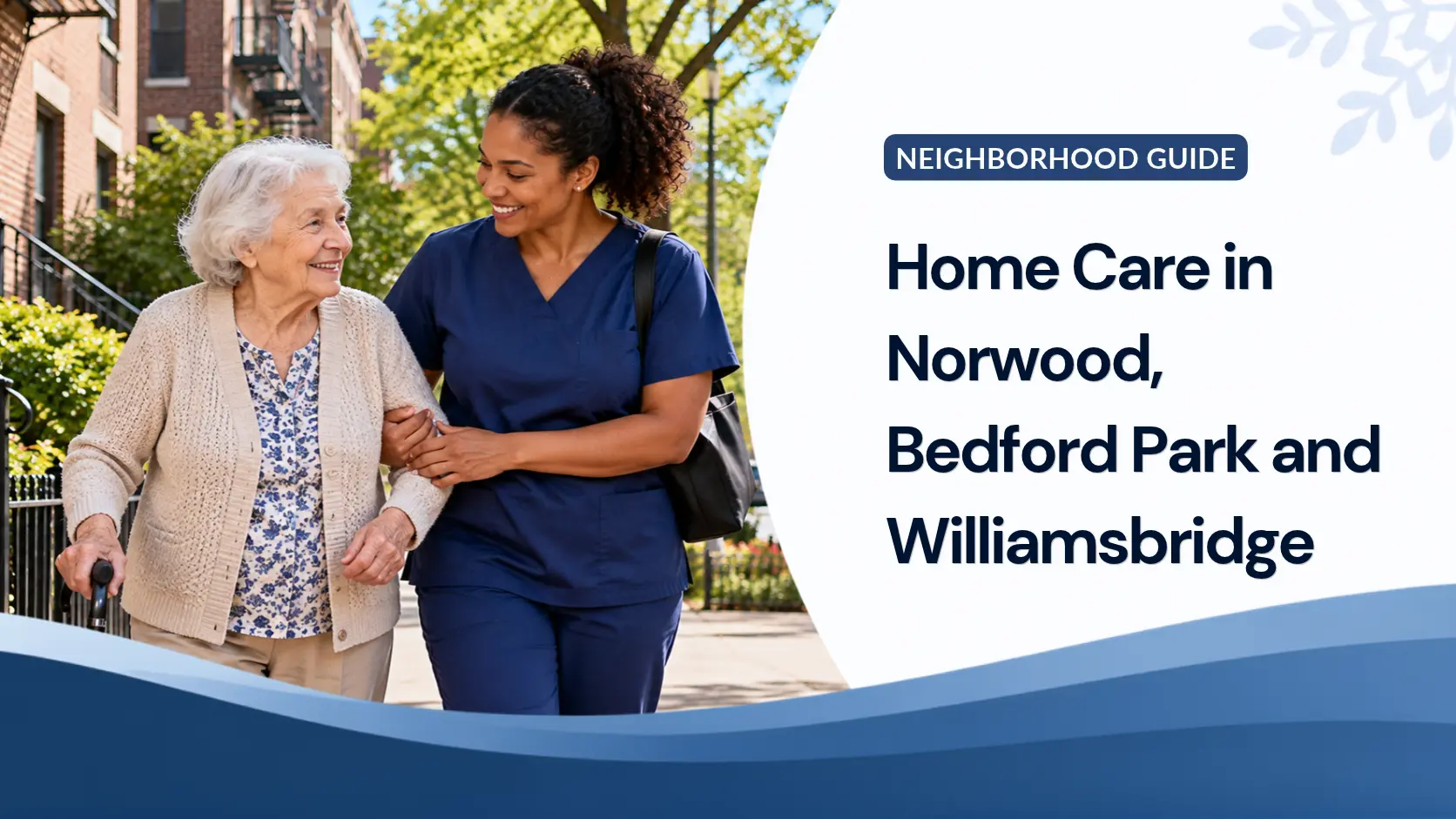
  • Home Care in Riverdale, Kingsbridge and Fordham: A Northwest Bronx Family Guide

    Home Care in Riverdale, Kingsbridge and Fordham: A Northwest Bronx Family Guide

    Bronx Neighborhood Guide

    Home Care in Riverdale, Kingsbridge and Fordham: A Northwest Bronx Family Guide

    Medicaid-covered and private home care for families in Riverdale, Kingsbridge, Norwood, Bedford Park, Fordham and University Heights, with caregivers matched by neighborhood and language.

    Quick answer

    Yes, Advantage Home Care serves the Northwest Bronx, from Riverdale and Kingsbridge to Norwood, Bedford Park, Fordham and University Heights, from our Bronx office at 391 East 149th Street. We staff home health aides and personal care aides who live in the area (many along the 1, 4, B and D lines), match caregivers by language (Spanish, Russian, Albanian, Bengali, Caribbean English, Yiddish-aware), and help families through Medicaid and MLTC enrollment at no charge. Call 718-375-2707.

    Two Very Different Halves of One Area

    The Northwest Bronx runs from the co-ops and private homes of Riverdale and Fieldston, where many families pay privately or combine Medicare-covered nursing with a few aide hours, to the dense pre-war apartment blocks of Kingsbridge Heights, Fordham and University Heights, where Medicaid is the main route to care and elevators are not guaranteed. Our coordinators handle both: a private-pay start within 48 hours for a Riverdale family after a hip replacement, and a full Medicaid application for a grandmother on Fordham Road who has been managing with help from neighbors. Discharges here come mainly from Montefiore’s Moses campus, St. Barnabas and Jacobi, and the fastest starts belong to families who call before discharge day.

    Caregivers Matched to the Neighborhood

    Riverdale, Fieldston, Spuyten Duyvil

    Private-pay and long-term-care-insurance cases are common; Russian-, Spanish- and Caribbean-English-speaking aides, and Shabbat-aware scheduling for observant households.

    Kingsbridge and Kingsbridge Heights

    Dominican, Puerto Rican and Albanian families; bilingual Spanish aides and Albanian-speaking caregivers on request.

    Norwood and Bedford Park

    Bengali-, Spanish-, Filipino- and West African-language households near Montefiore; aides who know the hospital’s discharge routine.

    Fordham and University Heights

    Predominantly Spanish-speaking; many multigenerational apartments where an aide covers the hours adult children are at work.

    How Medicaid Home Care Starts in the Northwest Bronx

    • Community Medicaid. We help with the application by phone, at home or at the East 149th Street office. Income over the limit can often be handled with a pooled income trust; see pooled income trusts in NYC.
    • The NYIA assessment. Independent nurse assessment plus clinical exam; bring discharge papers, medication list and a two-week note of the help the family provides.
    • MLTC plan enrollment. The plan authorizes weekly hours; we work with every major Bronx plan. See how many hours of Medicaid home care you can get in NYC.
    • Care starts. A matched aide, one coordinator, and help requesting more hours when needs change.

    Families who need care before Medicaid is in place can begin with private-pay hours and move the same caregiver onto Medicaid coverage later.

    Common Situations in Riverdale and Kingsbridge

    Coming home from Montefiore or St. Barnabas

    Ask the discharge planner to note the family wants home care and to send the summary to the agency. Checklist: what to set up before discharge day.

    Recovery after a hip or knee replacement

    Two to six weeks of daily help within joint precautions, often private pay while Medicare covers the therapy visits; see home care after hip replacement.

    A parent with heart failure or COPD in a walk-up

    Aides handle stairs, carrying and the daily routine so the person is not exhausted by errands; see home care for heart failure in NYC.

    Live-in care for someone with dementia

    Authorized when night-time need is documented; see overnight and live-in home care in NYC and home care for dementia.

    Why Northwest Bronx Families Choose Advantage Home Care

    A Bronx office, coordinators who speak Spanish and Russian, aides who live along the 1, 4, B and D lines, and honest answers about what Medicaid will cover. For the borough overview see home care in the Bronx; for the South Bronx see our Mott Haven and Hunts Point guide, and for the East Bronx the Pelham Bay guide.

    Frequently Asked Questions

    Is there a home care agency in Riverdale?

    Yes. Advantage Home Care serves Riverdale, Fieldston and Spuyten Duyvil with private-pay and Medicaid-covered aides, coordinated from our Bronx office. Call 718-375-2707.

    Do you provide home care in Kingsbridge and Fordham?

    Yes, daily, with bilingual Spanish/English aides and coordinators. Most Kingsbridge and Fordham cases are Medicaid-covered through an MLTC plan.

    Can you start private-pay care quickly in Riverdale?

    Usually within 24–48 hours, from a few hours a day to live-in, with no long-term contract. Many families later transition to Medicaid if the person qualifies.

    Does Medicaid pay for home care in the Bronx?

    Yes, for people who qualify financially and need help with daily activities; hours are authorized through an MLTC plan after the NYIA assessment.

    Do you have Russian- or Albanian-speaking caregivers in the Northwest Bronx?

    Russian-speaking aides are readily available; Albanian-speaking caregivers on request, with a realistic timeline given at intake.

    Are you hiring aides in the Northwest Bronx?

    Yes. Certified HHAs and PCAs from Riverdale to Fordham can apply online; free PCA training is available for new caregivers.

    Start Home Care in the Northwest Bronx

    Tell us about your family. We will explain what Medicaid can cover, match a caregiver to your neighborhood and language, and handle the paperwork.

    Call 718-375-2707Start Home Care

  • Home Care for Heart Failure in NYC: Keeping a Loved One Out of the Hospital

    Home Care for Heart Failure in NYC: Keeping a Loved One Out of the Hospital

    Condition Guide

    Home Care for Heart Failure in NYC: Keeping a Loved One Out of the Hospital

    What a home care aide does for someone with congestive heart failure, how Medicaid and Medicare each pay for it, and the daily routine that prevents the readmission cycle.

    Quick answer

    Heart failure is the leading reason older New Yorkers are readmitted to hospital within 30 days, and most of those readmissions start at home: a skipped water pill, a salty takeout meal, a few pounds of fluid nobody noticed. Home care for heart failure means an aide who runs that daily routine (weight, medications, low-sodium meals, activity pacing, watching for swelling and breathlessness) and reports changes early. Medicaid covers the hours when the person needs help with daily activities; Medicare covers short-term nursing after a hospital stay. Advantage Home Care staffs heart-failure-experienced aides across all five boroughs: 718-375-2707.

    Why Heart Failure Is a Home Care Condition

    Congestive heart failure (CHF) is managed almost entirely at home, by routine. The cardiology plan is usually simple to state and hard to keep: take the diuretic and other medications on time, keep salt and fluids within limits, weigh yourself every morning, stay active but paced, and call when weight jumps or breathing changes. For an older person who is also tired, forgetful, short of breath climbing to a fourth-floor walk-up, or living alone, that routine breaks down. An aide who is there every day is the difference between catching two pounds of fluid on Tuesday and an ambulance on Friday.

    What a Home Care Aide Does for Someone With CHF

    Daily weight and symptom check

    Same scale, same time, recorded in a log; noting new ankle or belly swelling, breathlessness lying flat, or a new cough, and reporting per the plan the family and doctor agreed.

    Medication reminders

    Prompting diuretics, beta-blockers, ACE inhibitors and other medications at the right times; home health aides may assist with self-administered medications under a nurse’s plan of care.

    Low-sodium meals

    Cooking to the cardiologist’s sodium and fluid limits in a way the person will actually eat, including within the household’s cuisine, and keeping high-salt convenience foods out of the routine.

    Activity pacing and safety

    Helping with bathing and dressing so they do not exhaust the person, spacing tasks through the day, and preventing falls when dizziness from medications is common.

    Appointments and follow-up

    Escorting to cardiology and lab visits and making sure the post-discharge follow-up within 7 days actually happens.

    Early escalation

    Knowing the red flags (rapid weight gain, chest pain, severe breathlessness, confusion) and calling the nurse, doctor or 911 as the plan directs.

    What aides do not do: aides do not adjust medication doses, interpret readings, or replace the visiting nurse. They keep the routine reliable and escalate changes fast.

    How Care Is Paid For: Medicare vs Medicaid

    After a heart failure hospitalization, Medicare covers a short episode of skilled home health from a Certified Home Health Agency: nurse visits to reconcile medications and teach the routine, sometimes physical therapy. That episode ends after a few weeks. Ongoing daily aide hours are not a Medicare benefit; they come through New York Medicaid (an MLTC plan authorizes the hours after the NYIA assessment) or private pay. Many families use both at once: the CHHA nurse for the first weeks, the agency aide for the long run. See does Medicare pay for home care in New York and how many hours of Medicaid home care you can get in NYC.

    Medicaid eligibility is based on functional need: under current New York rules most adults need help with three or more activities of daily living (two with a dementia diagnosis). Breathlessness that makes bathing, dressing and walking unsafe without help is exactly what the assessment looks at, so describe the bad days, not the good ones.

    Setting Up the Home for Heart Failure

    • A bathroom scale on a hard floor and a log sheet beside it; the cardiologist’s weight-gain thresholds written on the sheet.
    • A medication organizer filled weekly, with the diuretic timed so night-time bathroom trips are minimized.
    • A wedge or extra pillows if lying flat causes breathlessness; a hospital bed with head elevation is often Medicaid-covered, see Medicaid equipment coverage in New York.
    • Shower chair and grab bars so bathing does not become the day’s hardest exertion; see our home safety checklist.
    • For walk-up apartments, plan errands so the person is not climbing stairs more than necessary; the aide does the carrying.

    How Advantage Home Care Helps

    We staff personal care and home health aides with heart-failure experience in Brooklyn, the Bronx, Queens, Manhattan and Staten Island, matched by language and neighborhood, and we coordinate with the CHHA nurse during the post-discharge weeks so the routine carries on after the nurse’s visits stop. Our intake team handles the Medicaid application, NYIA assessment and MLTC enrollment at no charge, and private-pay hours can start within 24–48 hours when a discharge is imminent. Coming home from the hospital? Read what to set up before discharge day.

    Frequently Asked Questions

    Does Medicaid cover home care for congestive heart failure in New York?

    Yes, when the person is Medicaid-eligible and the assessment shows a need for help with daily activities. The diagnosis alone does not qualify someone; the functional need does.

    Can a home health aide weigh my father and record his blood pressure?

    Yes. Daily weight, and blood pressure with a home cuff, can be part of the plan of care, recorded in a log for the family and cardiologist. Aides report readings; they do not interpret or act on them beyond the agreed plan.

    How many hours of care does a person with heart failure usually get?

    It depends on need. Part-day help around meals, medications and bathing is common; full-day or live-in care is authorized when breathlessness, falls or confusion mean the person cannot be alone safely.

    What is the difference between the visiting nurse and the aide?

    The visiting nurse (from a Certified Home Health Agency, usually Medicare-paid) manages the medical plan for a limited period. The aide (from a licensed home care agency such as ours, Medicaid or private pay) provides daily hands-on help for as long as it is needed.

    Can the aide cook low-sodium versions of our family’s food?

    Yes. We match caregivers who know the household’s cuisine, whether Caribbean, Dominican, Russian, Chinese or Italian, so the sodium limits are met with food the person recognizes.

    How do we stop the hospital readmission cycle?

    Daily weights, medications on time, low-sodium meals, the 7-day follow-up appointment kept, and a person who notices changes early. That is the aide’s routine, and it is why families with a consistent aide see fewer emergency visits.

    Talk to Us About Heart Failure Home Care

    We will explain what Medicaid and Medicare each cover, coordinate with the discharge team, and match an aide who can run the daily routine.

    Call 718-375-2707Start Home Care

  • Home Care in Jackson Heights, Corona and Elmhurst: A Local Family Guide

    Home Care in Jackson Heights, Corona and Elmhurst: A Local Family Guide

    Queens Neighborhood Guide

    Home Care in Jackson Heights, Corona and Elmhurst: A Local Family Guide

    How families in the most multilingual neighborhoods in New York arrange Medicaid-covered and private home care, with caregivers who speak Spanish, Bengali, Nepali, Hindi, Urdu, Chinese or Tagalog.

    Quick answer

    Yes, Advantage Home Care is a licensed home care agency serving Jackson Heights, Corona, Elmhurst, East Elmhurst and Woodside. We staff home health aides and personal care aides matched by language and neighborhood, help families through Medicaid eligibility and MLTC enrollment at no charge, and can often start care within days of authorization or within 24–48 hours on a private-pay basis. Intake is available in Spanish. Call 718-375-2707.

    Home Care in a Neighborhood of 160 Languages

    Jackson Heights, Corona and Elmhurst are where New York’s home care language problem is most visible. An aide who cannot talk with the person she is bathing cannot do the job well, and an assessment conducted through a rushed phone interpreter often under-counts what a family actually does every day. So the two things that matter most here are a language-matched caregiver and an intake team that helps the family describe the real need. Elmhurst Hospital, one of the busiest in the city, discharges patients home to these blocks every day with a recommendation for home care; the families who get hours fastest are the ones who start the Medicaid steps before the discharge date.

    Caregivers Matched to the Neighborhood

    Corona and East Elmhurst

    Spanish-speaking households (Mexican, Ecuadorian, Dominican, Colombian); bilingual aides and Spanish-speaking coordinators.

    Jackson Heights

    Bengali-, Nepali-, Hindi-, Urdu- and Tibetan-speaking families along 73rd and 74th Streets and Roosevelt Avenue; Spanish and Colombian communities along 37th Avenue. We match by language on request.

    Elmhurst

    Chinese (Mandarin, Cantonese, Fuzhounese), Indonesian, Thai and Filipino households; Tagalog- and Chinese-speaking caregivers available.

    Woodside and Maspeth edge

    Filipino, Irish-American and Latino households; many adult children coordinating care for parents from other boroughs.

    How Medicaid Home Care Starts Here

    • Community Medicaid. We help complete the application in your language. Income above the limit can often be handled with a pooled income trust; see pooled income trusts in NYC. Immigration status questions are common in these neighborhoods; eligibility rules differ by status and we will tell you honestly what applies before you spend time on an application.
    • The NYIA assessment. Request an interpreter in the household’s language in advance. Bring discharge papers, a medication list and a two-week note of the help the family provides.
    • MLTC plan enrollment. The plan authorizes weekly hours; we work with every major plan in Queens. See how many hours of Medicaid home care you can get in NYC.
    • Care starts. A matched aide, one coordinator, and help requesting more hours as needs change.

    Common Situations in Jackson Heights and Corona

    Discharge from Elmhurst Hospital

    Tell the discharge planner the family wants home care and ask for the summary to be sent to the agency; see what to set up before discharge day.

    A parent with diabetes or heart failure living with adult children

    Part-day hours for meals, medications and bathing while the family works are the most common authorization; see home care for diabetes in NYC.

    A family caregiver who needs a break

    Weekend and overnight respite: emergency, overnight and weekend respite in NYC.

    Live-in care for someone who cannot be alone

    Authorized when night-time need is documented; see overnight and live-in home care in NYC.

    Why Families Here Choose Advantage Home Care

    Language-matched caregivers, Spanish-speaking intake, one coordinator per family, and straight answers about Medicaid. For the borough-wide picture see home care in Queens, and for nearby neighborhoods our Astoria and Long Island City guide and Bayside, Flushing and Northeast Queens guide.

    Frequently Asked Questions

    Is there a home care agency in Jackson Heights?

    Yes. Advantage Home Care serves Jackson Heights, Corona and Elmhurst with caregivers who live in Queens, matched by language. Call 718-375-2707 to start.

    Do you have Spanish-speaking home health aides in Corona?

    Yes. Corona and East Elmhurst are among our most requested areas for bilingual Spanish/English aides, and intake can be done in Spanish.

    Can you match a Bengali- or Nepali-speaking caregiver?

    Yes, on request. Tell us the household’s language at intake; if an exact match is not available immediately we tell you the realistic timeline rather than sending someone who cannot communicate.

    Does Medicaid pay for home care in Queens?

    Yes, for people who qualify financially and need help with daily activities. Hours are authorized through an MLTC plan after the NYIA assessment.

    How fast can care start in Elmhurst?

    With Medicaid hours already authorized, usually within days. Private pay can begin within 24–48 hours. New Medicaid applications take longer; ask about immediate need home care if urgent.

    Are you hiring caregivers in Jackson Heights and Corona?

    Yes. Certified HHAs and PCAs can apply online; multilingual caregivers are especially needed in these neighborhoods.

    Start Home Care in Jackson Heights, Corona or Elmhurst

    Tell us about your family, in English or Spanish. We will explain what Medicaid can cover, match a caregiver to your language, and handle the paperwork.

    Call 718-375-2707Start Home Care
  • Home Care for Diabetes in NYC: What Aides Do, What Medicaid Covers, and How to Start

    Home Care for Diabetes in NYC: What Aides Do, What Medicaid Covers, and How to Start

    Condition Guide

    Home Care for Diabetes in NYC: What Aides Do, What Medicaid Covers, and How to Start

    For families caring for an older adult with type 2 or type 1 diabetes at home in New York City, especially when eyesight, feet, kidneys or memory are starting to make self-management unsafe.

    Quick answer

    Home care for diabetes in NYC means a personal care or home health aide who keeps the daily routine on track: diabetic-appropriate meals on schedule, reminders for glucose checks and medications, daily foot and skin checks, safe bathing, and an alert eye for the signs of low or high blood sugar. Medicaid covers the hours when the person needs hands-on help with daily activities, not because of the diagnosis alone. Advantage Home Care staffs diabetes-experienced aides across all five boroughs and helps with the Medicaid steps at no charge: 718-375-2707.

    Why Diabetes Becomes a Home Care Issue

    Diabetes is usually self-managed for decades. It becomes a home care issue when the complications arrive together: retinopathy makes reading a glucose meter or an insulin pen hard; neuropathy makes feet numb and unsafe on stairs; kidney disease brings dialysis schedules; a stroke or early dementia makes medication timing unreliable. At that point the risk is not the diabetes itself but the missed dose, the skipped meal, the unnoticed foot wound, or the hypoglycemic fall at 3 a.m. That is exactly the kind of daily, predictable help a home care aide provides.

    What a Home Care Aide Does for Someone With Diabetes

    Meals on a schedule

    Preparing meals that follow the diet the doctor or dietitian set, timed with medications, with portion awareness and no skipped breakfasts.

    Medication and glucose reminders

    Prompting glucose checks and medications at the right times and recording results for the family and doctor. Home health aides, under a nurse’s plan of care, may assist with self-administered medications.

    Daily foot and skin checks

    Looking at feet, heels and pressure points every day for redness, blisters or wounds, keeping feet clean and dry, and reporting anything new the same day.

    Safe bathing and mobility

    Help in and out of the shower, with neuropathy-related balance problems, and on stairs; fall prevention is one of the most valuable things an aide does for a person with diabetes.

    Recognizing highs and lows

    Knowing the signs of hypoglycemia (shakiness, sweating, confusion) and hyperglycemia (extreme thirst, drowsiness), following the plan the family and doctor agreed, and calling for help when needed.

    Appointments and dialysis escorts

    Escorting to endocrinology, eye, podiatry and dialysis appointments, and making sure the person eats and hydrates around them.

    What aides do not do: aides do not cut toenails or perform foot care on a person with diabetes (that is for a podiatrist or nurse), do not adjust insulin doses, and do not make treatment decisions. They keep the routine reliable and escalate changes to the nurse, doctor and family.

    Does Medicaid Cover Home Care for Diabetes in New York?

    Yes, when the person is Medicaid-eligible and the independent assessment shows a need for help with daily activities such as bathing, dressing, walking, toileting or meal preparation. Under current New York rules, most adults need help with at least three activities of daily living to qualify for personal care services (two if dementia is also diagnosed). Diabetes-related vision loss, neuropathy and amputation are among the most common reasons older New Yorkers meet that threshold. Hours are then authorized through a Managed Long Term Care plan; see how many hours of Medicaid home care you can get in NYC.

    Diabetes supplies (meters, strips, lancets, insulin) are covered separately through the Medicaid or Medicare pharmacy benefit, and equipment such as shower chairs, grab bars and hospital beds through durable medical equipment; see what Medicaid covers for equipment and home modifications in New York.

    Medicare, Insurance and Private Pay

    Medicare covers short-term skilled home health after a hospital stay (for example nurse visits to manage a new insulin regimen or a foot wound), not ongoing aide hours. Long-term daily help comes through Medicaid or private pay. Many families start with a few private-pay hours a day while the Medicaid application is processed, then move the same caregiver onto Medicaid-covered hours. Our guide to whether Medicare pays for home care in New York explains the boundary.

    Setting Up the Home

    • A written daily plan on the fridge: meal times, medication times, target glucose ranges, and who to call for what.
    • A log the aide fills in: glucose readings, meals, foot check, anything unusual.
    • Fast-acting sugar (juice, glucose tablets) in a known place, with the aide briefed on when to use it.
    • Lighting on stairs and in the bathroom, non-slip mats, and footwear that protects numb feet; see our home safety checklist for seniors in NYC.

    How Advantage Home Care Helps

    We staff personal care and home health aides with diabetes experience in Brooklyn, the Bronx, Queens, Manhattan and Staten Island, matched by language (Spanish, Russian, Haitian Creole, Chinese, Bengali and more) and neighborhood. Our intake team helps with the Medicaid application, the NYIA assessment and MLTC enrollment at no charge, coordinates with the endocrinologist’s or clinic’s nurse when skilled visits are ordered, and can start private-pay hours within 24–48 hours if care cannot wait.

    Frequently Asked Questions

    Can a home health aide give insulin injections?

    In New York, aides do not administer insulin. A home health aide working under a nurse’s plan of care may assist a person who self-administers (setting up supplies, reminding, observing). Injections given by someone else are a nursing task, typically arranged through a certified home health agency or a trained family member.

    Can the aide check my mother’s blood sugar?

    Aides can remind, set up the meter and record the reading the person takes; home health aides may assist further under nurse supervision. Ask us to include glucose monitoring support in the plan of care so it is documented.

    Does Medicaid pay for home care if the only diagnosis is diabetes?

    Eligibility depends on functional need, not diagnosis. If diabetes complications mean the person needs help with three or more daily activities, home care hours can be authorized.

    How many hours of care does a person with diabetes usually get?

    It varies with need: part-day help around meals and medications is common; full-day or live-in care is authorized when vision loss, amputation, dialysis or dementia mean the person cannot be alone safely.

    Can you provide diabetic-diet meal preparation in Spanish- or Russian-speaking households?

    Yes. We match caregivers who know the household’s cuisine and language so the diet plan is followed in a way the person will actually eat.

    What if my father is on dialysis as well?

    Escorts to dialysis three times a week, post-dialysis fatigue support and fluid and diet management are all authorizable tasks. Tell the assessor and plan nurse about the dialysis schedule so the hours cover it.

    Talk to Us About Diabetes Home Care

    We will explain what Medicaid can cover, help with the application, and match an aide who understands the routine.

    Call 718-375-2707Start Home Care
  • Home Care in Mott Haven, Hunts Point and the South Bronx: A Local Family Guide

    Home Care in Mott Haven, Hunts Point and the South Bronx: A Local Family Guide

    Bronx Neighborhood Guide

    Home Care in Mott Haven, Hunts Point and the South Bronx: A Local Family Guide

    Medicaid-covered and private home care for families in Mott Haven, Melrose, Hunts Point, Longwood, Morrisania and Port Morris, from an agency with an office at the Hub on East 149th Street.

    Quick answer

    Yes, there is a home care agency in the South Bronx you can walk into. Advantage Home Care’s Bronx office is at 391 East 149th Street, 3rd Floor, Room 319, steps from the 3rd Avenue–149th Street station (2 and 5 trains) and the Bx15, Bx19 and Bx41 buses. We staff bilingual (Spanish/English) home health aides and personal care aides across Mott Haven, Hunts Point, Melrose, Longwood and Morrisania, help families with Medicaid and MLTC enrollment at no charge, and can often start care within days of authorization. Call 718-375-2707.

    Why an Office at the Hub Matters

    Most home care in the South Bronx is paid for by Medicaid, and Medicaid paperwork is easier done in person: bringing documents, signing forms, asking a coordinator what a notice means. Our East 149th Street office exists for exactly that. Families from Mott Haven, Melrose and Hunts Point come in with a hospital discharge summary from Lincoln Hospital or BronxCare and leave knowing what the next three steps are. Caregivers are recruited from the same neighborhoods, so the aide assigned to a home on Willis Avenue or Southern Boulevard is usually a short bus ride away, which is what makes 7 a.m. shifts reliable in winter.

    Caregivers Matched to the Neighborhood

    Mott Haven and Melrose

    Predominantly Spanish-speaking households (Puerto Rican, Dominican, Mexican, Honduran); most of our South Bronx aides are bilingual and many are from the neighborhood.

    Hunts Point and Longwood

    Families often need help timed around dialysis, clinic visits and school pick-ups; we build schedules around those fixed points and match aides who know the local routes.

    Morrisania and Claremont

    Caribbean-English-, West African- and Spanish-speaking caregivers available; large share of grandparent-headed households caring for children and elders at once.

    Port Morris

    Newer residents and older long-time tenants side by side; we handle both private-pay starts and Medicaid cases.

    How Medicaid Home Care Starts in the South Bronx

    • Community Medicaid. If your loved one does not have it, we help with the application at the office or at home. Income over the limit can usually be handled with a pooled income trust; see pooled income trusts in the Bronx and NYC.
    • The NYIA assessment. The independent nurse assessment and clinical exam decide eligibility and level of need. Bring the discharge summary, a medication list and a two-week note of the help the family gives now.
    • MLTC plan enrollment. The plan authorizes weekly hours; we work with every major plan in the Bronx. See how many hours of Medicaid home care you can get in NYC.
    • Care starts. A matched aide, a coordinator you can reach, and help requesting more hours if needs change.

    Need care before Medicaid is in place? Private-pay hours can start within 24–48 hours, and we transition the same caregiver to Medicaid coverage once approved.

    Common Situations We See at East 149th Street

    Discharge from Lincoln Hospital or BronxCare

    Ask the discharge planner to record that the family wants home care and to fax or send the summary to the agency. If Medicaid is active, aide hours can often begin the first week home. Checklist: what to set up before discharge day.

    A grandmother with diabetes and heart trouble who lives alone

    Part-day or full-day help with meals, medications and safe bathing is the most common authorization. See home care for diabetes in NYC.

    A working daughter who cannot cover nights

    Overnight and live-in hours are authorized when night-time need is documented; see overnight and live-in home care in NYC.

    A child or adult with a developmental disability

    OPWDD community habilitation and respite can run alongside Medicaid aide hours; the Bronx office coordinates with the Care Manager. Start with our OPWDD services guide.

    Why South Bronx Families Choose Advantage Home Care

    A real office in the neighborhood, bilingual coordinators, aides who live nearby, and honest answers about what Medicaid will cover. For the borough-wide picture see home care in the Bronx, and for the East Bronx see our Pelham Bay and East Bronx guide.

    Frequently Asked Questions

    Is there a home care agency in Mott Haven?

    Yes. Advantage Home Care’s Bronx office is at 391 East 149th Street, Room 319, in the Hub, serving Mott Haven, Melrose, Hunts Point and the surrounding neighborhoods. Walk in or call 718-375-2707.

    Do you have Spanish-speaking home health aides in the South Bronx?

    Yes. Most of our South Bronx caregivers are bilingual Spanish/English, and our Bronx coordinators speak Spanish. Intake can be done entirely in Spanish.

    Does Medicaid pay for home care in the Bronx?

    Yes, for people who qualify financially and need help with daily activities. Hours are authorized through an MLTC plan after the NYIA assessment; we handle each step with you at no charge.

    How fast can care start in Hunts Point or Longwood?

    With Medicaid hours already authorized, usually within days. Private pay can begin within 24–48 hours. A brand-new Medicaid application takes longer; ask about the immediate-need route if the situation is urgent.

    Can I come to the office without an appointment?

    Yes, during business hours; calling ahead means the right coordinator is ready. Bring ID, the Medicaid card if there is one, the medication list and any hospital paperwork.

    Are you hiring aides in the South Bronx?

    Yes. Certified HHAs and PCAs from the South Bronx can apply online; we also run free PCA training for new caregivers.

    Visit or Call Our Bronx Office

    391 East 149th Street, 3rd Floor, Room 319. We will explain what Medicaid can cover, match a caregiver to your neighborhood and language, and handle the paperwork.

    Call 718-375-2707Start Home Care

  • How Many Hours of Medicaid Home Care Can You Get in NYC? (2026 Guide)

    How Many Hours of Medicaid Home Care Can You Get in NYC? (2026 Guide)

    Medicaid Home Care Guide

    How Many Hours of Medicaid Home Care Can You Get in NYC?

    How New York decides your weekly hours, what typical authorizations look like, when live-in or 24-hour care is approved, and how to get more hours if the number is too low.

    Quick answer

    There is no fixed number. New York Medicaid authorizes home care hours based on an independent assessment of how much hands-on help a person needs with daily activities, then your Managed Long Term Care (MLTC) plan issues the authorization. In practice NYC families see anything from a few hours a day to 24-hour live-in care. If the hours do not match the need, you have a right to ask for more and to appeal. Advantage Home Care helps families through every step at no charge: 718-375-2707.

    Who Decides the Hours, and How

    Since 2022, every new Medicaid home care case in New York goes through the New York Independent Assessor (NYIA). Two things happen: a nurse assessment of daily functioning, and a clinical exam that confirms the person is medically able to be cared for at home. Under current New York rules, most adults must need help with at least three activities of daily living (ADLs) to qualify for personal care, or two ADLs if there is a dementia or Alzheimer’s diagnosis. ADLs include bathing, dressing, toileting, transferring (getting in and out of bed or a chair), walking and eating.

    Once eligibility is confirmed, the MLTC plan’s nurse builds a task-based plan of care: how many minutes each task takes, how often it is needed, and at what times of day. Those minutes add up to a weekly authorization, for example 28 hours a week (4 hours a day) or 56 hours a week (8 hours a day). The plan sends a written notice with the number.

    The assessment measures need, not diagnosis or age. Two people with the same condition can be authorized very different hours depending on how much help they actually require.

    What Typical Authorizations Look Like in NYC

    These are common patterns families see, not guarantees.

    Part-day care: 3–6 hours a day

    Help with bathing, dressing, a meal and medication reminders. Common when a family member is home the rest of the day.

    Full-day care: 8–12 hours a day

    For people who cannot be alone safely during the day, including many with dementia, stroke or advanced mobility limits.

    Live-in (24-hour, one aide)

    One aide lives in the home during the shift and sleeps there. Authorized when help is needed around the clock but the person generally sleeps through the night with at most a few interruptions.

    Split-shift (24-hour, two aides)

    Two aides in 12-hour awake shifts. Authorized when the person needs frequent hands-on help through the night, so an aide cannot get uninterrupted sleep.

    Read more on the difference in our guide to 24-hour, overnight and live-in home care in NYC.

    Live-In vs 24-Hour Split Shift: How Plans Decide

    The plan looks at night-time need. If the person needs help at night only occasionally, and there is a separate bed and a place for the aide to rest, the plan authorizes live-in care (which is paid as 13 hours a day, with the aide entitled to 8 hours of sleep, 5 of them uninterrupted, and 3 hours of meal breaks). If records show the person needs turning, toileting or supervision many times a night, the case for split-shift becomes strong. Keep a simple night log for two weeks before the assessment: date, time, what help was needed. It is the single most useful document a family can bring.

    Why Families Get Fewer Hours Than They Expected

    • Under-reporting on assessment day. People often say “I manage” when they mean “I manage with my daughter’s help.” Describe the help actually given, by anyone, every day.
    • Informal help counted. Plans may reduce hours when a family member is present and able to assist. Say clearly which hours family cannot cover (work, school, their own health).
    • Good day at the assessment. Symptoms vary. Bring the night log, hospital discharge papers, physical therapy notes and a medication list so the record shows the typical day, not the best one.
    • Tasks missing from the plan. Escorting to dialysis or chemotherapy, meal preparation for a special diet, and supervision for wandering are all authorizable tasks if they are documented.

    How to Get More Hours

    1. Ask the plan for a reassessment

    Any change in condition, a fall, a hospitalization, a new diagnosis, or a caregiver who can no longer help, is grounds to request a new assessment. Put the request in writing to the plan’s care manager and ask for a written response.

    2. Get the doctor’s documentation

    A short letter from the treating physician describing functional limits and safety risks (“cannot be left alone due to fall risk and wandering”) carries weight the family’s description alone does not.

    3. Appeal a denial or a cut

    If the plan denies an increase or reduces hours, the notice tells you how to appeal. You have the right to a plan appeal and then a New York State fair hearing, and if you appeal a reduction quickly, hours usually continue at the old level while the appeal is decided (“aid continuing”). Our guide to what to do when home care hours are cut or denied in New York walks through the deadlines.

    4. Check whether a waiver adds services

    For some people, the NHTD waiver or the TBI waiver adds coordination, skills training and other supports alongside MLTC aide hours.

    How Advantage Home Care Helps

    We are a licensed home care agency serving all five boroughs from offices in Brooklyn (Sheepshead Bay) and the Bronx (East 149th Street). Our intake team helps families prepare for the NYIA assessment, works with every major NYC MLTC plan, staffs the authorized hours quickly with aides matched by language and neighborhood, and helps you request more hours when the need changes. Most of our clients pay nothing out of pocket.

    Frequently Asked Questions

    How many hours of home care does Medicaid pay for in New York?

    As many as the assessment supports. Authorizations range from a few hours a week to 24-hour live-in or split-shift care. The number comes from a task-based plan of care, not a fixed schedule.

    Does Medicaid cover 24-hour home care in NYC?

    Yes, when the need for care around the clock is documented, either as live-in care (one aide) or split-shift care (two aides in awake shifts). Night-time need is the deciding factor.

    Can I choose my own hours?

    You can choose how the authorized hours are scheduled across the week, within reason, and which agency staffs them. You cannot increase the total without a reassessment.

    Will Medicaid reduce hours if I live with my parent?

    Plans may consider help a live-in relative can provide, but only for times that person is actually available and able. Work schedules, health limits and your own children all count as reasons you cannot cover certain hours.

    How long does it take to get hours after applying?

    From a complete Medicaid application to the first authorized shift is often two to three months in NYC. If care is needed urgently, ask about immediate need home care, and consider private-pay hours as a bridge.

    What if my hours were cut without a change in my condition?

    Appeal within the deadline on the notice and request aid continuing so the old hours stay in place while the appeal is heard. Reductions without a documented change in need are frequently reversed at fair hearing.

    Not Sure Your Hours Match the Need?

    Tell us the situation. We will explain what the assessment is likely to authorize, help you prepare, and staff the hours once approved.

    Call 718-375-2707Start Home Care
  • Home Care in Flatbush, East Flatbush and Crown Heights: A Local Family Guide

    Home Care in Flatbush, East Flatbush and Crown Heights: A Local Family Guide

    Brooklyn Neighborhood Guide

    Home Care in Flatbush, East Flatbush and Crown Heights: A Local Family Guide

    How families in central Brooklyn arrange Medicaid-covered and private home care, find caregivers who speak Haitian Creole, Caribbean English, Spanish, Yiddish or Russian, and start care this week.

    Quick answer

    Yes, Advantage Home Care is a licensed home care agency serving Flatbush, East Flatbush, Crown Heights, Prospect Lefferts Gardens, Ditmas Park and Kensington from our Brooklyn headquarters at 1515 Sheepshead Bay Road. We staff home health aides and personal care aides who live in or near these neighborhoods, match caregivers by language, and help families through Medicaid eligibility and MLTC enrollment at no charge. Call 718-375-2707.

    What Home Care Looks Like in Central Brooklyn

    Flatbush, East Flatbush and Crown Heights are some of the most family-dense neighborhoods in New York, with several generations often sharing a home or living a few blocks apart. Most home care here starts the same way: an older parent or grandparent who has managed for years begins to need help with bathing, stairs, meals or medication, and the adult children who have been filling the gap cannot keep it up alongside work. New York Medicaid is the most common way that care gets paid for, and the neighborhoods’ hospitals, including Kings County Hospital Center and SUNY Downstate’s University Hospital of Brooklyn in East Flatbush, discharge patients home with a recommendation for aide services every day.

    What makes care work in these neighborhoods is fit: a caregiver who speaks the family’s language, understands the food, respects the household’s faith and routine, and can get to the home reliably by the 2, 5, B or Q trains or the B41, B44 and B46 buses.

    Caregivers Matched to the Neighborhood

    Flatbush and East Flatbush

    Haitian Creole-, Jamaican- and other Caribbean-English-speaking aides are our most requested match here, along with Spanish. Many of our caregivers live along Church, Flatbush and Nostrand Avenues themselves.

    Crown Heights

    We match Yiddish- and Hebrew-aware caregivers for observant families (kosher kitchen routines, Shabbat-aware scheduling) as well as Caribbean and Spanish-speaking aides for the neighborhood’s other communities.

    Prospect Lefferts Gardens and Ditmas Park

    Mixed households, many with adult children coordinating care from Manhattan or out of state; we keep one coordinator on the case so there is a single phone number for the family.

    Kensington and Windsor Terrace

    Russian-, Uzbek- and Bengali-speaking aides are available on request alongside English and Spanish.

    How Medicaid Home Care Starts Here

    The process is the same across New York City, and our intake team runs it with you:

    • Community Medicaid. If your loved one does not have it yet, we help complete the application. Income over the limit can often be handled with a pooled income trust; see our guide to pooled income trusts in NYC.
    • The NYIA assessment. An independent nurse assessment and clinical exam determine eligibility for home care and the level of need. Bring hospital discharge papers and a two-week note of the help currently given.
    • MLTC plan enrollment. The plan authorizes weekly hours; we work with every major plan serving Brooklyn. Read how to choose an MLTC plan.
    • Care begins. We staff the authorized hours with a caregiver matched to the household, usually within days of authorization.

    Families who need care before Medicaid is in place can start with private-pay hours and transition the same caregiver to Medicaid coverage later.

    Common Situations in Flatbush and Crown Heights

    Coming home from Kings County or Downstate

    Ask the discharge planner to note that the family wants home care and to send the discharge summary to the agency; if Medicaid is already active, aide hours can often start within the first week home. Our guide to what to set up before discharge day has the checklist.

    A parent with dementia in a three-generation household

    Supervision hours during the day, and sometimes overnight, are authorizable when wandering or night-time confusion is documented. See home care for dementia in NYC.

    A family caregiver who needs a break

    Weekend and overnight respite is the most common request we get from central Brooklyn families; see emergency, overnight and weekend respite in NYC.

    A child or adult with a developmental disability

    OPWDD community habilitation and respite can run alongside Medicaid aide hours; our OPWDD services guide explains eligibility.

    Why Central Brooklyn Families Choose Advantage Home Care

    We are headquartered in Brooklyn, licensed by the New York State Department of Health, and staffed by caregivers who live in the borough. Families get one coordinator who handles the plan, the paperwork and schedule changes, language-matched aides, and honest answers about what Medicaid will and will not cover. For the borough-wide picture, see home care in Brooklyn.

    Frequently Asked Questions

    Is there a home care agency in Flatbush?

    Yes. Advantage Home Care serves Flatbush and East Flatbush daily from our Brooklyn office on Sheepshead Bay Road, with caregivers who live in the neighborhood. Call 718-375-2707 to start.

    Do you have Haitian Creole-speaking home health aides?

    Yes. Haitian Creole is one of the most common languages among our Brooklyn caregivers, alongside Caribbean English, Spanish and Russian. Tell us the household’s language at intake and we match accordingly.

    Can you provide home care in Crown Heights for an observant Jewish family?

    Yes. We match caregivers experienced with kosher kitchens and Shabbat-aware schedules, and can arrange live-in care when the assessment supports it.

    How fast can care start in East Flatbush?

    With Medicaid hours already authorized, usually within days. Private-pay care can begin within 24–48 hours. New Medicaid applications take longer; ask us about the immediate-need route if the situation is urgent.

    Does Medicaid pay for home care in Brooklyn?

    Yes, for people who qualify financially and need help with daily activities. Hours are authorized through an MLTC plan after the NYIA assessment; see how many hours Medicaid home care provides in NYC.

    Which nearby neighborhoods do you also cover?

    All of Brooklyn, including Canarsie, Brownsville, Bedford-Stuyvesant, Park Slope, Sunset Park, Bay Ridge and Sheepshead Bay.

    Start Home Care in Central Brooklyn

    Tell us about your family. We will explain what Medicaid can cover, match a caregiver to your neighborhood and language, and handle the paperwork.

    Call 718-375-2707Start Home Care
  • CDPAP and Puerto Rico: What Families Need to Know in 2026

    CDPAP and Puerto Rico: What Families Need to Know in 2026

    Paid Family Caregiving Guide

    CDPAP and Puerto Rico: What Families Need to Know in 2026

    CDPAP is New York’s program for paying a family member or friend to provide home care. Here is the honest picture for families in Puerto Rico, families moving to New York, and anyone whose CDPAP situation changed with the 2025 transition.

    💡 Key Takeaways
    • CDPAP is a New York State Medicaid program. It does not operate in Puerto Rico, and New York Medicaid does not cover care delivered there.
    • If you move from Puerto Rico to New York, you can qualify: establish NY residency, enroll in NY Medicaid, then apply — as of the 2025 transition, CDPAP runs through a single statewide fiscal intermediary, Public Partnerships LLC (PPL).
    • If CDPAP doesn’t fit — no eligible family caregiver, or you need care to start fast — Medicaid-covered agency home care (a PCA or HHA) is the parallel route, and it is what we provide.

    Thousands of families search every month for “CDPAP Puerto Rico” — usually a family already caring for a parent or spouse, hoping to be paid for that work the way New York families can be. The honest answer has two halves: what is possible in Puerto Rico, and what becomes possible if your family is in New York.

    Is CDPAP Available in Puerto Rico?

    No. The Consumer Directed Personal Assistance Program (CDPAP) is created and funded by New York State Medicaid, so it exists only in New York. Puerto Rico runs its own Medicaid system with its own home care benefits, and it does not have a CDPAP equivalent that pays family caregivers the same way. If your loved one lives in Puerto Rico and will stay there, ask the Puerto Rico Medicaid program directly about the home and community-based services they currently offer — benefits change, and the local office is the reliable source.

    Moving From Puerto Rico to New York: How You Can Qualify

    Residents of Puerto Rico are U.S. citizens, so there is no immigration barrier — but Medicaid does not transfer between Puerto Rico and New York. The path looks like this:

    1Establish New York residency. Live in New York with the intent to stay — a lease, utility bill or similar is typically enough documentation.
    2Enroll in New York Medicaid. Your Puerto Rico coverage does not carry over; you apply fresh in New York. Our guide to getting approved for Medicaid home care covers the documents and the income rules — and being over the income limit is often solvable.
    3Complete the home care assessment. The NYIA assessment determines how many weekly hours of care are authorized.
    4Choose your route: CDPAP or agency care. For CDPAP, you enroll through PPL (see below) and your chosen caregiver becomes your paid personal assistant. For agency-directed care, a licensed agency like Advantage Home Care matches and manages the caregiver — often the faster start.

    What Changed With CDPAP in 2025: PPL

    CDPAP used to run through hundreds of fiscal intermediary companies. In 2025 New York consolidated the program under a single statewide fiscal intermediary, Public Partnerships LLC (PPL) — every CDPAP consumer and personal assistant now enrolls and gets paid through PPL. Advantage Home Care is a licensed home care agency, not a CDPAP fiscal intermediary, so we will tell you plainly: if CDPAP is the right fit for your family, you enroll through PPL, and details change — confirm current rules with PPL or NY Medicaid directly.

    Where we do help: many families discover CDPAP is not the fit they hoped — the intended caregiver moved away, works full-time, or a spouse (who generally cannot be the paid assistant) is the only one available. In those cases, Medicaid pays for an agency caregiver instead — a personal care aide or home health aide — at no cost to eligible families. Same Medicaid, same hours, no waiting for a family member to be available.

    Se Habla Español

    Many of the families asking these questions are Spanish-speaking. Our coordinators and many of our caregivers speak Spanish, and we regularly help families arriving from Puerto Rico set up Medicaid and home care in New York. Read more about home care in your language.

    Frequently Asked Questions

    Can a family member get paid to be a caregiver in Puerto Rico?

    Generally not through a CDPAP-style program — Puerto Rico’s Medicaid system does not offer one statewide. Check with the Puerto Rico Medicaid office about current home care benefits. If the family moves to New York, paid family caregiving becomes possible through CDPAP.

    Can I keep CDPAP if I move from New York to Puerto Rico?

    No. New York Medicaid only covers care delivered in New York, so CDPAP ends when the consumer leaves the state. Plan the transition before moving.

    How do I apply for CDPAP in New York?

    Enroll in NY Medicaid, complete the assessment, then enroll yourself and your chosen personal assistant with PPL, the statewide fiscal intermediary. Rules about who can serve as the paid assistant (and the exceptions, such as spouses) come from NY Medicaid — confirm current details with PPL.

    What if I need care to start before CDPAP enrollment finishes?

    Agency home care can usually start much sooner — private pay within days, and Medicaid agency care as soon as approval and assessment are complete. Families sometimes start with agency care and evaluate CDPAP later.

    Does Advantage Home Care offer CDPAP?

    No — since the 2025 transition, CDPAP runs exclusively through PPL. We provide Medicaid-covered and private-pay agency home care across all five NYC boroughs, and we help families navigate Medicaid enrollment either way.

    Talk It Through in One Call

    Moving from Puerto Rico, or sorting out care after the CDPAP changes? Call 718-375-2707 — English or Spanish — and we’ll map out Medicaid, CDPAP vs agency care, and what can start now.

    Request Care Online →

  • The Medicaid Home Care Assessment in New York: How Your Hours Are Decided, and How to Prepare

    The Medicaid Home Care Assessment in New York: How Your Hours Are Decided, and How to Prepare

    Assessment Guide

    The Medicaid Home Care Assessment in New York: How Your Hours Are Decided, and How to Prepare

    One nurse visit largely determines your parent’s weekly hours. Walking in prepared is the highest-leverage hour a family can spend.

    The short answer

    New York decides Medicaid home care hours through an independent assessment: a nurse evaluates how much help the person needs with daily activities — bathing, dressing, toileting, mobility, meals — plus safety risks and what family already provides. The single most important preparation: describe the hardest days and the nights, not the best morning. Call 718-375-2707 and we’ll help you get ready before the visit.

    What Actually Happens

    🩺
    The nurse assessment

    A registered nurse works through a detailed, standardized assessment of daily functioning — it can run up to a few hours, in person or by video. Every answer feeds the hours calculation.

    👨‍⚕️
    The clinical appointment

    A separate, shorter appointment with an independent practitioner confirms that personal care at home is medically appropriate. Routine, but required.

    🧮
    How hours are decided

    Hours follow assessed need: which activities need help, how often (a task needed at night weighs differently than once a day), safety risk, and what informal help realistically exists. High-hour cases — above 12 hours a day — get an extra independent review.

    📬
    The outcome

    The determination arrives in writing, and your MLTC plan authorizes the weekly schedule. Not enough? You have reassessment and appeal rights.

    The Mistakes That Cost Families Hours

    • Host mode. Parents tidy up, dress well and perform independence for the nurse. The assessment scores what it sees and hears — answer for the average and worst days, and say so out loud when your parent minimizes.
    • Forgetting the nights. Toileting at 2 a.m., wandering, repositioning — night needs materially change the hours picture and are the most under-reported category.
    • Overstating family availability. If you work full-time and can’t actually be there at noon, don’t imply you can. Hours fill the gap between need and realistic informal support.
    • No documentation. Medication lists, hospital paperwork, a simple week-long diary of what help was needed when — concrete records anchor the assessment in reality.
    • Going in without context. Know the sequence: check you qualify → get Medicaid → assessment → choose an MLTC plan → hours start. What those hours can include is covered in what Medicaid covers at home.

    Quick Answers

    How long does the Medicaid home care assessment take?

    Plan for up to a few hours for the nurse assessment, plus a separate shorter clinical appointment. Scheduling both promptly keeps the overall timeline moving.

    How many hours will Medicaid approve?

    There’s no standard number — hours range from a few per week to around-the-clock, driven by assessed daily needs, night needs, safety and informal support. Cases above 12 hours/day get an additional review.

    Can family be present at the assessment?

    Yes — and someone who knows the daily reality should be. A family member’s specific examples counter a parent’s understandable urge to minimize.

    What if we disagree with the hours?

    Request a reassessment with documentation of what changed or was missed, or use the appeal process — see how to appeal in New York.

    Is there a reassessment later?

    Yes — routine reassessment happens periodically, and you can request one any time the condition changes. Document changes as they happen.

    What are MLTC evaluations?

    After the independent assessment, the MLTC plan you join does its own evaluation to build the care plan and authorize the weekly schedule — same principles, so the same preparation applies.

    Preparing for the Assessment: Quick Answers

    How do I prepare for the Medicaid home care assessment in New York?

    Keep a two-week log of every task someone helps with (bathing, dressing, toileting, transfers, walking, meals, medications), gather hospital discharge papers, a medication list and the doctor’s letter, and describe a typical bad day, not the best one. Have a family member present. What happens on the day itself is in the NYIA assessment visit explained.

    What questions does the NYIA nurse ask?

    How the person manages each activity of daily living, how often help is needed and by whom, cognition and memory, falls, incontinence, mobility inside and outside the home, and who is available to help at what times. Answers drive the hours, so be specific and honest. Call 718-375-2707 if you want us to prepare with you.

    Walk In Prepared

    A coordinator will walk you through what the assessment covers, what to document beforehand, and what to say plainly on the day.

    Call 718-375-2707
    Get Approved for Medicaid

  • Home Care in Brighton Beach and Coney Island: Russian-Speaking Caregivers in South Brooklyn

    Home Care in Brighton Beach and Coney Island: Russian-Speaking Caregivers in South Brooklyn

    Local Guide · South Brooklyn

    Home Care in Brighton Beach and Coney Island: Russian-Speaking Caregivers in South Brooklyn

    Care in the language your parent thinks in, from an agency whose office is ten minutes up the road.

    The short answer

    Yes — Russian-speaking home care aides are available across Brighton Beach, Coney Island, Gravesend and Sea Gate, covered by Medicaid for eligible residents or privately with a 24–48 hour start. Our office is minutes away at 1515 Sheepshead Bay Road, and coordinators speak Russian too. Call 718-375-2707.

    Why Language Comes First Here

    • Care in Russian is accepted; care through a language barrier is resisted. Bathing, dressing and medication routines are intimate — when the aide shares the language (and understands the food, the tea, the pharmacy habits), the same parent who “refused help” settles into it within a week.
    • Paperwork is half the battle. Medicaid, MLTC plans, assessments — our coordinators walk Russian-speaking families through it in whichever language is easier. See home care in your language.
    • The neighborhood is built for aging in place — the boardwalk for daily walks, groceries and pharmacies at street level, neighbors from the same wave of immigration. What’s usually missing is help inside the apartment, and that is exactly what aide hours cover.

    What Families Here Usually Arrange

    • Medicaid-covered daily hours — most Brighton Beach seniors qualify or can qualify; income over the limit is usually solved with a pooled income trust, not a rejection. See what Medicaid covers at home.
    • Help after a hospital stay at Coney Island Hospital or NYU Langone–Brooklyn — arranged before discharge so the first shift is there on day one.
    • Escorted appointments and errands, from the Avenue U medical offices to the pharmacy on Brighton Beach Avenue.

    Nearby guides: Sheepshead Bay and South Brooklyn and the borough-wide Brooklyn guide. This page is for the beach neighborhoods.

    Quick Answers

    Are there Russian-speaking home attendants in Brighton Beach?

    Yes — Russian-speaking aides are one of our largest caregiver groups, and Brighton Beach is the heart of where they work. Ukrainian-speaking caregivers are available as well.

    Does Medicaid pay for a home attendant in Coney Island?

    Yes — eligible residents get weekly aide hours through an MLTC plan at no cost. Our coordinators help with the application in Russian or English.

    Where is your office?

    1515 Sheepshead Bay Road — about ten minutes from Brighton Beach Avenue. You’re welcome to come in, or everything can be handled by phone.

    How fast can care start?

    Private-pay care usually starts within 24–48 hours. Medicaid hours begin after approval and assessment — and we can bridge with private hours in the meantime.

    Can the same aide come every day?

    Consistency is the goal — one primary aide, with a familiar backup for days off. Language matching makes consistency easier to maintain here.

    My parent refuses a stranger in the house. What helps?

    A Russian-speaking aide, introduced gradually — a few hours, a shared meal, the same face each visit. Refusal is usually about the language and the strangeness, not the help.

    Поможем — Starting This Week

    Call and speak with a coordinator in Russian or English. Tell us the block, the situation and the schedule — we’ll handle the rest.

    Call 718-375-2707
    Request Care Online

  • Day Habilitation Without Walls in NYC: Community-Based Day Hab, Explained

    Day Habilitation Without Walls in NYC: Community-Based Day Hab, Explained

    OPWDD Guide

    Day Habilitation Without Walls in NYC: Community-Based Day Hab, Explained

    A day program where the city is the classroom — no building, no fixed room, real community skills.

    The short answer

    Day habilitation without walls is OPWDD-funded day hab delivered out in the community instead of at a program site — small groups or one-on-one, working on real-world goals: transit, shopping, volunteering, libraries, parks, job-adjacent skills. Same funding and eligibility as site-based day hab, different setting. Call 718-375-2707 to talk through whether it fits your family member.

    Without Walls vs. the Alternatives

    🏙️
    Day hab without walls

    Structured weekday programming based in the community. The plan still has goals and staff ratios — the setting is the city itself. Best for people who are mobile, motivated by variety, and working toward independence.

    🏢
    Site-based day habilitation

    The classic model: a program location with rooms, staff and a daily rhythm. Better for people who need predictability, clinical supports on hand, or a calmer sensory environment. See how day habilitation works.

    🧭
    Community habilitation

    One-on-one skill building on the person’s own schedule — hours, not a program day. Often combined with day hab rather than replacing it. See community habilitation in NYC.

    📋
    How they combine

    Many people mix models — without-walls days for community goals, site-based days for structure, com hab hours in the evening. The Life Plan, built with the Care Coordination Organization, sets the mix.

    Who “Without Walls” Suits — and Who It Doesn’t

    • A strong fit: adults working on travel training, money handling, volunteering or pre-vocational goals; people who get restless in a program room; families whose top goal is real-world independence.
    • A weaker fit: people who need on-site nursing or behavior supports close at hand, or who do best with the same room, same faces, same schedule. Site-based programs exist for good reasons.
    • Eligibility is the same as all OPWDD services — confirmed eligibility, a Life Plan, and enrollment through your CCO. Starting from zero? Begin with OPWDD eligibility or the short OPWDD guide.

    Quick Answers

    What is a day habilitation without walls program?

    OPWDD day habilitation delivered in community settings rather than a program building — structured days, individual goals, small staff-supported groups out in the city.

    Is day hab without walls funded the same way?

    Yes — it’s Medicaid-funded through the OPWDD waiver like site-based day hab, at no cost to eligible families.

    What’s the difference between day hab without walls and community habilitation?

    Without-walls is still a day program — scheduled program days with a provider. Community habilitation is individual hours built around the person’s own life and goals.

    Can someone do both site-based and without-walls day hab?

    Yes — split weeks are common, and the Life Plan can be adjusted as the person’s confidence grows.

    How do we enroll in a without-walls program in NYC?

    Through your Care Coordination Organization: confirm OPWDD eligibility, add the service to the Life Plan, then choose a provider with without-walls programming in your borough.

    Does transportation count as part of the program?

    Travel is often part of the programming itself — travel training toward independent transit use is one of the most common without-walls goals.

    Day Hab Without Walls: Quick Answers

    What is day habilitation without walls?

    A community-based form of OPWDD day habilitation with no fixed site: a small group and staff spend the day in the community (volunteering, classes, errands, recreation) working on Life Plan goals. It suits adults who do not do well in a large site-based program.

    Who qualifies for day hab without walls in NYC?

    Adults who are OPWDD-eligible and enrolled in the HCBS waiver, with day habilitation written into their Life Plan by the Care Manager. See the NHTD waiver only if the person is not OPWDD-eligible; OPWDD day hab is the route for developmental disabilities.

    Find the Right Day Program Mix

    Our OPWDD team helps families compare day hab models, get the Life Plan right, and line up providers in your borough.

    Call 718-375-2707
    Explore OPWDD Services

  • Home Care in Astoria, Long Island City and Western Queens: A Local Guide

    Home Care in Astoria, Long Island City and Western Queens: A Local Guide

    Local Guide · Queens

    Home Care in Astoria, Long Island City and Western Queens: A Local Guide

    The neighborhoods that raised a generation of New Yorkers are now aging with them. Here is how Western Queens families arrange help at home.

    The short answer

    Home care aides serve all of Western Queens — Astoria, Long Island City, Sunnyside, Woodside, Jackson Heights and Elmhurst — through Medicaid-covered hours for eligible residents or private-pay care that starts within 24–48 hours. Caregivers who speak Greek, Spanish, Bengali, Arabic and more can be matched where language matters. Call 718-375-2707.

    What Western Queens Families Are Usually Solving

    • The parent who’s lived in the same Astoria apartment for 40 years and has no intention of leaving it. Aging in place here works — walkable blocks, groceries downstairs, neighbors who know each other — once daily help is added for bathing, meals and stairs.
    • Language and culture. Western Queens is one of the most multilingual places on earth. An aide who shares your parent’s language isn’t a luxury — it’s what makes care accepted rather than resisted. See home care in your language.
    • Adult children nearby but stretched. The classic arrangement: family covers evenings and weekends, Medicaid or private hours cover the working day.
    • Walk-ups. Plenty of Astoria and Sunnyside housing has stairs. Aides help with safe stair routines, or restructure the day so trips downstairs happen when help is there.

    Paying for Care in Queens

    The two routes are the same borough-wide: Medicaid-covered aide hours for eligible residents through an MLTC plan, or private pay that starts fast and bridges the wait — see how to get started.

    More Queens guides: the borough-wide Queens guide, Bayside, Flushing and Northeast Queens, and Jamaica, Richmond Hill and Southeast Queens. This page covers the western neighborhoods.

    Quick Answers

    Is there a home care agency serving Astoria?

    Yes — licensed NYC agencies including ours staff caregivers across Astoria, LIC, Sunnyside, Woodside, Jackson Heights and Elmhurst, matched by neighborhood and schedule.

    Does Medicaid cover home care in Queens?

    Yes — the standard NYC Medicaid home care program: eligibility, assessment, then weekly aide hours through an MLTC plan, at no cost to eligible families.

    Can you match a Greek-speaking or Spanish-speaking caregiver?

    Usually yes — Western Queens is where our multilingual matching matters most. Tell the coordinator the language first; it shapes the match.

    How fast can home care start in Long Island City?

    Private-pay care typically starts within 24–48 hours anywhere in Western Queens; Medicaid hours start after approval and assessment.

    My parent lives in a walk-up — is home care still workable?

    Yes. Aides plan the day around the stairs: escorted trips when help is present, deliveries and errands handled so unnecessary climbs disappear.

    Do you cover live-in or overnight care in Queens?

    Yes — overnight shifts and live-in arrangements are available across the borough when nights become the risk point.

    Home Care in Astoria and Long Island City: Quick Answers

    Is there a home care agency in Astoria?

    Yes. Advantage Home Care serves Astoria, Long Island City, Sunnyside and Woodside with Greek-, Spanish-, Arabic- and Bengali-speaking caregivers, Medicaid (MLTC) and private-pay. Call 718-375-2707.

    How do I start home care in Astoria or Long Island City?

    Call 718-375-2707. If Medicaid will pay, we begin the application and NYIA assessment with you at no charge and staff the hours once your MLTC plan authorizes them; private-pay care can usually start within 24–48 hours. Borough-wide details: home care in Queens.

    Care in Western Queens, This Week

    Tell us the neighborhood, the language and the schedule. A coordinator will match a caregiver who fits all three.

    Call 718-375-2707 Request Care Online