
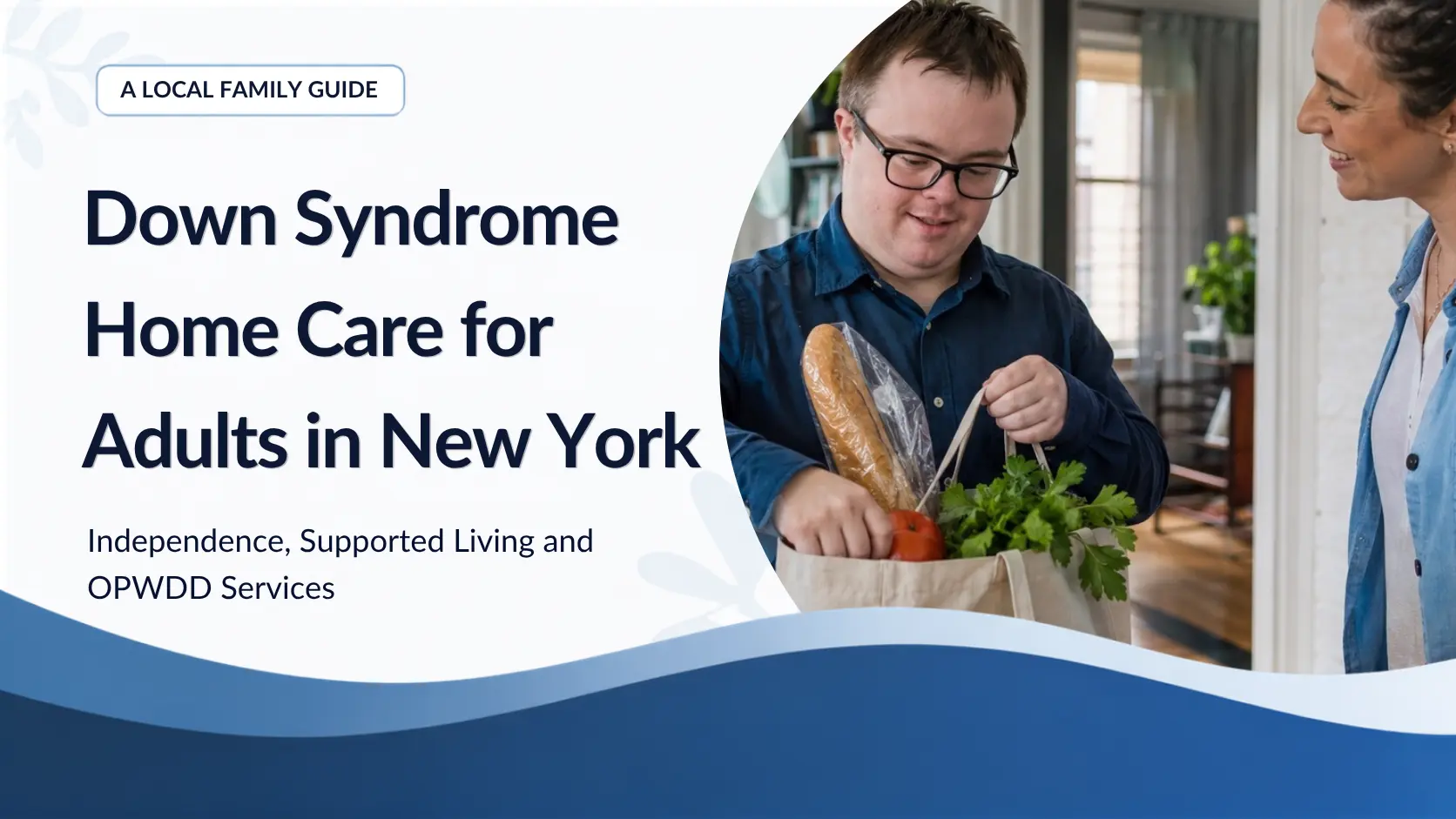
Down Syndrome Home Care for Adults in New York: Independence, Supported Living and OPWDD Services
A nursing home is almost never the answer. Here is how adults with Down syndrome live well at home — and who funds the support.
In New York, adults with Down syndrome get home care and independence support through OPWDD — trained aides at home, community habilitation to build daily-living skills, day programs, and respite for family caregivers, all Medicaid-funded. With the right support plan, many adults with Down syndrome live semi-independently at home or in supported apartments. Call 718-375-2707 to talk it through with a coordinator.
What “Independent” Realistically Looks Like
Independent supported living with Down syndrome is rarely all-or-nothing. Most adults thrive with a structured middle path: living at home or in their own apartment, with support hours shaped around the parts of the day that need it — morning routines, cooking, money and appointments, getting around the city safely. The goal of every service below is the same: more skills, more autonomy, less dependence on any one person.
The Support Menu in New York
In-home support
OPWDD-funded aides help with personal care, meals, medication reminders and household routines — at the family home or the adult’s own apartment. See OPWDD services for Down syndrome.
Community habilitation
One-on-one skill building out in the real world — shopping, transit, banking, cooking. This is the service that most directly grows independence. See community habilitation in NYC.
Day habilitation
Structured weekday programs with social connection and skill goals — see day habilitation in NYC.
Respite for the family
Funded breaks for parents and siblings who provide daily care — hours, overnights or blocks. See OPWDD respite services.
Supported Living Options, From Most to Least Independent
- Own apartment with support hours — for adults who manage most of the day alone. Community habilitation plus a few aide hours covers the gaps.
- Living at home with services — the most common arrangement: day program or work during the day, in-home support and family around it.
- Certified residential settings — OPWDD-certified group residences and family care homes, for adults who need staff nearby around the clock. These are homes, not nursing facilities — searches for “nursing homes for Down syndrome” usually end here instead, and that is good news.
The Planning Question Every Family Faces
Most adults with Down syndrome live with their parents — which works until parents age. The families who avoid crisis are the ones who build the support plan before it is urgent: OPWDD eligibility confirmed, services in place, skills growing, and a housing path sketched out. If eligibility is not yet settled, start with how OPWDD eligibility works or the short OPWDD guide. For the wider picture across disabilities, see home care for adults with disabilities in NYC.
Quick Answers
Can adults with Down syndrome live independently?
Many can, with structured support — their own apartment or the family home, plus community habilitation and aide hours matched to what they genuinely need help with.
Who pays for Down syndrome home care in New York?
Medicaid, through OPWDD. Once enrolled, in-home support, habilitation services, day programs and respite carry no out-of-pocket cost to the family.
Are there nursing homes for adults with Down syndrome?
Nursing homes are rarely appropriate. New York’s system is built around home and community settings — supported apartments, family homes with services, and OPWDD-certified residences.
What home adaptations help an adult with Down syndrome?
Visual schedules and labeled storage, simple kitchen safety devices, good lighting, and a phone set up for easy contact. Aides reinforce routines far more than equipment does.
What Down syndrome support services exist in New York State?
OPWDD covers the core: in-home aides, community and day habilitation, respite, employment supports and residential options — coordinated through a Care Coordination Organization.
What happens when parents can no longer provide care?
With OPWDD services already in place, support hours can increase or a residential placement can be arranged without starting from zero. That is why enrolling early matters.
Build the Plan Before It’s Urgent
Our OPWDD team helps families confirm eligibility, choose services and put trusted support in place — for now and for later.