
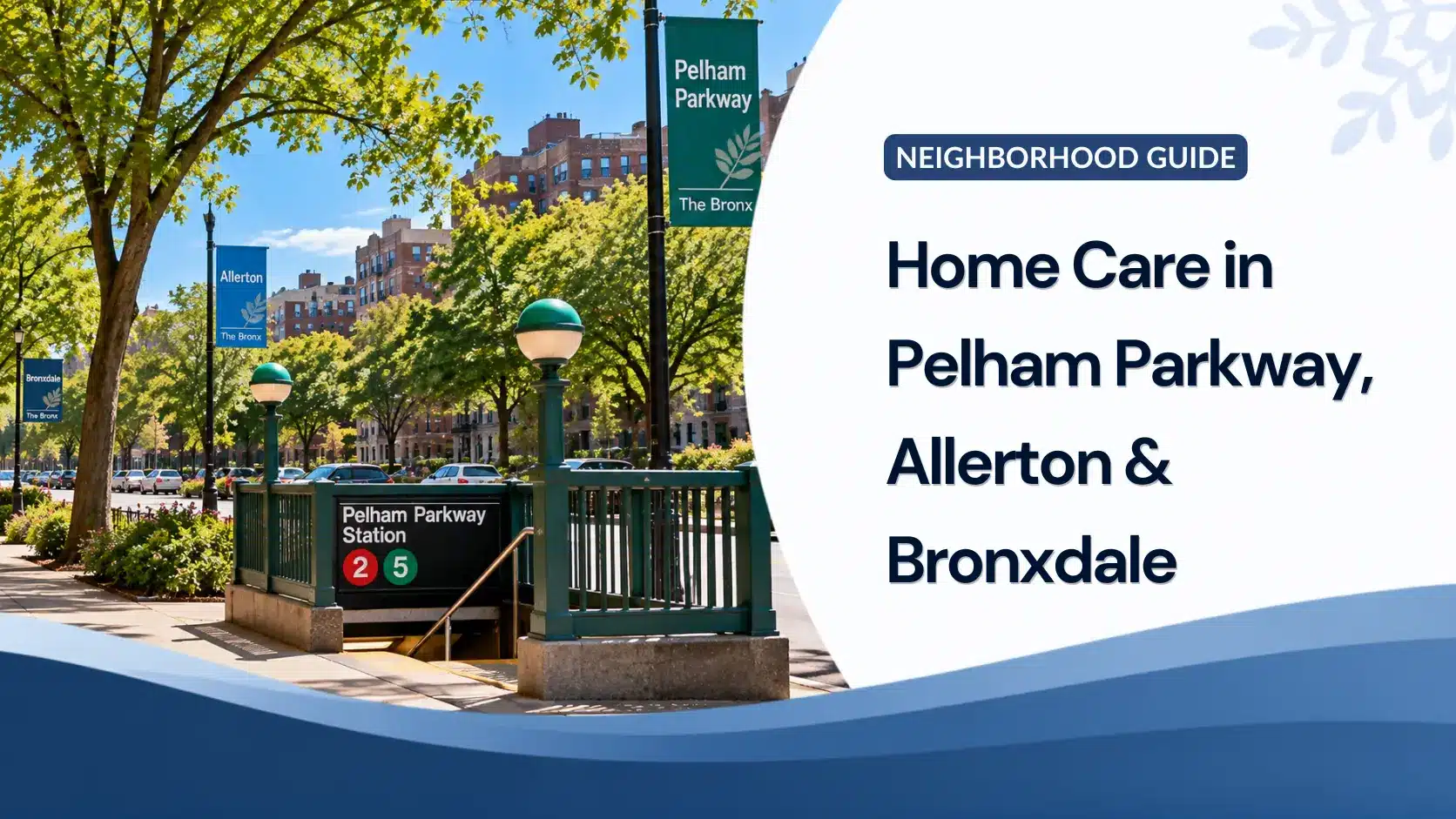
Home Care in Pelham Parkway, Allerton and Bronxdale: A Bronx Family Guide
Prewar elevator buildings along the Parkway, two-family houses on the side streets, and a mix of languages on every block. Here is how home care works for older adults in this part of the Bronx.
Home care in Pelham Parkway, Allerton and Bronxdale is available through Medicaid (usually an MLTC plan) or private pay. Aides help with bathing, dressing, meals, mobility and companionship, and can often be matched by language. The 2 and 5 trains and the Bx12 bus make the area reachable for aides from across the Bronx.
Home care in Pelham Parkway, Allerton and Bronxdale
These three neighborhoods sit just east of Bronx Park, between the Bronx Zoo and the Hutchinson River Parkway side of the borough. Pelham Parkway is named for the wide, tree-lined boulevard that runs through it. Allerton lies just north, centered on Allerton Avenue and White Plains Road. Bronxdale is to the west, near Bronx Park East. Together they are some of the more settled residential parts of the Bronx, with many residents who have lived in the same apartment for decades.
That stability is good news for aging in place: neighbors know each other, shops on Lydig Avenue, Allerton Avenue and White Plains Road are within walking distance, and families often live nearby. It also means many older adults here are now managing stairs, long hallways and old bathrooms that were not designed for walkers. Home care in Pelham Parkway and the surrounding blocks is often about keeping a long-time resident safely in a home they know. For the wider borough picture, read our pillar guide to home care in the Bronx.
Who lives here and what families ask for
Pelham Parkway and Allerton have long been home to Italian and Jewish families, and the area is known for its Albanian community. You will also find Russian-speaking residents and many Puerto Rican, Dominican, Caribbean, West African and South Asian households. In practice, that means families often ask for an aide who speaks Spanish, Albanian, Russian, Bengali or another language, or who understands certain foods and traditions.
Language matching is not always possible on the first day, but it is worth asking for. A parent who can talk easily with the aide is more relaxed, more likely to accept help with personal care, and better able to report how they feel. See our guide to home care in your language for how matching works.
The most common reasons families call us from this area include:
- A parent coming home after a stay at a nearby hospital.
- Falls or near-falls in the bathroom or on building stairs.
- Memory changes in a parent who lives alone.
- Chronic conditions such as diabetes, heart failure or COPD that make daily tasks harder.
- An adult child caregiver who is worn out and needs help.
Building types and safety planning
Many prewar buildings of about six stories with elevators, long hallways and older bathrooms. Grab bars and a shower chair go a long way.
Common on Allerton’s side streets. Front steps and interior stairs are the main fall risk, so railings and lighting matter.
Check building rules before installing equipment, and give the super the aide’s name and schedule.
NYCHA buildings have their own processes for live-in aides and accommodations. Plan for elevator outages.
Before care starts, walk through the apartment and remove loose rugs, add night lights, and make sure the path from bed to bathroom is clear. Our home safety checklist for seniors takes you room by room.
What a home care aide does
Aides help with personal care and daily living: bathing, dressing, grooming, toileting, transfers, walking, meal preparation, light housekeeping, laundry, shopping and escorting to appointments. A home health aide (HHA) can also help with some health-related tasks under nurse supervision, such as assisting with pre-poured medications as the plan of care allows. Aides do not give injections, change sterile dressings or make medical decisions. Those are nursing tasks.
Paying for care: Medicaid, MLTC and private pay
Most long-term home care in this area is paid by Medicaid. Adults who need care for more than 120 days usually enroll in a Managed Long Term Care (MLTC) plan after an assessment by the New York Independent Assessor: a nurse’s Community Health Assessment plus a separate practitioner appointment. The number of hours depends on how much help your parent needs with daily activities. To compare plans, read how to choose an MLTC plan in NYC.
Some families choose private pay, either while Medicaid is pending or because their parent is over the limits. Private pay can be as little as a few hours a week. Medicare, by contrast, covers only short-term, part-time skilled care such as nursing or therapy visits after an illness, not ongoing personal care.
Hospitals and medical care nearby
This part of the Bronx is close to several major medical centers. NYC Health + Hospitals/Jacobi is on Pelham Parkway South, and Montefiore’s Einstein campus is in nearby Morris Park. Calvary Hospital, which focuses on palliative and hospice care, is also in the area. When your parent is in the hospital, ask the discharge planner about home care, equipment and follow-up before the discharge date, not after.
How aides get here
The 2 and 5 trains run along White Plains Road with stops at Pelham Parkway, Allerton Avenue and Bronx Park East, and the 5 also serves a Pelham Parkway stop on its Dyre Avenue branch. The Bx12 Select Bus Service runs along Pelham Parkway and Fordham Road, linking the area to the west Bronx. This makes it practical to match aides who live in the Bronx and reach the area quickly, which helps with on-time arrivals and continuity. When we match, travel time is part of the decision.
Local resources
NYC Aging (formerly DFTA) funds older adult centers, home-delivered meals and case management throughout the Bronx. To find the nearest center, call 311. Bronx Park and the green malls along Pelham Parkway are pleasant spots for a supported walk with an aide when the weather is good.
How to get started
- List what your parent needs help with from morning to bedtime, and whether anyone helps at night now.
- Find out whether your parent has Medicaid. If not, decide whether to apply now, start with private pay, or both.
- Request the independent assessment for Medicaid home care and gather documents while you wait.
- Choose an MLTC plan that works with the agency you prefer, so you can keep the same aide.
- Prepare the apartment and tell the super or doorman who will be coming and when.
If your parent cannot safely wait several weeks, ask about faster options and private pay hours as a bridge. A short phone call can help you sort out which route fits.
Nearby neighborhoods
If your parent lives a little south or east, see our guides to home care in Morris Park, Van Nest and Westchester Square and home care in Pelham Bay, Parkchester and the East Bronx.
Related Guides
Home care in the Bronx · Morris Park and Van Nest · Pelham Bay and Parkchester · Private pay home care
Frequently Asked Questions
Is home care available in Pelham Parkway?
Yes. Advantage Home Care serves Pelham Parkway, Allerton, Bronxdale and the rest of the Bronx through Medicaid plans and private pay.
Can I find an Albanian or Russian-speaking aide in the Bronx?
Sometimes, depending on availability. Tell the agency your parent’s preferred language at the first call so matching can start right away.
Does Medicaid cover home care in Allerton?
Yes, for people who qualify. Most adults get it through an MLTC plan after an independent assessment, with hours based on daily needs.
How do I arrange home care after a stay at Jacobi?
Ask the discharge planner about home care early in the stay. Share your parent’s needs, and call the agency so the first shift can be ready when your parent comes home.
How fast can home care start in Bronxdale?
Private pay care can often start within days. Medicaid home care usually takes several weeks because of the assessment and enrollment steps.
Can an aide take my parent to appointments?
Yes, escorting to medical appointments is a common part of the plan of care. Aides can travel with your parent by bus, train, car service or Access-A-Ride.
Care close to home in the Bronx
Call us to talk about home care for your parent in Pelham Parkway, Allerton or Bronxdale.
Call 718-375-2707Start Home Care