
Category: Home Care

  • Home Care in Marine Park, Mill Basin and Bergen Beach: A South Brooklyn Family Guide

    Home Care in Marine Park, Mill Basin and Bergen Beach: A South Brooklyn Family Guide

    Brooklyn Neighborhood Guide

    Home Care in Marine Park, Mill Basin and Bergen Beach: A South Brooklyn Family Guide

    Medicaid-covered and private home care for the one-family-house neighborhoods of southeast Brooklyn, served from our headquarters ten minutes away on Sheepshead Bay Road.

    Quick answer

    Yes. Advantage Home Care’s Brooklyn headquarters at 1515 Sheepshead Bay Road is a short drive from Marine Park, Mill Basin, Bergen Beach and Gerritsen Beach. We provide home health aides and personal care aides, help with Medicaid eligibility and MLTC enrollment at no charge, and can start private-pay care within 24–48 hours. Call 718-375-2707.

    Home Care in Brooklyn’s House Neighborhoods

    Marine Park, Mill Basin, Bergen Beach and Gerritsen Beach are unlike most of Brooklyn: detached and semi-detached houses, driveways, and older residents who have owned their homes for decades. Many are retired city workers, and many are Italian-American, Irish-American, Jewish and, increasingly, Russian- and Chinese-speaking families. Public transit is thin, which changes two things about home care here. First, caregivers who drive or who live nearby matter more than anywhere else in the borough. Second, escorts to appointments at Maimonides, Coney Island Hospital or NYU Langone Brooklyn are a regular part of the job. Because our office is in Sheepshead Bay, coordinators can visit in person and caregivers are usually already in the area.

    Caregivers Matched to the Neighborhood

    Marine Park and Gerritsen Beach

    Aides who live in southern Brooklyn and can reach houses off the main bus lines reliably, including early-morning starts.

    Mill Basin and Bergen Beach

    Caregivers experienced with larger homes, stairs to second-floor bedrooms, and families who want the same aide every day.

    Russian- and Chinese-speaking households

    Bilingual caregivers on request; our Sheepshead Bay office handles intake in Russian.

    Kosher and observant homes

    Caregivers experienced with kosher kitchens and Shabbat scheduling.

    How Medicaid Home Care Starts Here

    • Community Medicaid. Homeowners often assume they cannot qualify. Under current New York rules a primary home is generally treated differently from savings, and income above the limit can often be handled with a pooled income trust; we walk families through it at no charge.
    • The NYIA assessment. See how the assessment decides your hours.
    • MLTC enrollment and hours. See how many hours you can get in NYC.
    • Care starts, with a coordinator who can drive over if something needs to be seen in person.

    Common Situations in Marine Park and Mill Basin

    A widowed parent alone in the house

    Part-day care for meals, medications and company, with an aide who can drive to the pharmacy and appointments; see elderly care at home in NYC.

    A fall on the stairs

    Recovery care plus practical changes; see fall prevention at home and equipment Medicaid covers.

    Discharge from Maimonides or Coney Island Hospital

    See what to set up before discharge day.

    Memory loss and wandering

    Supervision hours and a locked-door routine; see home care for dementia in NYC.

    Why Families Here Choose Advantage Home Care

    We are the agency down the road, licensed by the New York State Department of Health, with caregivers who already work in southern Brooklyn. Related: home care in Sheepshead Bay, Canarsie and East New York, and the borough overview, home care in Brooklyn.

    Frequently Asked Questions

    Is there a home care agency near Marine Park?

    Yes. Advantage Home Care’s office is at 1515 Sheepshead Bay Road, about ten minutes away. Call 718-375-2707.

    Do your caregivers drive?

    Many do, and we prioritize caregivers who live in southern Brooklyn for these neighborhoods because transit is limited.

    My parents own their house. Can they still get Medicaid home care?

    Often yes. Under current New York rules a primary home is generally treated differently from savings for Community Medicaid; our intake team reviews the details with you.

    Can an aide take my mother to appointments at Maimonides?

    Yes. Escorts to medical appointments are a normal part of home care and can be included in the plan of care.

    How fast can care start in Mill Basin?

    Private-pay care within 24–48 hours; Medicaid hours as soon as an authorization is in place. See same-week home care.

    Are you hiring caregivers in southeast Brooklyn?

    Yes, especially caregivers who drive. Certified HHAs and PCAs can apply online.

    Start Home Care in Marine Park, Mill Basin or Bergen Beach

    Call the office in Sheepshead Bay. We will explain what Medicaid can cover, match a caregiver who can reach you reliably, and handle the paperwork.

    Call 718-375-2707Start Home Care

  • Home Care for a Bedbound Loved One in NYC: Turning, Skin Care and Preventing Pressure Sores

    Home Care for a Bedbound Loved One in NYC: Turning, Skin Care and Preventing Pressure Sores

    Condition Guide

    Home Care for a Bedbound Loved One in NYC: Turning, Skin Care and Preventing Pressure Sores

    When a person can no longer leave the bed, care becomes a round-the-clock schedule of turning, cleaning, feeding and watching the skin. Here is what that schedule looks like and how families get it covered.

    Quick answer

    Bedbound home care means an aide who repositions the person about every two hours, keeps skin clean and dry, handles toileting and bathing in bed, feeds and hydrates safely, and reports the first sign of a pressure sore to the nurse. Because the need is continuous, day and night, it is one of the clearest cases for full-day or 24-hour Medicaid home care in New York. A hospital bed and pressure-relieving mattress are generally covered with a doctor’s order. Advantage Home Care builds these plans regularly. Call 718-375-2707.

    The Job Is the Schedule

    A person who cannot shift their own weight will develop a pressure sore within hours in the same position, and a sore that starts on the tailbone, heel or hip can become a wound that takes months to heal or leads to hospitalization. That is why bedbound care is not “sitting with” someone. It is a schedule: turn, check, clean, change, feed, hydrate, and turn again. Families can do it for a while; almost nobody can do it around the clock for months. Home care hours are what make it sustainable.

    What an Aide Does

    Repositioning

    Turning about every two hours using draw sheets and pillows, following the nurse’s positioning plan; heels lifted off the mattress.

    Skin checks and hygiene

    Daily inspection of tailbone, hips, heels, elbows and shoulder blades; keeping skin clean and dry; barrier cream as directed; prompt changing after incontinence.

    Bed bathing and grooming

    Full bathing in bed, oral care, hair and nails within the aide’s scope, and fresh linens.

    Feeding and fluids

    Sitting the person up properly for meals, thickened liquids if ordered, small frequent meals, and watching for coughing or choking.

    Aides do not treat wounds, change sterile dressings or manage feeding tubes; the visiting nurse does. What the aide provides is the two-hour rhythm that prevents the wound in the first place. If a sore already exists, see how the nurse and the aide divide wound care.

    Equipment That Makes It Possible

    A hospital bed with rails and height adjustment, an alternating-pressure or foam mattress, a Hoyer-style lift, a bedside commode and incontinence supplies are generally covered by Medicaid, and some by Medicare, with a doctor’s order documenting medical need. See equipment Medicaid covers. Order the bed before discharge if the person is coming from a hospital or rehab; see what to set up before discharge day.

    Getting Enough Hours

    Under current New York rules, the independent assessment records the need for help with turning, toileting, feeding and bathing, including at night. A bedbound person’s needs are continuous, and that is what supports full-day and 24-hour authorizations; document night-time turning and changing specifically. See how many hours you can get in NYC and live-in vs split-shift care. If two people are needed to turn or lift safely, see two-aide care. If hours are cut or denied, see how to appeal.

    Related Guides

    Home care for incontinence Β· Hospice and home care together Β· Home care after a stroke Β· Overnight and live-in home care

    Frequently Asked Questions

    Does Medicaid cover 24-hour home care for someone who is bedbound?

    It can, when the assessment documents continuous need including at night; live-in or split-shift care is authorized based on that documentation.

    How often must a bedbound person be turned?

    About every two hours is the usual standard, adjusted by the nurse for the person’s skin and condition.

    Can the aide change a dressing on a pressure sore?

    Sterile dressing changes and wound treatment are nursing tasks; the aide keeps the area clean, repositions and reports changes.

    Is an alternating-pressure mattress covered?

    Generally yes with a doctor’s order documenting need; confirm with the MLTC plan.

    Can one aide turn my father alone?

    It depends on his weight and condition; when it is not safe, the plan can include a second aide for those tasks.

    How fast can care start?

    Private pay within 24–48 hours; Medicaid hours as soon as an authorization is in place. Ask about immediate need home care if it is urgent.

    Make Round-the-Clock Care Sustainable

    Tell us about the bed, the skin and the nights. We will build the turning schedule, help document the need for full hours, and put trained caregivers in place.

    Call 718-375-2707Start Home Care
  • Home Care in Woodhaven, Ozone Park and Howard Beach: A Queens Family Guide

    Home Care in Woodhaven, Ozone Park and Howard Beach: A Queens Family Guide

    Queens Neighborhood Guide

    Home Care in Woodhaven, Ozone Park and Howard Beach: A Queens Family Guide

    Medicaid-covered and private home care along the A train and Cross Bay Boulevard, for Guyanese, Punjabi, Latino and Italian-American families caring for parents in the houses they grew up in.

    Quick answer

    Yes. Advantage Home Care is a licensed New York home care agency serving Woodhaven, Richmond Hill’s west side, Ozone Park, South Ozone Park and Howard Beach. We match caregivers by language (Spanish, Punjabi, Hindi, Guyanese Creole and English), help with Medicaid eligibility and MLTC enrollment at no charge, and can start private-pay care within 24–48 hours. Call 718-375-2707.

    Home Care in Southwest Queens

    Woodhaven and Ozone Park are among the most mixed neighborhoods in the city: Indo-Caribbean families from Guyana and Trinidad along Liberty Avenue, Punjabi Sikh families around Richmond Hill, Dominican, Mexican, Ecuadorian and Bangladeshi households throughout, and long-settled Italian-American families in Howard Beach and Lindenwood. What they share is the two-family house with an elderly parent upstairs and adult children working long hours, often in health care or transit themselves. Jamaica Hospital Medical Center is the main discharge point, with NYC Health + Hospitals/Queens and Long Island Jewish Forest Hills close behind. Howard Beach and Lindenwood sit off the subway, so caregivers who drive matter there.

    Caregivers Matched to the Neighborhood

    Indo-Caribbean households

    Caregivers familiar with Guyanese and Trinidadian cooking, Hindu and Muslim observance, and large extended families who share the caregiving.

    Punjabi and South Asian families

    Punjabi- and Hindi-speaking aides on request, vegetarian and halal cooking, same-gender care available.

    Spanish-speaking families

    Bilingual aides and coordinators; intake can be done in Spanish.

    Howard Beach and Lindenwood

    Caregivers who drive, escorts to Jamaica Hospital and to specialists in Forest Hills.

    How Medicaid Home Care Starts Here

    Need care before Medicaid is approved? Private-pay hours can begin within 24–48 hours and the same caregiver can move onto Medicaid coverage later.

    Common Situations in Woodhaven and Ozone Park

    A parent upstairs in a two-family house

    Living with family does not rule out Medicaid hours; see Medicaid home care when your parent lives with you.

    Diabetes, kidney disease or dialysis days

    Very common in this part of Queens; see home care for diabetes and home care for dialysis patients.

    Discharge from Jamaica Hospital

    See what to set up before discharge day.

    Everyone works; nobody is home during the day

    Daytime hours are exactly what Medicaid and private-pay home care are built for; see elderly care at home in NYC.

    Why Families Here Choose Advantage Home Care

    Licensed by the New York State Department of Health, caregivers matched to the household’s language and food, and honest answers about Medicaid. Nearby guides: Jamaica, Richmond Hill and Southeast Queens, the Rockaways. Borough overview: home care in Queens.

    Frequently Asked Questions

    Is there a home care agency serving Ozone Park?

    Yes. Advantage Home Care serves Ozone Park, South Ozone Park, Woodhaven and Howard Beach. Call 718-375-2707.

    Do you have Punjabi- or Hindi-speaking home health aides?

    Yes, on request. Tell us at intake and we give a realistic timeline for an exact match.

    Can a caregiver cook Guyanese or vegetarian meals?

    Meal preparation according to the family’s diet is part of the plan of care; we match caregivers who know the cuisine.

    Does Medicaid pay for home care in Queens?

    Yes, for people who qualify financially and need help with daily activities; hours are authorized through an MLTC plan after the NYIA assessment.

    Do you cover Howard Beach without a car?

    We prioritize caregivers who drive or live nearby for Howard Beach and Lindenwood.

    Are you hiring caregivers in southwest Queens?

    Yes. Certified HHAs and PCAs can apply online.

    Start Home Care in Woodhaven, Ozone Park or Howard Beach

    Tell us about your family. We will explain what Medicaid can cover, match a caregiver to your household, and handle the paperwork.

    Call 718-375-2707Start Home Care
  • When the Home Health Aide Doesn’t Show Up: Your Rights and What the Agency Owes You in New York

    When the Home Health Aide Doesn’t Show Up: Your Rights and What the Agency Owes You in New York

    Medicaid Guide

    When the Home Health Aide Doesn’t Show Up: Your Rights and What the Agency Owes You in New York

    Authorized hours are only real if someone arrives. Here is what a licensed agency is supposed to do when an aide is out, what you should do that morning, and how to make sure it does not become a pattern.

    Quick answer

    A licensed home care agency in New York is responsible for staffing the hours the plan authorized, including sending a replacement when the regular aide is sick or unavailable. If nobody comes, call the agency immediately, ask for a replacement that day, and write down the time and the answer. If missed shifts repeat, report them to the MLTC plan’s care manager; the plan can require the agency to fix it or transfer the case to another agency without losing your hours. Advantage Home Care runs a backup roster for exactly this reason. Call 718-375-2707.

    What the Agency Is Responsible For

    When an MLTC plan authorizes hours, it contracts with a licensed agency to deliver them. The agency, not the family, is responsible for finding a replacement when the regular aide cannot work, for telling the family as early as possible, and for keeping a record of every missed or shortened visit. Occasional gaps happen (aides get sick, trains stop), but a licensed agency should have on-call coordinators, a pool of backup caregivers, and a policy for same-day coverage. An agency that routinely leaves shifts unfilled, or that tells families “there is nobody” week after week, is not meeting its obligation.

    The Morning Nobody Comes

    Call the agency at once

    Ask for a replacement today and an estimated arrival time. Write down who you spoke to and when.

    Cover the immediate need

    Medications, meals and toileting first. If the person cannot be left alone safely, say so clearly to the agency.

    Document the gap

    Date, scheduled hours, actual hours, the reason given. A simple notebook or phone note is enough.

    If it repeats, escalate

    Call the MLTC plan’s care manager, report the pattern, and ask what the plan will do.

    Your Options When It Becomes a Pattern

    • Ask the agency for a different aide or a fixed backup. Sometimes the problem is one caregiver’s reliability, not the agency.
    • Ask the plan to intervene. Plans track agency performance and can require corrective action.
    • Switch agencies. Under current New York rules you can generally move to another agency in the plan’s network without losing your authorized hours; see how to switch home care agencies without losing your hours.
    • File a complaint. Persistent failures can be reported to the plan and to the New York State Department of Health, which licenses agencies.

    What Reliable Coverage Looks Like

    A coordinator who answers the phone before the shift starts, not after. A backup caregiver who has already met the client. A text or call the night before when a change is coming. At Advantage Home Care, each case has a coordinator and a backup list, and missed visits are logged and reviewed weekly. If you are choosing an agency, ask directly how they handle a sick call at 7 a.m.; see how to get started with home care in NYC.

    Related Guides

    How many hours of Medicaid home care can you get? Β· How to choose an MLTC plan Β· How to appeal cut or denied hours Β· Same-week home care

    Frequently Asked Questions

    Is the agency required to send a replacement aide?

    The agency is responsible for staffing the authorized hours and should provide a replacement when the regular aide is unavailable; report repeated gaps to the plan.

    Do we lose the missed hours?

    Missed hours are not “banked,” which is why coverage the same day matters; ask the agency for a replacement rather than accepting a lost day.

    Can I switch agencies if shifts keep being missed?

    Generally yes, within the plan’s network, without losing the authorization; the plan’s care manager arranges the transfer.

    Can a family member fill in and get paid?

    Not through a licensed agency’s aide hours; different Medicaid programs handle family caregivers, and we can explain the options.

    Who do I complain to if the agency does not respond?

    The MLTC plan first, then the New York State Department of Health, which licenses home care agencies.

    How does Advantage Home Care handle sick calls?

    Each case has a coordinator and a backup roster; we aim to notify the family before the shift and to cover the same day.

    Tired of Empty Mornings?

    Tell us what has been happening. We will explain your options with the plan, and if you decide to move, we will make the transfer without a gap in hours.

    Call 718-375-2707Start Home Care
  • Home Care After Pneumonia or Sepsis: Recovering Strength at Home in NYC

    Home Care After Pneumonia or Sepsis: Recovering Strength at Home in NYC

    Condition Guide

    Home Care After Pneumonia or Sepsis: Recovering Strength at Home in NYC

    A week in the hospital can cost an older adult months of strength. The recovery happens at home, and the first weeks decide whether it happens at all.

    Quick answer

    After pneumonia, sepsis or another serious infection, home care means an aide who keeps the person eating, drinking, moving and taking medications on schedule, helps safely with bathing and stairs while strength returns, and watches for the fever, confusion or breathing changes that send people back to the hospital. Medicare may cover short-term nurse and therapy visits; ongoing daily help is covered by Medicaid for those who qualify, or privately. Advantage Home Care can start within 24–48 hours. Call 718-375-2707.

    Why Recovery Is Harder Than the Illness

    Older adults lose muscle quickly in a hospital bed, and a serious infection adds fatigue, poor appetite and sometimes lingering confusion that can take weeks to clear. Families expect the person who comes home to be the person who went in, only tired. Instead they find someone who cannot manage the stairs, forgets the new antibiotic, drinks too little and sleeps most of the day. Readmission within a month is common, and most of the causes are practical: dehydration, missed medications, a fall, or a new infection nobody caught early. Home care is built for exactly those weeks.

    What an Aide Does in the Recovery Weeks

    Eating and drinking

    Small frequent meals and steady fluids, which matter more than anything else after an infection.

    Medication reminders

    Keeping the antibiotic course and other medications on schedule, and reporting missed doses or side effects.

    Moving safely

    Short walks, sitting up in a chair rather than lying in bed, and supervised bathing and stairs while balance returns.

    Watching for warning signs

    Fever, faster breathing, new confusion, less urine, swelling or a cough that gets worse, reported to the family and the visiting nurse the same day.

    Aides do not administer medications, manage oxygen or provide medical treatment; the visiting nurse does. The aide provides the daily presence that keeps the recovery plan on track.

    Who Pays for Care After a Hospital Stay

    • Medicare generally covers short-term skilled care after a hospital stay: visiting nurse and therapy, and sometimes a home health aide for a limited period tied to that skilled care. It does not cover ongoing daily help; see does Medicare pay for home care?
    • Medicaid covers ongoing hands-on help for people who qualify financially and need assistance with daily activities, authorized through an MLTC plan after the NYIA assessment. If your loved one already had Medicaid hours before the hospital stay, see what happens to the hours during a hospital stay.
    • Private pay covers the first weeks quickly, and the same caregiver can usually continue under Medicaid later.

    Set It Up Before Discharge

    Ask the discharge planner for the medication list, the follow-up appointments and whether a visiting nurse is ordered, and send them to the agency before discharge day; see what to set up before discharge day and same-week home care. If the person has COPD or heart failure, the recovery plan is more demanding; see home care for COPD and home care for heart failure.

    Frequently Asked Questions

    How long does recovery from pneumonia take for an older adult?

    Often several weeks to a few months for full strength, longer after sepsis; the doctor sets expectations, and home care supports the weeks in between.

    Does Medicare cover a home health aide after pneumonia?

    Sometimes, for a limited period tied to skilled nursing or therapy after the hospital stay; not for ongoing daily help.

    My father is confused since the hospital. Is that permanent?

    Confusion after a serious infection often improves over weeks, but it should be reported to the doctor; an aide’s daily notes help track it.

    Can an aide help with an oxygen concentrator?

    Aides can help the person follow the routine the nurse set and report problems, but they do not adjust settings or manage the equipment.

    How fast can care start after discharge?

    Private-pay care within 24–48 hours, sometimes on discharge day if we are contacted ahead.

    Will Medicaid hours continue after a hospital stay?

    Generally yes once the person is home; notify the MLTC plan on admission and discharge so the authorization is restarted without a gap.

    Make the Recovery Weeks Safer

    Tell us the discharge date and what the hospital ordered. We will have a caregiver in place, coordinate with the visiting nurse, and explain what Medicare and Medicaid can each cover.

    Call 718-375-2707Start Home Care
  • Home Care in Tremont, Belmont and Highbridge: A Central Bronx Family Guide

    Home Care in Tremont, Belmont and Highbridge: A Central Bronx Family Guide

    Bronx Neighborhood Guide

    Home Care in Tremont, Belmont and Highbridge: A Central Bronx Family Guide

    Medicaid-covered and private home care for the walk-up neighborhoods of the central Bronx, where most families come to us through Medicaid and most caregivers already live within a few stops.

    Quick answer

    Yes. Advantage Home Care’s Bronx office at 391 East 149th Street serves Tremont, East Tremont, Belmont, Highbridge, Mount Hope, Morris Heights and University Heights. We provide Medicaid-covered home health aides and personal care aides, most of them bilingual Spanish/English, help with Medicaid and MLTC enrollment at no charge, and can start care the same week. Call 718-375-2707.

    Home Care in the Central Bronx

    The neighborhoods along the Grand Concourse and Tremont Avenue are among the most Medicaid-dependent in the city, and home care here is overwhelmingly a Medicaid story: a grandmother in a fourth-floor walk-up, a family that has already been through the assessment once, and hours that need to be restored after a hospital stay. Belmont’s Arthur Avenue still has its Italian core alongside a large Albanian and Mexican community; Highbridge and Morris Heights are Dominican, Puerto Rican, West African and Bangladeshi. St. Barnabas Hospital, BronxCare (Bronx-Lebanon) and Montefiore’s Moses campus are the discharge points we hear from most, often the same day a family calls.

    Caregivers Matched to the Neighborhood

    Spanish-speaking households

    Bilingual Spanish/English aides and coordinators; intake can be done entirely in Spanish, in person at our office.

    Belmont and Arthur Avenue

    Italian- and Albanian-speaking caregivers on request; long-term matches for older residents in the neighborhood’s row houses and apartments.

    Highbridge and Morris Heights

    Caregivers who live nearby and can manage walk-ups; West African and Bangladeshi households matched on request.

    After a hospital stay

    Same-week restarts coordinated with St. Barnabas and BronxCare discharge planners.

    How Medicaid Home Care Starts Here

    • Community Medicaid. Many families already have it; if not, we help with the application in Spanish or English at our Bronx office.
    • The NYIA assessment. The independent nurse assessment and clinical exam decide eligibility; see how the assessment decides your hours.
    • MLTC enrollment. The plan authorizes weekly hours; see how many hours you can get in NYC.
    • Care starts. A matched caregiver and a coordinator you can visit in person.

    If hours were cut or denied, do not wait: see how to appeal in New York.

    Common Situations in Tremont and Highbridge

    Hours stopped during a hospital stay

    See what happens to Medicaid hours when your loved one is hospitalized.

    Switching from an agency that keeps missing shifts

    You can move without losing your hours; see how to switch home care agencies.

    Diabetes and dialysis

    See home care for diabetes and home care for dialysis patients.

    A parent who lives with you

    See Medicaid home care when your parent lives with you.

    Why Families Here Choose Advantage Home Care

    An office on East 149th Street you can walk into, bilingual coordinators, caregivers who live in the neighborhood, and honest answers about Medicaid. Nearby guides: Mott Haven, Hunts Point and the South Bronx, Riverdale, Kingsbridge and Fordham. Borough overview: home care in the Bronx.

    Frequently Asked Questions

    Is there a home care agency in Tremont?

    Yes. Advantage Home Care serves Tremont, Belmont, Highbridge and the surrounding neighborhoods from our office at 391 East 149th Street. Call 718-375-2707.

    Hablan espaΓ±ol?

    SΓ­. Nuestros coordinadores y la mayorΓ­a de nuestros cuidadores en el Bronx hablan espaΓ±ol; la solicitud se puede hacer completamente en espaΓ±ol.

    My mother already has Medicaid. How fast can care start?

    If she has an MLTC authorization, often within days. If she needs the assessment first, we help schedule it and can start private-pay hours in the meantime if the family chooses.

    Can we keep the same aide if we switch agencies to you?

    Sometimes, if the aide is willing and meets our requirements; we discuss it case by case.

    Do you handle fourth-floor walk-ups?

    Yes. Our caregivers in the central Bronx work in walk-ups every day.

    Are you hiring caregivers in the Bronx?

    Yes. Certified HHAs and PCAs, especially Spanish-speaking, can apply online.

    Start Home Care in Tremont, Belmont or Highbridge

    Call or visit our Bronx office. We will check your Medicaid status, explain what can be authorized, match a caregiver who lives nearby, and handle the paperwork.

    Call 718-375-2707Start Home Care
  • How Much Does Private-Pay Home Care Cost in NYC? Hourly, Overnight and Live-In Rates Explained

    How Much Does Private-Pay Home Care Cost in NYC? Hourly, Overnight and Live-In Rates Explained

    Planning Guide

    How Much Does Private-Pay Home Care Cost in NYC? Hourly, Overnight and Live-In Rates Explained

    Families ask this before anything else, and most websites will not answer it. Here is how home care is priced in New York City, what changes the number, and how to keep it manageable.

    Quick answer

    In New York City, private-pay home care from a licensed agency is generally billed by the hour for daytime care, with a minimum shift length; overnight care is billed as a shift; live-in care is billed as a daily rate. Rates in the city are among the highest in the country because aide wages are set by state law and rise most years. The exact figure depends on the schedule, the level of care and whether the aide is a PCA or an HHA. Advantage Home Care gives a written quote on the first call, with no obligation. Call 718-375-2707.

    How Home Care Is Priced

    Hourly (daytime)

    The most common arrangement: a fixed rate per hour, usually with a four-hour minimum per visit. Weekends and holidays may carry a higher rate.

    Overnight

    Billed per night. A “sleeping” overnight (aide may sleep if the client does) is priced differently from an “awake” overnight where the aide is up all night.

    Live-in

    One aide stays in the home and is paid a daily rate; New York rules require the aide to receive sleep and meal breaks, so a live-in is not 24 awake hours.

    Two-aide or 24-hour awake care

    Two 12-hour shifts, billed hourly; the most expensive option and the one Medicaid authorizes only with documented night-time need.

    What Changes the Rate

    • Wages set by law. New York’s home care worker minimum wage is above the general minimum wage and increases on a schedule, so agency rates move with it.
    • Level of care. Personal care (bathing, dressing, meals, companionship) versus more demanding care (transfers, bedbound care, dementia supervision) can carry different rates.
    • Schedule. Short visits, weekends, holidays and last-minute starts cost more per hour than a steady weekday schedule.
    • What is included. A licensed agency’s rate covers the aide’s wages, payroll taxes, workers’ compensation, insurance, background checks, training, supervision and a replacement when the aide is out. Hiring privately looks cheaper until any of those is needed.

    Making It Manageable

    Most families do not pay privately forever. The common pattern is private pay for the first weeks or months, while the Medicaid application, the NYIA assessment and MLTC enrollment run, and then Medicaid hours take over with the same caregiver. Under current New York rules, income above the Medicaid limit can often be handled with a pooled income trust, and a primary home is generally treated differently from savings. Long-term care insurance, if the person has it, typically reimburses agency care after an elimination period; veterans’ benefits may help some families. For a comparison with facility costs, see home care vs assisted living in NYC.

    Questions to Ask Any Agency

    Is the aide an employee of the agency (not a contractor)? What is the minimum visit? Is there a different weekend or holiday rate? What happens if the aide is sick? Is there a deposit, and how is billing handled? Will the same rate apply if we later move to Medicaid? A licensed agency should answer all of these in writing. See how to get started with home care in NYC.

    Related Guides

    How many hours of Medicaid home care can you get? Β· Overnight and live-in home care Β· Live-in vs split-shift care Β· Does Medicare pay for home care?

    Frequently Asked Questions

    How much is a home health aide per hour in NYC?

    Rates vary by agency, schedule and level of care and change as state wage rules change; we give a written quote on the first call rather than a number that will be out of date next year.

    Is live-in care cheaper than 24-hour care?

    Generally yes, because a live-in aide is paid a daily rate with required sleep and meal breaks, while 24-hour awake care means two paid shifts.

    Is there a minimum number of hours?

    Most agencies, including ours, have a minimum visit length, commonly four hours, because shorter visits are hard to staff.

    Does Medicare pay any of this?

    Not for ongoing daily care; Medicare covers short-term skilled care after illness or surgery.

    Can we start private pay and switch to Medicaid later?

    Yes. That is the most common path, and the same caregiver can usually stay on the case.

    Does long-term care insurance cover agency care?

    Usually yes after an elimination period, subject to the policy’s daily limit; we provide the documentation insurers require.

    Get a Written Quote Today

    Tell us the schedule and the level of care. We will give you a clear quote, explain what is included, and tell you honestly whether Medicaid is worth pursuing.

    Call 718-375-2707Start Home Care
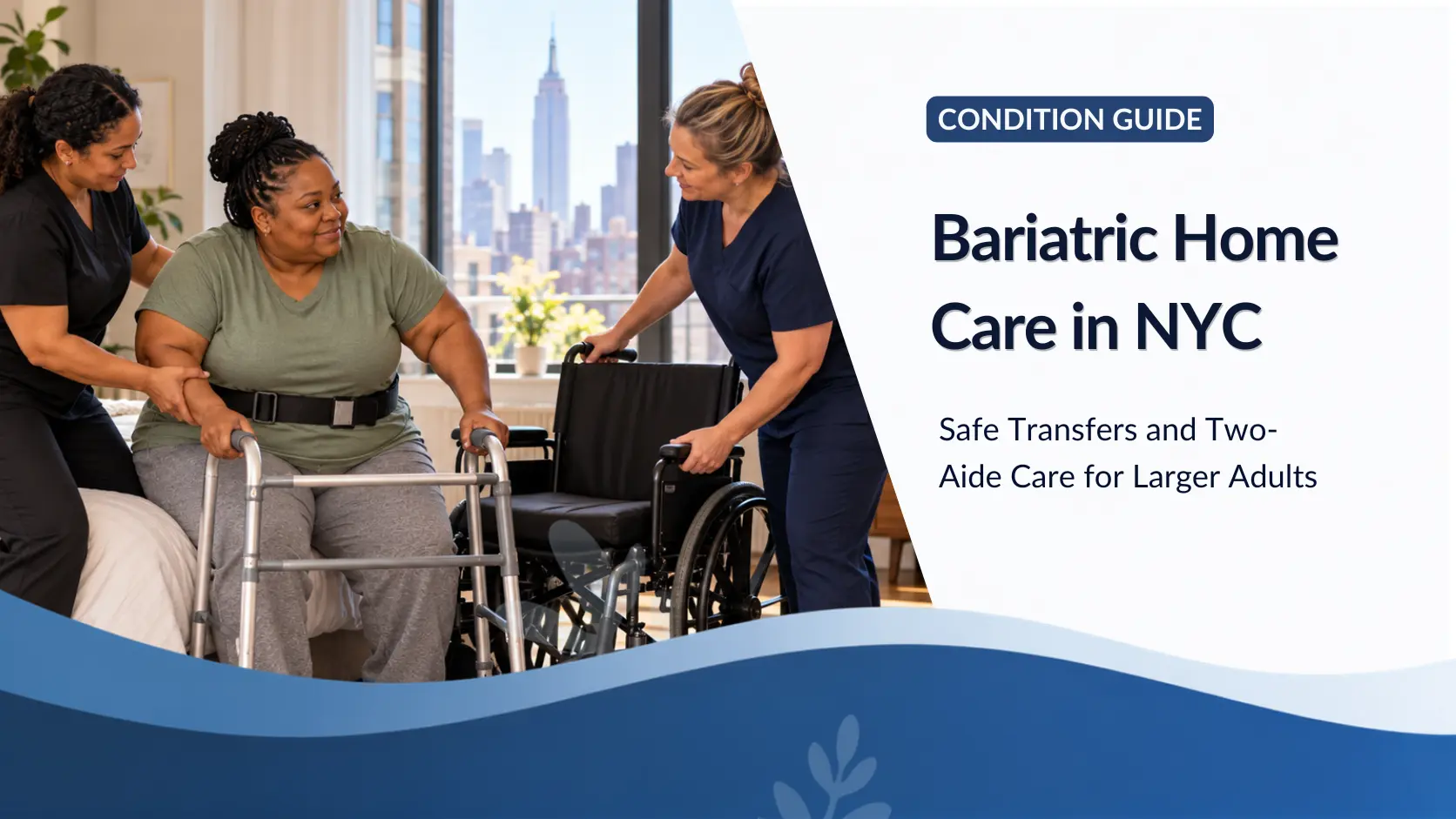
  • Bariatric Home Care in NYC: Safe Transfers and Two-Aide Care for Larger Adults

    Bariatric Home Care in NYC: Safe Transfers and Two-Aide Care for Larger Adults

    Condition Guide

    Bariatric Home Care in NYC: Safe Transfers and Two-Aide Care for Larger Adults

    When one person cannot safely help a loved one out of bed, families need a different kind of care plan: the right equipment, trained aides, and sometimes two of them. Here is how that works in New York.

    Quick answer

    Bariatric home care means caregivers trained in safe two-person transfers, a bariatric-rated hospital bed, lift and commode, careful skin and breathing care, and a plan that never asks one aide to lift alone. Under current New York rules, Medicaid can authorize a second aide for specific tasks when the assessment documents that transfers cannot be done safely by one person. Advantage Home Care builds these plans regularly. Call 718-375-2707.

    Why “One Aide” Is Not Always Safe

    Many families caring for a larger adult, or for anyone who cannot bear weight, have already learned this the hard way: a back injury for the caregiver, a fall for the client, or simply an aide who quits because the job is physically unsafe. Home care agencies have the same concern. The answer is not to give up on home care; it is to plan it correctly, with mechanical lifts, a bed at the right height, and a second person for the moments that need one.

    What Bariatric Home Care Includes

    Safe transfers

    Two-person technique or a Hoyer-style lift for bed to chair, chair to commode and repositioning; no dragging, no solo lifts.

    Bariatric equipment

    Wider hospital bed, lift, wheelchair, commode and shower chair rated for the person’s weight; see equipment coverage below.

    Skin care

    Turning schedules and careful drying of skin folds to prevent pressure sores and infections.

    Breathing and mobility

    Positioning that eases breathing, help with prescribed CPAP routines where permitted, short supervised standing and walking as tolerated.

    Aides follow the nurse’s and therapist’s plan; they do not provide wound treatment, adjust medical devices or give medications. What they provide is the trained, reliable hands the plan requires.

    Getting a Second Aide Authorized

    New York’s independent assessment records whether tasks such as transfers and toileting can be done by one person safely. When they cannot, the plan of care can include a second aide for those specific tasks or hours. The key is documentation: the person’s weight, the equipment in the home, any injuries during past transfers, and a therapist’s or doctor’s note that two-person assistance is required. See how the assessment decides your hours and how many hours you can get in NYC. If hours or the second aide are denied, see how to appeal in New York.

    Equipment Coverage

    Bariatric-rated hospital beds, lifts, wheelchairs and commodes are generally covered by Medicaid, and in some cases Medicare, with a doctor’s order and documentation of medical need; the bariatric rating itself must be specified on the order. See equipment and home modifications Medicaid covers. Apartment logistics matter too: measure doorways and elevators before the bed is delivered.

    Related Guides

    Home care for arthritis and mobility loss Β· Home care for diabetes Β· Home care for heart failure Β· Live-in vs split-shift care Β· Home care for adults with disabilities

    Frequently Asked Questions

    Will Medicaid pay for two aides at the same time?

    It can, for specific tasks or hours when the assessment documents that one person cannot safely perform them; this is different from split-shift 24-hour care, which is two aides in sequence.

    Do you have aides trained in bariatric transfers?

    Yes. We assign caregivers with two-person transfer and lift experience and pair them when the plan requires it.

    Is a Hoyer lift covered?

    Generally yes with a doctor’s order documenting need; bariatric-rated models must be specified. Confirm with the MLTC plan.

    What if the elevator or doorway is too small for a bariatric bed?

    Measure first; suppliers offer models that assemble in place, and we can help coordinate delivery.

    Can this work in a walk-up?

    Yes for daily care; the difficult part is medical appointments, which may need ambulette transport arranged through the plan.

    My husband is under 65. Does he qualify?

    Medicaid home care is based on need, not age; see home care for adults with disabilities.

    Build a Safe Care Plan

    Tell us about the transfers, the equipment and the apartment. We will plan the right number of aides, help document the need for the assessment, and start care safely.

    Call 718-375-2707Start Home Care
  • Home Care in Chelsea, Greenwich Village and the West Side: A Manhattan Family Guide

    Home Care in Chelsea, Greenwich Village and the West Side: A Manhattan Family Guide

    Manhattan Neighborhood Guide

    Home Care in Chelsea, Greenwich Village and the West Side: A Manhattan Family Guide

    Private-pay and Medicaid-covered home care for older New Yorkers aging in place below 59th Street on the West Side, where a fifth-floor walk-up, a doorman building and a Penn South co-op each need a different kind of caregiver.

    Quick answer

    Yes. Advantage Home Care is a licensed New York home care agency serving Chelsea, Greenwich Village, the West Village, Hell’s Kitchen, Hudson Yards and the Flatiron area. We provide home health aides and personal care aides, help with Medicaid eligibility and MLTC enrollment at no charge, and can start private-pay care within 24–48 hours. Call 718-375-2707.

    Aging in Place on the West Side

    Chelsea and the Village have an unusually high share of older residents living alone: rent-stabilized tenants who have been in the same apartment for forty years, co-op owners at Penn South and Westbeth, and long-time residents of the Elliott-Chelsea and Fulton houses. Many have no family in the city, and a neighbor, a building super or a friend is often the person who makes the first call. The requests are practical: someone to make sure medications are taken, to cook, to walk to the pharmacy on 8th Avenue, and to notice when something is wrong. Mount Sinai West, NYU Langone on 1st Avenue and Bellevue are the main discharge points. Walk-ups matter here; so does a caregiver who is comfortable with clients who have lived very independent lives and want that respected.

    Caregivers Matched to the Neighborhood

    Chelsea and Penn South

    Long-term matches for residents living alone; caregivers used to co-op rules, doormen and a client who wants a written daily note.

    Greenwich Village and West Village

    Aides comfortable with walk-ups and small apartments; escorts to appointments at NYU Langone and Mount Sinai West.

    Hell’s Kitchen and Hudson Yards

    Coverage from the older tenement blocks to new towers; Spanish-speaking caregivers on request.

    LGBTQ older adults

    Caregivers chosen for respect and discretion; we ask about preferences at intake rather than assuming.

    Private Pay, Medicaid, or Both

    Many West Side families start with private-pay hours because the need is immediate. If Medicaid is a possibility, the path under current New York rules is the same everywhere in the city: the Community Medicaid application (income over the limit can often be handled with a pooled income trust), the NYIA assessment, MLTC enrollment and an authorization of weekly hours; see how many hours you can get in NYC. A rent-stabilized lease or a co-op share does not by itself rule Medicaid out; our intake team reviews the details at no charge. The same caregiver who starts on private pay can usually continue under Medicaid.

    Common Situations in Chelsea and the Village

    A neighbor is worried about someone living alone

    We can start with a few hours a week and build from there; see elderly care at home in NYC.

    Discharge from Mount Sinai West or NYU

    See what to set up before discharge day and same-week home care.

    Low vision or hearing loss

    See home care for low vision and macular degeneration.

    Home care or assisted living?

    See home care vs assisted living in NYC.

    Why Families Here Choose Advantage Home Care

    Licensed by the New York State Department of Health, caregivers chosen for the client rather than the address, transparent private-pay rates and honest guidance on Medicaid. Nearby guides: Lower East Side, Chinatown and the East Village, Upper East Side, Upper West Side and Midtown. Borough overview: home care in Manhattan.

    Frequently Asked Questions

    Is there a home care agency serving Chelsea?

    Yes. Advantage Home Care serves Chelsea, the Village, Hell’s Kitchen and the West Side. Call 718-375-2707.

    Can a friend or neighbor arrange care for someone who has no family nearby?

    Yes, with the client’s agreement. We often work with a friend, a building super or a social worker as the point of contact.

    How quickly can private-pay care start?

    Usually within 24–48 hours of the intake call.

    Does a rent-stabilized apartment or co-op affect Medicaid?

    Not by itself. Under current New York rules a primary home is generally treated differently from savings; limits and details apply, and our intake team explains them.

    Do you provide overnight care in a walk-up?

    Yes. See overnight and live-in home care in NYC.

    Are you hiring caregivers in Manhattan?

    Yes. Certified HHAs and PCAs can apply online.

    Start Home Care in Chelsea, Greenwich Village or the West Side

    Tell us about the person and the apartment. We will match a caregiver, set the schedule, and explain honestly whether Medicaid is worth pursuing.

    Call 718-375-2707Start Home Care

  • Home Care for Loneliness and Depression in Older Adults: Companionship That Medicaid Can Cover in NYC

    Home Care for Loneliness and Depression in Older Adults: Companionship That Medicaid Can Cover in NYC

    Condition Guide

    Home Care for Loneliness and Depression in Older Adults: Companionship That Medicaid Can Cover in NYC

    Living alone in a city of eight million is still living alone. Here is how a daily caregiver changes an isolated parent’s week, and how families pay for it.

    Quick answer

    Medicaid home care in New York is authorized for help with daily activities, not for companionship alone, but most isolated older adults also need help with meals, medications, bathing or getting outside, and those needs qualify. Once an aide is there, the company, the walks and the meals eaten together come with the hours. Private-pay companion care is also available and can start within 24–48 hours. Call 718-375-2707.

    What Isolation Looks Like From the Outside

    The phone goes unanswered. The refrigerator holds the same three things it held last month. Medications are still in the bottle. A parent who used to go to church, the senior center or the corner store now says there is no point. Families read this as stubbornness or “just getting old”; often it is depression, grief or the slow shrinking of a world after a spouse dies or a friend moves away. Isolation in older adults is linked to faster physical decline, more falls and more hospital admissions, which is why it is a care issue and not only an emotional one.

    What a Daily Caregiver Changes

    Meals eaten with someone

    People eat more and better when they are not eating alone; an aide cooks, sits and eats too.

    A reason to get dressed

    A morning routine with someone expected at the door restores structure to the day.

    Getting outside

    Walks, the pharmacy, the park bench, the senior center, church; escorts are part of home care.

    Someone who notices

    Weight loss, missed medications, new confusion or a change in mood get reported to the family and the doctor early.

    What an Aide Can and Cannot Do About Depression

    A home health aide or personal care aide is not a therapist and does not treat depression. What the aide provides is what treatment plans usually ask for and families cannot supply every day: routine, activity, nutrition, medication reminders and human contact. If you suspect depression, talk to the primary care doctor; many older adults respond well to treatment, and NYC’s Department for the Aging and hospital geriatric programs can connect families to counseling and friendly-visitor programs. Home care sits alongside those, not in place of them.

    How to Get Hours Covered

    Under current New York rules, Medicaid home care hours are based on the need for hands-on help with activities of daily living, as measured in the NYIA assessment. Loneliness by itself does not count, but the things that come with it usually do: not eating, not managing medications, not bathing safely, not getting out. Describe those concretely. See how many hours you can get in NYC and do you qualify for home care? For families who do not qualify or who want care now, private-pay companion and personal care can start within 24–48 hours.

    Related Guides

    Elderly care at home in NYC Β· Home care for dementia Β· Home care vs assisted living Β· How to get started with home care in NYC

    Frequently Asked Questions

    Does Medicaid pay for companion care in New York?

    Not for companionship alone. It pays for help with daily activities, and companionship comes with those hours; most isolated older adults have qualifying needs.

    My mother refuses help. What can we do?

    Start small and frame it around a task she accepts, such as cooking or a walk. A few hours a week with the right caregiver often changes her mind; we can help choose a match she is likely to accept.

    Can the aide take my father to the senior center or church?

    Yes. Escorts and accompaniment to community activities can be part of the plan of care.

    Can I request a caregiver who speaks my parent’s language?

    Yes. Shared language is often the difference between a caregiver who is tolerated and one who becomes a friend.

    Is a few hours a week enough to matter?

    Often yes. Regular, predictable visits, even two or three mornings a week, restore routine and give the family an early warning system.

    How fast can private-pay companion care start?

    Usually within 24–48 hours.

    Give Your Parent a Reason to Answer the Door

    Tell us what your parent used to enjoy and what has changed. We will match a caregiver by language and personality, set a routine, and explain what Medicaid can cover.

    Call 718-375-2707Start Home Care
  • Home Care in Park Slope, Prospect Heights and Windsor Terrace: A Brooklyn Family Guide

    Home Care in Park Slope, Prospect Heights and Windsor Terrace: A Brooklyn Family Guide

    Brooklyn Neighborhood Guide

    Home Care in Park Slope, Prospect Heights and Windsor Terrace: A Brooklyn Family Guide

    Private-pay and Medicaid-covered home care for families around Prospect Park, where most requests start with a parent who moved nearby, a brownstone with too many stairs, and adult children who work long hours.

    Quick answer

    Yes, Advantage Home Care serves Park Slope, Prospect Heights, Windsor Terrace and Gowanus from our Brooklyn headquarters. Private-pay care can start within 24–48 hours, and we help families who qualify for Medicaid move onto covered hours without changing caregivers. Call 718-375-2707.

    Home Care Around Prospect Park

    The neighborhoods on the west side of Prospect Park have more private-pay home care than almost anywhere else in Brooklyn, and the typical case looks like this: an older parent moved into the neighborhood, or into an apartment near the children, and the family wants a reliable aide for mornings, evenings or overnight rather than a facility. Brownstone parlor floors, garden-level entrances and stoops shape the care plan. Windsor Terrace and Kensington add long-time residents who have stayed in their homes for decades, and for many of them Medicaid home care is the realistic path once savings run down. NewYork-Presbyterian Brooklyn Methodist on 7th Avenue is the main hospital, and its discharge planners send us a steady stream of same-week requests.

    Caregivers Matched to the Neighborhood

    Park Slope and Prospect Heights

    Experienced aides comfortable in brownstones and doorman buildings alike, used to families who want a written daily log and one point of contact.

    Windsor Terrace and Kensington

    Long-term caregivers for older residents aging in place, including Spanish-, Russian- and Bangla-speaking aides on request.

    Gowanus and South Slope

    Coverage that fits new residential buildings and older row houses; escorts to Methodist and to physical therapy.

    Overnight and weekend needs

    Overnight, live-in and weekend-only arrangements for families who cover weekdays themselves.

    Private Pay First, Medicaid When It Fits

    Many families here start with private-pay hours because the need is immediate and Medicaid is not yet in place, or because income and savings are above the limits. That is a normal path. Under current New York rules, income above the Community Medicaid limit can often be handled with a pooled income trust, and a primary home is generally treated differently from savings. If Medicaid becomes the right option, the steps are the same everywhere in the city: the application, the NYIA assessment, MLTC plan enrollment, and an authorization of weekly hours; see how many hours you can get in NYC. The same caregiver who started on private pay can usually continue under Medicaid.

    Common Situations in Park Slope and Windsor Terrace

    A parent who just moved to the neighborhood

    Start with a few hours a day so the routine is set before a crisis; see elderly care at home in NYC.

    Discharge from Methodist

    Care can be arranged before discharge day; see what to set up before discharge day and same-week home care.

    Nights are the hard part

    Overnight care lets the family sleep; see overnight and live-in home care in NYC.

    Deciding between home care and assisted living

    Costs, coverage and who each suits; see home care vs assisted living in NYC.

    Why Families Here Choose Advantage Home Care

    A Brooklyn agency licensed by the New York State Department of Health, with caregivers who know the neighborhood, transparent private-pay rates and honest guidance on when Medicaid is worth pursuing. Borough overview: home care in Brooklyn. Nearby guides: Flatbush and Crown Heights, Sunset Park and Borough Park.

    Frequently Asked Questions

    Is there a home care agency in Park Slope?

    Yes. Advantage Home Care serves Park Slope, Prospect Heights, Windsor Terrace and Gowanus. Call 718-375-2707.

    How quickly can private-pay care start?

    Usually within 24–48 hours of the intake call, sometimes the next morning.

    Can we start private pay and switch to Medicaid later?

    Yes. That is one of the most common paths for families here, and the same caregiver can usually stay on the case.

    Do you offer overnight-only or weekend-only care?

    Yes. Many families cover weekdays themselves and use us for nights or weekends.

    Does my parent’s brownstone affect Medicaid eligibility?

    Under current New York rules a primary home is generally treated differently from savings, though limits and details apply; our intake team explains them at no charge.

    Are you hiring caregivers in Park Slope?

    Yes. Certified HHAs and PCAs can apply online.

    Start Home Care in Park Slope, Prospect Heights or Windsor Terrace

    Tell us what a good day looks like for your parent. We will match a caregiver, set the schedule, and explain honestly whether Medicaid is worth pursuing.

    Call 718-375-2707Start Home Care
  • How to Get More Medicaid Home Care Hours in NYC: Requesting a Reassessment When Needs Change

    How to Get More Medicaid Home Care Hours in NYC: Requesting a Reassessment When Needs Change

    Medicaid Guide

    How to Get More Medicaid Home Care Hours in NYC: Requesting a Reassessment When Needs Change

    Hours are set for the person the nurse saw on assessment day. When that person changes, the hours can change too, but only if someone asks in the right way.

    Quick answer

    To increase Medicaid home care hours in New York, ask the MLTC plan’s care manager, in writing, for a reassessment based on a change in condition, and send supporting documentation: a doctor’s note describing the new needs, hospital or ER records, and a specific list of tasks the person now needs help with and how often, including at night. The plan must respond with a new assessment and a written decision; if the decision is not enough, you can appeal. Advantage Home Care helps families prepare these requests at no charge. Call 718-375-2707.

    When You Can Ask for More Hours

    Home care authorizations are not fixed for the year. Under current New York rules, a plan member can request a reassessment whenever there is a significant change in condition: a fall, a hospital stay, a new diagnosis, worsening dementia, a new inability to walk, bathe or manage toileting, or the loss of a family caregiver who was covering hours. You do not need to wait for the scheduled reassessment. The request goes to the plan, not to the agency, but the agency’s aide notes are often the best evidence you have.

    What Moves the Needle

    A doctor’s letter

    Naming the diagnoses and stating plainly what the person now needs help with and how often; vague “needs more care” letters do little.

    Hospital and ER records

    A recent admission for a fall, infection or heart failure is strong evidence of changed need.

    A task-by-task list

    Bathing, dressing, toileting, transfers, walking, meals, medications, night-time needs; frequency and whether one person can do it safely.

    Aide and family notes

    Dated notes of incidents, night-time waking, refusals to eat, wandering; patterns matter more than single events.

    Increase vs. Appeal: Two Different Paths

    Asking for more hours is a request for a new decision; appealing is challenging a decision already made. If you ask for an increase and the plan says no or gives less than needed, that written denial is what you appeal. If the plan cuts hours at a routine reassessment, appeal right away and, if you act within the deadline on the notice, the old hours generally continue during the appeal. See how to appeal in New York. For the underlying rules on what supports 24-hour care, see live-in vs split-shift care and how many hours you can get in NYC.

    While You Wait

    A reassessment takes time. If the gap is dangerous, ask the plan about temporary additional hours and, if necessary, add private-pay hours through the agency; the same caregiver can extend the day. If the person was just discharged, Medicare home health nursing and therapy can run alongside. Keep every letter and note the date of every call.

    Related Guides

    How the assessment decides your hours Β· What happens at the MLTC nurse visit Β· When your parent lives with you Β· Keeping your hours year after year

    Frequently Asked Questions

    Can I ask for more Medicaid home care hours before the yearly reassessment?

    Yes. A significant change in condition entitles the member to request a reassessment at any time; make the request in writing to the plan’s care manager.

    How long does a reassessment take?

    It varies by plan; ask for the timeline in writing and follow up. If the situation is urgent, say so and document why.

    Will asking for more hours put the current hours at risk?

    A reassessment looks at current need; if need has increased, hours are unlikely to fall. Prepare as carefully as for the first assessment.

    My mother’s aide says she needs more time. Does that count?

    The aide’s dated notes are useful evidence; pair them with a doctor’s letter and a task list.

    Does the agency request the increase?

    The request comes from the member or family to the plan; the agency helps prepare it and can provide aide documentation.

    What if the plan refuses to reassess?

    Ask for the refusal in writing and appeal it; a refusal to reassess after a documented change can itself be challenged.

    Build the Case for More Hours

    Tell us what has changed. We will help gather the documentation, draft the request to the plan, and cover the gap with care in the meantime.

    Call 718-375-2707Start Home Care