Category: NYC Resources

  • OPWDD Services for Down Syndrome in NYC: Building Independence at Home

    OPWDD Services for Down Syndrome in NYC: Building Independence at Home

    OPWDD for Down Syndrome

    OPWDD Services for Down Syndrome in NYC: Building Independence at Home

    Down syndrome is a qualifying condition for OPWDD services in New York. Here’s what that support looks like in real life β€” and how Advantage Home Care helps families access it.

    πŸ’‘ Key Takeaways
    • Down syndrome is a qualifying developmental disability for OPWDD services in New York.
    • OPWDD funds community habilitation, day habilitation, respite, and in-home support that build independence and daily-living skills.
    • Advantage Home Care provides these OPWDD services and guides families through eligibility and the Front Door.

    People with Down syndrome are living fuller, more independent lives than ever β€” and the right support makes that possible. New York’s OPWDD system funds services that help individuals with Down syndrome build skills, take part in their communities, and thrive at home. Advantage Home Care helps NYC families access every bit of it.

    A real-world example

    Consider a young woman in Brooklyn, 18 and living with Down syndrome, who has just finished school. She’s capable and outgoing, but her family isn’t sure what comes next now that the structure of the school day is gone. Through OPWDD, she enrolls in day habilitation, giving her routine, friendships, and skill-building, and receives community habilitation to work on cooking, budgeting, and using the subway. A year later she’s more independent than her family imagined β€” and they have a partner in planning her future. That’s what these OPWDD services are built for.

    How OPWDD Services Help People With Down Syndrome

    OPWDD support is built around the individual’s goals. For someone with Down syndrome, the most relevant services usually include:

    Explore our full range of OPWDD services and OPWDD support services, or read our guide to OPWDD day habilitation.

    Does Down Syndrome Qualify for OPWDD?

    Yes. Down syndrome is a recognized developmental disability under OPWDD β€” it is present from birth, lifelong, and results in substantial functional limitations. Eligibility is established through OPWDD’s “Front Door” process, which requires medical and diagnostic documentation. We help families gather what’s needed and navigate intake; for the full walkthrough, see our guide to OPWDD eligibility in New York.

    How Advantage Home Care Helps

    Support focused on independence. We match individuals with staff who encourage skill-building and community participation, meeting each person where they are.

    We guide the whole process. From the Front Door and eligibility to building a plan with your Care Coordination Organization, we help families move forward with confidence.

    A partner through every transition. The move from school to adult life is a big one; our care coordination and family support team helps families plan for it and adjust as goals evolve.

    Frequently Asked Questions

    Does Down syndrome qualify for OPWDD services in New York?

    Yes. Down syndrome is a qualifying developmental disability under OPWDD β€” present from birth, lifelong, and causing substantial functional limitations.

    What OPWDD services help most with Down syndrome?

    Day habilitation, community habilitation, respite, and in-home support are the most commonly used β€” all available through Advantage Home Care’s OPWDD services.

    What happens when my child ages out of school?

    This is one of the most important transitions OPWDD supports. Day habilitation and community habilitation provide routine, growth, and community connection after school ends. Planning early makes the transition smoother.

    How do we get started?

    It begins with the OPWDD Front Door process to establish eligibility. We help families gather documentation and move from approval to services in the home.

    Related OPWDD condition guides: Intellectual Disability, Autism, and Williams Syndrome.

    Part of our complete guide to OPWDD Services in NYC →

    Down Syndrome Support Services in New York: Quick Answers

    What Down syndrome support services are available in New York State?

    Through OPWDD: community habilitation, day habilitation, respite, family support, supported employment and, where needed, residential options; through Medicaid: personal care and home health aides, therapies and equipment. Advantage Home Care delivers the in-home portion across NYC and helps families get OPWDD eligibility, which for Down syndrome is usually straightforward with genetic confirmation.

    Where do I start Down syndrome care in New York City?

    Contact the OPWDD Front Door for eligibility, choose a Care Coordination Organization for a Care Manager, and call a provider like Advantage Home Care (718-375-2707) to plan in-home support while the Life Plan is written. Children under 3 also get Early Intervention through the NYC Department of Health.

    Get OPWDD Support for Down Syndrome

    Whether you’re starting the Front Door process or planning your loved one’s next chapter, we’re here to help. Call 718-375-2707 or reach out online.

    Get Started β†’

  • OPWDD Services in NYC: Conditions We Support and Services We Provide

    OPWDD Services in NYC: Conditions We Support and Services We Provide

    Complete OPWDD Guide

    OPWDD Services in NYC: Conditions We Support and Services We Provide

    Everything New York families need to know about OPWDD in one place β€” who qualifies, what services are available, and how Advantage Home Care helps you access OPWDD home care and community support.

    πŸ’‘ Key Takeaways
    • OPWDD funds home and community-based services for New Yorkers with developmental disabilities that began before age 22.
    • Core services include community habilitation, day habilitation, respite, and in-home support.
    • Advantage Home Care provides these OPWDD services and guides families from the Front Door all the way to services in the home.

    The New York State Office for People With Developmental Disabilities (OPWDD) funds a wide range of services that help individuals with developmental disabilities live full, connected lives at home and in their communities. This guide brings it all together: the conditions that qualify, the OPWDD home care and community services available in New York, and how to access them. Wherever you are in the journey, Advantage Home Care’s OPWDD services can help.

    OPWDD Services We Provide

    OPWDD support is built around each person’s goals. These are the core services we deliver, each with its own in-depth guide:

    Conditions We Support

    OPWDD serves people with a range of developmental disabilities. We have a dedicated guide for each β€” what support looks like, a real-world example, and how to get started:

    Don’t see a specific diagnosis? OPWDD supports many developmental disabilities β€” contact us and we’ll help with any qualifying condition.

    Who Qualifies for OPWDD?

    To be eligible for OPWDD services, a person generally must have a documented developmental disability that originated before age 22, is expected to continue indefinitely, and results in substantial functional limitations. Qualifying diagnoses include intellectual disability, autism, cerebral palsy, epilepsy (with related functional impact), and a range of genetic and neurological conditions such as Down syndrome, Prader-Willi, Fragile X, and many others listed above. Eligibility is established through OPWDD’s “Front Door” process, which involves documentation and an intake. It’s a step that overwhelms many families β€” and one we help with directly. For a full walkthrough, see our guide to OPWDD eligibility in New York.

    How to Get Started

    1Front Door & eligibility. We help you request services and establish OPWDD eligibility with the right documentation.
    2Care planning. With a Care Coordination Organization, a Life Plan is built around your loved one’s goals.
    3Services begin. We match your loved one with the right staff and start community habilitation, day hab, respite, or in-home support.
    4Ongoing partnership. We adjust the plan as your loved one grows and their needs evolve.

    Explore our full OPWDD services and OPWDD support services.

    Frequently Asked Questions

    What is OPWDD?
    OPWDD is the New York State Office for People With Developmental Disabilities. It funds and oversees home and community-based services β€” like community habilitation, day habilitation, respite, and in-home support β€” that help New Yorkers with developmental disabilities live independently and participate in their communities.
    Who qualifies for OPWDD, and what are the qualifying diagnoses?
    Eligibility requires a documented developmental disability that began before age 22, is expected to be lifelong, and causes substantial functional limitations. Qualifying diagnoses include intellectual disability, autism, cerebral palsy, epilepsy, and many genetic and neurological conditions such as Down syndrome, Prader-Willi, Fragile X, Angelman, and others. Eligibility is confirmed through OPWDD’s Front Door process.
    How do I apply for OPWDD services in New York?
    You start at OPWDD’s “Front Door,” which involves gathering documentation of the disability, attending an intake, and establishing eligibility. From there, a Care Coordination Organization helps build a Life Plan. Advantage Home Care guides families through each step β€” see our OPWDD eligibility guide.
    Does OPWDD provide home care?
    Yes. OPWDD funds in-home support through services like community habilitation and respite, delivered by trained staff in the person’s own home. Advantage Home Care provides this OPWDD home care across New York City.
    What services does OPWDD cover?
    OPWDD covers a broad set of services, including community habilitation, day habilitation, respite, care coordination, in-home support, and more β€” all built around an individual Life Plan. This guide links to a dedicated page for each core service.

    Home Care for Developmental Disabilities in New York: Quick Answers

    Do you provide in-home support for developmental disabilities in New York?

    Yes. Advantage Home Care provides in-home support for children and adults with developmental disabilities across all five NYC boroughs: personal care and home health aides, community habilitation, respite for family caregivers, and coordination with the person’s OPWDD Care Manager and Life Plan. Most of it is funded through Medicaid and the OPWDD HCBS waiver at no cost to the family.

    What developmental disabilities home care services does OPWDD fund?

    OPWDD funds home and community-based services rather than “home care” in the Medicaid-MLTC sense: community habilitation (skill-building at home and in the neighborhood), day habilitation, respite, supported employment, environmental modifications and, for people who also qualify medically, personal care aides through Medicaid. We staff the in-home pieces and help families combine them.

    Are there day hab programs that serve adults with developmental disabilities in NYC?

    Yes, in every borough: site-based and “without walls” community-based day habilitation for adults who are OPWDD-eligible and in the HCBS waiver. See our guides to OPWDD day habilitation and day hab without walls.

    How do I get home care for a developmental disability in New York?

    Start with OPWDD eligibility through the Front Door (diagnosis documentation, psychological evaluation), enroll in the HCBS waiver and get a Care Manager, then services are written into the Life Plan and delivered by approved providers. If the person also needs hands-on personal care, a separate Medicaid home care authorization can run alongside. Call 718-375-2707 and we will map both.

    Get OPWDD Support for Your Family

    Whether you’re at the very start of the Front Door process or looking for a provider who truly partners with families, we’re here to help. Call 718-375-2707 or reach out online.

    Get Started →

  • Advantage Home Care in the Bronx: Trusted In-Home Care for Your Family

    Advantage Home Care in the Bronx: Trusted In-Home Care for Your Family

    Bronx Home Care

    Advantage Home Care in the Bronx: Trusted In-Home Care for Your Family

    From Riverdale to Co-op City, Advantage Home Care helps Bronx families keep their loved ones safe and independent at home β€” with trained local caregivers and a team that handles Medicaid and the paperwork.

    πŸ’‘ Key Takeaways
    • Advantage Home Care provides in-home care throughout the Bronx, the borough with the highest share of seniors relying on home care in NYC.
    • We offer personal care aides, home health aides, waiver support, and care coordination β€” through Medicaid or private pay.
    • Our Bronx caregivers come from the communities they serve, and our team manages the Medicaid enrollment for you.

    The Bronx has one of the largest populations of older adults relying on home care of any borough in New York City β€” and navigating that care takes local knowledge. Advantage Home Care brings both: trained caregivers who live in and understand Bronx communities, and a team that handles the Medicaid and enrollment details so families can focus on their loved one.

    Home Care Services We Provide in the Bronx

    We match each family with the right level of support:

    πŸ§‘β€πŸ¦³
    Personal Care AidesDaily help with bathing, dressing, meals, and mobility. PCA services β†’
    🩺
    Home Health AidesPersonal care plus health monitoring under nurse supervision. HHA services β†’
    🧠
    NHTD & TBI SupportCommunity-living support for disabilities and brain injuries. NHTD/TBI β†’
    πŸ—‚οΈ
    Care CoordinationOne coordinator connecting caregivers, family, and doctors. Coordination β†’

    Serving Bronx Neighborhoods

    Our caregivers support families across the borough, including Riverdale, Kingsbridge, Fordham, Belmont, Morris Park, Pelham Bay, Throggs Neck, Parkchester, Soundview, Co-op City, Wakefield, and beyond. Because our aides come from these neighborhoods, we can match caregivers who speak your family’s language β€” Spanish, Bengali, Albanian, and more β€” and who know the community your loved one calls home.

    Why Bronx Families Choose Us

    Caregivers who stay. We work to keep the same aide with your family, so your loved one builds trust with someone familiar rather than a rotating series of strangers.

    We handle Medicaid and MLTC. The enrollment process is one of the biggest hurdles to getting care started. Our team guides Bronx families through Medicaid approval and MLTC plan selection and handles the paperwork.

    Coordination that continues. A dedicated coordinator stays involved as needs change, so you always have someone to call.

    Want a broader look at options in the borough? See our full guide to home care in the Bronx.

    How Bronx Families Pay for Care

    Most families receive care through New York Medicaid, typically via an MLTC plan that authorizes weekly aide hours β€” and many qualify who assume they can’t. For those who don’t qualify or need care immediately, private pay home care offers flexible scheduling that can start within days. We’ll help you find the right path.

    Frequently Asked Questions

    Does Advantage Home Care serve all of the Bronx?

    Yes. We provide caregivers throughout the Bronx, from Riverdale and Kingsbridge to Parkchester, Co-op City, and beyond.

    Can I get a caregiver who speaks my family’s language?

    In most cases, yes. Language and cultural matching is one of the first things we consider when pairing a caregiver with your family.

    Is Bronx home care covered by Medicaid?

    Yes β€” most of our Bronx clients receive care through Medicaid, and we help families apply and enroll. Private pay is also available.

    How soon can care start in the Bronx?

    Private pay care can often begin within a few days; Medicaid-funded care depends on the approval timeline, which we work to move along quickly.

    Start Care in the Bronx

    Tell us about your loved one and we’ll match them with the right caregiver and explain your coverage options. Call 718-375-2707 or reach out online β€” we can usually have care in place quickly.

    Get Started β†’

  • Advantage Home Care: NYC’s Trusted Home Care Agency for Families

    Advantage Home Care: NYC’s Trusted Home Care Agency for Families

    About Advantage Home Care

    Advantage Home Care: NYC’s Trusted Home Care Agency for Families

    We help New York City families keep their loved ones safe, supported, and independent at home β€” with trained caregivers, real care coordination, and guidance through every step of Medicaid and private pay.

    πŸ’‘ Key Takeaways
    • Advantage Home Care is a New York City home care agency serving families across all five boroughs.
    • We provide personal care aides, home health aides, NHTD/TBI and OPWDD waiver support, care coordination, and private pay home care.
    • Our team handles the Medicaid and enrollment paperwork so families can focus on their loved one, not the bureaucracy.

    Choosing a home care agency is one of the most personal decisions a family makes. You are inviting someone into your home to care for the person you love most β€” so trust, consistency, and competence matter more than anything. Advantage Home Care was built around exactly that: dependable, respectful in-home care for New Yorkers, backed by a team that treats your family like its own.

    Who We Are

    Advantage Home Care is a home care agency serving families throughout New York City. We match seniors and individuals with disabilities to trained, carefully vetted caregivers, and we support both the client and their family through the entire process β€” from the first phone call and the Medicaid application to the day care begins and every adjustment after that. Because New York City is one of the most diverse places on earth, we prioritize caregivers who reflect the languages and cultures of the neighborhoods we serve, so care feels familiar, not foreign.

    Services We Provide

    Families come to us with very different needs β€” a parent recovering from surgery, an adult child with a developmental disability, a spouse living with a progressive illness. Our services are built to cover the full range:

    πŸ§‘β€πŸ¦³
    Personal Care Aides (PCA)Help with bathing, dressing, grooming, meals, mobility, and daily routines. Learn about PCA services β†’
    🩺
    Home Health & Certified AidesHands-on care plus basic health monitoring under nurse supervision. HHA services β†’
    🧠
    NHTD & TBI Waiver SupportCommunity-living support for people with disabilities and brain injuries. NHTD/TBI support β†’
    🧩
    OPWDD ServicesSpecialized support for individuals with developmental disabilities. OPWDD services β†’
    πŸ—‚οΈ
    Care CoordinationOne point of contact connecting caregivers, family, doctors, and Medicaid. Care coordination β†’
    πŸ’³
    Private Pay Home CareFlexible hourly care that can start within days, no Medicaid required. Private pay β†’

    Serving Families in Every Borough

    We provide home care across New York City, with caregivers and coordinators who know their communities. Wherever you are, we can help β€” and we have local guides for each borough: Brooklyn, the Bronx, Queens, Manhattan, and Staten Island. Same standards of care, staffed by people who understand your neighborhood.

    What Sets Advantage Home Care Apart

    Caregiver consistency. We work hard to keep the same aide with your family rather than rotating strangers through your home, because trust and routine are what make home care actually work β€” especially for someone with dementia, a brain injury, or a progressive illness.

    We handle the paperwork. Medicaid, MLTC enrollment, waiver applications, assessments β€” the system is genuinely confusing. Our team walks families through getting approved for Medicaid home care and manages the details so you are not doing it alone.

    Real coordination, not just staffing. A dedicated coordinator stays involved after care begins, adjusting the plan as needs change and keeping families informed. You always have someone to call.

    Trained, vetted caregivers. Every aide is screened and trained, and we match caregivers to each family’s specific needs β€” language, condition, schedule, and personality.

    How Families Pay for Care

    Most of our clients receive care through New York Medicaid, typically via a managed long-term care (MLTC) plan that authorizes weekly aide hours. Many families are surprised to learn they qualify β€” New York’s community Medicaid rules are more flexible than people expect, and we help you navigate them. For families who don’t qualify, or who need care to begin immediately, private pay offers flexible hourly scheduling that can start within days. Veterans and individuals with disability waivers have additional options we can walk you through.

    How to Get Started

    Getting started is simple: one phone call. We’ll ask about your loved one’s needs, explain which coverage options fit, and lay out the next steps β€” whether that’s beginning a Medicaid application or scheduling private care right away. There’s no obligation, and no pressure.

    Our Offices and Phone Number

    Advantage Home Care operates two offices and serves families in all five boroughs. Care is delivered in your home, so you never need to travel to us.

    • Brooklyn headquarters: 1515 Sheepshead Bay Road, 2nd Floor, Brooklyn, NY 11235
    • Bronx office: 391 East 149th Street, 3rd Floor, Room 319, Bronx, NY 10455
    • Phone: 718-375-2707 for care and services — main office 718-375-2707
    • Email: info@advantagehome.care

    Full details, neighbourhood coverage and directions are on our contact page.

    Advantage Home Care, Not the Other Ones

    There are several similarly named agencies in the United States — Advantage Home Health Care, Care Advantage, Advantage Healthcare, Advantage Home Care in other states. We are Advantage Home Care, a licensed New York agency based in Brooklyn with a second office in the Bronx, and we operate only in New York City. If you were referred to us by a hospital, MLTC plan or a neighbour, this is the right place. If you are unsure, call 718-375-2707 and we will tell you in ten seconds.

    Frequently Asked Questions

    What areas does Advantage Home Care serve?

    We serve families across New York City, including Brooklyn, the Bronx, Queens, Manhattan, and Staten Island.

    Does Advantage Home Care accept Medicaid?

    Yes. Most of our clients receive care through Medicaid, and our team helps families apply and enroll in an MLTC plan. We also offer private pay for families who prefer it or need care immediately.

    What kinds of caregivers does the agency provide?

    We provide personal care aides (PCAs), home health aides (HHAs), and specialized caregivers for NHTD/TBI waiver and OPWDD services, along with care coordination to tie it all together.

    How quickly can care start?

    Private pay care can often begin within a few days. Medicaid-funded care depends on the approval timeline, which we work to move along as quickly as possible.

    What is Advantage Home Care’s phone number?

    Call 718-375-2707 for care and services. Our main office line is 718-375-2707 and you can email info@advantagehome.care.

    Where are Advantage Home Care’s offices?

    Our Brooklyn headquarters is at 1515 Sheepshead Bay Road, 2nd Floor, Brooklyn, NY 11235, and our Bronx office is at 391 East 149th Street, 3rd Floor, Room 319, Bronx, NY 10455.

    Is Advantage Home Care the same as Advantage Home Health Care or Care Advantage?

    No. Those are separate companies. Advantage Home Care is a licensed New York City home care agency with offices in Brooklyn and the Bronx.

    Talk to Advantage Home Care

    Whether you’re just starting to explore options or you need care to begin this week, we’re here to help you figure out the right path. Call 718-375-2707 or reach out online β€” we’ll take it from there.

    Get Started β†’

  • Advantage Home Care in Brooklyn: Trusted In-Home Care Across the Borough

    Advantage Home Care in Brooklyn: Trusted In-Home Care Across the Borough

    Brooklyn Home Care

    Advantage Home Care in Brooklyn: Trusted In-Home Care Across the Borough

    From Bay Ridge to Brighton Beach, Advantage Home Care helps Brooklyn families keep their loved ones safe and independent at home β€” with caregivers who know the borough and a team that handles the paperwork.

    πŸ’‘ Key Takeaways
    • Advantage Home Care provides in-home care throughout Brooklyn, NYC’s largest and most diverse borough.
    • We offer personal care aides, home health aides, waiver support, and care coordination β€” through Medicaid or private pay.
    • Our Brooklyn caregivers reflect the borough’s languages and communities, so care feels familiar from day one.

    Brooklyn is home to more than 2.5 million people and dozens of distinct communities, each with its own language, culture, and rhythm. Home care here can’t be one-size-fits-all β€” and it isn’t with us. Advantage Home Care matches Brooklyn families with trained caregivers who fit their loved one’s needs, routines, and background, so support at home feels natural rather than clinical.

    Home Care Services We Provide in Brooklyn

    Whatever stage your family is at, we can help with the right level of care:

    πŸ§‘β€πŸ¦³
    Personal Care AidesDaily help with bathing, dressing, meals, and mobility. PCA services β†’
    🩺
    Home Health AidesPersonal care plus health monitoring under nurse supervision. HHA services β†’
    🧠
    NHTD & TBI SupportCommunity-living support for disabilities and brain injuries. NHTD/TBI β†’
    πŸ—‚οΈ
    Care CoordinationOne coordinator connecting caregivers, family, and doctors. Coordination β†’

    Our Brooklyn Office

    Advantage Home Care is based in Sheepshead Bay — not a call centre in another state. Our Brooklyn headquarters is at 1515 Sheepshead Bay Road, 2nd Floor, Brooklyn, NY 11235, minutes from the B and Q at Sheepshead Bay station. Call 718-375-2707 to speak to a coordinator, or email info@advantagehome.care.

    Being local matters more than it sounds. It means our caregivers live in the same neighbourhoods as our clients, our coordinators know which MLTC plans move quickly, and shifts get covered because someone is a ten-minute bus ride away. For the neighbourhood-level view, read our Sheepshead Bay and South Brooklyn guide.

    Serving Brooklyn Neighborhoods

    Our caregivers support families across the borough, including Bay Ridge, Bensonhurst, Borough Park, Brighton Beach, Sheepshead Bay, Flatbush, Midwood, Canarsie, Crown Heights, Williamsburg, Sunset Park, and beyond. Because our aides come from these same communities, we can match caregivers who speak your family’s language β€” Russian, Spanish, Mandarin, Cantonese, Yiddish, Haitian Creole, and more β€” which makes a real difference in daily comfort and communication.

    Why Brooklyn Families Choose Us

    Local caregivers who stay. We prioritize keeping the same aide with your family, so your loved one builds a real relationship with someone they trust β€” not a rotating cast of strangers.

    We handle Medicaid and MLTC. The enrollment maze is one of the hardest parts of getting care started. Our team guides Brooklyn families through Medicaid approval and MLTC plan selection, and manages the paperwork.

    Coordination that continues. A dedicated coordinator stays involved as needs change, so you always have someone local to call.

    Looking for a broader overview of options in the borough? See our full guide to home care in Brooklyn.

    How Brooklyn Families Pay for Care

    Most families receive care through New York Medicaid, usually via an MLTC plan that authorizes weekly aide hours β€” and many qualify who assume they won’t. For those who don’t qualify or need care right away, private pay home care offers flexible scheduling that can begin within days. We’ll help you figure out which path fits.

    Frequently Asked Questions

    Does Advantage Home Care serve all of Brooklyn?

    Yes. We provide caregivers throughout Brooklyn, from Bay Ridge and Bensonhurst to Flatbush, Crown Heights, and beyond.

    Can I get a caregiver who speaks my family’s language?

    In most cases, yes. Brooklyn’s diversity is reflected in our caregiver team, and language and cultural matching is one of the first things we consider.

    Does Brooklyn home care get covered by Medicaid?

    Yes β€” most of our Brooklyn clients receive care through Medicaid, and we help families apply and enroll. Private pay is also available.

    How soon can care start in Brooklyn?

    Private pay care can often begin within a few days; Medicaid-funded care depends on the approval timeline, which we work to speed up.

    Where is Advantage Home Care in Brooklyn?

    Our Brooklyn headquarters is at 1515 Sheepshead Bay Road, 2nd Floor, Brooklyn, NY 11235. Call 718-375-2707. We also have a Bronx office at 391 East 149th Street.

    Which Brooklyn neighbourhoods do you cover?

    All of them — Sheepshead Bay, Brighton Beach, Manhattan Beach, Gravesend, Bensonhurst, Bay Ridge, Dyker Heights, Borough Park, Midwood, Marine Park, Mill Basin, Canarsie, Flatbush, Sunset Park, Park Slope, Crown Heights, Bedford-Stuyvesant, Williamsburg, Greenpoint, Coney Island and beyond.

    Do caregivers speak Russian or Spanish?

    Yes. Language matching is standard for us, including Russian, Spanish, Creole, Mandarin, Bengali, Urdu and more. Ask for it when you call — it is one of the biggest factors in a placement lasting.

    How do I start home care in Brooklyn?

    Call 718-375-2707 or use our contact form. A coordinator reviews what is needed, tells you whether Medicaid is likely to cover it, and arranges a nurse assessment. Private pay can often start within 24 to 48 hours. See how to get started.

    Start Care in Brooklyn

    Tell us about your loved one and we’ll match them with the right caregiver and explain your coverage options. Call 718-375-2707 or reach out online β€” we can usually have care in place quickly.

    Get Started β†’

  • Types of Respite Care: Every Option for Family Caregivers in New York

    Types of Respite Care: Every Option for Family Caregivers in New York

    Respite Care Guide

    Types of Respite Care: Every Option for Family Caregivers in New York

    There are six main types of respite care, and they are not interchangeable. Here is what each one involves, who it suits, how long it can last, and how New York families arrange one.

    πŸ’‘ Key Takeaways
    • Respite care is short-term substitute care that lets a family caregiver step away while their loved one stays safe and supported.
    • Six models exist: in-home respite, adult day programs, overnight and 24-hour cover, short-term residential stays, emergency respite, and Medicare’s hospice inpatient respite.
    • In-home respite is what most New York families end up using, because nothing about the person’s routine has to change.
    • There is no single national limit on respite hours β€” how much you get depends on which funding route you are on.

    If you’re caring for an aging parent, a spouse with dementia, or a family member with a disability, you’ve probably heard “make sure you take care of yourself, too.” The advice is right β€” caregiver burnout is the number one reason home care arrangements collapse β€” but it’s useless without a practical answer to the obvious question: who takes over while I’m gone? That answer is respite care.

    The short answer

    Respite care is short-term cover so an unpaid family caregiver can rest, work, or handle their own health. There are six types: in-home respite, adult day programs, overnight and 24-hour cover, short-term residential stays, emergency respite, and hospice inpatient respite. In-home respite is the most common β€” a trained respite caregiver comes to you, so the person you care for stays in their own home and routine. In New York it is funded through Medicaid aide hours, OPWDD, the NHTD and TBI waivers, State Office for the Aging programs, the VA, or privately. Private-pay respite can usually start within 24 to 48 hours. Call 718-375-2707.

    What Is Respite Care?

    Respite care is short-term, substitute care that steps in so a family caregiver can step away β€” for an afternoon, a weekend, or a planned vacation. The person you care for gets safe, attentive support; you get time to work, rest, handle your own health, or simply breathe. It is not a luxury. Family caregivers have measurably higher rates of depression, illness, and injury than non-caregivers, and regular breaks are the most effective prevention there is.

    You will see the same thing called a lot of different names, and the vocabulary trips families up when they start searching. Respite services, a respite program, respite hours, a respite stay, caregiver relief, and family respite all describe the same underlying idea. The person who provides it may be called a respite caregiver, a respite worker, a respite aide, or a respite care provider β€” in New York that person is usually a trained personal care aide or home health aide. What changes between the six models below is not the job. It is where the care happens and how long it lasts.

    The Six Types of Respite Care

    Start by matching the model to the break you actually need. A caregiver who needs two afternoons a week has a completely different problem from one facing surgery next month, and picking the wrong model is the most common reason families give up on respite before they have really tried it.

    Type of respite Where it happens Typical length Best for
    In-home respite Your own home 2 hours to 24/7 Most families; anyone who does poorly with change
    Adult day program A day centre A full weekday Caregivers who work; people who want social contact
    Overnight / 24-hour Your own home One night to several weeks Night-time wandering, sundowning, caregiver travel
    Short-term residential Assisted living or nursing facility A few days to a few weeks Caregiver surgery, recovery, or a long trip
    Emergency respite Usually your own home Immediate, open-ended Caregiver hospitalised or suddenly unavailable
    Hospice inpatient respite Medicare-approved facility Up to 5 days at a time Families of someone already enrolled in hospice

    1. In-home respite care

    A trained aide comes to your home and takes over your usual caregiving β€” personal care, meals, medication reminders, mobility help, supervision, company. Nothing changes for your loved one: same home, same bed, same routine, same television programme at the same hour. It is the most flexible of the six, scaling from a recurring Tuesday afternoon up to full around-the-clock cover, and it is the option most New York families settle on. This is the type Advantage Home Care provides.

    It is also the easiest to fund, because in New York the aide hours that Medicaid already authorises are your respite β€” you do not need a separately labelled “respite” service to get the break.

    2. Adult day programs (day respite)

    Your loved one spends the day at a social or medical adult day centre β€” activities, meals, supervision, and at medical day programs, nursing and therapy β€” while you get a predictable, reliable block of the day back. For a caregiver holding down a job, this is often the only model that actually fits the week. Adult day services are frequently covered by Medicaid managed long-term care plans, which makes them one of the cheapest routes to a regular break. The trade-off is transport and rigidity: it happens on the centre’s schedule, not yours, and some people with advanced dementia find the unfamiliar setting unsettling.

    3. Overnight and 24-hour respite

    Night is when caregiving is hardest and least visible. If you are getting up three times a night for someone who wanders, sundowns, or needs repositioning, daytime help does not touch the real problem. Overnight respite puts an aide in the home for the night shift, or a live-in caregiver in place for a stretch of days or weeks so you can travel. We cover how this works in detail in our guide to 24-hour, overnight and live-in home care in NYC.

    4. Short-term residential respite (respite stays)

    Some assisted living communities and nursing facilities accept short stays β€” typically a few days to a few weeks β€” usually used when a caregiver is having surgery, recovering from their own illness, or travelling somewhere a home aide cannot follow. These are almost always private pay in New York, and they need booking ahead because respite beds are limited. Worth knowing: a residential respite stay is also how some families trial a community before committing to a permanent move.

    5. Emergency respite care

    Emergency respite is what you need when the plan fails β€” you are admitted to hospital, a back injury takes you out, a family crisis pulls you away with no notice. Programs that advertise emergency respite are thin on the ground, so in practice the fastest route for most New York families is private-pay in-home cover, which can usually be arranged within 24 to 48 hours and converted to a funded arrangement later. Our guide to emergency, overnight and weekend respite in NYC walks through what to do when you need cover this week.

    6. Hospice inpatient respite

    If the person you care for is enrolled in hospice, Medicare’s hospice benefit includes inpatient respite care: a short stay in a Medicare-approved facility specifically so the family caregiver can rest. Medicare limits it to roughly five days at a time and charges a small coinsurance β€” around 5% of the Medicare-approved amount β€” rather than covering it entirely. It can be used more than once, but it is designed as occasional relief, not an ongoing arrangement.

    Two smaller options are worth knowing about even though they rarely carry a family on their own: volunteer and faith-based respite, run by congregations, Alzheimer’s organisations, and disability non-profits, usually a few hours at a time and free; and recreational respite β€” camps, weekend programs and after-school groups for children and adults with developmental disabilities, most of which in New York run through OPWDD.

    Who Respite Care Is For

    Respite is not an elderly-care service. It exists wherever one person is doing unpaid care work that does not stop.

    • Older adults. The largest group by far β€” respite for the elderly is usually in-home aide hours or an adult day program, funded by Medicaid personal care or New York State aging programs.
    • Dementia and Alzheimer’s. The most demanding kind of caregiving and the one with the highest burnout rate. Continuity matters here: ask for the same respite caregiver each time rather than whoever is available.
    • Adults with developmental disabilities and autism. New York funds respite directly through OPWDD, both in-home and site-based. See what OPWDD is and how to apply.
    • Adults with physical disabilities or brain injury. The NHTD and TBI waivers include respite as a covered service. See also home care for adults with disabilities in NYC.
    • Children with special needs. Parents are caregivers too, and after-school, weekend and camp respite exists specifically for them β€” including in-home aide support for autistic children.
    • People who are terminally ill. Handled through the hospice benefit described above.
    • Spouses and single parents caring alone. The households with no second adult to hand over to are precisely the ones where respite stops being optional.

    What a Respite Caregiver Does β€” and Who Can Be One

    A respite caregiver temporarily takes over the day-to-day work you normally do: bathing, dressing and toileting; meals and feeding; medication reminders; transfers and mobility; light housekeeping tied to the person’s care; supervision for safety; and company. The point is that they take over your whole routine, not a slice of it β€” a break where you are still on call is not a break.

    Who is allowed to do it depends on how it is being paid for. Through an agency, a respite caregiver is a trained, insured, background-checked personal care aide or home health aide, and the agency handles cover if that person is sick. Privately hired independent providers can be cheaper but leave you as the employer, responsible for vetting, taxes, and finding a replacement at short notice.

    Can a family member be paid to provide respite care? Sometimes, yes. Under OPWDD, a family member other than a legally responsible relative can often be hired and paid as a respite provider. Under Medicaid personal care, an adult child or other relative can frequently be paid as the aide, though spouses and parents of minor children are generally excluded. The rules differ by program, so ask about your specific situation rather than assuming either way.

    How Much Respite Care You Can Get: Hours, Days and Limits

    There is no single national allowance, which is why searching “how many respite hours am I allowed” returns such contradictory answers. What applies to you depends entirely on the funding route:

    • Medicaid personal care hours. Set by the assessment and your plan authorisation, not by a respite cap. Families who request a reassessment with a two-week log of what they actually do each day frequently come out with more hours than they went in with. If hours are cut, you have appeal rights with strict deadlines.
    • OPWDD respite. Set in the Life Plan and reviewed annually; both in-home and site-based respite can be authorised.
    • NHTD and TBI waivers. Respite is authorised through the service plan.
    • State and county caregiver programs. Usually a fixed block of hours per year, often a few dozen β€” real, but rarely enough on their own.
    • Medicare hospice respite. About five consecutive days at a time, repeatable.
    • Private pay. No limit at all. You buy the hours you want, which is why most families use it to top up a funded arrangement rather than replace it.

    One thing to clear up, because it comes up constantly: the “six weeks of free respite” rule people find online is British, from the UK’s reablement and intermediate care scheme. There is no US equivalent, and no automatic free entitlement in New York.

    What Respite Care Costs β€” the Short Version

    If you are paying privately in New York City, in-home respite is billed hourly and typically runs around $28–$35 per hour depending on the level of care, with premium rates for nights, weekends and very short shifts, and separate flat pricing for overnight and live-in cover. Regular weekly respite works out cheaper per hour than one-off emergency cover. Adult day programs are usually the least expensive model; short-term residential stays the most.

    For the full breakdown β€” hourly, daily and weekly figures, what Medicaid, OPWDD, the VA and long-term care insurance each pay, and how to get covered hours instead of paying β€” see our dedicated guide to respite care cost in NYC and who pays.

    How to Get Respite Care in New York: Five Steps

    Most families stall at the first step, because “arrange respite care” sounds like one task when it is really five small ones.

    1. Decide which model and how much. Write down the specific hours you need covered in a normal week, plus anything coming up β€” surgery, a wedding, a trip. Vague requests get vague help.
    2. Check what is already authorised. If the person you care for has Medicaid and aide hours, you may already have respite and not be using it. If they have Medicaid but no hours, start with getting approved for Medicaid home care β€” New York’s community Medicaid rules are more generous than most people assume.
    3. Call NY Connects on 1-800-342-9871. One call maps every county-level option: the Area Agency on Aging, the State Respite Program, the federal National Family Caregiver Support Program, and EISEP, which provides subsidised non-Medicaid home care on a sliding scale for older adults.
    4. Go through OPWDD’s Front Door if the person has a developmental disability, since respite is funded directly rather than as a by-product of aide hours. See OPWDD respite services in NYC.
    5. Bridge the gap with private pay. Program applications take weeks; burnout does not wait. A small block of private-pay respite now, arranged in 24 to 48 hours, buys you the breathing room to do steps two through four properly.

    Signs You Need Respite Sooner Rather Than Later

    Caregivers are famously bad at judging this for themselves, so be honest: Are you sleeping poorly most nights? Skipping your own medical appointments? Feeling irritable with the person you care for, then guilty about it? Unable to remember your last full day off? Any one of these is a signal. All of them together is an emergency β€” and the fix is not trying harder. It’s building relief into the schedule before you break, not after. Our guide to caregiver burnout goes through the warning signs in more depth.

    Respite Care: Common Questions

    What are the different types of respite care?

    Six: in-home respite, adult day programs, overnight and 24-hour cover, short-term residential stays, emergency respite, and hospice inpatient respite. Volunteer and recreational respite exist alongside them as supplements. In-home respite is the most widely used because the person being cared for stays in their own home and routine.

    What is in-home respite care?

    A trained aide comes to the home and takes over the family caregiver’s usual duties β€” personal care, meals, medication reminders, mobility help, supervision and company β€” for anything from a couple of hours to full 24-hour cover. It is the most flexible type of respite and the one that changes least for the person being cared for.

    What does a respite caregiver do?

    They temporarily take over the whole day-to-day caregiving routine, not part of it, so the family caregiver can genuinely step away. At Advantage Home Care, respite caregivers are experienced personal care aides and home health aides who are briefed on the person’s existing routine before the first shift.

    Can a family member be paid to provide respite care?

    Often yes, depending on the program. OPWDD generally allows a relative who is not a legally responsible parent or spouse to be hired and paid as a respite provider. Under Medicaid personal care, adult children and other relatives can frequently be paid as the aide, while spouses and parents of minor children usually cannot. Ask about your specific arrangement rather than assuming.

    How long can respite care last?

    There is no universal limit. Under Medicaid it follows your authorised aide hours; under OPWDD it follows the Life Plan; Medicare’s hospice respite is capped at about five consecutive days at a time; state and county caregiver programs typically grant a fixed block of hours per year. Private-pay respite has no limit at all, from a single afternoon to several weeks of live-in cover.

    Is respite care free for six weeks?

    No β€” that rule comes from the UK, not the United States. In New York there is no automatic free entitlement, though grant-funded, non-profit and county programs do offer limited blocks of free or low-cost respite hours, especially for caregivers of adults 60+ and people with dementia. Call NY Connects at 1-800-342-9871 to find what your county runs.

    Does Medicaid cover respite care in New York?

    New York Medicaid does not usually fund a service labelled “respite” for the general adult population, but it funds personal care and home health aide hours in the home, which give the family caregiver the same break. Waiver programs are different: NHTD, TBI and OPWDD all include respite as a distinct covered service.

    Can I arrange respite care at short notice?

    Yes. Private-pay respite can usually be arranged within 24 to 48 hours, which is why many families keep it as the emergency option even when Medicaid covers their regular hours. Program-funded respite takes considerably longer to set up.

    What is the difference between respite care and regular home care?

    The service is the same; the purpose is different. Regular home care is arranged around the needs of the person receiving it. Respite care is arranged around the needs of the person giving the care β€” it is scheduled specifically so the family caregiver can be somewhere else. In practice the same aide can serve both purposes at once.

    Respite Care for Family Caregivers in New York: Quick Answers

    What respite care is available for family caregivers in New York?

    Six main routes: Medicaid-funded aide hours through MLTC (the most common in NYC), OPWDD respite for developmental disabilities, adult day programs, short-term facility stays, veterans’ respite benefits, and private-pay hours from a licensed agency. Which ones you can use depends on the person’s coverage, not on how tired you are. Advantage Home Care helps families sort out which applies; call 718-375-2707.

    Is in-home respite care covered by Medicaid in New York?

    Yes, when the person receiving care is Medicaid-eligible. The hours are authorized to the care recipient through their MLTC plan or OPWDD Life Plan and staffed by an agency aide, which in practice gives the family caregiver the break. There is no separate “respite” application for most NYC families.

    What respite care services does Advantage Home Care provide?

    In-home respite from a few hours to overnight, weekend and live-in coverage, delivered by HHAs and PCAs across all five boroughs, plus OPWDD respite for families of children and adults with developmental disabilities. See emergency, overnight and weekend respite and what respite care costs and who pays.

    Not Sure Which Type of Respite You Need?

    One call tells you which model fits your week, which route to covered hours applies to your family, and how quickly we can put a respite caregiver in your home β€” usually within days.

    Call 718-375-2707Apply for Home Care

  • OPWDD Day Habilitation in NYC: What It Is, Who Qualifies, and How Families Access It

    OPWDD Day Habilitation in NYC: What It Is, Who Qualifies, and How Families Access It

    OPWDD Services Guide

    OPWDD Day Habilitation in NYC: What It Is, Who Qualifies, and How Families Access It

    Day habilitation is one of the most important OPWDD services available to individuals with developmental disabilities in New York. Therefore, here is exactly what day HAB programs provide, who qualifies, and how NYC families get started.

     
    πŸ’‘ Key Takeaways
    • First, day habilitation provides structured daytime programming β€” skill building, socialization, community participation, and personal development β€” for individuals with developmental disabilities.
    • Second, day hab is funded by OPWDD and costs families nothing out of pocket. Specifically, it is available to individuals who are OPWDD-eligible and enrolled in services.
    • Ultimately, day hab serves both as a meaningful daily program for the individual and as essential daytime relief for families who provide care at home.

    Indeed, families caring for a loved one with a developmental disability often face a difficult daily question: what happens during the day? Specifically, when school-age services end, when a family caregiver needs to work, or when an adult child with a disability needs structure and social connection beyond the home, the answer is often day habilitation. Consequently, day hab programs are one of the most widely used OPWDD services in New York City β€” and one of the most valuable. Therefore, this guide covers what day habilitation actually provides, who qualifies, and how families access it through Advantage Home Care’s OPWDD support services.

    Looking for a provider rather than an explanation? This guide covers how OPWDD day habilitation works and who qualifies for it. If you already hold a Life Plan and need an agency to deliver it, see day habilitation with Advantage Home Care, or start from our OPWDD support services overview.

    What Is Day Habilitation?

    Essentially, day habilitation β€” commonly called β€œday hab” β€” is a structured daytime program designed to help individuals with developmental disabilities develop and maintain skills, participate in their community, and engage in meaningful daily activities. Specifically, programs operate during daytime hours (typically 9 AM to 3 PM, though schedules vary) and take place at licensed program sites or in community settings throughout NYC. Furthermore, day hab is not daycare. Instead, it is a goal-oriented service built around each individual’s specific needs, strengths, and Life Plan. Consequently, the programming is personalized β€” what one participant works on may be entirely different from the next.

    What Day Hab Programs Typically Include

    πŸ“š
    Skill Building & Life SkillsFirst, programs focus on practical daily living skills β€” cooking, personal hygiene, money management, time awareness, and communication. Specifically, goals are tailored to each individual’s abilities and documented in their service plan.
    🀝
    Socialization & Peer InteractionFurthermore, day hab provides structured social opportunities that many individuals with developmental disabilities do not get at home. Consequently, participants build friendships, practice social skills, and develop confidence through group activities.
    πŸ™οΈ
    Community IntegrationAdditionally, many day hab programs include regular outings β€” visits to libraries, parks, museums, stores, and community events. Therefore, participants practice navigating real-world environments with appropriate support.
    🎨
    Creative & Recreational ActivitiesMoreover, art, music, movement, and sensory activities are central to many programs. Specifically, these activities promote self-expression, motor skill development, and emotional regulation while keeping the day engaging and varied.
    πŸ‹οΈ
    Health & WellnessSpecifically, programs often incorporate physical activity, nutrition education, and health awareness. Consequently, participants develop healthier habits and maintain physical function over time.
    πŸ“
    Behavioral & Emotional SupportFinally, trained staff provide consistent behavioral support throughout the day. Therefore, individuals who need help with emotional regulation, transitions, or behavioral challenges receive structured, professional guidance.

    Who Qualifies for Day Habilitation?

    Importantly, day habilitation is available to individuals who meet OPWDD eligibility requirements. Specifically, this means individuals with a qualifying developmental disability β€” including but not limited to:
    Intellectual disability
    Cerebral palsy
    Down syndrome
    Epilepsy (when accompanied by a developmental disability)
    Prader-Willi syndrome
    Fragile X syndrome
    Angelman syndrome
    Spina bifida (when accompanied by a developmental disability)
    Furthermore, the disability must have originated before age 22, and the individual must be enrolled in OPWDD services with an approved Life Plan (formerly called an Individualized Service Plan). Specifically, day hab is then added to the Life Plan as an authorized service.

    Day Habilitation vs. Community Habilitation

    Importantly, families sometimes confuse day habilitation with community habilitation β€” they sound similar but work differently:
    Feature
    Day Habilitation
    Community Habilitation
    Setting
    Program site or community outings
    Individual’s home or community
    Format
    Group-based with peers
    One-on-one with a worker
    Schedule
    Structured daytime hours
    Flexible β€” evenings and weekends possible
    Best for
    Social engagement, structure, group learning
    Individualized skill work, community access
    Funded by
    OPWDD
    OPWDD
    Consequently, many individuals receive both services β€” day hab during the day for group programming, and community hab in the evenings or weekends for individualized skill building and community participation.

    How to Access Day Habilitation in NYC

    1
    Confirm OPWDD EligibilityFirst, the individual must be determined eligible by OPWDD. Specifically, this requires documentation of a qualifying developmental disability with onset before age 22.
    2
    Work With a Care Manager or Service CoordinatorNext, the individual’s assigned Care Manager (through a Care Coordination Organization, or CCO) develops or updates the Life Plan to include day habilitation as an authorized service.
    3
    Choose a Day Hab ProviderThen, the family selects a licensed day habilitation provider in their area of NYC. Importantly, not all providers are the same β€” visit the program, ask about staff ratios, observe the environment, and ensure it matches your loved one’s needs and personality.
    4
    Begin AttendingFinally, once the service is authorized and the provider enrollment is complete, the individual begins attending. Specifically, most programs allow a gradual start so the individual can acclimate comfortably.

    The Transition From School-Age Services to Day Hab

    Critically, one of the most common entry points for day habilitation is the transition from school-age services. Specifically, when a student with a developmental disability ages out of the school system (typically at age 21), families suddenly face a gap β€” the structured, full-day programming that school provided disappears overnight. Consequently, day hab becomes the primary replacement for that daytime structure. Therefore, families should begin planning for this transition at least one to two years before the student exits school, working with their OPWDD Service Coordinator and school transition team.

    Day Habilitation Programs: Quick Answers

    What is day hab?

    “Day hab” is short for day habilitation, an OPWDD-funded program where adults with intellectual or developmental disabilities spend structured daytime hours building daily-living, social and community skills, either at a site or out in the community. It is not day care and it is not a job program, although it can lead toward one.

    What OPWDD day habilitation programs are there in NYC?

    Site-based programs (a set location with a daily schedule), community-based or “without walls” programs (small groups out in the neighborhood most of the day), and blended models. Every program must be run by an OPWDD-approved provider and is written into the person’s Life Plan by their Care Manager.

    Who qualifies for day habilitation in New York?

    Adults (generally 21 and over, or younger once school-age services end) who are OPWDD-eligible and enrolled in the HCBS waiver. Eligibility starts with OPWDD eligibility through the Front Door, then a Care Manager adds day hab to the Life Plan.

    Is day habilitation free?

    For OPWDD-eligible individuals with Medicaid, day habilitation is funded through the Medicaid HCBS waiver at no cost to the family, including program transportation in most cases. Advantage Home Care can staff the in-home support around the day hab schedule; call 718-375-2707.

    How Advantage Home Care Supports OPWDD Families

    Ultimately, navigating OPWDD services in New York City is complex β€” and families should not have to do it alone. Therefore, our team helps families understand OPWDD eligibility, connect with the right services, and coordinate in-home support alongside programs like day habilitation. Specifically, we provide OPWDD home care services including personal care, respite, and community support for individuals with developmental disabilities throughout NYC. Reach out to get started.
     
  • TBI Home Care in NYC: Services, Waivers, and How to Get Support After a Brain Injury

    TBI Home Care in NYC: Services, Waivers, and How to Get Support After a Brain Injury

    TBI & NHTD Care Guide

    TBI Home Care in NYC: Services, Waivers, and How to Get Support After a Brain Injury

    A traumatic brain injury changes everything β€” but it doesn’t have to mean a nursing home. New York’s TBI Medicaid Waiver funds in-home and community support for individuals with brain injuries who want to live independently. Here’s how it works.

    πŸ’‘ Key Takeaways
    • New York’s TBI Medicaid Waiver funds home and community-based services for individuals aged 18–64 with a traumatic brain injury.
    • Services include home care, housing subsidies, day programs, respite, and community integration support β€” all designed to support independent living.
    • The TBI Waiver is administered separately from standard Medicaid home care β€” eligibility and enrollment work differently.

    Traumatic brain injury affects approximately 3 million Americans every year β€” from car accidents and falls to sports injuries and violence. For those whose injuries result in lasting cognitive, physical, or behavioral changes, the path to community living can feel uncertain. New York State created the TBI Medicaid Waiver specifically to change that: to give individuals with brain injuries the home and community supports they need to live outside of institutional settings. If you or someone you love is navigating life after a TBI in New York City, this guide explains what’s available and how to access it through our NHTD/TBI support services.

    What Is the TBI Medicaid Waiver?

    The TBI Waiver is a New York State Medicaid program β€” officially the Traumatic Brain Injury Home and Community-Based Services Waiver β€” that funds a broad range of services for individuals with TBI who want to live at home or in the community rather than in a nursing facility or other institutional setting.

    It’s not standard Medicaid home care. The TBI Waiver is a separate, specialized program with its own eligibility criteria, enrollment process, and service menu. It’s designed specifically for the complex, often unpredictable needs of individuals recovering from or living with traumatic brain injury.

    Who Qualifies for TBI Waiver Services?

    πŸŽ‚
    Age 18–64

    The TBI Waiver serves working-age adults. Individuals 65 and older may be eligible for other Medicaid home care programs instead.

    🧠
    Documented TBI Diagnosis

    A traumatic brain injury must be documented and must have resulted in lasting functional limitations affecting daily living, behavior, cognition, or communication.

    πŸ₯
    Nursing Facility Level of Care

    The individual must require a level of care that would otherwise qualify for nursing facility placement β€” even if they’re currently living at home.

    πŸ›οΈ
    Medicaid Eligibility

    Must be enrolled in or eligible for Medicaid. Financial eligibility requirements apply, though individuals above standard income limits may qualify through spend-down.

    🏠
    Community Living Goal

    The individual must want to live in the community and have a safe plan for doing so β€” not currently residing in a nursing facility long-term (though transitioning from one is allowed).

    πŸ“‹
    Service Plan in Place

    Enrollment requires an approved service plan developed with a TBI Service Coordinator that outlines all needed supports and how they’ll be provided.

    What Services Does the TBI Waiver Cover?

    The TBI Waiver covers a wide range of home and community-based services β€” far broader than standard Medicaid home care. The actual services approved depend on each individual’s assessed needs and service plan:

    🏠
    In-Home Supports & Personal Care

    Help with Activities of Daily Living β€” bathing, dressing, meals, mobility β€” provided by trained home care aides in the person’s own home. This is the core of most TBI Waiver service plans.

    πŸ’°
    Housing Subsidy (TBI Housing Program)

    One of the most impactful and underutilized TBI Waiver services β€” a monthly housing subsidy that helps individuals afford accessible, appropriate housing in the community. The housing subsidy can be the deciding factor in whether community living is actually feasible.

    🧭
    TBI Service Coordination

    A dedicated coordinator who develops and manages the individual’s service plan, connects them with needed providers, and helps navigate the complexities of the TBI Waiver system. Every enrolled individual has a service coordinator.

    🌞
    Day Habilitation & Community Integration

    Structured programs that support skill development, community participation, and meaningful daily activity β€” particularly important for individuals whose TBI affects cognitive function, behavior, or social skills.

    😴
    Respite Services

    Planned relief for family caregivers β€” a professional caregiver steps in so family members can rest, work, or attend to their own needs. Available in-home or at a respite facility.

    πŸ”§
    Environmental Modifications

    Funding for home modifications β€” grab bars, ramps, widened doorways, accessible bathrooms β€” that make safe community living possible for individuals with physical limitations from their TBI.

    TBI Waiver vs. NHTD Waiver: What’s the Difference?

    New York administers two closely related Medicaid waivers that often get confused:

    • TBI Waiver: Specifically for individuals aged 18–64 with a traumatic brain injury. Focuses on TBI-specific supports including cognitive rehabilitation, behavioral supports, and the TBI housing subsidy.
    • NHTD Waiver (Nursing Home Transition and Diversion): Broader program for individuals with physical disabilities or chronic illness of any age who need nursing-facility-level care and want to live in the community. Some individuals who don’t qualify for the TBI Waiver may qualify for NHTD instead.

    Both waivers are administered by the New York State Department of Health and share some service categories, but they serve different populations and have different eligibility pathways. Our team can help you determine which program fits your situation. Learn more about our NHTD and TBI support services.

    TBI Home Care in NYC: Common Questions

    What does TBI home care in NYC include?

    Personal care and home health aides for bathing, dressing, meals, safety supervision and cueing, coordinated with TBI waiver services such as service coordination, independent living skills training, structured day programs and, where approved, the TBI housing subsidy. Care is staffed across the five boroughs and is usually Medicaid-funded.

    How does the TBI housing subsidy work?

    The Medicaid TBI waiver can pay part of a participant’s rent and utilities when housing is what stands between them and living in the community. It is requested through the Regional Resource Development Center (RRDC) and service coordinator. Our full guide: the New York TBI waiver, services and housing subsidy.

    Can Advantage Home Care staff TBI aides while the waiver is pending?

    Yes. Waiver enrollment can take months; hands-on aide hours can often start sooner through MLTC or immediate-need Medicaid. Call 718-375-2707 and we will map both tracks for you.

    How to Access TBI Home Care in New York City

    The TBI Waiver enrollment process involves several steps and typically takes 3–6 months from initial application to approved services. Starting early β€” and with knowledgeable guidance β€” significantly speeds the process:

    1
    Confirm Medicaid eligibility

    If not already enrolled in Medicaid, this is the first step. Financial eligibility must be established before TBI Waiver enrollment can proceed.

    2
    Contact the Regional Resource Development Center (RRDC)

    The RRDC for your region manages TBI Waiver applications and conducts the initial screening. In NYC, this is the Regional Resource Development Center for Region 4.

    3
    Complete clinical and functional assessments

    A medical review confirms the TBI diagnosis and level of care need. A functional assessment evaluates daily living limitations and determines what services are needed.

    4
    Develop a service plan with a coordinator

    Once approved, a TBI Service Coordinator is assigned to develop an individualized service plan. This plan drives all subsequent service authorizations.

    5
    Select providers and begin services

    Services are provided by authorized providers β€” including licensed home care agencies like Advantage Home Care β€” working within the approved service plan.

    Advantage Home Care supports individuals with TBI across New York City’s five boroughs through our NHTD/TBI services. If you’re navigating TBI Waiver enrollment or looking for authorized home care providers, our care coordination team can help guide you through the process. Reach out to start the conversation.

  • OPWDD Eligibility in New York: How to Apply and What to Expect

    OPWDD Eligibility in New York: How to Apply and What to Expect

    OPWDD Eligibility Guide

    OPWDD Eligibility in New York: How to Apply and What to Expect

    Getting access to OPWDD services starts with a formal eligibility determination. Here’s exactly what qualifies, what documentation you need, how the application process works, and what to do if you’re denied.

    πŸ’‘ Key Takeaways
    • OPWDD eligibility requires a qualifying developmental disability that originated before age 22 and results in substantial functional limitations.
    • The eligibility determination process involves documentation review and a functional assessment β€” it can take several months.
    • Starting the OPWDD application early β€” ideally years before school-based services end β€” is one of the most important things families can do.

    The Office for People With Developmental Disabilities (OPWDD) is New York State’s primary agency for funding and coordinating services for individuals with developmental disabilities. The services it funds β€” including in-home support, day programs, respite care, and residential options β€” can be transformative for individuals and families. But accessing them begins with a formal eligibility determination, and many families don’t know how that process works until they’re in the middle of it. This guide covers everything you need to know about OPWDD eligibility in New York, from who qualifies to what happens if you’re denied. For more on the services themselves, see our OPWDD services page and OPWDD support services.

    Who Qualifies for OPWDD Services?

    OPWDD eligibility is based on three core criteria, all of which must be met:

    1
    A qualifying developmental disability

    The disability must be one of the following β€” or result in similar functional limitations to one of the following:

    • Intellectual disability
    • Autism spectrum disorder (ASD)
    • Cerebral palsy
    • Epilepsy (when it results in substantial functional limitations)
    • Neurological impairment with developmental impact
    • Other conditions closely related to intellectual disability in manifestation and support needs

    Note: Specific diagnoses like Down syndrome, Fragile X syndrome, Prader-Willi syndrome, Angelman syndrome, and spina bifida are commonly approved under these categories.

    2
    Onset before age 22

    The disability must have originated before the individual’s 22nd birthday. This is why OPWDD serves people from birth through the end of life β€” but the qualifying disability must be documented as having begun in childhood or young adulthood.

    3
    Substantial functional limitations in three or more life areas

    The disability must result in substantial limitations in at least three of the following areas: self-care, receptive and expressive language, learning, mobility, self-direction, capacity for independent living, and economic self-sufficiency. This functional impact requirement is why diagnosis alone is not sufficient β€” the disability must meaningfully affect daily functioning.

    Conditions Commonly Approved for OPWDD Eligibility

    🧩
    Autism spectrum disorder
    🧠
    Intellectual disability
    🧬
    Down syndrome
    🧬
    Fragile X syndrome
    🧬
    Prader-Willi syndrome
    🧬
    Angelman syndrome
    πŸ’ͺ
    Cerebral palsy
    ⚑
    Epilepsy (with functional impact)
    🦴
    Spina bifida
    🧠
    Neurological impairment

    The OPWDD Application Process: Step by Step

    1
    Contact your regional OPWDD office or Developmental Disabilities Regional Office (DDRO)

    In New York City, contact the NYC DDRO to initiate the eligibility process. You can also reach out through OPWDD’s central office at 1-866-946-9733 or visit opwdd.ny.gov.

    2
    Gather and submit documentation

    Documentation requirements vary by diagnosis but typically include: comprehensive psychological or neuropsychological evaluation, diagnostic reports from physicians or specialists, school records (IEP, evaluations), medical records documenting the disability’s onset and functional impact, and prior assessments or evaluations. The more complete and consistent the documentation, the smoother the eligibility review.

    3
    Documentation review by OPWDD clinical staff

    OPWDD reviews submitted records to determine whether the diagnostic criteria are met. For clear-cut cases with comprehensive documentation, this may result in eligibility determination without further assessment. For borderline or complex cases, additional evaluation may be requested.

    4
    Functional assessment (if required)

    In some cases, OPWDD conducts or requests a functional assessment to evaluate limitations across the life areas required for eligibility. This may involve direct observation, standardized assessment tools, and input from family members and current providers.

    5
    Eligibility determination issued

    OPWDD issues a formal eligibility determination β€” either approving or denying eligibility. If approved, the individual is entered into the OPWDD system and can begin the process of identifying a Care Manager and developing a service plan.

    6
    Care Manager assignment and service planning

    Once eligible, a Care Manager (from a voluntary agency or Care Management Organization) is assigned to develop an individualized service plan β€” identifying which OPWDD services the individual needs and connecting them with approved providers.

    What Happens If OPWDD Denies Eligibility?

    A denial is not necessarily final. If OPWDD determines that an individual is not eligible, families have the right to appeal the decision through a Fair Hearing. Key steps if you receive a denial:

    • Request the written denial and its specific reasons. Understanding exactly why the application was denied is essential to building an appeal.
    • Gather additional documentation. If the denial was due to insufficient evidence of functional limitations or diagnostic ambiguity, additional evaluations, updated records, or letters from providers may strengthen the appeal.
    • Request a Fair Hearing. You have 60 days from the denial notice to request a Fair Hearing through the New York State Office of Administrative Hearings.
    • Consider legal advocacy support. Disability rights organizations in New York City β€” including Disability Rights Advocates and the New York Lawyers for the Public Interest β€” can provide guidance or representation for OPWDD eligibility appeals.

    OPWDD Eligibility: Quick Answers

    What does OPWDD stand for?

    OPWDD is the New York State Office for People With Developmental Disabilities. It is the state agency that determines developmental-disability eligibility and funds services such as day habilitation, community habilitation, respite and residential supports, mostly through the Medicaid HCBS waiver.

    Who is eligible for OPWDD services?

    People with a qualifying developmental disability (for example intellectual disability, autism, cerebral palsy, epilepsy or a neurological impairment) that began before age 22, is expected to continue indefinitely, and causes substantial limits in daily functioning. Documentation from a psychologist or physician is submitted through the OPWDD Front Door.

    How long does OPWDD eligibility take?

    From the Front Door information session to a written eligibility decision often takes a few months, depending on how complete the evaluations are. Advantage Home Care can help families gather the right paperwork and, once eligible, staff the in-home support. Call 718-375-2707.

    The Most Important Timing Advice: Start Early

    The OPWDD eligibility process takes time β€” typically several months from initial contact to approved eligibility β€” and once eligible, accessing specific services often involves additional waitlists. For families with children in special education, this has a critical implication: school-based services end at age 21. If a young adult with a developmental disability hasn’t been determined eligible for OPWDD before their 21st birthday, there is no seamless handoff β€” there is a gap.

    The standard guidance from OPWDD advocacy organizations is to begin the eligibility process no later than age 14–15. Earlier is better. Advantage Home Care’s team can help families at any stage β€” whether you’re beginning the process, navigating an appeal, or looking for support after eligibility has been confirmed. Learn more about our OPWDD services or reach out to our team directly.

  • Home Care for Children and Adults With Autism in NYC: What Families Need to Know

    Home Care for Children and Adults With Autism in NYC: What Families Need to Know

    Autism & OPWDD Family Guide

    Home Care for Children and Adults With Autism in NYC: What Families Need to Know

    Every person with autism is different β€” and so is the home care that works for them. Here’s how NYC families access specialized support for loved ones with autism, from OPWDD services to in-home caregiving.

    πŸ’‘ Key Takeaways
    • Autism Spectrum Disorder (ASD) qualifies for OPWDD services in New York β€” covering in-home support, day habilitation, respite, and more.
    • The right caregiver for a person with autism requires specific training, patience, and genuine rapport β€” not just general home care experience.
    • Starting the OPWDD eligibility process early β€” even before a child turns 18 β€” is one of the most important steps a family can take.

    More than 1 in 36 children in the United States is diagnosed with autism spectrum disorder β€” and those children grow into adults who continue to need support throughout their lives. For families in New York City navigating this journey, the range of available services is broader than most realize. From specialized OPWDD services for individuals with developmental disabilities to in-home caregivers who understand the daily realities of autism, the right support can make an enormous difference β€” in independence, in safety, and in quality of life for the whole family.

    The short answer

    Autism home care services put a trained aide in the home to support daily routines, personal care, communication, sensory needs and safety — for children and for adults. In New York the main funding route is OPWDD, which covers in-home support, community habilitation and respite; Medicaid home care hours are an option too. Private pay can start within 24 to 48 hours. Call 718-375-2707.

    Understanding Autism and What Home Support Addresses

    Autism spectrum disorder affects communication, social interaction, sensory processing, and behavior β€” but the presentation varies enormously from one person to the next. Support needs that are minor for one individual may be significant for another. Effective home care starts with understanding the specific person, not a diagnosis category.

    πŸ—£οΈ
    Communication Support

    Some individuals with autism are nonspeaking or have limited verbal communication. Caregivers learn each person’s communication style β€” whether AAC devices, PECS, sign language, or behavioral cues.

    πŸ“…
    Routine & Structure

    Predictable daily schedules are often essential for people with autism. A caregiver who maintains consistent routines β€” mealtimes, activities, transitions β€” reduces anxiety and behavioral challenges significantly.

    🌑️
    Sensory Management

    Sensory sensitivities β€” to sound, light, texture, or touch β€” can make daily tasks difficult or distressing. A skilled caregiver understands how to approach personal care, mealtimes, and activities in sensory-aware ways.

    🎯
    Skill Building & Independence

    In-home support for autism isn’t just about assistance β€” it’s about building independence. Caregivers work on life skills like dressing, cooking, hygiene, and community navigation at the individual’s pace.

    πŸ›‘οΈ
    Safety & Behavioral Support

    Elopement risk, self-injurious behavior, and meltdowns require caregivers with specific training in de-escalation and safety strategies β€” not just general home care skills.

    πŸ«‚
    Family Respite

    Caring for a child or adult with autism is one of the most demanding caregiving roles there is. Respite care β€” a trained professional stepping in β€” gives families the break they need to sustain the care they provide.

    OPWDD Services: The Primary Pathway for Autism Support in NY

    For individuals with autism in New York, the Office for People With Developmental Disabilities (OPWDD) is the primary gateway to a wide range of funded services. Autism spectrum disorder qualifies as a developmental disability under OPWDD β€” making individuals with ASD eligible for services from childhood through the rest of their lives.

    🏠
    Community Habilitation

    In-home and community-based support for building daily living skills, social skills, and independence. Often the most used OPWDD service for individuals with autism living at home.

    🌞
    Day Habilitation Programs

    Structured daytime programming focused on skill development, social interaction, and community participation β€” providing meaningful activity and giving family caregivers a break during the day.

    😴
    Respite Services

    Short-term in-home or out-of-home care that gives family caregivers planned relief. OPWDD-funded respite can be used for evenings, weekends, or extended breaks.

    🏑
    Residential & Supported Living

    For individuals who need more intensive or consistent support, OPWDD funds a range of residential options β€” from supervised living to individualized residential alternatives.

    What to Expect From the OPWDD Eligibility Process

    Accessing OPWDD services starts with a determination of eligibility β€” confirming that autism (or another qualifying developmental disability) was present before age 22 and results in substantial functional limitations. The process involves submitting diagnostic documentation and completing an intake assessment. Families are assigned a Care Manager who coordinates services and helps navigate the system.

    One of the most important things families should know: start early. The OPWDD eligibility process takes time, and waitlists for certain services can be long. Beginning the process well before a child turns 18 β€” ideally by age 14 or 15 β€” ensures continuity of support as they transition out of school-based services.

    Advantage Home Care works with individuals and families at every stage of the OPWDD process. Our team can help you understand eligibility, navigate the application, and connect you with the OPWDD services and care coordination support that match your family’s needs across New York City’s five boroughs.

    Related guides: OPWDD services for autism · HHA for a child with autism · all 21 qualifying diagnoses · respite for parents and carers.

    Autism Home Care: Common Questions

    What are autism home care services?

    One-to-one support in the family home: help with dressing, bathing and toileting, mealtime and sleep routines, communication support, managing transitions and sensory overload, building independence skills, and keeping the person safe. For children it usually runs alongside school; for adults it supports daily living and community access.

    Can we get in-home support for autism in NYC?

    Yes. In-home support and community habilitation are delivered in your own home and neighbourhood across all five boroughs. See our OPWDD support services.

    Who pays for autism home care — Medicaid or OPWDD?

    Usually OPWDD, which funds in-home support, community and day habilitation and respite once eligibility is established and services are written into the Life Plan. Medicaid personal care hours can also apply. See OPWDD eligibility and how to apply.

    Is ABA therapy the same as autism home care?

    No. ABA is a clinical therapy delivered by trained behaviour professionals. Home care is ongoing daily support from an aide. They complement each other — many families have both, with the aide reinforcing routines between therapy sessions.

    Can we get an aide for an autistic child specifically?

    Yes, and it is worth asking for someone with relevant experience rather than accepting whoever is free. See home health aide for a child with autism for what to expect and how to prepare.

    Where do we start if we have no diagnosis paperwork yet?

    Start the OPWDD Front Door process anyway and gather documents in parallel — the psychological and adaptive behaviour assessments take the longest to schedule. In the meantime, private-pay hours can cover the immediate need.

    In-Home Autism Support, Across All Five Boroughs

    Tell us about your child or family member and where you are with OPWDD. We will tell you the next step and what we can staff.

    Call 718-375-2707Apply for Home Care
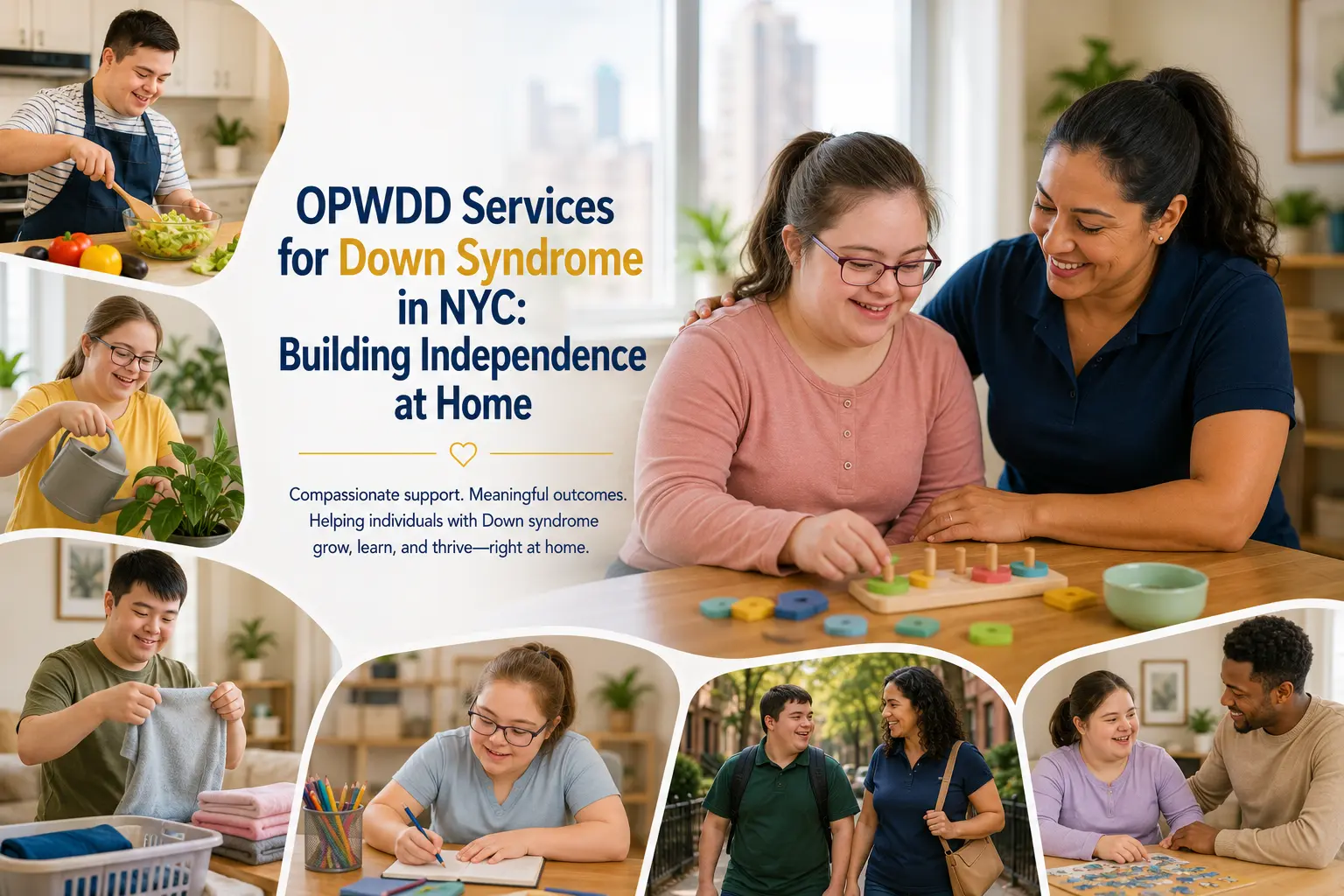
  • Home Care for Veterans in NYC: Benefits, Programs, and How to Get Started

    Home Care for Veterans in NYC: Benefits, Programs, and How to Get Started

    Senior & Veteran Care Guide

    Home Care for Veterans in NYC: Benefits, Programs, and How to Get Started

    Veterans who served our country deserve support at home as they age or face health challenges. New York City veterans have access to a range of VA and Medicaid home care programs β€” here’s how to navigate them.

    πŸ’‘ Key Takeaways
    • Veterans in NYC may qualify for home care through VA programs, Medicaid, or a combination of both.
    • The VA Aid & Attendance benefit can provide meaningful financial support for veteran home care costs.
    • Coordinating VA and Medicaid benefits together can significantly expand the care available to eligible veterans.

    New York City is home to one of the largest veteran populations in the country. Many of these men and women are now in their 70s, 80s, and beyond β€” navigating aging, service-related disabilities, and the same home care questions that face any NYC family. The difference is that veterans have earned access to a set of additional programs and benefits that can make quality veterans home care more accessible and more affordable.

    The Short Answer

    Veterans in NYC can get home care three ways: VA programs like Homemaker/Home Health Aide and Aid & Attendance, Medicaid home care, or private pay β€” and VA and Medicaid benefits can be combined. Eligibility for VA in-home care runs through your VA medical team; Medicaid runs through an MLTC plan. Call 718-375-2707 and we’ll help sort out which applies.

    Home Care Options Available to NYC Veterans

    Veterans home care is delivered through the same kinds of caregivers as any home care β€” a personal care aide or home health aide β€” but veterans have several additional funding paths:

    πŸ›οΈ
    VA Home-Based Primary Care

    The VA provides a Home-Based Primary Care (HBPC) program for veterans with complex health needs who have difficulty traveling to VA facilities. A VA care team visits the home regularly for medical management.

    🀝
    VA Homemaker & Home Health Aide

    The VA offers a homemaker and home health aide services program for eligible veterans who need help with daily activities. Availability depends on clinical eligibility and local VA capacity.

    πŸ’°
    Aid & Attendance Pension Benefit

    This VA pension benefit provides additional monthly income to veterans (and surviving spouses) who need help with daily activities. It can be used to pay for in-home care, assisted living, or adult day programs.

    πŸ₯
    Medicaid Home Care

    Veterans who meet New York’s Medicaid eligibility requirements can receive Medicaid home care independently of VA benefits. Many veterans qualify for both, and the two can often be coordinated.

    πŸ§“
    NYC Department of Veterans Services

    The NYC DVS offers benefits counseling, claims assistance, and connections to city programs for veterans β€” including help navigating home care and long-term care options.

    πŸ“‹
    MLTC Plans for Veterans

    Veterans enrolled in Medicaid can join an MLTC plan to coordinate long-term home care services. Some plans have specific outreach and support for veteran members.

    Understanding the VA Aid & Attendance Benefit

    The Aid & Attendance benefit is one of the most underutilized VA programs β€” many veterans and their families don’t know it exists. It provides additional monthly pension income on top of regular VA pension for veterans who meet one or more of the following criteria:

    • Need help with daily activities such as bathing, dressing, or eating
    • Are bedridden or spend much of the day in bed due to illness
    • Are a patient in a nursing home due to mental or physical incapacity
    • Have limited eyesight even with glasses or contact lenses

    The benefit amounts change every year. A veteran who qualifies can receive a meaningful monthly supplement that can go directly toward paying a home care agency or caregiver, and surviving spouses of veterans may also qualify for a benefit. Because the exact amounts and rules update annually, it’s worth confirming current figures with the VA or a benefits counselor when you apply.

    Can Veterans Use Both VA and Medicaid Benefits?

    In many cases, yes β€” and doing so is one of the most effective ways to maximize home care coverage. VA benefits and Medicaid are separate programs with separate eligibility rules. A veteran may use VA Aid & Attendance to supplement private pay care while also receiving Medicaid-funded home care through an MLTC plan. However, coordination requires careful planning to avoid conflicts between programs. A knowledgeable care coordinator can help map out how both programs can work together in a specific situation.

    Where to Start in NYC

    The path to veterans home care benefits often starts with three steps: confirming VA eligibility and enrollment, applying for Aid & Attendance if applicable, and separately checking Medicaid eligibility for home care. Each process has its own timeline and documentation requirements, which is why working with an experienced team matters. Advantage Home Care works with veteran families across all five NYC boroughs and can connect you with the right resources to begin the process.

    Frequently Asked Questions

    Does the VA provide in-home care for veterans?
    Yes. The VA offers several in-home options, including Home-Based Primary Care and a homemaker and home health aide program for eligible veterans, plus the Aid & Attendance pension benefit, which provides extra monthly income that can be used to pay for home care.

    Who is eligible for the VA home care program?
    Eligibility depends on the specific program, but generally a veteran must be enrolled in VA health care and have a clinical need for help with daily activities. Aid & Attendance has its own criteria tied to needing assistance with daily living, being largely bedridden, or being in a care facility. A benefits counselor can confirm which programs a veteran qualifies for.

    How do I apply for VA home care benefits?
    Start by confirming VA health care enrollment, then apply for the relevant program β€” such as Aid & Attendance β€” through the VA, and separately check Medicaid home care eligibility in New York. Each has its own paperwork; the NYC Department of Veterans Services and an experienced care team can help you navigate both.

    Can a veteran receive both VA and Medicaid home care?
    Often, yes. VA and Medicaid are separate programs, and many veterans coordinate both β€” for example, using Aid & Attendance toward private care while receiving Medicaid-funded aide hours through an MLTC plan. Careful planning helps the programs work together without conflict.

    Home Care for Veterans in NYC: Quick Answers

    Can a veteran get a home health aide through the VA in New York City?

    Yes. VA Homemaker/Home Health Aide services are arranged through the VA NY Harbor Healthcare System and the Bronx VA (James J. Peters) via a community care referral to a contracted agency. Veterans who also qualify for Medicaid can combine VA and MLTC hours. Call 718-375-2707 and we will help you ask the VA social worker the right questions.

    What is Aid and Attendance and does it pay for home care?

    A VA pension add-on for veterans or surviving spouses who need help with daily activities; it is paid to the veteran and can be used toward private-pay home care hours. Eligibility depends on wartime service, income and assets.

    Help a Veteran Get the Care They Earned

    Whether your loved one is exploring VA benefits, Medicaid home care, or both, we’ll help you understand the options and get care in place across New York City. Call 718-375-2707 or reach out online to get started.

    Get Started →

  • Beyond the Front Door: Opening New Pathways with OPWDD Support

    Beyond the Front Door: Opening New Pathways with OPWDD Support

    Beyond the Front Door: Opening New Pathways with OPWDD Support

    By The Advantage Home Care Team β€’ 4 min read

    For families supporting relatives with developmental disabilities, looking toward the future is driven by devotion and hope. Ultimately, these families share an absolute desire for their loved ones to live rich, independent lives. In New York State, the main gateway to these resources is the Office for People With Developmental Disabilities (OPWDD).

    However, researching the state’s official “Front Door” orientation framework can feel like an uphill climb. In fact, navigating clinical criteria, compiling evaluations, and waiting on authorizations quickly drains a family’s emotional energy.

    Keep in mind: OPWDD frameworks are designed to build customized, lifelong autonomy. Importantly, you don’t have to shoulder this administrative weight alone. Instead, partnering with a dedicated agency helps streamline the complex criteria. As a result, your loved one gets matching support on a timeline that actually works.

    Real Situations Where Families Seek OPWDD Partnership

    The needs of individuals naturally shift over time. However, there are a few common life milestones that trigger action. During these times, families decide to let a professional agency coordinate their OPWDD support. Specifically, this partnership makes all the difference in the following situations:

    1. Building Real-World Community Independence

    As teenagers with developmental challenges become young adults, their personal goals naturally expand. Consequently, their focus moves outside the immediate family circle. Parents often reach out to us with a common concern. They say, “My daughter wants to shop independently, but she responds differently to an outside mentor.” Therefore, we match individuals with specialized Community Habilitation coaches. These coaches step into that mentor role to build practical life skills directly in local neighborhoods.

    2. Proactively Preventing Caregiver Burnout

    Being a primary, long-term family caregiver is a beautiful but deeply exhausting role. Consequently, many families quietly run on fumes. They often forget to tend to their own health appointments, careers, or relationships. To solve this, households partner with us to utilize OPWDD Respite care frameworks. This specific service allows parents and siblings to finally take a breath. Furthermore, they can recharge with absolute peace of mind. They know their loved one is safe and happy with a professional aide.

    3. Transitioning Away from School Routines

    One of the highest-stress chapters occurs when individuals age out of the structured school system. Suddenly, the familiar daily schedule of classes, therapies, and peer groups disappears. Because of this, families lean on our agency during this difficult transition. Together, we establish a consistent alternative schedule. Specifically, we blend structural Day Habilitation programs with individual support. Ultimately, this keeps their loved one fully engaged and connected.

    Your Partner in Growth

    Stepping through the state’s structural process can feel tedious. However, the destination is entirely worth it. Witnessing your loved one master a new daily skill is an unmatched joy. Similarly, seeing them make new community friends or gain personal independence is incredible. Therefore, let an experienced team guide the coordination. We will match you with the ideal caregiver to protect your family’s peace of mind. Ultimately, you set up a framework where your loved one can truly thrive.