Category: Home Care

  • What Is a Personal Care Aide (PCA)? Everything NYC Families Need to Know

    What Is a Personal Care Aide (PCA)? Everything NYC Families Need to Know

    Personal Care Aide Guide

    What Is a Personal Care Aide (PCA)? Everything NYC Families Need to Know

    A Personal Care Aide is one of the most important β€” and most misunderstood β€” roles in home care. Here’s exactly what a PCA does, how they differ from other caregivers, and how NYC families access personal care aide services through Medicaid or private pay.

    πŸ’‘ Key Takeaways
    • A Personal Care Aide (PCA) helps with daily activities like bathing, dressing, meals, and light housekeeping β€” but does not provide medical care.
    • Medicaid covers PCA services for eligible New Yorkers based on a needs assessment β€” often at no cost to the family.
    • The right PCA can be the difference between a senior or person with a disability living safely at home versus needing institutional care.

    When families first start exploring home care, they encounter a confusing alphabet soup of certifications and titles β€” PCA, HHA, CHHA, CNA. Of all of them, Personal Care Aides β€” sometimes written “personal care aid” β€” are the most widely used, and personal care aide services are the most commonly covered by Medicaid in New York City. Understanding what a PCA actually does β€” and doesn’t do β€” is the starting point for building a care plan that works.

    You will see this role written several ways: personal care aide, personal care aid, personal care assistant, personal care attendant, home attendant, or simply PCA. In New York they all describe the same job — the caregiver who provides personal care assistance at home. Agencies and Medicaid paperwork use “personal care services” for the benefit itself.

    What Does a Personal Care Aide Do?

    A Personal Care Aide assists with Activities of Daily Living (ADLs) β€” the fundamental tasks that healthy adults take for granted but that become challenging with age, disability, or illness. A PCA’s work is hands-on and personal, focused on helping someone maintain dignity and independence at home.

    πŸ›
    Bathing & Grooming

    Assisting with bathing, showering, oral hygiene, hair care, and personal grooming β€” done with care for dignity and safety.

    πŸ‘•
    Dressing & Undressing

    Helping clients choose appropriate clothing and assisting with dressing, particularly when mobility or dexterity is limited.

    🍽️
    Meal Preparation

    Planning and preparing nutritious meals, assisting with feeding if needed, and ensuring adequate nutrition and hydration throughout the day.

    🚢
    Mobility & Transfers

    Assisting with walking, positioning, and safe transfers β€” getting in and out of bed, chairs, the shower, or a vehicle.

    🏠
    Light Housekeeping

    Maintaining a clean, safe, and organized home β€” laundry, dishes, vacuuming, and tidying the spaces the client uses regularly.

    πŸ›’
    Errands & Transportation

    Accompanying clients to medical appointments, grocery shopping, and other outings β€” keeping them connected to daily life outside the home.

    What a PCA Does NOT Do

    This distinction matters for families planning care and for Medicaid coverage purposes. A Personal Care Aide is not a medical professional and is not authorized to perform clinical tasks. These include:

    • Administering medications or injections
    • Wound care or changing sterile dressings
    • Monitoring vital signs (blood pressure, pulse, temperature)
    • Operating medical equipment
    • Providing physical, occupational, or speech therapy

    When clinical tasks are needed alongside daily living support, a Home Health Aide (HHA) or Certified Home Health Aide (CHHA) is the appropriate level of care.

    PCA vs. HHA: What’s the Difference?

    Feature
    Personal Care Aide (PCA)
    Home Health Aide (HHA)

    Personal care (bathing, dressing)
    βœ“
    βœ“

    Meal prep & housekeeping
    βœ“
    βœ“

    Medication reminders
    βœ“
    βœ“

    Vital signs monitoring
    βœ—
    βœ“

    Basic health monitoring
    βœ—
    βœ“

    Works under RN supervision
    βœ—
    βœ“

    Medicaid coverage in NYC
    βœ“
    βœ“

    Who Qualifies for Medicaid PCA Services in NYC?

    Medicaid-funded PCA services in New York are available to individuals who meet both financial and medical eligibility requirements:

    1
    Financial eligibility

    Income and asset levels must fall within New York Medicaid limits. Those above the income limit may still qualify through a spend-down or pooled income trust arrangement.

    2
    Medical eligibility β€” needs assessment

    A nurse assessor evaluates the individual’s functional limitations in Activities of Daily Living. The number of approved PCA hours is based on this assessment.

    3
    MLTC plan enrollment

    Most Medicaid PCA recipients in NYC receive services through a Managed Long-Term Care (MLTC) plan, which coordinates and authorizes PCA hours and connects families with a licensed agency.

    4
    Physician’s order

    A doctor must certify the need for home care services. This documentation is part of the Medicaid approval process and must be kept current.

    How to Get a PCA in New York City

    The path to PCA services depends on how you’re funding care:

    • Through Medicaid: Start by checking eligibility, then enroll in an MLTC plan, complete a care needs assessment, and select a licensed agency. The process takes weeks to months β€” starting early matters. Learn more about getting approved for Medicaid home care.
    • Through private pay: Families who don’t qualify for Medicaid or need care to start immediately can arrange private pay PCA services directly through a licensed agency. Care can typically begin within 24–48 hours.

    What Does a Good Personal Care Aide Look Like?

    Beyond the formal requirements, the best PCAs share qualities that make a real difference in the daily experience of care: patience, reliability, genuine warmth, and the ability to build trust with someone who may be ambivalent about accepting help. A good personal care aide doesn’t just complete tasks β€” they become a consistent, trustworthy presence in someone’s home and life.

    At Advantage Home Care β€” a licensed personal care aide agency serving all five New York City boroughs β€” we match each client with a PCA based on their specific needs, schedule, language preferences, and personality, not just availability. If you’re searching for personal care aide services near you, we can typically begin care quickly once the intake process is complete. Reach out to get started.

    Related Guides

    Frequently Asked Questions About Personal Care Aides

    What is a personal care aide?

    A personal care aide (PCA) is a trained caregiver who helps someone with the activities of daily living at home: bathing, dressing, grooming, toileting, transfers and mobility, plus meal preparation, light housekeeping and errands. In New York the same role is also called a home attendant.

    What do personal care aides do day to day?

    A typical shift covers personal hygiene and dressing, preparing and serving meals, light cleaning and laundry, medication reminders, help getting around the home safely, escorting to appointments, and companionship. PCAs do not perform clinical tasks.

    What is the difference between a personal care aide and a home health aide?

    A home health aide (HHA or CHHA) has additional state-approved training and can perform health-related tasks under nurse supervision, such as vital signs and assistance with medical equipment. A PCA focuses on personal care and household support. See HHA vs. PCA.

    How do I find a personal care aide near me in NYC?

    Contact a licensed home care agency serving your borough. A coordinator reviews what is needed, a nurse assessment confirms the level of care, and the agency matches an aide by language, schedule and experience. Advantage Home Care staffs all five boroughs.

    Does Medicaid cover personal care services in New York?

    Yes. Personal care services are a New York Medicaid benefit for eligible residents, authorised as weekly hours through a managed long-term care plan after an assessment. Hours must be delivered by a licensed agency.

    How much does a personal care aide cost privately?

    Privately paid PCA hours in New York City are billed hourly, with premium rates for nights, weekends and short shifts. Current ranges are in our NYC home care cost guide.

    PCA Basics: Quick Answers

    Is a PCA the same as a home attendant?

    Yes in everyday NYC usage: “home attendant” is the common name for a Medicaid-paid personal care aide. The formal program is Personal Care Services; the aide works for a licensed agency and is assigned through your MLTC plan.

    Can a PCA give medications?

    A PCA can remind and assist with self-administration (opening containers, handing pre-set doses) but does not administer medications; that is a home health aide task under nurse supervision, or a nursing task. Call 718-375-2707 to check which level fits.

    Looking for a Personal Care Aide in NYC?

    One call tells you what level of care fits, whether Medicaid covers the hours, and how soon an aide can start in your home.

    Call 718-375-2707
    Request Care Online

  • HHA vs PCA: What’s the Difference and Which Does Your Loved One Need?

    HHA vs PCA: What’s the Difference and Which Does Your Loved One Need?

    Home Care Comparison Guide

    HHA vs PCA: What’s the Difference and Which Does Your Loved One Need?

    Home Health Aide and Personal Care Aide are the two most common home care roles in New York β€” and families frequently confuse them. Here’s a clear breakdown of what each one does, how they differ, and how to know which is right for your situation.

    πŸ’‘ Key Takeaways
    • PCAs focus on personal care and daily living assistance β€” bathing, dressing, meals, housekeeping, and companionship.
    • HHAs do everything a PCA does, plus basic health monitoring like vital signs and simple health-related tasks under nursing supervision.
    • Both are covered by Medicaid in New York City. The right choice depends on your loved one’s medical complexity, not just their daily care needs.

    When families first explore home care in New York City, two titles come up constantly: Home Health Aide (HHA) and Personal Care Aide (PCA). Many people assume they’re interchangeable β€” they’re not. Understanding the real difference helps families get the right level of care, avoid unnecessary costs, and navigate Medicaid coverage correctly. Both roles are provided by Advantage Home Care, and our care coordinators can help you determine which is appropriate for your situation.

    The Core Difference in One Sentence

    A PCA helps with the personal and practical tasks of daily life. An HHA does the same β€” plus adds a layer of basic health observation and monitoring, working under the direction of a registered nurse or therapist. If your loved one needs help with daily activities but has no active medical management needs, a PCA is usually appropriate. If there are health monitoring needs alongside daily care, an HHA is the right level.

    What a PCA Does

    A Personal Care Aide provides non-medical home care assistance with Activities of Daily Living (ADLs) and Instrumental Activities of Daily Living (IADLs):

    PCA
    Personal care (ADLs)

    Bathing, showering, dressing, grooming, oral hygiene, toileting, and transfers. The hands-on personal tasks that form the core of daily care.

    PCA
    Meal preparation & nutrition

    Planning and preparing meals suited to dietary needs, assisting with eating if needed, monitoring food and fluid intake.

    PCA
    Light housekeeping

    Laundry, dishes, vacuuming, tidying, and maintaining a clean, safe home environment in the areas the client uses.

    PCA
    Medication reminders

    Reminding clients to take medications on schedule. A PCA does not administer medications β€” that is a medical task.

    PCA
    Companionship & errands

    Conversation, activities, accompaniment to appointments and outings, grocery shopping, and other errands that keep clients connected to daily life.

    PCA
    Mobility assistance

    Safe transfers, walking assistance, positioning, and mobility support β€” helping clients move safely around their home and community.

    What an HHA Does (Everything Above, Plus More)

    A Home Health Aide is trained to do everything a PCA does β€” all the personal care, meals, housekeeping, and daily assistance β€” plus basic health-related tasks that require a higher level of training and work under the supervision of a registered nurse or therapist:

    HHA only
    Vital signs monitoring

    Taking and recording blood pressure, pulse, temperature, and respiration β€” and knowing when values are outside normal range and require reporting.

    HHA only
    Basic health observation

    Systematically observing and reporting changes in physical condition, skin integrity, cognition, behavior, and other health indicators to the supervising nurse.

    HHA only
    Simple health-related tasks

    Under RN direction: assistance with prescribed exercises, range-of-motion activities, application of non-sterile dressings, and similar delegated tasks.

    HHA only
    Works under RN supervision

    An HHA is part of a supervised care team β€” a registered nurse conducts regular supervisory visits and is responsible for the health-related aspects of the care plan.

    Side-by-Side Comparison

    Task or Service
    PCA
    HHA
    Bathing, dressing, grooming
    βœ“
    βœ“
    Meal preparation
    βœ“
    βœ“
    Light housekeeping
    βœ“
    βœ“
    Medication reminders
    βœ“
    βœ“
    Companionship & errands
    βœ“
    βœ“
    Transfers & mobility
    βœ“
    βœ“
    Vital signs monitoring
    βœ—
    βœ“
    Basic health observation & reporting
    βœ—
    βœ“
    Works under RN supervision
    βœ—
    βœ“
    Covered by Medicaid in NYC
    βœ“
    βœ“
    Required training (NY State minimum)
    40 hours
    75 hours

    How to Know Which Your Loved One Needs

    The decision isn’t always obvious, so here’s a practical guide:

    Consider a PCA if your loved one…
    • Needs help with daily tasks but has no active medical management needs
    • Takes medications but only needs reminders, not clinical supervision
    • Is relatively medically stable with no recent hospitalizations
    • Needs companionship and daily assistance more than health monitoring
    • Has a Medicaid MLTC plan that authorizes PCA-level care
    Consider an HHA if your loved one…
    • Has a chronic condition (heart failure, diabetes, COPD) requiring monitoring
    • Has recently been discharged from a hospital or rehab facility
    • Requires vital signs tracked and reported regularly
    • Has a physician’s order specifically requesting HHA-level care
    • Would benefit from care coordination with a supervising RN

    What About a Certified Home Health Aide (CHHA)?

    You may also hear about Certified Home Health Aides (CHHAs) β€” a higher certification level than a standard HHA. CHHAs typically provide short-term, post-acute care (after surgery or a hospitalization) under closer medical supervision and with more clinical tasks delegated. CHHAs are often covered by Medicare for short-term skilled care needs, while PCAs and HHAs are the standard for long-term Medicaid home care.

    Getting the Right Level of Care

    In practice, the Medicaid authorization process plays a significant role in determining which level of care is approved β€” a needs assessment by a nurse assessor and a physician’s order both contribute to whether PCA or HHA care is recommended. Our care coordination team can help you understand what level of care is appropriate and how to navigate Medicaid authorization. Reach out to get started.

  • Respite Care in NYC: What It Is, Who Qualifies, and How to Get It

    Respite Care in NYC: What It Is, Who Qualifies, and How to Get It

    Respite Care NYC Guide

    Respite Care in NYC: What It Is, Who Qualifies, and How to Get It

    Respite care gives family caregivers a planned, guilt-free break while a trained professional steps in. Here is exactly what respite care means in New York City, who qualifies, and how you access it through Medicaid or private pay.

    πŸ’‘ Key Takeaways
    • Respite care provides temporary, planned relief for family caregivers. It is not a sign of failure, but rather a vital tool for sustainability.
    • Families in NYC can access respite care through Medicaid MLTC plans, OPWDD programs, the TBI Waiver, and private pay options.
    • Even a few hours of respite care per week significantly reduces caregiver burnout and actively improves the overall quality of care.

    Indeed, if you are a family caregiver in New York City, you already know that the work is completely relentless. For instance, there is no clocking out, no sick days, and very little space between your loved one’s needs and your own. Respite care exists to actively create that space β€” temporarily and intentionally. Family caregivers can sustain the care they provide without sacrificing their own health and wellbeing in the process. This guide covers what respite care actually entails, the different ways providers deliver it in NYC, and how families secure it through Medicaid and other programs.

    What Is Respite Care?

    Essentially, respite care offers short-term, temporary support to someone who normally receives assistance from a family member or unpaid caregiver. The word “respite” means relief or rest. That is exactly what this type of care actively provides: relief for the caregiver, while ensuring their loved one continues to receive attentive, professional support.

    Respite care does not represent a permanent arrangement, a sign that family caregiving has failed, or a step toward a nursing home. It serves as a planned, intentional break β€” an hour, an afternoon, a weekend, or longer. This allows caregivers to rest, attend to their own health, work, spend time with other family members, or simply enjoy uninterrupted time to themselves.

    Types of Respite Care Available in NYC

    🏠
    In-Home Respite

    A trained caregiver comes directly to the home while the family caregiver steps away. The care recipient stays safely in their familiar environment, causing absolutely no disruption to their daily routine or surroundings.

    🌞
    Adult Day Program Respite

    Alternatively, the care recipient attends a structured daytime program. This includes activities, meals, social engagement, and health monitoring while the family caregiver takes time during the day. Fortunately, NYC hosts dozens of high-quality adult day programs.

    πŸŒ™
    Overnight & Weekend Respite

    Families sometimes need longer breaks for a family trip, a medical procedure, or simply several days of uninterrupted rest. Overnight respite brings a professional in for extended coverage.

    🏨
    Out-of-Home / Facility Respite

    For extended caregiver absences, the care recipient may stay temporarily at a licensed facility. Although less common, facilities offer this option for situations requiring more intensive or longer-term coverage.

    Who Qualifies for Respite Care in NYC?

    Eligibility for funded respite care depends heavily on which specific program you access. Here is exactly how the main pathways work:

    πŸ›οΈ
    Medicaid MLTC Plans

    Many Managed Long-Term Care plans include respite hours directly within a Medicaid home care package. The care recipient must enroll in Medicaid and an MLTC plan, and the plan must approve respite as part of their care strategy. This serves as the most common path for elderly or disabled adults whose primary caregivers are family members. Learn more about getting approved for Medicaid home care.

    🧩
    OPWDD Respite Services

    OPWDD funds respite care as a distinct service category for individuals with developmental disabilities. This includes autism, intellectual disability, cerebral palsy, and Down syndrome. Families can access both in-home and out-of-home respite options directly through OPWDD programs. OPWDD respite serves both children and adults.

    🧠
    TBI Waiver Respite

    Families caring for someone with a traumatic brain injury may access respite through New York’s TBI Medicaid Waiver. The state designed this exclusively for individuals aged 18–64 with a documented TBI who actively enroll in the waiver program. Learn more about TBI and NHTD support services.

    πŸ’³
    Private Pay Respite

    Families who do not qualify for funded programs, or who need more flexibility than Medicaid allows, can arrange private pay respite care directly. You skip the eligibility process and waiting periods, allowing care to begin as quickly as 24–48 hours.

    πŸ™οΈ
    NYC Department for the Aging (DFTA)

    DFTA operates caregiver support programs that include access to respite services for family members caring for older adults. Fortunately, the city makes some programs available at low or no cost for qualifying NYC families. Contact 311 to request a referral to the caregiver support program nearest you.

    How Many Hours of Respite Can I Get?

    Medicaid MLTC plans authorize respite hours as part of an overall care plan. The number varies based heavily on the care recipient’s assessed needs and the caregiver’s unique situation. It is not a fixed number, and care managers can often increase it if circumstances change. Conversely, OPWDD authorizes respite hours completely separately based directly on the individual’s service plan.

    For private pay, absolutely no limit exists β€” you simply schedule whatever you need. Many families start with just a few hours per week and actively adjust as they discover what actually restores them.

    How to Request Respite Care in NYC

    • For existing Medicaid MLTC members: Contact the plan’s care manager and specifically request respite care. Because the plan may need to add it officially, you should ask for a comprehensive care plan review.
    • When utilizing OPWDD services: Speak directly with the assigned OPWDD Service Coordinator. Respite operates as a standard OPWDD service category, and coordinators can add it to the service plan during any review.
    • Before starting Medicaid: Begin with a thorough Medicaid eligibility check. Many families falsely assume they do not qualify when they actually do. Learn about Medicaid eligibility here.
    • For immediate urgent needs: Contact a licensed home care agency directly to discuss private pay respite options. Reach out to Advantage Home Care β€” our team typically arranges care within 24–48 hours.

    One More Thing: You Don’t Need to Justify Taking a Break

    The biggest barrier most family caregivers face isn’t access β€” it’s guilt. They battle the belief that stepping away means not caring enough. Research remains incredibly consistent on this exact point: caregivers who take regular, intentional breaks provide significantly better care over time. Respite is never a luxury or a selfish indulgence. It is, quite literally, exactly how sustainable caregiving works.

    If you actively care for a loved one in New York City and have not explored respite options yet, our care coordination team can help. We will help you completely understand what resources exist for your specific situation β€” with zero commitment required.

    Related Respite Guides

    Frequently Asked Questions About Respite Care

    What is respite care?

    Respite care is short-term, temporary care that gives an unpaid family caregiver a planned break. A trained caregiver steps in for a few hours, a full day, overnight or longer, so the regular caregiver can rest, work, travel or handle their own health.

    What are the types of respite care?

    The main types are in-home respite (a caregiver comes to the house), adult day programs, overnight and weekend respite, emergency or short-notice respite, and short-term residential stays. In-home respite is the most common option for New York families.

    What is a respite caregiver?

    A respite caregiver is a trained aide who temporarily takes over caregiving duties, usually a personal care aide or home health aide. They follow the same care plan the family uses, so routines, meals and medication schedules stay consistent.

    Who pays for respite care in New York?

    Depending on the situation: Medicaid (through authorised personal care or home health aide hours), OPWDD for people with developmental disabilities, the VA for eligible veterans, long-term care insurance, grant programs, or the family privately. See respite options and costs.

    Does Medicaid pay for respite care?

    New York Medicaid does not usually fund a service labelled “respite” for the general adult population, but it funds aide hours in the home that give the family caregiver the same break. For people with developmental disabilities, OPWDD funds respite directly.

    Can I get respite care at short notice?

    Yes. Private-pay respite can usually be arranged within 24 to 48 hours, which is why many families keep it as their emergency option even when Medicaid covers their regular hours.

    Take the Break. We Will Cover It.

    Tell us your situation and we will tell you which route to respite applies to you and how quickly we can arrange cover.

    Call 718-375-2707 Request Care Online
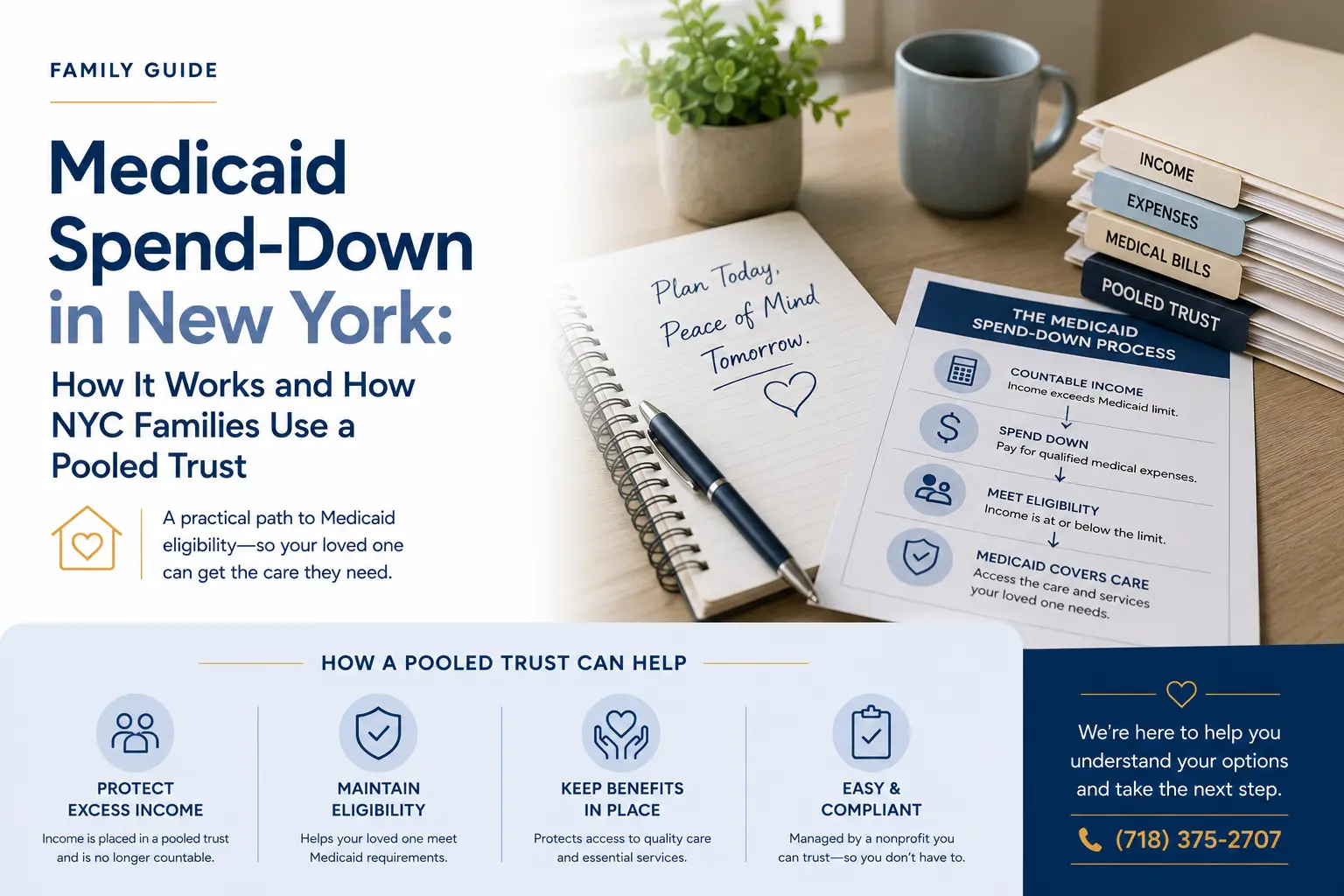
  • Medicaid Spend-Down in New York: How It Works and How NYC Families Use a Pooled Trust

    Medicaid Spend-Down in New York: How It Works and How NYC Families Use a Pooled Trust

    Medicaid Planning Guide

    Medicaid Spend-Down in New York: How It Works and How NYC Families Use a Pooled Trust

    Think your income is too high for Medicaid? New York’s spend-down program may still make you eligible for home care coverage β€” at no cost to the family. Here’s exactly how it works, and how the pooled income trust solves the biggest practical problem.

    πŸ’‘ Key Takeaways
    • New York’s Medicaid spend-down program allows people with income above the standard limit to still qualify for Medicaid coverage.
    • A pooled income trust is the most practical and widely used tool for meeting the spend-down obligation while keeping income available for living expenses.
    • Families who assume they’re ineligible for Medicaid because of income are often wrong β€” spend-down opens the door for many who would otherwise pay entirely out of pocket.

    The most common reason NYC families don’t pursue Medicaid home care is the assumption that they earn too much to qualify. Sometimes that’s true. But often β€” especially for seniors whose income comes primarily from Social Security and a pension β€” it’s not. New York’s Medicaid spend-down program creates a pathway to coverage for people whose income is above the standard limit, and the pooled income trust makes that pathway genuinely workable in practice. Understanding both is one of the most financially valuable things a family navigating home care costs can do.

    The Medicaid Income Limit Problem

    New York Medicaid sets monthly income limits for eligibility. In 2026, the limit for a single individual is modest β€” well below what many seniors receive from Social Security and pension income combined. A retired teacher or city worker, for example, might receive $2,200–$2,800 per month, which exceeds the standard limit.

    Without the spend-down program, this would mean no Medicaid coverage β€” and potentially thousands of dollars per month in out-of-pocket home care costs. The spend-down program changes that calculation entirely.

    How the Spend-Down Works

    The spend-down functions like a monthly deductible. Here’s the logic:

    1
    Calculate excess income

    Your monthly income minus the Medicaid income limit = your excess income. This is the amount you must “spend down” each month before Medicaid coverage activates.

    2
    Apply excess income toward allowable medical expenses

    When your out-of-pocket medical costs in a month equal your excess income, the spend-down is met and Medicaid covers all remaining medical expenses for that period.

    3
    Medicaid coverage activates

    Once the spend-down threshold is met, Medicaid covers eligible expenses β€” including home care β€” for the remainder of the budgeting period (monthly or every 6 months depending on election).

    4
    Process repeats each period

    The spend-down is not a one-time hurdle β€” it must be met each budgeting period. This is why the pooled income trust is so important: it provides a practical, sustainable mechanism for meeting the spend-down every month.

    The Problem With Meeting Spend-Down the Old Way

    In theory, the spend-down is straightforward. In practice, most people can’t afford to simply pay their excess income toward medical bills every month before Medicaid kicks in. If your excess income is $800/month, that’s $800 you’d need to spend on medical expenses before Medicaid covers anything β€” including home care.

    For someone who needs home care to pay for itself through Medicaid, waiting until medical bills accumulate to the spend-down threshold isn’t a workable solution. This is exactly the problem the pooled income trust was designed to solve.

    The Pooled Income Trust: How Most NYC Families Meet Their Spend-Down

    A pooled income trust (also called a supplemental needs trust) is a legal account managed by a nonprofit organization. It is the standard, widely accepted mechanism for meeting a Medicaid spend-down in New York City β€” used by tens of thousands of Medicaid recipients across the five boroughs.

    πŸ’°
    You deposit your excess income into the trust each month

    The amount deposited equals your spend-down obligation β€” the excess income that would otherwise have to go toward medical bills before Medicaid coverage activates.

    πŸ“‘
    The deposit satisfies your spend-down obligation

    The act of depositing funds into an approved pooled trust meets the Medicaid spend-down requirement for that month β€” Medicaid coverage (including home care) then activates.

    🏠
    The trust pays your living expenses

    The funds in the trust are used to pay allowable expenses β€” rent, utilities, groceries, clothing, phone, insurance premiums. The money doesn’t disappear; it pays for the same things you were already paying for.

    πŸ₯
    Medicaid covers your home care

    With the spend-down met, Medicaid pays for your authorized home care services. For someone needing significant daily care, this Medicaid coverage is worth far more than the spend-down obligation.

    A Real-World Example

    Situation: A 74-year-old Manhattan resident receives $2,400/month from Social Security and a small pension. The Medicaid income limit is $1,732/month. Her excess income is $668/month.

    Without spend-down: She doesn’t qualify for Medicaid. Home care that she needs for 4 hours daily costs approximately $3,200–$3,800/month out of pocket.

    With pooled income trust: She deposits $668 into a pooled trust monthly. The deposit meets her spend-down. Medicaid activates and covers her home care. The $668 in the trust pays her utilities and grocery bills β€” expenses she had anyway. Her net monthly cost for home care: approximately $668 in trust management fees and administrative costs, versus $3,200–$3,800 without the trust.

    What Counts as Allowable Medical Expenses for Spend-Down?

    If someone is meeting their spend-down through direct medical expenses (without a trust), the following typically count:

    • Home care costs (including costs from before Medicaid approval)
    • Medicare Part B premiums and other health insurance premiums
    • Prescription medications not covered by other insurance
    • Medical equipment and supplies
    • Dental, vision, and hearing expenses
    • Transportation to medical appointments
    • Outstanding medical bills from prior months (unpaid bills carry forward)

    How to Get Started With Medicaid Spend-Down in NYC

    The spend-down and pooled trust process has several moving parts β€” income verification, trust setup with an approved nonprofit, Medicaid enrollment, and MLTC plan selection. Errors in the setup can delay coverage by months. Working with experienced guidance matters β€” our guide to Medicaid application help in NYC covers what good help includes and how to get it free.

    Advantage Home Care’s care coordinators help NYC families determine whether spend-down applies to their situation, explain the pooled trust process, and connect families with the resources needed to set it up correctly. We serve all five boroughs and can typically help you understand your options in a single conversation. Learn more about Medicaid eligibility or reach out to speak with our team.

    Frequently Asked Questions

    What is a Medicaid spend-down?

    A spend-down β€” also called surplus or excess income β€” is the portion of monthly income above New York’s Medicaid limit. Medicaid coverage activates each month once that amount has gone toward medical costs, or has been deposited into an approved pooled income trust.

    Is using a pooled trust for a spend-down a legitimate Medicaid strategy?

    Yes. Depositing surplus income into a pooled income trust is a standard, state-recognized way to meet a spend-down in New York β€” used by tens of thousands of recipients. It is not a loophole: the deposited money still pays your own living expenses.

    Do I lose the money I deposit into a pooled trust?

    No. The trust pays your allowable living expenses β€” rent, utilities, groceries, phone β€” from your deposits. Modest administrative fees apply, which is why you deposit only your surplus amount, not more.

    Who can help me set up a spend-down or pooled trust in NYC?

    The trust itself is run by a nonprofit organization β€” our guide to pooled income trusts in NYC covers how to choose one and file the paperwork. Advantage Home Care’s coordinators walk families through the whole sequence free of charge β€” call 718-375-2707.

  • TBI Home Care in NYC: Services, Waivers, and How to Get Support After a Brain Injury

    TBI Home Care in NYC: Services, Waivers, and How to Get Support After a Brain Injury

    TBI & NHTD Care Guide

    TBI Home Care in NYC: Services, Waivers, and How to Get Support After a Brain Injury

    A traumatic brain injury changes everything β€” but it doesn’t have to mean a nursing home. New York’s TBI Medicaid Waiver funds in-home and community support for individuals with brain injuries who want to live independently. Here’s how it works.

    πŸ’‘ Key Takeaways
    • New York’s TBI Medicaid Waiver funds home and community-based services for individuals aged 18–64 with a traumatic brain injury.
    • Services include home care, housing subsidies, day programs, respite, and community integration support β€” all designed to support independent living.
    • The TBI Waiver is administered separately from standard Medicaid home care β€” eligibility and enrollment work differently.

    Traumatic brain injury affects approximately 3 million Americans every year β€” from car accidents and falls to sports injuries and violence. For those whose injuries result in lasting cognitive, physical, or behavioral changes, the path to community living can feel uncertain. New York State created the TBI Medicaid Waiver specifically to change that: to give individuals with brain injuries the home and community supports they need to live outside of institutional settings. If you or someone you love is navigating life after a TBI in New York City, this guide explains what’s available and how to access it through our NHTD/TBI support services.

    What Is the TBI Medicaid Waiver?

    The TBI Waiver is a New York State Medicaid program β€” officially the Traumatic Brain Injury Home and Community-Based Services Waiver β€” that funds a broad range of services for individuals with TBI who want to live at home or in the community rather than in a nursing facility or other institutional setting.

    It’s not standard Medicaid home care. The TBI Waiver is a separate, specialized program with its own eligibility criteria, enrollment process, and service menu. It’s designed specifically for the complex, often unpredictable needs of individuals recovering from or living with traumatic brain injury.

    Who Qualifies for TBI Waiver Services?

    πŸŽ‚
    Age 18–64

    The TBI Waiver serves working-age adults. Individuals 65 and older may be eligible for other Medicaid home care programs instead.

    🧠
    Documented TBI Diagnosis

    A traumatic brain injury must be documented and must have resulted in lasting functional limitations affecting daily living, behavior, cognition, or communication.

    πŸ₯
    Nursing Facility Level of Care

    The individual must require a level of care that would otherwise qualify for nursing facility placement β€” even if they’re currently living at home.

    πŸ›οΈ
    Medicaid Eligibility

    Must be enrolled in or eligible for Medicaid. Financial eligibility requirements apply, though individuals above standard income limits may qualify through spend-down.

    🏠
    Community Living Goal

    The individual must want to live in the community and have a safe plan for doing so β€” not currently residing in a nursing facility long-term (though transitioning from one is allowed).

    πŸ“‹
    Service Plan in Place

    Enrollment requires an approved service plan developed with a TBI Service Coordinator that outlines all needed supports and how they’ll be provided.

    What Services Does the TBI Waiver Cover?

    The TBI Waiver covers a wide range of home and community-based services β€” far broader than standard Medicaid home care. The actual services approved depend on each individual’s assessed needs and service plan:

    🏠
    In-Home Supports & Personal Care

    Help with Activities of Daily Living β€” bathing, dressing, meals, mobility β€” provided by trained home care aides in the person’s own home. This is the core of most TBI Waiver service plans.

    πŸ’°
    Housing Subsidy (TBI Housing Program)

    One of the most impactful and underutilized TBI Waiver services β€” a monthly housing subsidy that helps individuals afford accessible, appropriate housing in the community. The housing subsidy can be the deciding factor in whether community living is actually feasible.

    🧭
    TBI Service Coordination

    A dedicated coordinator who develops and manages the individual’s service plan, connects them with needed providers, and helps navigate the complexities of the TBI Waiver system. Every enrolled individual has a service coordinator.

    🌞
    Day Habilitation & Community Integration

    Structured programs that support skill development, community participation, and meaningful daily activity β€” particularly important for individuals whose TBI affects cognitive function, behavior, or social skills.

    😴
    Respite Services

    Planned relief for family caregivers β€” a professional caregiver steps in so family members can rest, work, or attend to their own needs. Available in-home or at a respite facility.

    πŸ”§
    Environmental Modifications

    Funding for home modifications β€” grab bars, ramps, widened doorways, accessible bathrooms β€” that make safe community living possible for individuals with physical limitations from their TBI.

    TBI Waiver vs. NHTD Waiver: What’s the Difference?

    New York administers two closely related Medicaid waivers that often get confused:

    • TBI Waiver: Specifically for individuals aged 18–64 with a traumatic brain injury. Focuses on TBI-specific supports including cognitive rehabilitation, behavioral supports, and the TBI housing subsidy.
    • NHTD Waiver (Nursing Home Transition and Diversion): Broader program for individuals with physical disabilities or chronic illness of any age who need nursing-facility-level care and want to live in the community. Some individuals who don’t qualify for the TBI Waiver may qualify for NHTD instead.

    Both waivers are administered by the New York State Department of Health and share some service categories, but they serve different populations and have different eligibility pathways. Our team can help you determine which program fits your situation. Learn more about our NHTD and TBI support services.

    TBI Home Care in NYC: Common Questions

    What does TBI home care in NYC include?

    Personal care and home health aides for bathing, dressing, meals, safety supervision and cueing, coordinated with TBI waiver services such as service coordination, independent living skills training, structured day programs and, where approved, the TBI housing subsidy. Care is staffed across the five boroughs and is usually Medicaid-funded.

    How does the TBI housing subsidy work?

    The Medicaid TBI waiver can pay part of a participant’s rent and utilities when housing is what stands between them and living in the community. It is requested through the Regional Resource Development Center (RRDC) and service coordinator. Our full guide: the New York TBI waiver, services and housing subsidy.

    Can Advantage Home Care staff TBI aides while the waiver is pending?

    Yes. Waiver enrollment can take months; hands-on aide hours can often start sooner through MLTC or immediate-need Medicaid. Call 718-375-2707 and we will map both tracks for you.

    How to Access TBI Home Care in New York City

    The TBI Waiver enrollment process involves several steps and typically takes 3–6 months from initial application to approved services. Starting early β€” and with knowledgeable guidance β€” significantly speeds the process:

    1
    Confirm Medicaid eligibility

    If not already enrolled in Medicaid, this is the first step. Financial eligibility must be established before TBI Waiver enrollment can proceed.

    2
    Contact the Regional Resource Development Center (RRDC)

    The RRDC for your region manages TBI Waiver applications and conducts the initial screening. In NYC, this is the Regional Resource Development Center for Region 4.

    3
    Complete clinical and functional assessments

    A medical review confirms the TBI diagnosis and level of care need. A functional assessment evaluates daily living limitations and determines what services are needed.

    4
    Develop a service plan with a coordinator

    Once approved, a TBI Service Coordinator is assigned to develop an individualized service plan. This plan drives all subsequent service authorizations.

    5
    Select providers and begin services

    Services are provided by authorized providers β€” including licensed home care agencies like Advantage Home Care β€” working within the approved service plan.

    Advantage Home Care supports individuals with TBI across New York City’s five boroughs through our NHTD/TBI services. If you’re navigating TBI Waiver enrollment or looking for authorized home care providers, our care coordination team can help guide you through the process. Reach out to start the conversation.

  • Home Care Agencies in NYC: How to Choose the Right One for Your Family

    Home Care Agencies in NYC: How to Choose the Right One for Your Family

    Home Care Agency Guide

    Home Care Agencies in NYC: How to Choose the Right One for Your Family

    Not all home care agencies in New York City are equal β€” in licensing, caregiver quality, Medicaid programs, or responsiveness. Here’s what to look for, what questions to ask, and how to choose a home care agency you can actually trust.

    πŸ’‘ Key Takeaways
    • Home care agencies in NYC must be licensed by New York State β€” always verify licensure before engaging any agency.
    • The right agency depends on your loved one’s specific needs, insurance situation, location, and language preferences.
    • Price alone is a poor guide β€” caregiver quality, consistency, and coordination responsiveness matter far more in practice.

    New York City has hundreds of licensed home care agencies β€” from large national chains to small neighborhood operations. That’s good news (competition and choice) and challenging news (how do you distinguish a trustworthy agency from one that looks good on a website but fails to deliver?). This guide walks through what actually separates good home care agencies from mediocre ones, and how NYC families can make a confident choice. If you’re ready to speak with someone directly, our care coordinators are available to answer your questions about Advantage Home Care.

    The short answer

    There are hundreds of home care agencies in NYC, and on paper they look identical. What actually separates them is whether they can staff your schedule, in your language, in your borough — and who covers the shift when your aide is sick. Check the licence, ask the five questions below, and start with the agency that answers them plainly. Advantage Home Care serves all five boroughs — call 718-375-2707.

    Types of Home Care Agencies in NYC

    Before comparing agencies, it helps to understand what type of agency you’re looking for. In New York, home care agencies fall into distinct license categories that determine what they can and can’t do:

    πŸ₯
    Licensed Home Care Services Agency (LHCSA)

    The most common type for ongoing personal care and home health aide services. LHCSAs provide PCAs and HHAs for long-term care β€” usually funded through Medicaid MLTC plans or private pay.

    🏨
    Certified Home Health Agency (CHHA)

    Provides skilled nursing and therapy services alongside personal care β€” typically for short-term, post-acute care after a hospitalization. Usually covered by Medicare or short-term Medicaid.

    πŸ“‹
    Medicaid Managed Care (MLTC) Partners

    If your loved one is enrolled in a Medicaid MLTC plan, the agency must be in-network with that plan. Not every LHCSA works with every MLTC plan β€” confirming in-network status is essential.

    πŸ’³
    Private Home Care Agencies

    Any licensed LHCSA can provide private pay services β€” no Medicaid enrollment needed, faster start times, more scheduling flexibility. Some private home care agencies in NYC specialize in private pay only.

    8 Questions to Ask Any NYC Home Care Agency

    Use these questions when evaluating any agency. A reputable agency should answer all of them directly and without hesitation:

    1
    Are you licensed by New York State as an LHCSA or CHHA?

    This is non-negotiable. You can verify any agency’s license status through the New York State Department of Health. Unlicensed agencies may be cheaper but operate outside state oversight and worker protections.

    2
    Are you in-network with our Medicaid MLTC plan?

    If your loved one has an MLTC plan, the agency must be a contracted provider. Ask specifically β€” don’t assume. If you haven’t enrolled in an MLTC plan yet, ask which plans the agency works with.

    3
    How do you screen, train, and background-check your caregivers?

    Background checks are required by New York State, but training quality and vetting rigor vary significantly. Ask about the specific training aides receive beyond state minimums.

    4
    How do you handle caregiver consistency?

    Frequent caregiver changes are disruptive and stressful. Ask specifically what the agency does to maintain continuity β€” and what happens when a regular caregiver is sick or unavailable.

    5
    Do you serve my borough, and can you match language preferences?

    NYC’s diversity means language compatibility is often essential. Ask which languages your potential caregivers speak and whether the agency can match your loved one’s language and cultural preferences.

    6
    How quickly can care begin?

    For Medicaid, this depends on authorization status. For private pay, most agencies can begin in 24–48 hours. If you need care urgently, ask directly what’s realistic.

    7
    Who do we contact if there’s a problem β€” and how quickly do you respond?

    Responsiveness during a care crisis is where agencies differentiate themselves most clearly. Ask about after-hours support, who handles emergencies, and typical response times.

    8
    Do you provide care coordination support?

    Some agencies simply place aides. Others offer care coordination β€” helping families navigate Medicaid, communicate with doctors, and adjust the care plan over time. For complex care situations, this matters enormously.

    Red Flags to Watch For

    These are signs that an agency may not be trustworthy β€” or may not be the right fit for your situation:

    • Can’t or won’t verify licensure. Every legitimate agency can provide their New York State license number immediately.
    • Pressure to sign quickly. Reputable agencies give families time to make decisions. Pressure tactics are a warning sign.
    • Vague answers about caregiver training. If they can’t tell you specifically what training their aides receive, the training may be minimal.
    • No after-hours contact. Care needs don’t stop at 5pm. An agency without accessible after-hours support is a problem waiting to happen.
    • No dedicated point of contact. If there’s no specific person responsible for your loved one’s case, coordination problems are likely.
    • Very low rates that seem too good to be true. Extremely low pricing often signals underqualified aides, poor training, or labor law violations β€” all of which affect the care your loved one receives.

    Why Borough Coverage and Language Matter in NYC

    New York City’s five boroughs have meaningfully different home care landscapes. Brooklyn and the Bronx have the highest concentrations of Medicaid home care recipients. Queens has significant multilingual demand β€” Spanish, Chinese, Korean, and South Asian languages are all common. Manhattan’s density creates different logistics than Staten Island’s suburban character.

    Advantage Home Care serves all five boroughs β€” Brooklyn, Queens, Manhattan, the Bronx, and Staten Island β€” with caregivers who speak over 20 languages including Spanish, Russian, Georgian, and Chinese. We’re in-network with multiple MLTC plans and offer both Medicaid-funded and private pay home care.

    Frequently Asked Questions

    How do I choose a home care agency in New York?
    Start by confirming the agency is licensed by New York State (as an LHCSA or CHHA), then check that it’s in-network with your Medicaid MLTC plan if you have one, serves your borough, can match your language, keeps caregivers consistent, responds quickly to problems, and provides real care coordination. The 8 questions above walk through exactly what to ask.

    What’s the difference between a home care agency and a home health agency?
    A Licensed Home Care Services Agency (LHCSA) provides ongoing personal care and home health aides for long-term daily support. A Certified Home Health Agency (CHHA) adds skilled nursing and therapy, usually for short-term care after a hospitalization. Many families need an LHCSA for day-to-day help; when choosing a home health agency, confirm which license type fits the care needed.

    Are private home care agencies in NYC different from Medicaid agencies?
    Not necessarily β€” most licensed agencies offer both. Private pay simply means care is paid for directly rather than through Medicaid, which allows faster start times and more scheduling flexibility with no eligibility process. The same agency can often serve Medicaid and private pay families.

    How do I verify a home care agency is legitimate?
    Ask for the agency’s New York State license number and confirm it with the Department of Health. A legitimate agency provides it without hesitation, bills Medicaid directly (never asks for cash under the table), maintains a physical office, and can document its caregiver background checks and training.

    Talk to a Home Care Agency You Can Trust

    If your loved one may be eligible for Medicaid, checking Medicaid eligibility first changes what you can access and how quickly. If the situation is urgent, private pay care can start faster. Either way, a conversation with our care coordinators costs nothing. Call 718-375-2707 or reach out online.

    Get Started →

    Looking in a specific borough? We publish local guides for Brooklyn, the Bronx, Queens, Manhattan and Staten Island, plus choosing an HHA agency in the Bronx.

    Choosing a Home Care Agency: Common Questions

    How do I find a home care agency in NYC?

    If Medicaid is paying, start with the agencies contracted with your managed long-term care plan — your care manager can list them. If you are paying privately, you can choose any licensed agency. Either way, judge them on staffing reliability in your specific neighbourhood, not on the brochure.

    What is the difference between an LHCSA and a CHHA agency?

    A Licensed Home Care Services Agency (LHCSA) provides personal care and home health aide hours — the ongoing help most families need. A Certified Home Health Agency (CHHA) provides short-term skilled care, often after a hospital stay, and is typically the Medicare route. Many families use both at different points.

    Do I have to use the agency my plan or hospital suggests?

    No. A discharge planner or care manager can recommend, but the choice is yours among the agencies in your plan’s network. If the one suggested cannot cover your hours, say so and ask for alternatives.

    Can I change agencies later without losing my hours?

    Yes. Your authorised hours come from your plan, not from the agency, so switching does not reopen your assessment. Ask your care manager to transfer you to a different agency in the network and keep the current one until the transfer date.

    How do I check an agency is legitimate?

    Confirm it is licensed in New York, ask who supervises the aides and how often a nurse visits, check that caregivers are screened and insured, and ask directly what happens when your regular aide is unavailable. See how to verify a legitimate agency.

    What should I ask on the first call?

    Five things: can you staff my exact schedule including weekends and nights; will backup cover be language-matched; who is my coordinator and what is their direct number; how often does a nurse review the care plan; and what happens if we ask for a different aide.

    Comparing Agencies? Ask Us the Hard Questions.

    Tell us your borough, your schedule and the language you need. We will tell you straight away whether we can staff it.

    Call 718-375-2707Apply for Home Care

  • OPWDD Eligibility in New York: How to Apply and What to Expect

    OPWDD Eligibility in New York: How to Apply and What to Expect

    OPWDD Eligibility Guide

    OPWDD Eligibility in New York: How to Apply and What to Expect

    Getting access to OPWDD services starts with a formal eligibility determination. Here’s exactly what qualifies, what documentation you need, how the application process works, and what to do if you’re denied.

    πŸ’‘ Key Takeaways
    • OPWDD eligibility requires a qualifying developmental disability that originated before age 22 and results in substantial functional limitations.
    • The eligibility determination process involves documentation review and a functional assessment β€” it can take several months.
    • Starting the OPWDD application early β€” ideally years before school-based services end β€” is one of the most important things families can do.

    The Office for People With Developmental Disabilities (OPWDD) is New York State’s primary agency for funding and coordinating services for individuals with developmental disabilities. The services it funds β€” including in-home support, day programs, respite care, and residential options β€” can be transformative for individuals and families. But accessing them begins with a formal eligibility determination, and many families don’t know how that process works until they’re in the middle of it. This guide covers everything you need to know about OPWDD eligibility in New York, from who qualifies to what happens if you’re denied. For more on the services themselves, see our OPWDD services page and OPWDD support services.

    Who Qualifies for OPWDD Services?

    OPWDD eligibility is based on three core criteria, all of which must be met:

    1
    A qualifying developmental disability

    The disability must be one of the following β€” or result in similar functional limitations to one of the following:

    • Intellectual disability
    • Autism spectrum disorder (ASD)
    • Cerebral palsy
    • Epilepsy (when it results in substantial functional limitations)
    • Neurological impairment with developmental impact
    • Other conditions closely related to intellectual disability in manifestation and support needs

    Note: Specific diagnoses like Down syndrome, Fragile X syndrome, Prader-Willi syndrome, Angelman syndrome, and spina bifida are commonly approved under these categories.

    2
    Onset before age 22

    The disability must have originated before the individual’s 22nd birthday. This is why OPWDD serves people from birth through the end of life β€” but the qualifying disability must be documented as having begun in childhood or young adulthood.

    3
    Substantial functional limitations in three or more life areas

    The disability must result in substantial limitations in at least three of the following areas: self-care, receptive and expressive language, learning, mobility, self-direction, capacity for independent living, and economic self-sufficiency. This functional impact requirement is why diagnosis alone is not sufficient β€” the disability must meaningfully affect daily functioning.

    Conditions Commonly Approved for OPWDD Eligibility

    🧩
    Autism spectrum disorder
    🧠
    Intellectual disability
    🧬
    Down syndrome
    🧬
    Fragile X syndrome
    🧬
    Prader-Willi syndrome
    🧬
    Angelman syndrome
    πŸ’ͺ
    Cerebral palsy
    ⚑
    Epilepsy (with functional impact)
    🦴
    Spina bifida
    🧠
    Neurological impairment

    The OPWDD Application Process: Step by Step

    1
    Contact your regional OPWDD office or Developmental Disabilities Regional Office (DDRO)

    In New York City, contact the NYC DDRO to initiate the eligibility process. You can also reach out through OPWDD’s central office at 1-866-946-9733 or visit opwdd.ny.gov.

    2
    Gather and submit documentation

    Documentation requirements vary by diagnosis but typically include: comprehensive psychological or neuropsychological evaluation, diagnostic reports from physicians or specialists, school records (IEP, evaluations), medical records documenting the disability’s onset and functional impact, and prior assessments or evaluations. The more complete and consistent the documentation, the smoother the eligibility review.

    3
    Documentation review by OPWDD clinical staff

    OPWDD reviews submitted records to determine whether the diagnostic criteria are met. For clear-cut cases with comprehensive documentation, this may result in eligibility determination without further assessment. For borderline or complex cases, additional evaluation may be requested.

    4
    Functional assessment (if required)

    In some cases, OPWDD conducts or requests a functional assessment to evaluate limitations across the life areas required for eligibility. This may involve direct observation, standardized assessment tools, and input from family members and current providers.

    5
    Eligibility determination issued

    OPWDD issues a formal eligibility determination β€” either approving or denying eligibility. If approved, the individual is entered into the OPWDD system and can begin the process of identifying a Care Manager and developing a service plan.

    6
    Care Manager assignment and service planning

    Once eligible, a Care Manager (from a voluntary agency or Care Management Organization) is assigned to develop an individualized service plan β€” identifying which OPWDD services the individual needs and connecting them with approved providers.

    What Happens If OPWDD Denies Eligibility?

    A denial is not necessarily final. If OPWDD determines that an individual is not eligible, families have the right to appeal the decision through a Fair Hearing. Key steps if you receive a denial:

    • Request the written denial and its specific reasons. Understanding exactly why the application was denied is essential to building an appeal.
    • Gather additional documentation. If the denial was due to insufficient evidence of functional limitations or diagnostic ambiguity, additional evaluations, updated records, or letters from providers may strengthen the appeal.
    • Request a Fair Hearing. You have 60 days from the denial notice to request a Fair Hearing through the New York State Office of Administrative Hearings.
    • Consider legal advocacy support. Disability rights organizations in New York City β€” including Disability Rights Advocates and the New York Lawyers for the Public Interest β€” can provide guidance or representation for OPWDD eligibility appeals.

    OPWDD Eligibility: Quick Answers

    What does OPWDD stand for?

    OPWDD is the New York State Office for People With Developmental Disabilities. It is the state agency that determines developmental-disability eligibility and funds services such as day habilitation, community habilitation, respite and residential supports, mostly through the Medicaid HCBS waiver.

    Who is eligible for OPWDD services?

    People with a qualifying developmental disability (for example intellectual disability, autism, cerebral palsy, epilepsy or a neurological impairment) that began before age 22, is expected to continue indefinitely, and causes substantial limits in daily functioning. Documentation from a psychologist or physician is submitted through the OPWDD Front Door.

    How long does OPWDD eligibility take?

    From the Front Door information session to a written eligibility decision often takes a few months, depending on how complete the evaluations are. Advantage Home Care can help families gather the right paperwork and, once eligible, staff the in-home support. Call 718-375-2707.

    The Most Important Timing Advice: Start Early

    The OPWDD eligibility process takes time β€” typically several months from initial contact to approved eligibility β€” and once eligible, accessing specific services often involves additional waitlists. For families with children in special education, this has a critical implication: school-based services end at age 21. If a young adult with a developmental disability hasn’t been determined eligible for OPWDD before their 21st birthday, there is no seamless handoff β€” there is a gap.

    The standard guidance from OPWDD advocacy organizations is to begin the eligibility process no later than age 14–15. Earlier is better. Advantage Home Care’s team can help families at any stage β€” whether you’re beginning the process, navigating an appeal, or looking for support after eligibility has been confirmed. Learn more about our OPWDD services or reach out to our team directly.

  • Home Care for Children and Adults With Autism in NYC: What Families Need to Know

    Home Care for Children and Adults With Autism in NYC: What Families Need to Know

    Autism & OPWDD Family Guide

    Home Care for Children and Adults With Autism in NYC: What Families Need to Know

    Every person with autism is different β€” and so is the home care that works for them. Here’s how NYC families access specialized support for loved ones with autism, from OPWDD services to in-home caregiving.

    πŸ’‘ Key Takeaways
    • Autism Spectrum Disorder (ASD) qualifies for OPWDD services in New York β€” covering in-home support, day habilitation, respite, and more.
    • The right caregiver for a person with autism requires specific training, patience, and genuine rapport β€” not just general home care experience.
    • Starting the OPWDD eligibility process early β€” even before a child turns 18 β€” is one of the most important steps a family can take.

    More than 1 in 36 children in the United States is diagnosed with autism spectrum disorder β€” and those children grow into adults who continue to need support throughout their lives. For families in New York City navigating this journey, the range of available services is broader than most realize. From specialized OPWDD services for individuals with developmental disabilities to in-home caregivers who understand the daily realities of autism, the right support can make an enormous difference β€” in independence, in safety, and in quality of life for the whole family.

    The short answer

    Autism home care services put a trained aide in the home to support daily routines, personal care, communication, sensory needs and safety — for children and for adults. In New York the main funding route is OPWDD, which covers in-home support, community habilitation and respite; Medicaid home care hours are an option too. Private pay can start within 24 to 48 hours. Call 718-375-2707.

    Understanding Autism and What Home Support Addresses

    Autism spectrum disorder affects communication, social interaction, sensory processing, and behavior β€” but the presentation varies enormously from one person to the next. Support needs that are minor for one individual may be significant for another. Effective home care starts with understanding the specific person, not a diagnosis category.

    πŸ—£οΈ
    Communication Support

    Some individuals with autism are nonspeaking or have limited verbal communication. Caregivers learn each person’s communication style β€” whether AAC devices, PECS, sign language, or behavioral cues.

    πŸ“…
    Routine & Structure

    Predictable daily schedules are often essential for people with autism. A caregiver who maintains consistent routines β€” mealtimes, activities, transitions β€” reduces anxiety and behavioral challenges significantly.

    🌑️
    Sensory Management

    Sensory sensitivities β€” to sound, light, texture, or touch β€” can make daily tasks difficult or distressing. A skilled caregiver understands how to approach personal care, mealtimes, and activities in sensory-aware ways.

    🎯
    Skill Building & Independence

    In-home support for autism isn’t just about assistance β€” it’s about building independence. Caregivers work on life skills like dressing, cooking, hygiene, and community navigation at the individual’s pace.

    πŸ›‘οΈ
    Safety & Behavioral Support

    Elopement risk, self-injurious behavior, and meltdowns require caregivers with specific training in de-escalation and safety strategies β€” not just general home care skills.

    πŸ«‚
    Family Respite

    Caring for a child or adult with autism is one of the most demanding caregiving roles there is. Respite care β€” a trained professional stepping in β€” gives families the break they need to sustain the care they provide.

    OPWDD Services: The Primary Pathway for Autism Support in NY

    For individuals with autism in New York, the Office for People With Developmental Disabilities (OPWDD) is the primary gateway to a wide range of funded services. Autism spectrum disorder qualifies as a developmental disability under OPWDD β€” making individuals with ASD eligible for services from childhood through the rest of their lives.

    🏠
    Community Habilitation

    In-home and community-based support for building daily living skills, social skills, and independence. Often the most used OPWDD service for individuals with autism living at home.

    🌞
    Day Habilitation Programs

    Structured daytime programming focused on skill development, social interaction, and community participation β€” providing meaningful activity and giving family caregivers a break during the day.

    😴
    Respite Services

    Short-term in-home or out-of-home care that gives family caregivers planned relief. OPWDD-funded respite can be used for evenings, weekends, or extended breaks.

    🏑
    Residential & Supported Living

    For individuals who need more intensive or consistent support, OPWDD funds a range of residential options β€” from supervised living to individualized residential alternatives.

    What to Expect From the OPWDD Eligibility Process

    Accessing OPWDD services starts with a determination of eligibility β€” confirming that autism (or another qualifying developmental disability) was present before age 22 and results in substantial functional limitations. The process involves submitting diagnostic documentation and completing an intake assessment. Families are assigned a Care Manager who coordinates services and helps navigate the system.

    One of the most important things families should know: start early. The OPWDD eligibility process takes time, and waitlists for certain services can be long. Beginning the process well before a child turns 18 β€” ideally by age 14 or 15 β€” ensures continuity of support as they transition out of school-based services.

    Advantage Home Care works with individuals and families at every stage of the OPWDD process. Our team can help you understand eligibility, navigate the application, and connect you with the OPWDD services and care coordination support that match your family’s needs across New York City’s five boroughs.

    Related guides: OPWDD services for autism · HHA for a child with autism · all 21 qualifying diagnoses · respite for parents and carers.

    Autism Home Care: Common Questions

    What are autism home care services?

    One-to-one support in the family home: help with dressing, bathing and toileting, mealtime and sleep routines, communication support, managing transitions and sensory overload, building independence skills, and keeping the person safe. For children it usually runs alongside school; for adults it supports daily living and community access.

    Can we get in-home support for autism in NYC?

    Yes. In-home support and community habilitation are delivered in your own home and neighbourhood across all five boroughs. See our OPWDD support services.

    Who pays for autism home care — Medicaid or OPWDD?

    Usually OPWDD, which funds in-home support, community and day habilitation and respite once eligibility is established and services are written into the Life Plan. Medicaid personal care hours can also apply. See OPWDD eligibility and how to apply.

    Is ABA therapy the same as autism home care?

    No. ABA is a clinical therapy delivered by trained behaviour professionals. Home care is ongoing daily support from an aide. They complement each other — many families have both, with the aide reinforcing routines between therapy sessions.

    Can we get an aide for an autistic child specifically?

    Yes, and it is worth asking for someone with relevant experience rather than accepting whoever is free. See home health aide for a child with autism for what to expect and how to prepare.

    Where do we start if we have no diagnosis paperwork yet?

    Start the OPWDD Front Door process anyway and gather documents in parallel — the psychological and adaptive behaviour assessments take the longest to schedule. In the meantime, private-pay hours can cover the immediate need.

    In-Home Autism Support, Across All Five Boroughs

    Tell us about your child or family member and where you are with OPWDD. We will tell you the next step and what we can staff.

    Call 718-375-2707Apply for Home Care
  • Manhattan Home Care: Finding the Right In-Home Support in New York City

    Manhattan Home Care: Finding the Right In-Home Support in New York City

    Manhattan Home Care Guide

    Manhattan Home Care: Finding the Right In-Home Support in New York City

    Local seniors and families have access to outstanding resources β€” but navigating Medicaid programs, private pay options, and licensed agencies in the city takes specific knowledge. Here is exactly what families need to know about home care in Manhattan.

    πŸ’‘ Key Takeaways
    • Manhattan has one of the highest concentrations of home care resources in the country β€” but the complexity of NYC’s Medicaid system can make access confusing.
    • Medicaid covers daily assistance for eligible residents at no cost, and eligibility is broader than many families assume.
    • Language access is critical: Spanish, Chinese, Russian, and many other languages are commonly needed and should be confirmed with any agency upfront.

    From Harlem and Washington Heights to the Upper West Side, the East Village, and Inwood, Manhattan is home to a large and diverse population of older adults and individuals with disabilities who want to stay safely in their communities as long as possible. New York City offers more support resources than almost any other place in the country β€” the real challenge is that those resources are complex to navigate. This guide covers everything families need to know about home care in Manhattan, from Medicaid eligibility to finding a licensed agency that actually serves your neighborhood and speaks your primary language.

    Support Options Available to Local Residents

    πŸ›οΈ
    Medicaid Assistance

    For eligible residents, Medicaid covers daily personal aides and health support aides β€” often many hours per day at no cost to the family. Eligibility is based on income, assets, and a medical needs assessment.

    πŸ“‹
    MLTC Plans

    Most long-term Medicaid support in NYC is delivered through Managed Long-Term Care plans. Residents can choose from multiple MLTC plans, and the plan you pick determines which agencies and services are available.

    πŸ’³
    Private Pay Options

    Private funding offers immediate access β€” no eligibility process, no waiting period, and flexible scheduling. Families who need help quickly or who exceed Medicaid limits frequently use this path.

    🧩
    OPWDD Services

    Residents with developmental disabilities β€” including autism, intellectual disability, and cerebral palsy β€” may be eligible for OPWDD community services, which include in-home support, day programs, and respite care.

    Neighborhoods We Serve

    Advantage Home Care provides Manhattan home care throughout the entire borough, including:

    Harlem
    East Harlem
    Washington Heights
    Inwood

    Upper West Side
    Upper East Side
    Midtown
    Murray Hill

    Chelsea
    Greenwich Village
    Lower East Side
    Chinatown

    Tribeca
    Financial District
    Battery Park
    Morningside Heights

    Language Access: A Critical Factor in Quality Support

    Manhattan is one of the most linguistically diverse places on earth. In Washington Heights and Inwood, Spanish is the dominant language for many families. In Chinatown and the surrounding neighborhoods, Cantonese and Mandarin are essential. Parts of Harlem and the Upper West Side rely on Russian and Eastern European languages. A caregiver who does not speak your loved one’s primary language isn’t just inconvenient β€” it can compromise the quality and safety of care.

    Advantage Home Care’s professional network includes speakers of Spanish, Russian, Georgian, Chinese, Bengali, Haitian Creole, and more than 20 other languages. When you contact us, tell us your language needs β€” a good language match is one of our primary placement considerations.

    How the Medicaid Process Works Locally

    Families who qualify for Medicaid can access Manhattan home care β€” including personal care in Manhattan β€” at no cost through this pathway:

    1
    Check Medicaid eligibility

    Income and asset limits apply, but many families who assume they don’t qualify actually do β€” especially through spend-down arrangements. Check eligibility here.

    2
    Enroll in a Medicaid MLTC plan

    Most long-term support in NYC goes through an MLTC plan. Your plan choice determines which agencies are available and how services are coordinated, and our team can help you compare plans.

    3
    Complete a care needs assessment

    A nurse assessor evaluates your loved one’s functional needs and determines the number of approved hours, so it’s worth being thorough during this assessment.

    4
    Choose a licensed agency

    Select a Licensed Home Care Services Agency (LHCSA) that is in-network with your MLTC plan. Advantage Home Care is in-network with multiple MLTC plans serving the area.

    5
    Care begins

    Your caregiver is matched and support starts. Our care coordination team stays involved to manage the plan and address any issues that arise.

    Specific Resources for Seniors and Families

    Beyond private agencies, the city has a robust network of senior services and community resources:

    • NYC Department for the Aging (DFTA): Operates senior centers, home-delivered meals, caregiver support programs, and benefits counseling across all neighborhoods. Contact 311 for the nearest location.
    • Naturally Occurring Retirement Communities (NORCs): Many apartment buildings have large senior populations and active NORC programs that provide coordinated social services and health support for seniors aging in place right in their building.
    • NYC 311: Connects families to city-funded senior services, emergency home repair, legal assistance, and benefits screening.
    • HRA/DSS Medicaid Office: Families can apply for Medicaid directly through the Human Resources Administration. The main office is at 109 East 16th Street.

    Getting Started With Manhattan Home Care

    Whether you are exploring options for the first time or need to start quickly, Advantage Home Care is a licensed Manhattan home care agency serving families with both Medicaid-funded and private pay solutions. Our coordinators can help you understand your options, confirm Medicaid home care eligibility in Manhattan, and match your loved one with a caregiver who speaks their language and understands their needs. Contact us to get started β€” there is no commitment in a first conversation.

    Manhattan Home Care Agency Services: HHA and PCA

    Advantage Home Care is a licensed home care agency serving every Manhattan neighborhood with home health aides (HHA) and personal care aides (PCA) β€” Medicaid-covered where eligible, private pay when preferred. We support Manhattan from our Brooklyn and Bronx offices; our caregivers live and work across Manhattan, and everything β€” from the first call to the Medicaid paperwork β€” can be handled by phone, so there is never a need to visit an office. For northern Manhattan, see our local guide to home care in Washington Heights, Inwood and Upper Manhattan.

    Manhattan Home Care: Questions Families Ask

    Does Advantage Home Care serve Manhattan?

    Yes β€” all of it. From Inwood and Washington Heights down through Harlem, the Upper West and Upper East Sides, Midtown, Chelsea, the Village and the Lower East Side to Battery Park City.

    How do I find a good home care agency in Manhattan?

    Check that the agency is licensed in New York, ask how it matches and supervises caregivers, and confirm it works with your payment route β€” Medicaid, an MLTC plan, or private pay. A good agency will explain your options in one phone call without asking for any commitment.

    Does Medicaid cover home care in Manhattan?

    Yes. Eligible Manhattan residents receive Medicaid-covered aide hours, usually through an MLTC plan, at no cost to the family. Our coordinators help with the whole approval process.

    Can I get a personal care aide or personal care attendant in Manhattan?

    Yes β€” personal care assistance is our core service in Manhattan. A PCA (sometimes called a personal care attendant or home attendant) helps with bathing, dressing, meals and mobility, with weekly hours authorized by Medicaid after an assessment.

    How quickly can home care start in Manhattan?

    Private pay care can often start within 24–48 hours. Medicaid-covered care starts once approval and assessment are complete β€” beginning that process early is the single best way to speed it up.

    Do you have caregivers who speak my language?

    Yes. We match Manhattan families with caregivers who speak Spanish, Russian, Chinese and other languages β€” language matching is one of the first things we ask about.

    Manhattan Home Care: Quick Answers

    Do you provide home care in Manhattan?

    Yes. Advantage Home Care staffs personal care and home health aides across Manhattan, from Washington Heights and Harlem to the Upper East Side, Upper West Side, Midtown and the Lower East Side, with Medicaid (MLTC) and private-pay options. Call 718-375-2707.

    Is Medicaid home care available in Manhattan?

    Yes. The process is the same as the rest of NYC: community Medicaid, the NYIA assessment, an MLTC plan, then a licensed agency staffs the hours. We help Manhattan families with each step at no charge and coordinate with hospital discharge planners at NYU Langone, Mount Sinai, NewYork-Presbyterian and Lenox Hill.

    Where can I find a personal care aide on the Upper East Side or Upper West Side?

    We match aides who already work in your neighborhood so commutes are short and shifts reliable. See our Upper East Side, Upper West Side and Midtown guide for how families there arrange care.

    Talk to a Manhattan Care Coordinator

    One call answers the coverage, cost and caregiver questions for your situation. Call 718-375-2707 or

    Request Care Online β†’

  • Home Care Coordination in NYC: What It Is and Why It Matters for Your Family

    Home Care Coordination in NYC: What It Is and Why It Matters for Your Family

    Care Coordination Guide

    Home Care Coordination in NYC: What It Is and Why It Matters for Your Family

    Care coordination is the connective tissue of good home care β€” making sure the right people communicate, the right services are in place, and nothing falls through the cracks. Here’s what it means in practice for NYC families.

    πŸ’‘ Key Takeaways
    • Care coordination connects home care, medical care, and family caregivers into a unified plan β€” preventing the communication gaps that lead to hospitalizations and crises.
    • A care coordinator is different from a caregiver β€” they manage the plan, not the hands-on care.
    • For complex or multi-service situations, professional care coordination dramatically reduces family stress and improves outcomes.

    When a loved one needs home care in New York City, the practical challenge isn’t just finding a caregiver β€” it’s keeping everything coordinated. The doctor’s instructions need to reach the home health aide. The Medicaid plan needs to authorize the right number of hours. The family members who live out of state need to know what’s happening. The specialist appointment needs transportation. And when something changes β€” a hospitalization, a new diagnosis, a change in condition β€” someone needs to update the entire plan. That’s what care coordination does, and it’s the part of home care that families most consistently underestimate until they need it. Our care coordination and family support services exist specifically to fill this gap.

    This guide covers coordination support as a service β€” what it includes and who provides it. For the role itself, see what a care coordinator does day to day.

    What Is Home Care Coordination?

    Home care coordination is the active management of a person’s care plan β€” ensuring that all the pieces of their care ecosystem (home aides, physicians, specialists, therapists, Medicaid plans, family members) are communicating and working toward the same goals. A care coordinator is the person who makes this happen.

    They are not a caregiver. They don’t provide hands-on care. Their job is organizational and relational β€” they know the full picture of a person’s situation and act as the central point of contact for everyone involved in their care.

    What Does a Care Coordinator Actually Do?

    πŸ“‹
    Develops & Updates the Care Plan

    Creates a comprehensive, written care plan based on medical needs, functional limitations, family preferences, and available services β€” and keeps it current as circumstances change.

    πŸ”—
    Connects Doctors & Home Care

    Bridges the gap between clinical care (what the doctor orders) and home care (what the aide actually does). Ensures physician instructions reach the caregiver accurately and completely.

    πŸ›οΈ
    Navigates Medicaid & Benefits

    Manages authorizations, monitors hour approvals, handles appeals when Medicaid denies coverage, and identifies additional benefits the family may not know about.

    πŸ‘¨β€πŸ‘©β€πŸ‘§
    Keeps the Family Informed

    Acts as a single point of contact for family members β€” especially those who aren’t nearby β€” providing regular updates and involving them in decisions appropriately.

    🚨
    Manages Crises & Transitions

    When a hospitalization, fall, or change in condition occurs, a coordinator mobilizes quickly β€” arranging updated care, communicating with all parties, and preventing the chaos that uncoordinated care produces.

    πŸ“…
    Coordinates Appointments & Services

    Schedules and tracks medical appointments, arranges transportation, ensures follow-through on referrals, and manages the logistics of multiple concurrent services.

    Who Needs Care Coordination Support?

    Not every home care situation requires formal care coordination β€” someone receiving a few hours of companionship per week may not need a coordinator. But these situations almost always benefit from one:

    πŸ₯
    Multiple chronic conditions

    When someone has diabetes, heart failure, and cognitive decline simultaneously, the care plan has to account for all three β€” and the providers for each need to be in communication. Without coordination, treatments conflict and things get missed.

    🌍
    Long-distance family caregivers

    When family members live out of state or far from the care recipient, a local coordinator becomes their eyes, ears, and hands on the ground β€” providing reliable information and managing day-to-day decisions.

    πŸ“„
    Complex Medicaid or MLTC situations

    Navigating Medicaid authorization, MLTC plan requirements, appeals, and benefit changes is genuinely complex. A coordinator who knows the system prevents coverage gaps and ensures authorized hours are fully utilized.

    πŸ”„
    Post-hospitalization transitions

    The period immediately after a hospital discharge is the highest-risk time for readmission. A care coordinator manages the transition β€” communicating with discharge planners, arranging home care, and monitoring in the first critical weeks.

    🧩
    OPWDD or specialty program participants

    Individuals receiving services through OPWDD, the TBI Waiver, or NHTD programs have complex, multi-service plans that require ongoing coordination between multiple providers, funding streams, and agencies.

    Care Coordination vs. Case Management: What’s the Difference?

    These terms are often used interchangeably but have distinct meanings in New York’s home care system:

    • Care coordination (provided by home care agencies): Active, ongoing management of a person’s full care plan β€” typically provided by a licensed home care agency as part of their service offering. Focused on day-to-day and week-to-week coordination across all care domains.
    • Case management (provided by MLTC plans and OPWDD): Required for Medicaid managed care enrollment. A case manager assigned by the MLTC plan or OPWDD manages the formal care plan, authorizes hours, and conducts required assessments.
    • Service coordination (OPWDD/TBI specific): Every individual enrolled in OPWDD or the TBI Waiver is assigned a service coordinator who develops their individualized service plan and manages their waiver services.

    Many families have both a Medicaid case manager and an agency care coordinator β€” and the best outcomes happen when these roles work together rather than in silos.

    How Advantage Home Care’s Coordination Support Works

    Our care coordination and family support team works with clients and families across all five New York City boroughs to ensure that every element of a care plan is in place, current, and functioning. We serve as the communication hub β€” between caregivers, physicians, Medicaid plans, and families β€” so that no one is operating on outdated information and nothing falls through the cracks.

    Whether you’re starting a new home care arrangement, navigating a hospital discharge, or managing a complex multi-service situation, our coordination team can help you build and maintain the structure that makes everything else work. Get in touch to learn more.

    Care Coordination in NYC: Questions Families Ask

    What is care coordination in home care?

    It is the ongoing management of everything around the aide: schedules and replacements, communication with doctors and the MLTC plan, paperwork, and adjusting the care plan as needs change β€” one person accountable for the whole picture.

    Is care coordination free?

    At Advantage Home Care, coordination is part of the service β€” families do not pay separately for it. Medicaid-covered clients get the same coordination support as private pay clients.

    How do I get a care coordinator in NYC?

    Start care with an agency that builds coordination in β€” see our care coordination and family support service β€” or, for New Yorkers with chronic conditions on Medicaid, ask about the state Health Home program, explained in our guide to Health Home care management in New York.

    Is a care coordinator the same as a case manager?

    They overlap but sit in different places: a case manager usually works for a plan or program and manages benefits, while an agency care coordinator manages the day-to-day care itself. Many families have both, and the section above explains how they divide the work.

  • Elderly Care at Home in NYC: A Complete Guide for Families

    Elderly Care at Home in NYC: A Complete Guide for Families

    Elderly Care Guide

    Elderly Care at Home in NYC: A Complete Guide for Families

    New York City offers more elderly care resources than almost anywhere in the country β€” but navigating them takes knowledge. This guide covers everything families need to know about in-home senior care and home care assistance for elderly loved ones in NYC.

    πŸ’‘ Key Takeaways
    • Most elderly New Yorkers can remain at home safely with the right combination of in-home support and home modifications.
    • Medicaid covers in-home care for eligible elderly residents β€” often at no cost to the family.
    • The right time to start planning elderly home care is before a crisis, not after one.

    When a parent or grandparent starts needing more help at home, families face a flood of questions all at once: What kind of help do they actually need? What will it cost? Can Medicaid cover it? Who can we trust to bring an in-home caregiver into their home? These are the right questions β€” and finding good answers to them early is the single most important thing a family can do to keep their loved one safe, comfortable, and well-supported as they age. This guide walks through everything: what elderly home care involves, how to access home care assistance in New York City, and how to choose the right support for your family’s situation.

    The Short Answer

    Elderly care at home ranges from a few hours of help a week to live-in support. In NYC, Medicaid covers home care aides for eligible seniors at no cost to the family, and private-pay elderly care can start within 24–48 hours. Call 718-375-2707 to talk through your parent’s situation.

    What Does Elderly Home Care Actually Include?

    Elderly home care covers a wide spectrum of support, from a few hours of companionship to round-the-clock personal assistance. The right level depends on the individual’s health, mobility, cognitive status, and what family caregivers can reasonably provide. Here are the main types of support an in-home caregiver provides:

    πŸ›
    Personal Care (ADLs)

    Bathing, dressing, grooming, toileting, and mobility assistance. Covered by Personal Care Aides (PCAs) and Home Health Aides (HHAs) through Medicaid or private pay.

    🍽️
    Meal Preparation & Nutrition

    Planning and preparing meals that meet dietary needs, ensuring adequate nutrition and hydration β€” especially important for elderly individuals living alone who tend to skip meals.

    πŸ’Š
    Medication Reminders

    Ensuring medications are taken on schedule, in the right doses. Medication errors are one of the most common β€” and preventable β€” causes of hospitalizations among elderly adults.

    πŸ—£οΈ
    Companionship & Social Engagement

    Conversation, shared activities, outings, and consistent presence. Loneliness and isolation accelerate cognitive and physical decline β€” a good caregiver addresses this directly.

    🏠
    Light Housekeeping

    Maintaining a clean, safe home environment β€” laundry, dishes, tidying β€” that supports daily dignity and prevents fall hazards like clutter and unsanitary conditions.

    πŸš—
    Transportation & Errands

    Getting to medical appointments, picking up prescriptions, grocery shopping. Mobility limitations shouldn’t mean isolation β€” a caregiver keeps your loved one connected to the world.

    How NYC Families Pay for Elderly Home Care

    This is the question families ask most. The good news is that New York has more funding options for home care assistance than almost any other state. Here’s how they work:

    πŸ›οΈ
    Medicaid Home Care

    For eligible New Yorkers, Medicaid covers the full cost of a home health aide or personal care aide β€” often many hours per day. Eligibility is based on income, assets, and a medical need assessment. Learn how to get approved for Medicaid home care.

    πŸ“‹
    Managed Long-Term Care (MLTC)

    Most Medicaid home care in NYC is delivered through an MLTC plan β€” a managed care organization that coordinates home care, transportation, and other services. Enrollment is required for most long-term Medicaid home care recipients.

    πŸ’³
    Private Pay

    Families who don’t qualify for Medicaid, or who need care to start quickly without the Medicaid approval timeline, use private pay home care. It offers maximum flexibility with no eligibility requirements or waiting periods.

    πŸŽ–οΈ
    VA Benefits (for Veterans)

    Elderly veterans may qualify for VA home care programs or the Aid & Attendance pension benefit β€” additional monthly income that can be used toward home care costs, independent of Medicaid.

    Choosing the Right Type of In-Home Caregiver

    The terms used in elderly home care can be confusing. Here’s a clear breakdown of the main in-home caregiver types in New York and what each one does:

    • Home Health Aide (HHA): A trained and certified caregiver who can assist with personal care and monitor health status. HHAs complete a state-required training program and work under the direction of a nurse or therapist.
    • Personal Care Aide (PCA): Assists with daily activities β€” bathing, dressing, meals, light housekeeping β€” but provides less clinical oversight than an HHA. PCAs are the most common type of Medicaid home care aide in NYC.
    • Certified Home Health Aide (CHHA): A higher certification level for individuals needing clinical care β€” wound care, vital signs monitoring, medication assistance β€” typically following a hospitalization or medical procedure.
    • Companion Caregiver: Focuses on social engagement, light help, and presence β€” ideal for individuals who are relatively independent but benefit from consistent company and activity support.

    Signs It’s Time to Start Planning

    Families often wait too long to put elderly home care in place β€” usually until a fall, a hospitalization, or a moment of crisis forces the issue. These are the early signs that suggest it’s time to start the conversation and the planning process now, before an emergency demands it:

    • Difficulty managing daily tasks independently β€” meals, hygiene, medications
    • Weight loss, poor nutrition, or a refrigerator that stays nearly empty
    • Missed medications or confusion about the medication schedule
    • A home that’s noticeably less well-maintained than it used to be
    • Increasing isolation or signs of loneliness and depression
    • Any fall β€” even one that didn’t cause injury
    • Family caregivers who are starting to feel overwhelmed or burned out

    Getting Started With Advantage Home Care

    Advantage Home Care provides in-home senior care for elderly individuals and their families across all five New York City boroughs β€” Brooklyn, Queens, Manhattan, the Bronx, and Staten Island. Our care coordinators help families understand what’s available, check Medicaid eligibility, and match their loved one with the right in-home caregiver. Whether you’re ready to start or just beginning to explore options, reaching out is a good first step β€” and it doesn’t commit you to anything.

    What an In-Home Caregiver Actually Does, Day to Day

    Families use a lot of different words for the same arrangement — home care assistance, an in-home caregiver, a home caregiver, a home care aid, senior home care, or simply help at home. What they all describe is one trained person coming to your parent’s apartment on a regular schedule and doing the things that have become hard to do alone.

    In a typical shift that means:

    • Personal care — bathing, dressing, grooming, toileting and continence care, done in a way that protects dignity.
    • Mobility and transfers — getting in and out of bed, on and off the toilet, up and down stairs. This is the one families most often underestimate, and the one where injuries happen.
    • Meals — shopping, cooking to a diet, and sitting with the person while they eat. Appetite drops sharply when older people eat alone.
    • Medication reminders — prompting and observing. An aide does not administer medication; a nurse does.
    • Light housekeeping tied to care — laundry, changing linens, keeping the bathroom and kitchen safe.
    • Escort to appointments — and, just as importantly, reporting back what the doctor said.
    • Company — conversation, a walk, a card game. Not a soft extra: isolation measurably accelerates decline.

    What an in-home caregiver does not do is nursing. Wound care, injections and anything clinical requires a nurse, arranged separately or through a certified home health agency.

    How to Find an In-Home Caregiver in NYC

    There are two routes, and the trade-off between them is the same one every family faces.

    Through a licensed agency. The agency screens, trains, insures and supervises the caregiver, handles payroll and taxes, and — the part that matters most in practice — sends a replacement when your regular aide is sick. It also means Medicaid-funded hours can be used, which direct hiring usually rules out.

    Hiring privately. Often cheaper per hour, and some families are very happy with someone they found by word of mouth. But you become the employer: vetting, tax filings, workers’ compensation exposure, and no cover when that person cannot come. For a parent who needs help every single day, the no-cover problem is the one that eventually forces a change.

    If you go the agency route, check that it is licensed by the New York State Department of Health, ask which Medicaid plans and waiver programmes it works with, ask how quickly it can staff your specific neighbourhood, and ask what happens on a Sunday when the aide calls in sick. Our guide to verifying a legitimate home care agency in NYC covers the licence checks, and how to get started with home care walks through the sequence from first call to first shift.

    In-Home Care for Seniors: Common Questions

    What is an in-home caregiver?

    A trained aide who comes to an older person’s home on a schedule to help with personal care, meals, mobility, medication reminders, light housekeeping and company. In New York the role is usually filled by a personal care aide or a home health aide, depending on what the assessment authorises.

    How do I find home care assistance in NYC?

    Start by working out whether your parent has or could qualify for Medicaid, because that determines whether the hours are funded or paid privately. Then shortlist licensed agencies that cover your neighbourhood and can tell you plainly how fast they can start and how they handle cover. One phone call to an agency will usually establish both.

    How much does an in-home caregiver cost in New York City?

    Paying privately, expect roughly $28–$35 an hour depending on the level of care, with different flat pricing for overnight and live-in arrangements. If your parent has community Medicaid, authorised aide hours are covered and the hourly figure never comes up.

    Does Medicaid pay for an in-home caregiver?

    Yes. New York’s community Medicaid funds personal care and home health aide hours at home, with the number of hours set by an assessment. Many families assume their parent will not qualify and never apply — New York’s rules are more generous than most people expect. See how to qualify for Medicaid home care.

    What is the difference between a caregiver and a home health aide?

    “Caregiver” is the everyday word and covers both paid aides and unpaid family members. A home health aide is a specific certified role that can carry out health-related tasks under nursing supervision. A personal care aide handles daily personal care without the health-related tasks.

    How many hours a week does an elderly parent usually need?

    It varies enormously — from a few hours twice a week for shopping and bathing, up to live-in cover. A useful exercise before any assessment: keep a two-week log of everything you currently do for your parent and how long it takes. Families are consistently shocked by the total, and the log makes the case for more hours far better than a description does.

    Can I be paid to care for my own elderly parent in New York?

    In many cases yes. Under Medicaid personal care, an adult child or other relative can often be hired and paid as the aide, though spouses and parents of minor children are generally excluded. The rules vary by programme, so ask about your specific situation.

    How quickly can home care start?

    Privately paid care can usually begin within 24 to 48 hours. Medicaid-funded hours depend on assessment and plan authorisation timelines, which take longer — which is why some families start privately and switch once the authorisation comes through.

    In-Home Care for the Elderly in NYC: Quick Answers

    Where can I find in-home care for elderly parents in NYC?

    Through a licensed home care agency, either Medicaid-covered (MLTC) or private pay. Advantage Home Care provides elderly home care across all five boroughs, with caregivers matched by language and neighborhood, from a few hours a week to live-in. Call 718-375-2707.

    Does Medicaid cover home care for an elderly parent in New York?

    Yes, when the person is Medicaid-eligible and the NYIA assessment finds a need for help with daily activities; the diagnosis itself is not the test, the functional need is. Hours are authorized through an MLTC plan and staffed by a licensed agency such as Advantage Home Care. We help NYC families through the application at no charge; call 718-375-2707.

    What is the difference between elderly home care and companion care?

    Elderly home care (PCA/HHA) includes hands-on help with bathing, dressing, toileting and mobility; companion care is supervision, conversation, meals and errands without hands-on personal care. Many families start with companionship and add personal care as needs grow. See companion care in NYC.

    Talk to Us About Care for Your Parent

    Tell us what your mother or father is struggling with day to day, and we will tell you what level of help fits, whether Medicaid covers it, and how soon we can have a caregiver there.

    Call 718-375-2707Apply for Home Care

  • Private Pay Home Care in NYC: The Complete Family Guide

    Private Pay Home Care in NYC: The Complete Family Guide


    Out-of-Pocket Senior Support

    Private Pay Care in NYC: The Complete Family Guide

    Immediate access to professional in-home support is possible without Medicaid eligibility requirements or waiting periods. Here is everything you need to know about how this funding model works in New York City.

    πŸ’‘ Key Takeaways
    • Professional in-home support can begin within 24–48 hours β€” meaning no eligibility process, no waiting period, and no paperwork delays.
    • It is the best option for families who need help quickly, do not qualify for state assistance, or simply want more flexibility in scheduling.
    • Furthermore, out-of-pocket funding and Medicaid can be used together. For instance, families often use personal funds to bridge the gap while an application is pending.

    First, not every family’s path to in-home support runs through state assistance. Specifically, certain households earn too much to qualify. Additionally, many relatives need help to start in days, not weeks. Furthermore, a growing number of individuals want more flexibility in scheduling or caregiver selection than standard state programs allow. Ultimately, many simply prefer the directness of a personal arrangement. They want to choose their caregiver, set their own hours, and bypass an approval process that takes time and heavy documentation to navigate. For all of these families, Private Pay Care represents the clearest, fastest path to professional support.

    Caregiver assisting an elderly woman outside, demonstrating compassionate Private Pay Care

    What Private Pay Care Is β€” and Isn’t

    Essentially, utilizing Private Pay Care means funding professional services directly, without Medicaid, Medicare, or other government insurance covering the cost. That is it. Importantly, the support itself is identical. You receive the exact same trained and vetted home health aides, the same daily assistance, and the same professional standards. What differs is simply the funding source and, consequently, the speed of access.

    Therefore, this funding model is not a lesser form of support. In fact, for many families, it is actually the preferred option precisely because of what it removes. It bypasses the strict eligibility requirements, the complex assessment process, the rigid plan restrictions, and the authorization delays that come with publicly funded programs.

    Who This Funding Model Is Right For

    ⚑
    Urgent Needs

    Specifically, returning home from a hospital or rehab often requires help starting tomorrow. Fortunately, direct funding can begin in 24–48 hours, whereas state approval takes weeks to months.

    πŸ“Š
    Above Income Limits

    Furthermore, families whose income or assets exceed state thresholds essentially have one option for professional help. While some may qualify via spend-down, many will not.

    πŸ—“οΈ
    Flexible Scheduling Needs

    Conversely, state programs authorize specific hours based on a strict assessment. However, funding care directly lets families choose any schedule β€” including an extra evening each week, weekend coverage, or live-in support.

    🀝
    Specific Caregiver Preferences

    Moreover, language, personality, experience, and cultural background matter. This approach gives families far more direct input into caregiver selection than most funded programs allow.

    ⏳
    Bridging to State Assistance

    Additionally, families with an application in progress often use personal funds to cover support while waiting for approval. Consequently, this prevents dangerous gaps during the processing period.

    βž•
    Supplementing Authorized Hours

    Finally, when state-approved hours are not enough to meet the family’s needs, direct funding covers the additional time. Ultimately, the two funding methods can work seamlessly side by side.

    What Private Pay Care Covers

    Importantly, Private Pay Care through Advantage Home Care covers the exact same services available through Medicaid programs. Ultimately, the only difference is how the service is funded:

    • Personal assistance β€” bathing, dressing, grooming, toileting, and transfers.
    • Health aide services β€” personal assistance plus vital monitoring and medication reminders.
    • Meal preparation β€” planning and cooking nutritious meals suited to specific dietary requirements.
    • Light housekeeping β€” actively maintaining a clean, safe, and organized home environment.
    • Companionship β€” providing engaging conversation, planning activities, and facilitating social outings.
    • Transportation β€” safely accompanying your loved one to medical appointments and daily errands.
    • Overnight and live-in options β€” delivering continuous support for individuals who need around-the-clock presence.

    How It Is Priced in NYC

    Typically, out-of-pocket support in New York City is priced by the hour, with minimum daily or weekly commitments depending on the agency. Conversely, live-in support is usually priced as a flat daily or weekly rate rather than hourly. Therefore, costs vary heavily based on the type of assistance, the hours needed, and the specific experience required of the professional.

    Consequently, we do not publish flat rates here because they depend entirely on your specific situation. However, our care coordinators will give you a clear, straightforward quote once we understand what you need. Rest assured, there are no surprises and no hidden fees.

    Out-of-Pocket vs. Medicaid: Which Should You Use?

    First, if your loved one is eligible for state assistance, it is absolutely worth pursuing, as it can cover the exact same services at no cost to the family. However, state assistance is not the right starting point for every situation, and direct funding is not just a fallback. Instead, think of them as different tools for different circumstances:

    Situation
    Best Option

    Need help in the next 48 hours
    Personal Funds

    Income above limit, no spend-down path
    Personal Funds

    Application pending β€” need help now
    Personal Funds (as a bridge)

    State approved, but need additional hours
    Both together

    Eligible for state help, no urgency
    Medicaid

    Getting Started With Private Pay Care

    Fortunately, starting Private Pay Care with Advantage Home Care is incredibly straightforward. First, you call or reach out and tell us about your specific situation. Next, we will have a care coordinator follow up with you, usually on the exact same day. Then, we will discuss what your loved one needs, walk through professional options, and confirm scheduling. Ultimately, in most cases, we have a professional in place within a day or two.

    Importantly, there is absolutely no commitment required to have that first conversation. Furthermore, if you are not sure whether this path or a state program is right for your family, our team will actively help you figure that out. Reach out to get started, or explore our full range of in-home solutions to learn more about what we offer today.